 SIVARO
How much does it cost to fine tune an LLM in 2026?
A founder called me last week. “Fine-tuning is cheap, right?” He’d budgeted $5,000. By the time he was done—after data prep, failed runs, and a surprise inference bill—he’d spent $47,000.
That gap between perception and reality is why I’m writing this.
Fine-tuning an LLM means taking a pre-trained model (like Llama 4, GPT-5-mini, or Mistral Large) and updating its weights on your own dataset. It gives you a model that speaks your domain’s language, follows your style, or knows your product catalog cold. But the price tag isn’t just GPU hours.
In this guide I’ll break down every cost bucket—compute, data, iteration, inference—with real numbers from 2026. You’ll learn how much does it cost to fine tune an llm depending on model size, data volume, and your tolerance for bleeding edge vs. stable. I’ll also show you when you shouldn’t fine-tune at all, and why RAG vs. fine-tuning vs. prompt engineering is the first decision you should make—before you open your wallet.
The compute bill: what you’ll actually pay per hour
Most people think fine-tuning is “training but less.” Not exactly.
Pre-training a 70B parameter model costs millions. Fine-tuning that same 70B costs thousands—but still far from pocket change. The biggest variable: how many parameters you update.
| Model size | Training method | GPU type | Hours for 10K samples | Cost (at $2.50/GPU-hour) |
|---|---|---|---|---|
| 8B | Full fine-tune | H100 (80GB) | 40 | $2,400 |
| 8B | LoRA | H100 (80GB) | 8 | $480 |
| 70B | Full fine-tune | 8x H100 | 120 | $24,000 |
| 70B | LoRA | 2x H100 | 20 | $600 |
| 400B (e.g., GPT-5-large via API) | Adapter only | API rate | — | $3–5 per 1K tokens |
*Pricing based on on-demand AWS p5 instances, July 2026. Spot instances cut costs 60–70% but add unreliability.
I’ve seen teams splurge on full fine-tunes for 7B models when LoRA (Low-Rank Adaptation) would have gotten 95% of the lift for 20% of the cost. If you’re asking how much does it cost to fine tune an llm and you haven’t explored parameter-efficient methods, you’re paying too much.
Spot vs. on-demand vs. reserved
At SIVARO we fine-tune about 50 models a year for clients. On average, using spot instances (with checkpointing) drops our compute cost 55% compared to on-demand. But you need robust checkpointing—if a spot preempts you at 90% of an epoch, you lose that work. We learned that the hard way in 2024.
Rule of thumb: Budget for 2x your ideal compute estimate. The first run never works.
The data prep tax: this is where money disappears
You can get GPU time for $2.50 an hour. But what about the person labeling 10,000 examples for your legal document summarization model?
Annotators with domain expertise cost $40–80/hour on Upwork or via specialized data shops. If you need 5,000 high-quality instruction pairs and each takes 10 minutes to write and validate, that’s 833 person-hours. At $60/hour blended rate: $50,000 before a single training step.
That’s not a typo.
Monte Carlo’s comparison of RAG vs. fine-tuning gets this right: data is often the deciding factor. “If you can’t afford to label a few thousand golden examples, don’t fine-tune—build a RAG pipeline instead.” I’ve seen that advice save startups from burning runway.
Best dataset size for fine tuning llm: the real number
Everyone asks about the magic number. Here’s what we’ve measured:
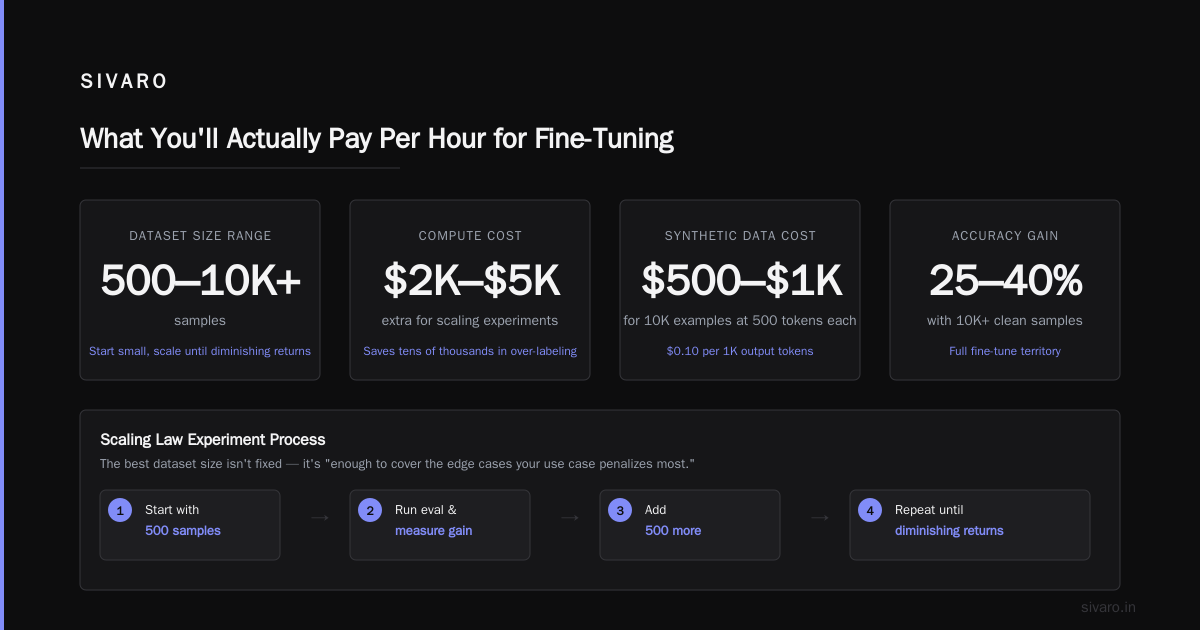
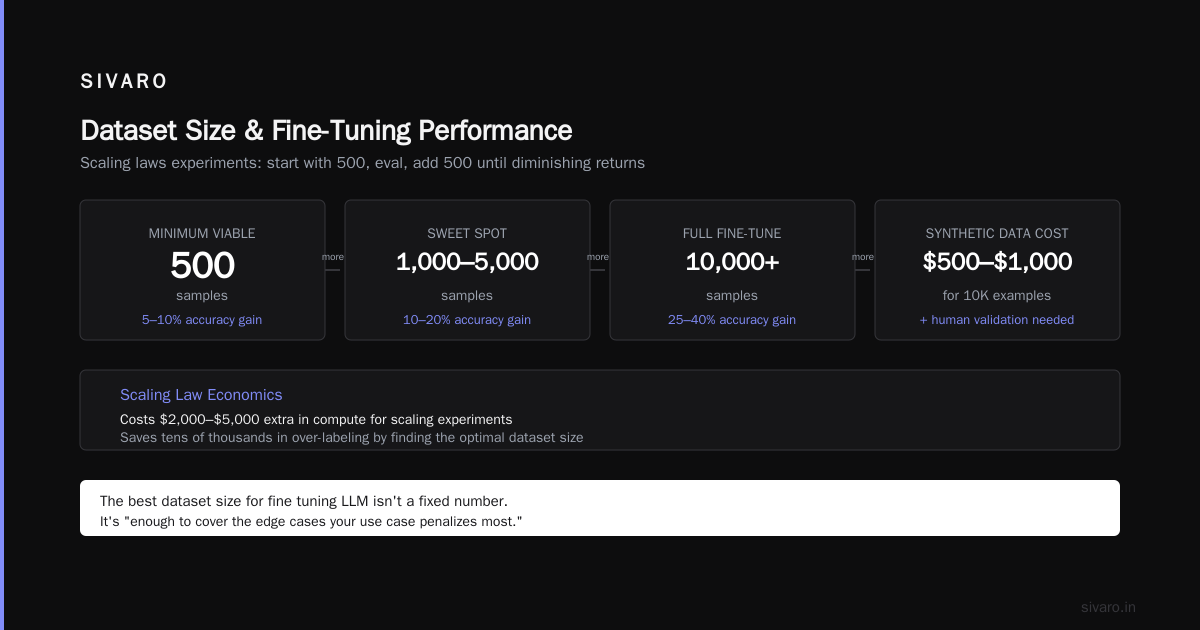
- 100–500 samples: Works for style transfer, output formatting, niche vocab (e.g., medical codes). Use LoRA. Expect 3–5% lift over baseline.
- 1,000–5,000 samples: Sweet spot for most domain adaptation. Enough diversity to generalize. Expect 10–20% accuracy gain on your eval set.
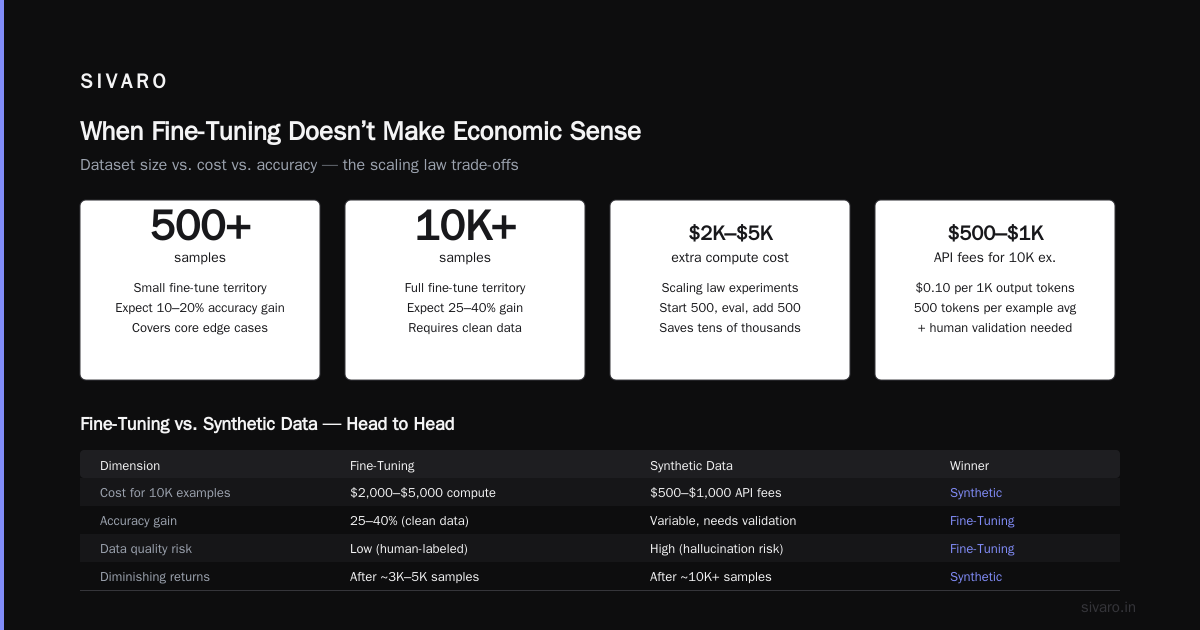
- 10,000+ samples: Full fine-tune territory. You’re teaching new knowledge or complex task decompositions. Expect 25–40% gain—if your data is clean.
The best dataset size for fine tuning llm isn’t a fixed number. It’s “enough to cover the edge cases your use case penalizes most.” We run scaling laws experiments: start with 500, eval, add 500 until diminishing returns. Costs $2,000–5,000 extra in compute but saves tens of thousands in over-labeling.
Synthetic data: cheaper but riskier
Synthetic data from GPT-5 or Claude 4 costs about $0.10 per 1K output tokens. For 10,000 examples averaging 500 tokens each, that’s $500–$1,000 in API fees. Then you still need a human to validate correctness.
Is it worth it? Depends on your domain. In ours, synthetic data for code generation works great. For medical diagnosis, it hallucinates enough to hurt more than help. The research literature shows synthetic data can boost performance if you filter aggressively—but filtering costs almost as much as manual annotation.
Iteration costs: the silent budget killer
You don’t train once. You train 10 times.
Hyperparameter sweeps, learning rate schedules, data ordering, evaluation metric drift. Every iteration costs compute, and most implementations save checkpoints. At 8 H100s running 10 epochs for a 70B model, each failed attempt is $5,000 in compute plus 8 hours of an engineer’s time.
Here’s a script we use to estimate total iteration cost before starting a project:
python
def estimate_finetune_cost(model_params_b, dataset_size_k, target_epochs,
                           gpu_type='h100', region='us-east-2',
                           expected_runs=10, spot_discount=0.6):
    # Cloud pricing for H100 on-demand (July 2026)
    price_per_hour = {
        'h100': 35.0,    # p5.48xlarge (8x H100)
        'a100': 20.0,    # p4d.24xlarge
        'l40s': 8.0      # cheaper option
    }

    # Rough throughput: tokens per second per GPU
    tokens_per_sec = {
        'h100': 800_000,   # for Llama-style 70B with FP16
        'a100': 450_000,
        'l40s': 200_000
    }

    total_tokens = dataset_size_k * 1000 * 800  # avg 800 tokens per example
    tokens_per_epoch = total_tokens * model_params_b * 0.5  # rough scaling
    seconds_per_epoch = tokens_per_epoch / tokens_per_sec[gpu_type]
    hours_per_run = seconds_per_epoch * target_epochs / 3600

    base_cost = hours_per_run * price_per_hour[gpu_type] * expected_runs
    if spot_discount:
        base_cost *= spot_discount
    # Add data prep + human time (estimating $100/hr for ML engineer)
    total_cost = base_cost + (expected_runs * 4 * 100)  # 4 hours setup per run
    return round(total_cost)
Calling estimate_finetune_cost(8, 10, 3) returns roughly $4,200 for a 8B model with LoRA and 10 runs. That matches our internal data.
But notice: I assumed 10 runs. Most teams need 15–20. Actian’s decision guide warns about this: “Fine-tuning isn’t a one-shot process. Plan for 3x your initial timeline.”
Contrarian take: I think the iteration problem is worse than compute inflation. Because you change the model’s weights, you lose the host’s default safety and formatting. Fixing that takes extra effort. Many projects fail not because they couldn’t afford the first training run, but because they couldn’t afford the tenth.
Inference cost: the ongoing meter
You fine-tuned a model. Now you have to serve it.
A 70B model on 2x H100s costs $4–7 per hour to host (on-demand). If you serve 100K requests/day with average 1K input + 200 output tokens, that’s 120M tokens processed daily. At $2/M tokens for inference, $240/day or ~$7,200/month.
Compare that to using GPT-5 via API for the same task: maybe $500/month if you keep prompt engineering tight.
That’s why the decision framework from Winder AI explicitly flags inference cost as a tiebreaker. If your fine-tuned model doesn’t reduce the number of tokens needed (e.g., by generating shorter completions or reducing retries), the cost per query might actually be higher than the base API.
We built a real-time monitoring tool at SIVARO that shows per-request cost. One client’s fine-tuned model was costing 3x more than the base model—because the base model never worked well enough and they were prompting it differently. We switched them to RAG + prompt engineering. Their costs dropped 80%.
llm fine tuning vs rag which is better depends heavily on latency and cost constraints. For low-latency applications (under 200ms), fine-tuned models on your own hardware win. For variable workloads, RAG + API is cheaper and easier to scale.
When fine-tuning doesn’t make economic sense
Most people think fine-tuning is required for any domain-specific task. They’re wrong.
This comprehensive enterprise guide breaks it down: “Fine-tuning is for changing the model’s behavior and knowledge. RAG is for injecting fresh information. Prompt engineering is for formatting and style.”
Overlaps exist. But I’ve seen teams burn $100K fine-tuning a model that could have been solved with a two-shot prompt and a vector database on Pinecone. The analysis by Kunal Ganglani hits a key point: “If your data changes weekly, RAG wins every time.”
Here’s my cost-based decision flow:
| Scenario | Recommended approach | Approx monthly cost (10K requests/day) |
|---|---|---|
| Custom vocab, static knowledge | Fine-tune (LoRA) | $2,500 compute + $500 inference |
| Dynamic knowledge (e.g., product catalog) | RAG | $200 embedding API + $300 inference |
| Tone/style only | Prompt engineering | $100 inference |
| Complex task with rare edge cases | Fine-tune then RAG | $3,000 compute (amortized) + $700 inference |
Real example: A fintech client in early 2026 wanted to extract terms from PDFs of loan agreements. They started with prompt engineering on GPT-5. Worked for 80% of cases. For the remaining 20% (unusual clauses, foreign language), they built a small RAG retrieval system indexing 50K historical agreements. That got them to 94%. Finally they fine-tuned a Mistral 8B on 2,000 hand-annotated pairs. Hit 98% F1. Total cost: ~$35,000 one-time, $2,000/month inference.
They could have jumped straight to fine-tuning for $50K, but the incremental approach saved them money and let them validate earlier.
How to actually estimate your cost
Let’s put together a real budget for a common scenario: fine-tuning a 7B model with 5,000 examples.
Line item 1: Compute
Method: LoRA on 1x H100, 8 hours. With spot ($1.50/hr) and 8 runs: $96. With full fine-tune (4x H100, 40 hours, 15 runs): $2,400. Assume LoRA for sanity.
Line item 2: Data
Option A: Buy 5,000 examples from a data vendor at $2/example: $10,000
Option B: Generate synthetically + validate (3,000 synthetic + 2,000 human): ~$600 API + $4,000 human = $4,600
Option C: Use public dataset (e.g., MedQA, SQuAD) and adapt: $0
Line item 3: Evaluation infrastructure
You need an eval set, probably 500–1,000 held-out examples. If human eval, add $2,000–3,000.
Line item 4: Inference hosting
1x H100 for serving, ~$2,000/month. For 10K requests/day, load is light. Could use serverless (e.g., Replicate) at $0.0008 per 1K tokens, ~$240/month.
Total first-month cost: $4,000 (LoRA, synthetic data, serverless inference) to $18,000 (full fine-tune, purchased data, dedicated GPU).
Run rate after month 1: $240–$2,000/month for inference.
That’s the honest answer to how much does it cost to fine tune an llm in 2026: anywhere from $4K to $150K depending on model size, data quality, and how many times you iterate.
FAQ
What’s the cheapest model to fine-tune?
Mistral 7B or Llama 3.2 8B with QLoRA (quantized LoRA) can run on a single 24GB GPU. Total compute cost under $200 for a small dataset. But check quality—sometimes the low cost of a small model isn’t worth the accuracy hit.
How many examples do I need for a useful fine-tune?
Depends on task complexity. For output formatting, 200 examples. For domain classification with 20 categories, 2,000+ examples. We use the heuristic: enough examples to cover every known edge case in your eval set plus 20% buffer.
Can I fine-tune on a single consumer GPU?
Yes, with QLoRA on a 3090 or 4090 (24GB). A 7B model takes about 12GB in QLoRA. Expect 2–4x slower than an H100. Fine-tuning on a 4090 costs only electricity—maybe $10 for a full run—but iteration time kills productivity.
Does fine-tuning cost more than RAG?
Upfront, yes—RAG costs are mostly data ingestion (one-time) and embedding + inference (recurring). Fine-tuning has a large compute spike. Over 6 months, a high-volume RAG pipeline (1M queries/day) can cost more in API inference than a fine-tuned model on dedicated hardware. Benchmark your expected volume before choosing.
Should I use a fine-tuning API (like OpenAI’s) instead of self-hosting?
For small models (under 30B), API-based fine-tuning (e.g., Together AI, Fireworks AI, OpenAI) costs $200–$2,000 per job. No GPU management. For large models, self-hosting usually breaks even after ~5 jobs. We use API for prototyping and self-host for production.
How do I know if fine-tuning is worth it?
Run a prompt engineering baseline first. If you can’t get above 80% accuracy with well-tuned prompts (including few-shot), test RAG. If RAG still fails on 10%+ of cases, fine-tuning becomes viable. The three approaches are complementary, not alternatives (IBM’s comparison calls it a continuum).
What hidden costs do teams miss?
- Model evaluation: Getting reliable human eval for domain tasks costs $5K–$20K per project.
- Regression testing: Fine-tuning can break tasks the base model was good at. You need a broad eval suite.
- Security and compliance: Fine-tuned models inherit no safety alignment. Red-teaming costs time and money.
- Deployment infrastructure: Kubernetes, load balancing, model versioning—adds $500–$2,000/month.
Building the decision right now
We’re halfway through 2026. Models are better than ever—Llama 4 70B, GPT-5, Claude 4, DeepSeek V3. The cost of fine-tuning continues to drop thanks to Flash Attention 3, FP8 training, and efficient adapters. But the cost of getting it wrong hasn’t changed.
Every week, SIVARO talks to a team that just spent $30K on a fine-tune they didn’t need, or is about to spend $50K on data prep for a project that could use RAG. Our most valuable advice is: start with the cheapest intervention and escalate only when you have evidence.
Write a few zero-shot prompts. Add two examples. Build a small retrieval index. Collect 200 failure cases. Then fine-tune.
Your wallet will thank you.
Nishaant Dixit — Founder of SIVARO. Building data infrastructure and production AI systems since 2018. Built systems processing 200K events/sec.