 SIVARO

How Long Does It Take to Fine Tune a LLM? Real Answers from Production
I spent three months in 2025 helping a healthcare company fine-tune their first LLM. We burned through $40,000 in compute credits. The model was worse than the base GPT-4 we started with.
That failure taught me more than my four successful fine-tunes combined. Here's what I know about timeframes — and what nobody tells you.
Fine-tuning a large language model isn't a single number. It's a range that depends on your data, your model size, your hardware, and your definition of "done." A simple LoRA on a 7B parameter model? Two hours. A full fine-tune of a 70B model on 500K medical records? Two months. Maybe more.
Most people ask "how long does it take to fine tune a llm" and expect a single answer. They're wrong to expect one. The question you should be asking is "how long does it take to fine tune my specific LLM for my specific use case."
I'll give you the ranges I've seen in production. The gotchas that killed other people's timelines. And the exact workflow I use at SIVARO.
The Three Time Horizons of Fine-Tuning
Fine-tuning isn't one step. It's three phases. Each has its own timeframe.
Phase 1: Preparation (2 days to 3 weeks)
Cleaning your data. Formatting it. Running validation. Most people skip this. They should get fired.
Phase 2: Training (30 minutes to 2 weeks)
The actual compute time. Depends on model size, dataset size, and hardware.
Phase 3: Evaluation and iteration (1 day to 4 weeks)
Testing whether it works. Fixing what doesn't. Going back to Phase 1.
Total time? One week for a simple task on an open-source 7B model. Eight weeks for production-grade work on a frontier model.
Let me walk through each.
Phase 1: Data Prep — The Silent Time Killer
You'll spend 60% of your total time on data. Not on training. On data.
I've seen teams spend two weeks formatting 10,000 conversation pairs for a customer support model. I've also seen someone dump raw chat logs into a training script and get garbage out in three hours.
Here's what creates the spread:
How clean is your source data?
- Clean, structured data (think well-maintained SQL tables): 2-3 days
- Raw text dumps, chat logs, PDFs: 1-3 weeks
- Scraped web data: Don't even start unless you have a team
For the healthcare company I mentioned — we had 200GB of clinical notes. That's 2-3 million pages of text. Mixed formatting. Abbreviations from 40 different EHR systems. We spent three weeks just normalizing medication names.
How does format choice affect your timeline?
The OpenAI model optimization guide shows their expected format: messages with role, content, and optional tool calls. But you're not forced into that. Open-source models accept many formats.
For LoRA (Low-Rank Adaptation), you need 100-500 examples minimum. For full fine-tune, 10,000+ if you're starting from base weights. Less if you're continuing training from an instruction-tuned checkpoint.
The data validation step everyone forgets
Write a validation script before you start training. Here's a minimal one I use:
python
def validate_finetune_data(data_path):
    """Quick and dirty check before burning GPU hours"""
    import json

    with open(data_path) as f:
        lines = f.readlines()

    errors = []
    for i, line in enumerate(lines):
        try:
            obj = json.loads(line)
            if "input" not in obj and "messages" not in obj:
                errors.append(f"Line {i}: missing input or messages field")
            if "output" not in obj and "completion" not in obj:
                errors.append(f"Line {i}: missing output or completion field")
        except json.JSONDecodeError:
            errors.append(f"Line {i}: invalid JSON")

    print(f"Total lines: {len(lines)}")
    print(f"Validation errors: {len(errors)}")

    if len(errors) > 10:
        print("FAIL: Too many errors. Fix your data.")
        for e in errors[:5]:
            print(f"  {e}")
    else:
        print("PASS: Data looks clean")
That script has saved me from wasting hundreds of GPU hours. Run it before you queue a job.
Phase 2: Training — Where the Numbers Live
This is what people actually mean when they ask "how long does it take to fine tune a llm." The training run itself.
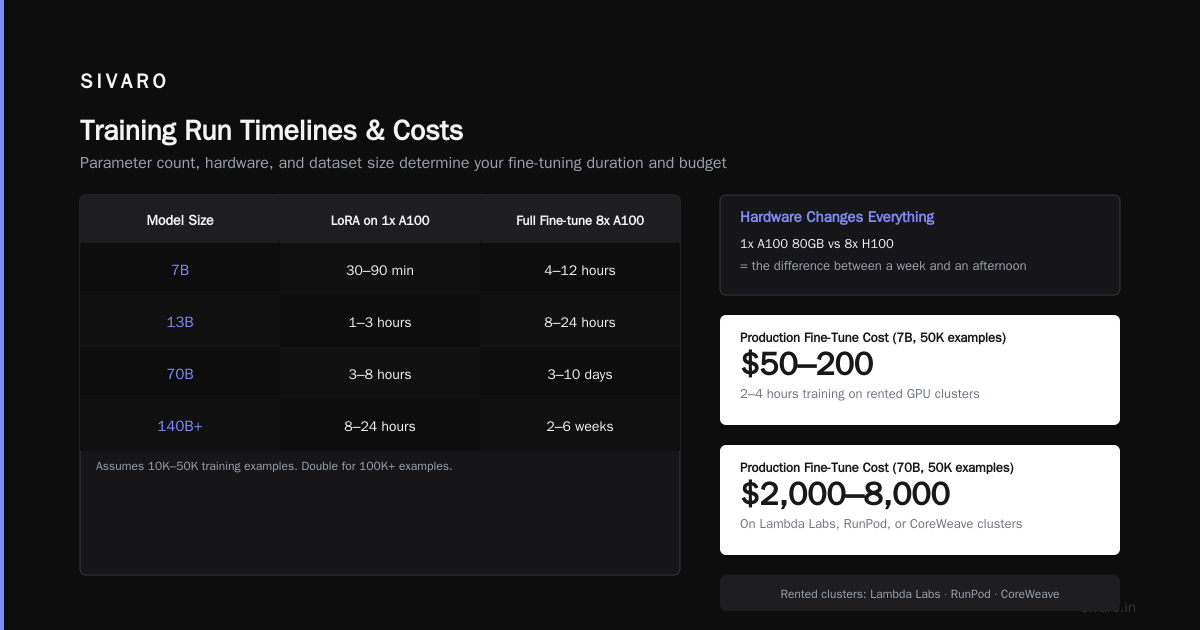
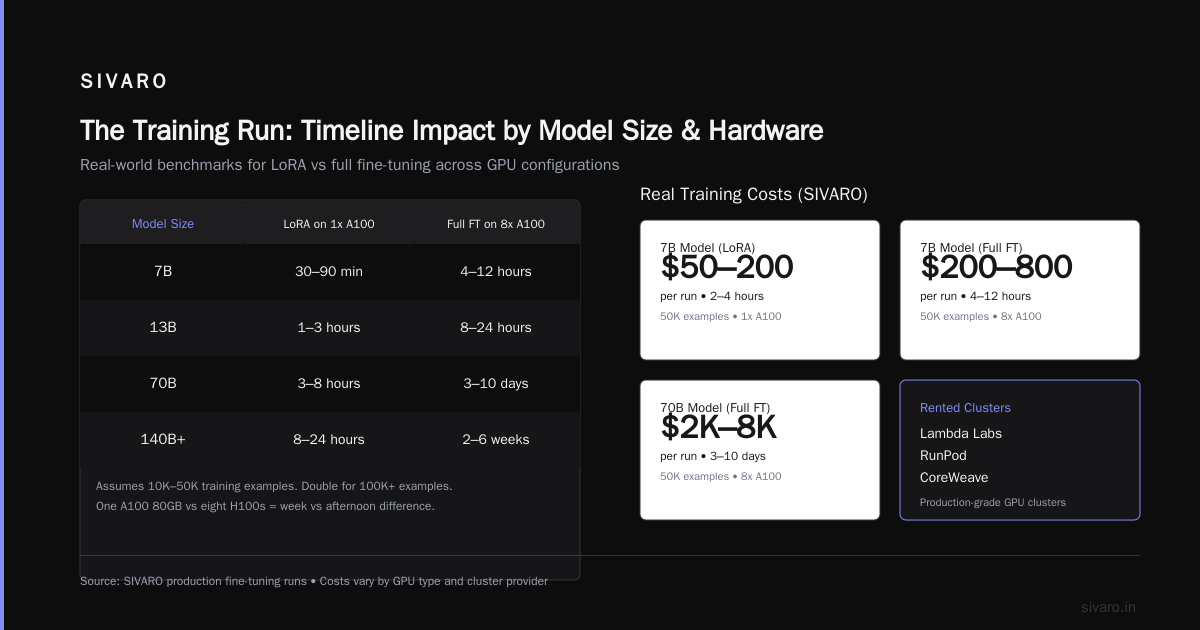
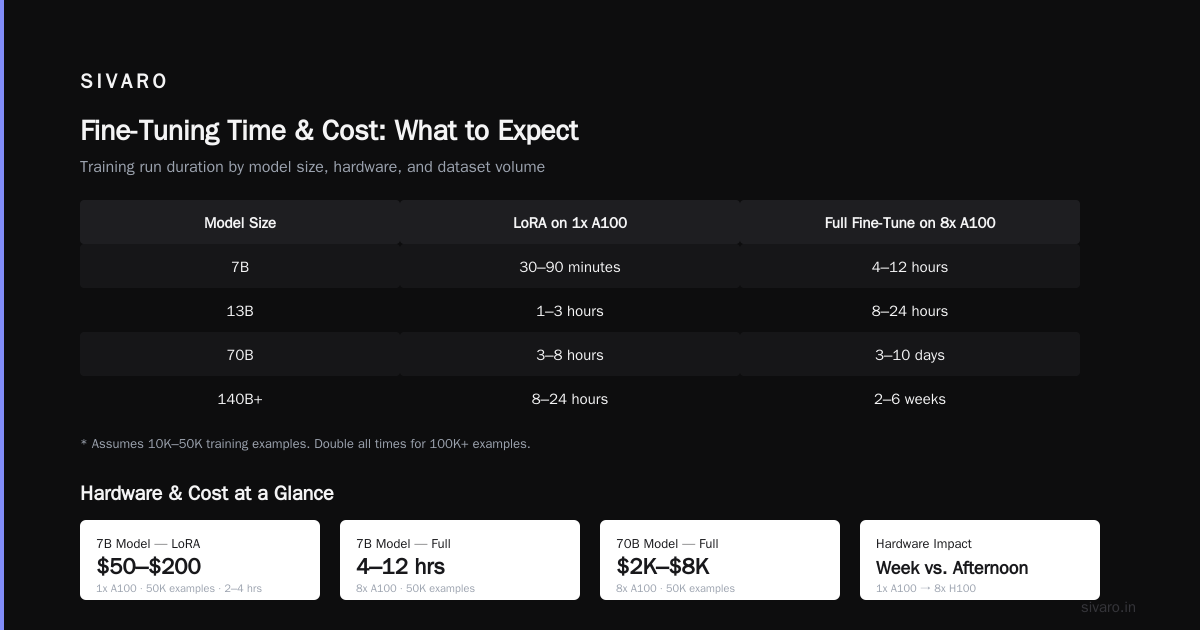
Parameter count is the biggest factor
| Model Size | LoRA on 1x A100 | Full fine-tune on 8x A100 |
|---|---|---|
| 7B | 30-90 minutes | 4-12 hours |
| 13B | 1-3 hours | 8-24 hours |
| 70B | 3-8 hours | 3-10 days |
| 140B+ | 8-24 hours | 2-6 weeks |
These assume 10K-50K training examples. Double them for 100K+ examples.
Hardware dramatically changes your timeline
One A100 80GB vs eight H100s? That's the difference between a week and an afternoon.
At SIVARO, we run on rented clusters. We've used Lambda Labs, RunPod, and CoreWeave. For a production fine-tune of a 7B model with 50K examples, we pay about $50-200 per run depending on GPU choice. That's for 2-4 hours of training.
For a 70B model? $2,000-8,000 per run. And you'll need multiple runs. Budget accordingly.
The data-to-speed relationship isn't linear
Most people think "twice the data means twice the time." It doesn't.
Training time scales roughly linearly with tokens, not examples. If you have 10K short examples (100 tokens each) vs 10K long examples (2000 tokens each), the long ones take 20x longer.
A realistic benchmark from Raphael Bauer's fine-tuning experiments: his 7B model with 10K examples ran for 45 minutes on a single A100. With 100K examples, it ran for 4.5 hours. Roughly linear. But his average example length was 800 tokens. Yours might be different.
LoRA vs full fine-tune: the real time difference
LoRA trains only a small set of adapter weights. Usually 0.1-1% of total parameters. That's why it's fast.
Full fine-tune updates all weights. Much slower. Much more expensive. But sometimes necessary.
When do you need full fine-tune? When the task requires learning genuinely new capabilities, not just style or format. Teaching a model to think step-by-step for medical diagnosis? Full fine-tune. Teaching it to output JSON instead of markdown? LoRA will work fine.
Here's a concrete LoRA training loop I modified from Hugging Face's example:
python
from transformers import AutoModelForCausalLM, AutoTokenizer, TrainingArguments
from peft import LoraConfig, get_peft_model
from trl import SFTTrainer

# Load base model (Mixtral 8x7B in this case)
model = AutoModelForCausalLM.from_pretrained(
    "mistralai/Mixtral-8x7B-Instruct-v0.1",
    device_map="auto",
    load_in_4bit=True
)

# LoRA config — these rank values matter for speed
lora_config = LoraConfig(
    r=16,  # Lower = faster, less quality. Higher = slower, more capacity
    lora_alpha=32,
    target_modules=["q_proj", "v_proj", "k_proj", "o_proj"],
    lora_dropout=0.05,
    bias="none",
    task_type="CAUSAL_LM"
)

# Training args that control speed
training_args = TrainingArguments(
    output_dir="./mixtral-finetuned",
    per_device_train_batch_size=4,
    gradient_accumulation_steps=4,
    num_train_epochs=3,
    learning_rate=2e-4,
    fp16=True,
    logging_steps=25,
    save_steps=500,
    report_to="wandb"
)

trainer = SFTTrainer(
    model=model,
    args=training_args,
    train_dataset=dataset,
    tokenizer=tokenizer,
    dataset_text_field="text",
    max_seq_length=2048
)

trainer.train()
On a single A100 with Mixtral 8x7B (quantized to 4-bit), this runs for about 2-3 hours with 10K examples. Without quantization? 6-8 hours. With 8 GPUs? 45 minutes.
The gradient_accumulation_steps=4 effectively multiplies your batch size without more memory. The per_device_train_batch_size=4 fits because of 4-bit quantization. Baseline without quantization? Batch size of 1. Training time triples.
Phase 3: Evaluation and Iteration — The Infinite Loop
Training done. You have a model. Now the real work starts.
You will run your fine-tune. It will output garbage. You will fix the data. You will run again. Repeat until the model is useful.
How many iterations? For the projects I've run at SIVARO:
- Simple formatting change (output JSON instead of text): 2-3 iterations, 2 days total
- Domain adaptation (teach general model to write medical reports): 8-12 iterations, 3-4 weeks
- Complex reasoning (multi-step financial analysis): 15-20 iterations, 6-8 weeks
Each iteration costs time and money. That 70B model I mentioned? $2,000-8,000 per run. Twelve iterations is $24,000-96,000. And that's just compute. Not counting your team's salary.
The evaluation framework that saves your sanity
Most teams do this wrong. They run the model, read 10 outputs, say "looks good," ship it. Then it fails in production.
Build an eval set before you start training. Not during. Before.
python
def evaluate_model_responses(model, eval_cases):
    """
    Test a model against specific criteria.
    Returns pass/fail for each case with details.
    """
    results = []
    for case in eval_cases:
        prompt = case["prompt"]
        expected_behavior = case["expected"]

        response = model.generate(prompt)

        # Check for specific behaviors
        checks = {
            "format_match": "{" in response and "}" in response if case.get("expects_json") else True,
            "length_ok": len(response.split()) < case.get("max_words", 200),
            "avoids_negation": not any(bad_word in response.lower() for bad_word in
                                      ["i cannot", "i don't know", "as an ai"])
        }

        passed = all(checks.values())
        results.append({
            "case_id": case["id"],
            "passed": passed,
            "failed_checks": [k for k, v in checks.items() if not v],
            "response_preview": response[:200]
        })

    pass_rate = sum(r["passed"] for r in results) / len(results)
    return pass_rate, results
This catches format failures, length violations, and refusal behaviors. Three things that kill production LLM deployments. At Google Cloud's fine-tuning overview, they emphasize this eval-first approach. For good reason.
The Factors That Kill Timelines (But Nobody Advertises)
You will crash your GPU. Multiple times.
Out of memory errors. CUDA kernel failures. Driver version mismatches. CUDA version mismatches. PyTorch version mismatches.
Every production fine-tune I've done has had at least one hardware failure. Usually three.
Budget 20% overhead for "shit broke and I need to restart."
Data distribution shift between training and production
Your training data comes from January. Your production traffic comes from July. User behavior changed. Your fine-tune degrades.
You need to re-fine-tune every 2-4 months. Factor that into your timeline. The Coursera advanced fine-tuning course covers this — but doesn't mention how much it hurts when your CEO asks why the model got worse.
The best open source models to fine tune (as of mid-2026)
My current rankings for production fine-tuning:
- Mistral 7B v0.3 — Best performance-per-compute ratio. Fits on a single consumer GPU (with quantization). 2-3 hour LoRA runs on an RTX 4090. Good for 80% of business use cases.
- Llama 3.1 8B — Better at instruction following than Mistral. Needs more memory. 3-4 hour LoRA runs on an A100.
- Qwen 2.5 32B — Chinese and English both excellent. Underrated for enterprise work. 5-8 hour LoRA runs on 2x A100.
- DeepSeek-V2 — The dark horse. 236B total but uses MoE so only 21B active. Needs multi-GPU. 8-12 hours for LoRA on 4x A100.
Avoid: Falcon (outdated architecture), LLaMA 2 (base is too weak compared to 3.1), and any model below 3 billion parameters for serious work.
How long does it take to fine tune a llm for production — the real answer
For a production system that handles real user traffic:
- Rapid prototype (prove the concept works): 3-5 days
- Production v1 (handles real traffic, meets accuracy bar): 3-6 weeks
- Production v2 (optimized latency, cost, and accuracy): 6-12 weeks
I've seen this at three companies now. The first version always takes longer than you expect. The second version is faster because you already have the eval pipeline and data infrastructure.
When Fine-Tuning Is the Wrong Answer
Here's the contrarian take: most companies should not fine-tune.
If you're reading this thinking "how long does it take to fine tune a llm for my chatbot"... consider RAG (Retrieval Augmented Generation) first.
Fine-tuning teaches the model new behaviors. RAG gives it new information.
If your problem is "the model doesn't know about our internal products" — that's a RAG problem. Build a vector database. Write good retrieval prompts. Done in a week.
If your problem is "the model outputs text in the wrong tone for our brand" — that's a fine-tuning problem. Or maybe just a better system prompt.
A business guide from Stratagem Systems breaks down ROI: fine-tuning costs 10-100x more than prompt engineering for the same improvement. Only pay that premium when prompts can't solve the problem.
So when should you fine-tune? When the model needs to learn a new capability, not just new knowledge. Writing legal documents in a specific structure. Following a reasoning process for medical diagnosis. Generating code in a proprietary language.
Those justify the cost. Making the model friendlier? Write a better prompt.
The Bottom Line on Timeline
Someone asked me this week "how long does it take to fine tune a llm?" I gave them three numbers:
- 2 hours if you already have clean data and a working pipeline
- 3 weeks if you're starting from scratch with a reasonable task
- 3 months if you're doing something genuinely novel
The variable isn't the training. It's the data quality, the evaluation bar, and how many iterations you need.
The ToTheNew LLM fine-tuning guide says most projects fail because teams underestimate data prep. I'd add: they also underestimate how long evaluation takes. Because evaluating an LLM isn't checking if a SQL query runs. It's reading 100 responses and deciding if they pass the smell test. That takes days.
Start with the smallest model that could plausibly work. Use LoRA. Set up your eval first. Run fast iterations.
And for god's sake, validate your data before you queue that training job. Your GPU bill will thank you.
FAQ: How Long Does It Take to Fine Tune a LLM?
Q: What's the absolute minimum time to fine-tune a small model?
A: With a pre-formatted dataset of 100 examples and a 7B model like Mistral on an RTX 4090, you can run a LoRA in under 30 minutes. The total time including setup is 2-3 hours if you know what you're doing.
Q: How long does it take to fine tune a llm on GPT-4?
A: You can't fine-tune GPT-4 itself. OpenAI offers fine-tuning for GPT-3.5 and GPT-4-mini. Their model optimization docs show typical training times of 1-6 hours for GPT-3.5, depending on data size. GPT-4-mini takes 2-8 hours.
Q: Can I fine-tune a model in one day?
A: Yes, if you have clean data and use LoRA on a small model. Full fine-tunes on models above 13B parameters usually need 2+ days just for training.
Q: How long does fine-tuning take on free/cheap hardware?
A: On Google Colab free tier (T4 GPU): expect 4-8 hours for a 7B LoRA with 500 examples. On Colab Pro (A100): 1-2 hours. Consumer hardware (RTX 3090/4090): 1-3 hours for most 7B LoRA jobs.
Q: Why did my fine-tuning take twice as long as expected?
A: Most common reasons: your examples are longer than you thought (check average token count), you're using full precision instead of half-precision (fp16/bf16), or your batch size is 1 because you're out of memory. Check your training logs — the per-step time tells all.
Q: How long before I need to re-fine-tune my model?
A: Every 2-4 months, depending on how fast your domain changes. Customer support models need quarterly updates. Medical coding models can last 6-9 months if guidelines don't change. Always monitor production performance — don't wait for users to complain.
Q: Is it faster to fine-tune or build a RAG system?
A: RAG is always faster to prototype (1-3 days vs 1-3 weeks). But fine-tuning is often faster at inference time (one model call vs retrieval + generation). Total time investment: RAG wins for knowledge tasks. Fine-tuning wins for behavior tasks.
Q: What's the fastest way to get started with fine-tuning?
A: Use Unsloth or Axolotl. Both handle quantization, efficient training, and LoRA setup automatically. You can go from zero to a trained model in about 4 hours with either tool and a curated dataset from Hugging Face.
Nishaant Dixit — Founder of SIVARO. Building data infrastructure and production AI systems since 2018. Built systems processing 200K events/sec.