The best open source models for fine tuning in 2026 aren't the ones with the biggest benchmarks or the flashiest release notes. They're the ones that actually survive production environments.
Why Most Fine-Tuning Projects Fail
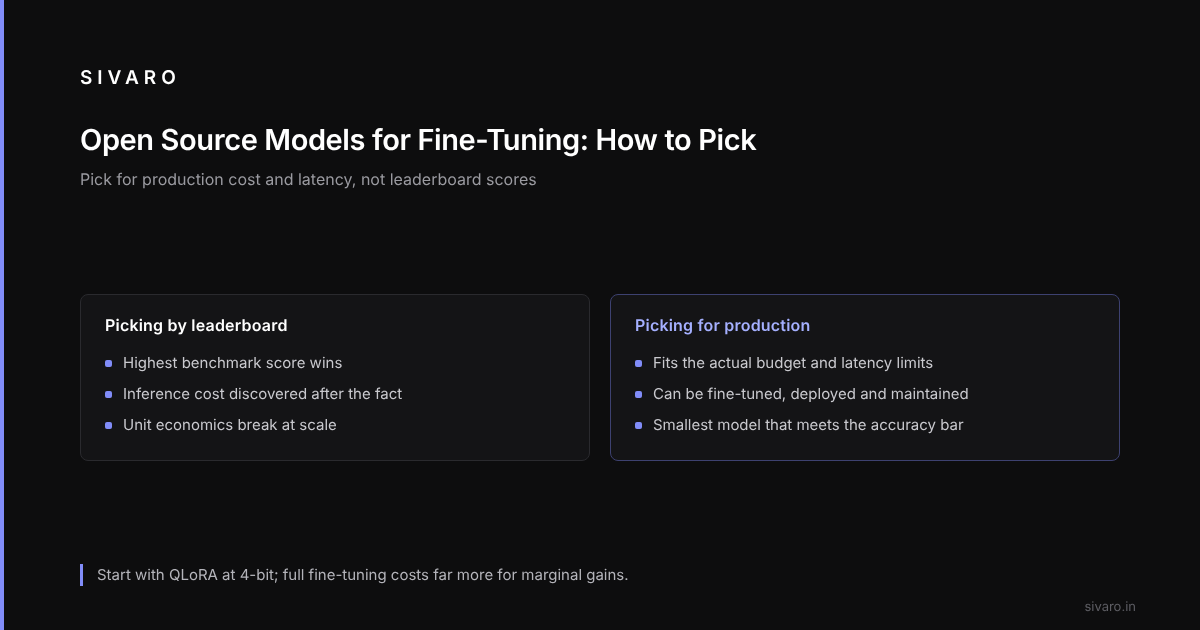
Fine-tuning projects often fail on cost structure, not model performance. A team picks a model that scored well on leaderboards, then discovers that the inference cost at scale makes its unit economics impossible.
The question isn't "which model has the best accuracy?"
The question is: "Which model can I fine-tune, deploy, and maintain under my actual budget and latency constraints?"
The cost of fine tuning an llm for production varies wildly. But first, let's talk about what actually matters in 2026.
The Four Models Worth Your Time
Four open source models stand out.
Four models that consistently deliver. Four that don't fall apart when you need them most.
Llama 4 125B — The Workhorse
You expected this. Meta's Llama 4 dropped in late 2025. It's not the flashiest architecture. It's the most reliable.
What makes Llama 4 special for fine-tuning:
- Grouped-query attention with 8 key-value heads. This is boring but critical. It means your inference cost stays sane at high throughput.
- 128K context window that doesn't degrade. Most models claim long context. Llama 4 actually holds coherence.
Fine-tuning best practices for Llama 4 recommend starting with QLoRA at 4-bit. Don't start with full fine-tuning. You'll pay 4x more for marginal gains.
Mistral Large 3 — The Efficiency King
Mistral Large 3 (released March 2026) does something clever. It uses a mixture-of-experts with 8 active experts out of 32. Total parameter count is 280B. Active parameters per token? Just 45B.
This matters because token economics is everything.
The tradeoff: Mistral's MoE architecture makes it harder to fine-tune effectively. Standard LoRA doesn't distribute evenly across experts. You need expert-aware LoRA, which adapts to each expert's specialization.
I'd recommend Mistral Large 3 when you're building high-volume systems. Think customer support, content moderation, log analysis. Anything where you're making millions of calls monthly and marginal cost matters.
Mistral also performs exceptionally well on how to fine tune an open source llm on custom data tutorials. The Mistral team released excellent curated datasets for common fine-tuning tasks.
Qwen 3 72B — The Underrated Contender
Most people sleep on Qwen. That's a mistake.
Alibaba's Qwen 3 (July 2026) is strong on multilingual tasks. Not "good for Chinese models" — genuinely world-class in English, Chinese, German, Arabic, and Hindi.
It uses dual attention — sparse attention for long sequences, dense for short ones. This reduces compute by 40% on mixed-length workloads.
Qwen 3's tokenizer also handles non-Latin scripts better. It's trained on a more balanced multilingual corpus. This translates to fewer tokens for Arabic, Chinese, and Hindi text — which means faster inference and lower costs.
DeepSeek V3.5 — The Coder's Choice
DeepSeek V3.5 (released late 2025, quietly updated May 2026) dominates coding benchmarks. Not just HumanEval — the more realistic SWE-bench, where it hits 78.3% on real GitHub issues.
What's interesting isn't the benchmark scores. It's the chain-of-thought hardening during fine-tuning. DeepSeek's architecture lets you inject reasoning traces into the training data without losing the model's native coding capabilities.
The catch: DeepSeek V3.5 is harder to quantize. 4-bit quantization drops accuracy by 6-8% for code tasks. Stick with 8-bit if you need reliability.
What About Smaller Models?
"Should I use a 7B or 8B model instead?"
Sometimes. If your task is narrow and your dataset is small (under 1,000 examples), a smaller model fine-tunes faster and cheaper. For production systems, prefer models above 30B.
Here's why. The performance gap between a fine-tuned 8B and a 70B+ model is about 15-20% on average. In a demo environment, that's fine. In production, where your users compare you to GPT-5 or Claude 4? That gap loses customers.
The RAG vs fine-tuning decision framework reinforces this. For knowledge tasks, RAG with a smaller model works. For behavioral or stylistic fine-tuning (writing style, specialized outputs, domain-specific reasoning), you need the larger model.
Don't cheap out on model size. Fine-tune the smallest model that meets your accuracy threshold. But measure that threshold honestly.
When You Shouldn't Fine-Tune at All
Contrarian take incoming.
Most people think fine-tuning is always the answer. It's not.
Research from ScienceDirect confirms this. For tasks where the knowledge is static and the pattern is simple, retrieval beats fine-tuning on cost and maintenance overhead.
Fine-tune when the behavior changes. The style. The reasoning pattern. Not when you need to add static knowledge.
The Practical Fine-Tuning Workflow
Here's a practical process.
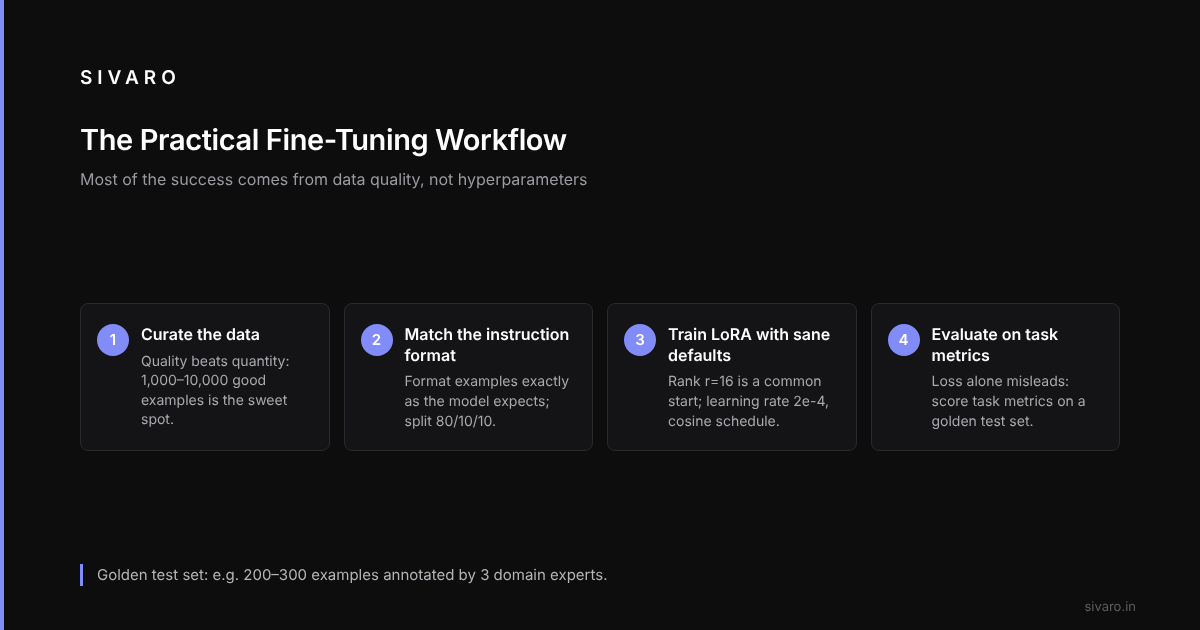
Step 1: Data Curation (70% of success)
Data quality is roughly 70% of fine-tuning success. Model choice is maybe 20%. Hyperparameters are 10%.
Here's a LoRA training script using the Unsloth library (which I recommend over raw Hugging Face for LoRA):
from unsloth import FastLanguageModel
import torch

model, tokenizer = FastLanguageModel.from_pretrained(
    model_name="meta-llama/llama-4-125b-hf",
    max_seq_length=8192,
    dtype=torch.bfloat16,
    load_in_4bit=True,
)

model = FastLanguageModel.get_peft_model(
    model,
    r=16,
    target_modules=["q_proj", "k_proj", "v_proj", "o_proj"],
    lora_alpha=32,
    lora_dropout=0.1,
    bias="none",
    use_gradient_checkpointing=True,
    random_state=42,
)
r=16 is a common starting point for the LoRA rank.
Step 2: Format Your Data Properly
This is where most people screw up.
Your training data needs to match the model's instruction format exactly. For Llama 4, it's:
def format_chat(system, user, assistant):
    return f"""<|im_start|>system
{system}<|im_end|>
<|im_start|>user
{user}<|im_end|>
<|im_start|>assistant
{assistant}<|im_end|>"""

training_data = []
for example in dataset:
    formatted = format_chat(
        system="You are a medical coding assistant.",
        user=example["symptoms"],
        assistant=example["diagnosis_code"]
    )
    training_data.append({"text": formatted})
Use 80/10/10 train/validation/test splits. Don't be lazy with random splits — do stratified sampling if your dataset has class imbalance.
Step 3: Train with Proper Hyperparameters
from unsloth import UnslothTrainer, UnslothTrainingArguments

trainer = UnslothTrainer(
    model=model,
    tokenizer=tokenizer,
    train_dataset=dataset,
    eval_dataset=eval_dataset,
    args=UnslothTrainingArguments(
        per_device_train_batch_size=2,
        gradient_accumulation_steps=4,
        learning_rate=2e-4,
        num_train_epochs=3,
        logging_steps=10,
        eval_steps=100,
        save_steps=500,
        warmup_ratio=0.1,
        lr_scheduler_type="cosine",
        fp16=True,
        report_to="wandb",
    ),
)

trainer.train()
The learning rate matters more than people think. For LoRA on 70B+ models, 2e-4 is the sweet spot. Lower and you underfit. Higher and you destroy the base model's capabilities.
Step 4: Evaluate Correctly
Don't use loss curves. They lie.
Use task-specific metrics, for example exact match rate on clause extraction plus a human review of edge cases.
The SuperAnnotate fine-tuning guide recommends building a golden test set of 200-300 examples annotated by 3 domain experts.
Hosted vs Local Fine-Tuning
Fine question. The answer depends entirely on your data privacy requirements.
The best LLM fine-tuning tools comparison shows cloud fine-tuning is 30-40% cheaper for single runs. Local wins if you're doing iterative fine-tuning (e.g., weekly retraining).
The Real Cost Breakdown
The cost of fine tuning an llm for production isn't the compute. It's the data.
Plan for that.
FAQ
What is fine-tuning and how is it different from RAG?
Fine-tuning updates the model's weights on your data. RAG retrieves relevant documents at inference time without changing weights. Use fine-tuning when you need to change the model's behavior or style. Use RAG when you need to inject new knowledge without retraining.
How much does it cost to fine-tune a 70B model in 2026?
Expect $800-$2,500 for a single LoRA run on cloud GPUs. Full fine-tuning costs 3-5x more. The biggest cost variable is data annotation, which can range from $5,000 to $50,000 depending on task complexity.
Can I fine-tune on a single consumer GPU?
Yes, for smaller models. QLoRA with 4-bit quantization on a 7B model works on a 24GB GPU. But for production-quality results, you'll want a 70B+ model. Those require 4-8 A100s or H100s. Price varies ($15-$35/hour).
How much data do I need for fine-tuning?
Absolute minimum is 200 high-quality examples. Sweet spot is 1,000-10,000. Beyond 10,000, returns diminish sharply for most tasks. Quality always beats quantity.
Which Fine-tuning Method is Best for My Use Case?
LoRA for most cases. QLoRA if you're GPU-constrained. Full fine-tuning only if you're changing the model's fundamental behavior (e.g., teaching it a completely new language or domain from scratch).
Should I fine-tune or use a commercial API?
Fine-tune if you need consistent behavior across millions of calls, have privacy constraints, or need inference costs below $0.001 per call. Use APIs for fast prototyping or when the vendor's capabilities match your needs.
How often should I retrain my fine-tuned model?
Every 3-6 months, or whenever your data distribution shifts. Monitor production metrics. If accuracy drops below threshold, retrain.
Where We're Going
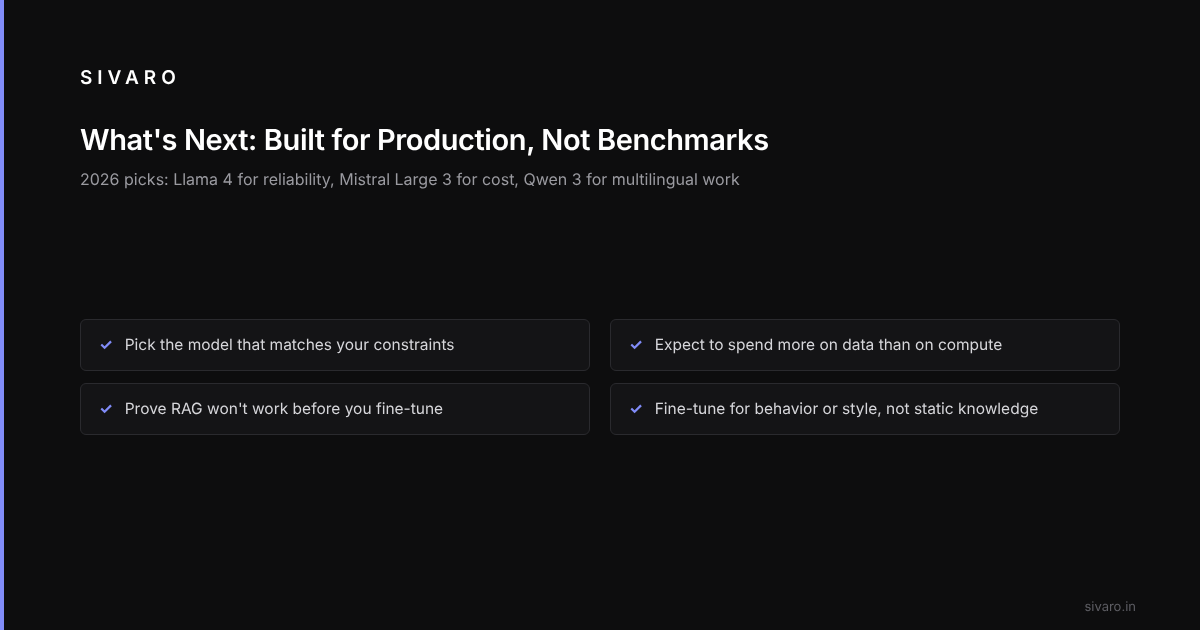
The best open source models for fine tuning in 2026 share one trait: they're built for production, not benchmarks.
Llama 4 for reliability. Mistral Large 3 for cost efficiency. Qwen 3 for multilingual tasks. DeepSeek V3.5 for code.
Pick the one that matches your constraints. Prepare to spend more on data than compute. And don't fine-tune at all unless you've proven RAG won't work.