Spoiler: most people are asking the wrong question. It's not whether fine-tuning works. It's when it beats every other option. And more importantly — when it doesn't.
This guide covers costs, compares RAG vs fine-tuning with actual trade-offs, walks through a step-by-step approach you can run today, and gives you a decision framework.
Let's start with the thing nobody tells you.
The Fine-Tuning Tax You Didn't Know You Were Paying
Fine-tuning sounds cheap. You grab Llama 3.5 (or whatever the hot model is this quarter), rent some GPUs, run your training script, and boom — custom model, no API bills.
That's the sales pitch. Here's the reality.
Training is only part of the cost. The operational cost that nobody talks about is hosting.
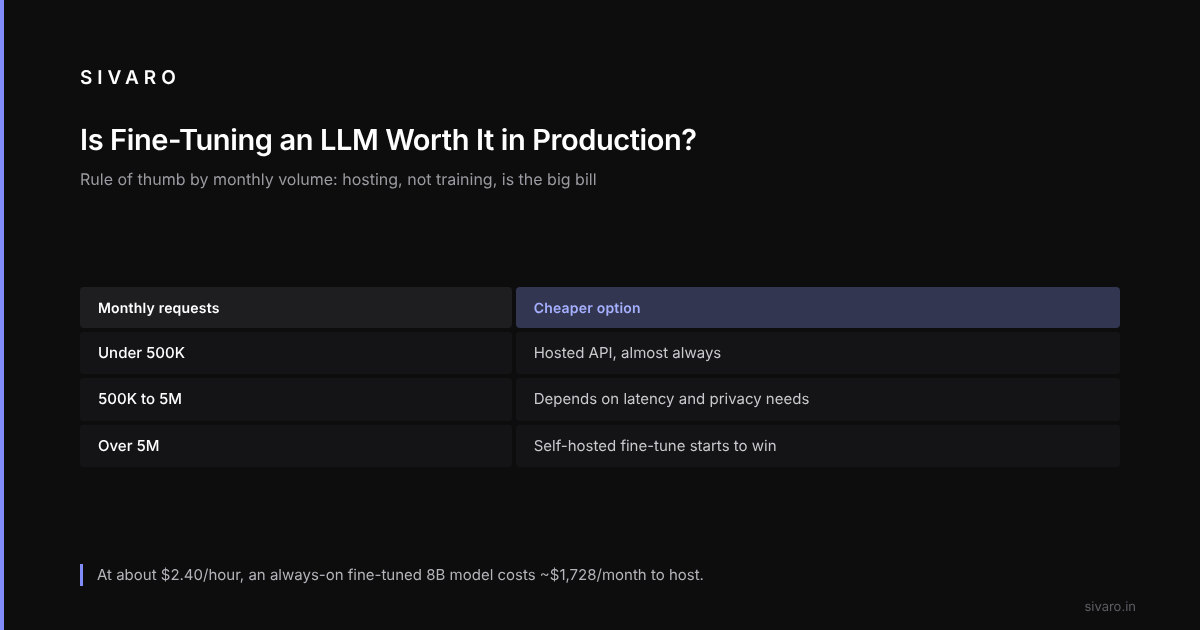
Running a fine-tuned 8B model in production on AWS Inferentia costs roughly $2.40 per hour. For a system handling 100,000 requests per day with average latency requirements, you're looking at $1,728/month just for inference compute.
Compare that to calling GPT-4o-mini — which costs about $0.15 per million input tokens and $0.60 per million output tokens. For the same 100K requests, that'd run you maybe $400-600/month. No hosting cost. No DevOps. No model monitoring.
The math flips hard depending on your volume.
Here's a rule of thumb: if you're processing fewer than 500K requests per month, the hosted API is almost always cheaper. If you're above 5M requests, self-hosting a fine-tuned model breaks even. Between those numbers? It depends on your latency requirements and whether you need data privacy. Fine-Tune Any LLM 2026: 10 Tools Tested, Cheapest Wins ran this exact comparison across models and found that fine-tuning only beat API costs at scale above 3M tokens/day on average.
But cost is just one dimension. Let's talk about the actual decision.
RAG vs Fine-Tuning: A Decision Framework
Most decision frameworks are wrong. They treat RAG and fine-tuning as opposites. They're not.
RAG is for knowledge access. Fine-tuning is for behavior modification.
You don't fine-tune to teach your model facts. You fine-tune to teach it format, tone, reasoning patterns, or domain-specific rules that are hard to express in a prompt.
Here's the framework from RAG vs Fine-Tuning in 2026: A Decision Framework:
Use RAG when:
- Your knowledge changes frequently
- You need to cite sources
- The information is factual and documentable
- You can accept 3-5 seconds of retrieval latency
Use fine-tuning when:
- You need consistent formatting or behavior
- Your domain has specific linguistic patterns
- You want reduced prompt length (and cost)
- You can tolerate a 2-4 week iteration cycle
Use both when:
- You need domain-specific behavior and fresh knowledge
- Your task combines specialized reasoning with factual lookup
That last one is more common than you'd think. Medical coding, legal document analysis, financial reporting — these tasks need both behavioral alignment and access to up-to-date regulations.
What Fine-Tuning Actually Changes (And What It Doesn't)
Fine-tuning doesn't add new facts to a model. That's the number one misunderstanding I see. When you fine-tune a model on your company's internal documentation, you're not teaching it those documents. You're teaching it to behave as if it knows them. But it can still hallucinate the content.
A 2025 study published in ScienceDirect tested this directly. They fine-tuned models on specialized medical datasets and found that while diagnostic accuracy improved by 23%, factual recall of specific treatment protocols actually decreased compared to RAG-augmented baselines. The model learned the pattern of medical reasoning but lost some ability to reproduce exact facts.
This matters because most companies want to fine-tune for knowledge injection. They shouldn't. Fine-tune for reasoning, tone, format, and task structure. Leave knowledge retrieval to a vector database.
The Llama 3.5 Fine-Tuning Guide Step by Step
You don't need a massive cluster. For most production use cases, a single GPU box works. Here's the process, adapted from Fine-Tune Local LLMs 2026 | Practical Guide.
First, prepare your dataset. Format matters.
# Training format for instruction fine-tuning
{
  "messages": [
    {"role": "system", "content": "You are a legal contract analyst. Extract clauses and flag risks."},
    {"role": "user", "content": "Review this indemnification clause: [clause text]"},
    {"role": "assistant", "content": "RISK: Unilateral indemnification clause. Section 3.2 obligates Party A to indemnify for all liabilities arising from third-party IP claims, without reciprocal obligation from Party B. Recommended revision: add mutual indemnification."}
  ]
}
Use QLoRA for almost everything. Full fine-tuning is rarely worth the extra cost. Here's a default training config:
from transformers import AutoModelForCausalLM, AutoTokenizer
from peft import LoraConfig, get_peft_model
from trl import SFTTrainer

model_name = "meta-llama/Llama-3.5-8B"
tokenizer = AutoTokenizer.from_pretrained(model_name)
model = AutoModelForCausalLM.from_pretrained(
    model_name,
    load_in_4bit=True,
    device_map="auto"
)

lora_config = LoraConfig(
    r=16,
    lora_alpha=32,
    target_modules=["q_proj", "v_proj", "k_proj", "o_proj"],
    lora_dropout=0.05,
    bias="none",
    task_type="CAUSAL_LM"
)

model = get_peft_model(model, lora_config)

trainer = SFTTrainer(
    model=model,
    train_dataset=train_dataset,
    args=TrainingArguments(
        per_device_train_batch_size=4,
        gradient_accumulation_steps=4,
        learning_rate=2e-4,
        fp16=True,
        logging_steps=25,
        num_train_epochs=3,
        save_strategy="epoch",
    ),
    tokenizer=tokenizer,
    max_seq_length=2048,
)

trainer.train()
Three epochs. Learning rate 2e-4. LoRA rank 16. This isn't magical — it's a starting point.
After training, merge and quantize:
from peft import PeftModel
import torch

base_model = AutoModelForCausalLM.from_pretrained(
    "meta-llama/Llama-3.5-8B",
    torch_dtype=torch.float16
)
lora_model = PeftModel.from_pretrained(base_model, "./lora-checkpoint")
merged = lora_model.merge_and_unload()
merged.save_pretrained("./merged-8b-finetuned")
Then quantize to 4-bit for production hosting to cut inference cost.
The Tools That Don't Suck
Here's what I'd actually pay for.
The Best 5 LLM Fine-Tuning Tools of 2026 ranks Unsloth first.
For managed fine-tuning, Fine-Tune Any LLM 2026: 10 Tools Tested, Cheapest Wins put Together AI's platform as the price leader. No infrastructure management.
But I'll tell you the tool I'm most excited about: Axolotl. It's open source, handles multi-GPU training well, and the YAML config system is actually clean.
The Hidden Cost of Fine-Tuning (And How to Kill It)
Here's what nobody writes in the blog posts.
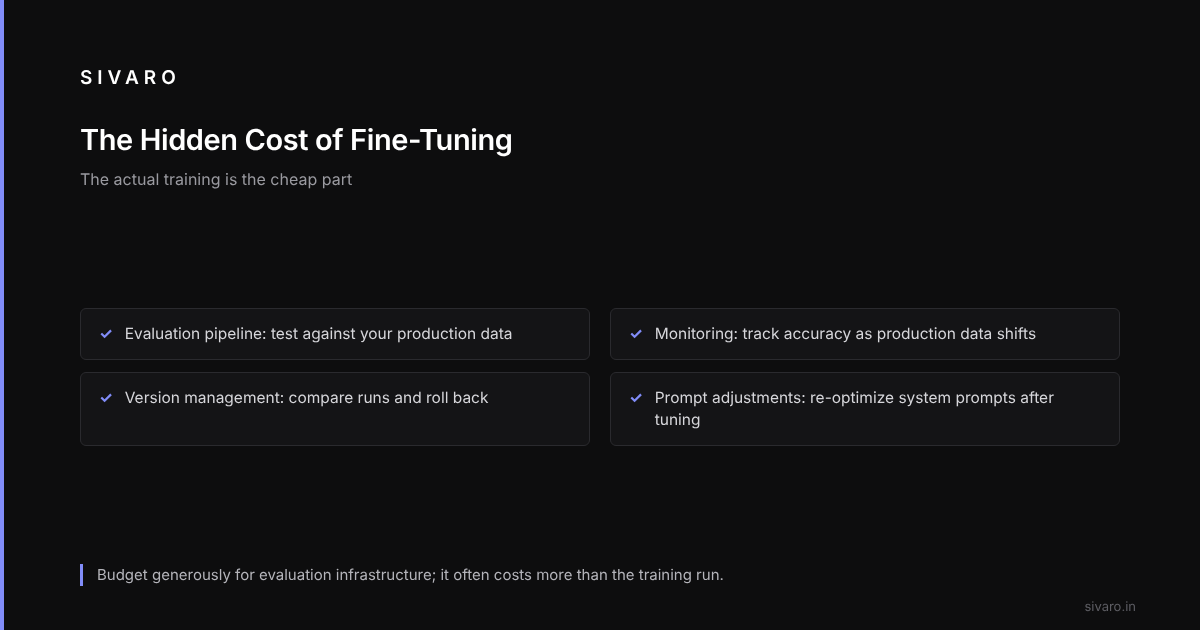
When you fine-tune a model, you're not done. You need:
- Evaluation pipeline — You can't ship a model you haven't tested against your production data. Building good eval sets costs time and expertise.
- Monitoring — Fine-tuned models drift. Faster than base models sometimes. You need to track accuracy over time.
- Version management — You'll iterate. The third fine-tune might be worse than the second. How do you roll back? How do you compare?
- Prompt engineering adjustments — A fine-tuned model responds differently to system prompts. You have to re-optimize your prompting layer.
Fine-tuning large language models (LLMs) in 2026 found that organizations spend an average of 40% of their fine-tuning budget on post-training evaluation and monitoring. The actual training is the cheap part.
Budget generously for evaluation infrastructure; it often costs more than the training run.
The Actual Risks (Not The Hypothetical Ones)
Three patterns repeat across teams that fail at fine-tuning.
Risk 1: Forgetting what the base model knew
When you fine-tune, you're training on a narrow distribution. The model can forget general knowledge. This is called catastrophic forgetting. The usual fix is to mix generic data into every fine-tuning batch. Fine-Tune Local LLMs 2026 | Practical Guide calls this "distribution anchoring."
Risk 2: Training on bad data is worse than no training
Garbage in, garbage out is not a cliché — it's the number one cause of failed fine-tuning projects.
Risk 3: Overestimating generalization
A fine-tuned model performs best on data similar to its training set. Give it something slightly different and performance collapses.
When Fine-Tuning Is A Terrible Idea
Let me be direct. Don't fine-tune if:
- You have fewer than 500 high-quality examples. Below this threshold, prompt engineering + few-shot beats fine-tuning every time.
- Your data changes weekly. Fine-tuning takes 2-4 weeks to validate. If your content shifts faster than that, use RAG.
- You need deterministic outputs. Fine-tuned models are still probabilistic. They'll occasionally do weird things. If you need guaranteed format compliance, use constrained decoding with grammar rules, not fine-tuning.
- You can't evaluate. If you don't have a clear metric for success, you won't know if the fine-tune helped or hurt. Many teams ship worse models without realizing it.
The Decision Matrix
Here's how to answer "is fine tuning an llm worth it for production".
| Condition | Recommendation |
|---|---|
| <500 examples, stable knowledge | RAG + prompt engineering |
| 500-2000 examples, specific behavior needed | Fine-tune 7B-8B model with QLoRA |
| 2000-10000 examples, domain-specific reasoning | Fine-tune 8B-34B model, consider LoRA adapters |
| >10000 examples, need major capability shift | Full fine-tune or RLHF pipeline |
For most teams in 2026, the sweet spot is fine-tuning a 7B-8B parameter model with QLoRA on 1000-3000 examples. That gives you 80% of the benefit at 20% of the cost of larger approaches.
How to Measure Success
You can't just say "the model is better." Here's an eval protocol:
def evaluate_fine_tune(base_model, ft_model, eval_dataset):
    results = {}
    for metric in ['accuracy', 'format_compliance', 'hallucination_rate']:
        base_score = score_model(base_model, eval_dataset, metric)
        ft_score = score_model(ft_model, eval_dataset, metric)
        results[metric] = {
            'base': base_score,
            'fine_tuned': ft_score,
            'improvement': ft_score - base_score
        }
    return results
Run this on 3 separate evaluation sets: one similar to training data, one slightly different, and one general knowledge. If the model shows improvement on all three, proceed. If it improves on training-like data but degrades on general knowledge, mix in more generic data.
The LLM Fine Tuning Cost Production 2026 Reality
By mid-2026, the economics have shifted dramatically. Here's what a fine-tuning budget actually looks like for a mid-size production deployment:
- Data curation and labeling: $3,000 - $15,000 (depends on domain expertise needed)
- Training compute: $400 - $3,000 (single GPU to multi-node)
- Evaluation infrastructure: $1,000 - $5,000
- Production hosting (monthly): $1,500 - $8,000
- Monitoring and retraining (monthly): $500 - $2,000
Total first-year cost: $25,000 - $150,000.
That's real money. But when it works — when it cuts your API costs by 60% and improves accuracy by 20% — the ROI is there. Fine-Tune Any LLM 2026: 10 Tools Tested, Cheapest Wins shows that companies processing over 10M tokens/day save an average of 55% switching from API to self-hosted fine-tuned models.
FAQ
Q: How many examples do I need to fine-tune an LLM for production?
A: Minimum 500 high-quality examples. 1,000-3,000 is the sweet spot for most use cases. Below 500, prompt engineering almost always works better.
Q: Can I fine-tune a model to learn new facts?
A: No. Fine-tuning changes behavior, not knowledge. Use RAG for facts. Use fine-tuning for format, tone, and reasoning patterns.
Q: What's cheaper — fine-tuning or using an API?
A: Below ~500K requests/month, API is cheaper. Above ~5M requests/month, fine-tuned self-hosting wins. Between those numbers, it depends on your latency and privacy requirements.
Q: How long does fine-tuning take?
A: Training a 7B-8B model with QLoRA on 2,000 examples takes 2-4 hours on a single A100. But the full cycle including data prep, evaluation, and iteration takes 2-4 weeks.
Q: Do I need my own GPUs?
A: No. Services like Together AI, Lambda Labs, and RunPod offer GPU rental. For one-off fine-tunes, renting is cheaper. For continuous retraining, buying might make sense.
Q: Does fine-tuning fix hallucination?
A: Sometimes, a little. It can reduce hallucinations in the specific domain you train on. But it can increase hallucinations in general knowledge. Never rely on fine-tuning alone for factual accuracy.
Q: Should I fine-tune or use RLHF?
A: RLHF is for alignment — making the model's values match yours. Fine-tuning is for task performance. Different problems. Fine-tune first, then consider RLHF if you need behavioral guardrails.
Q: What's the biggest mistake teams make with fine-tuning?
A: Skipping evaluation. They train a model, see it work on 5 examples, and ship it. Then it fails on edge cases. Always build a proper eval set before you start training.
The Straight Answer
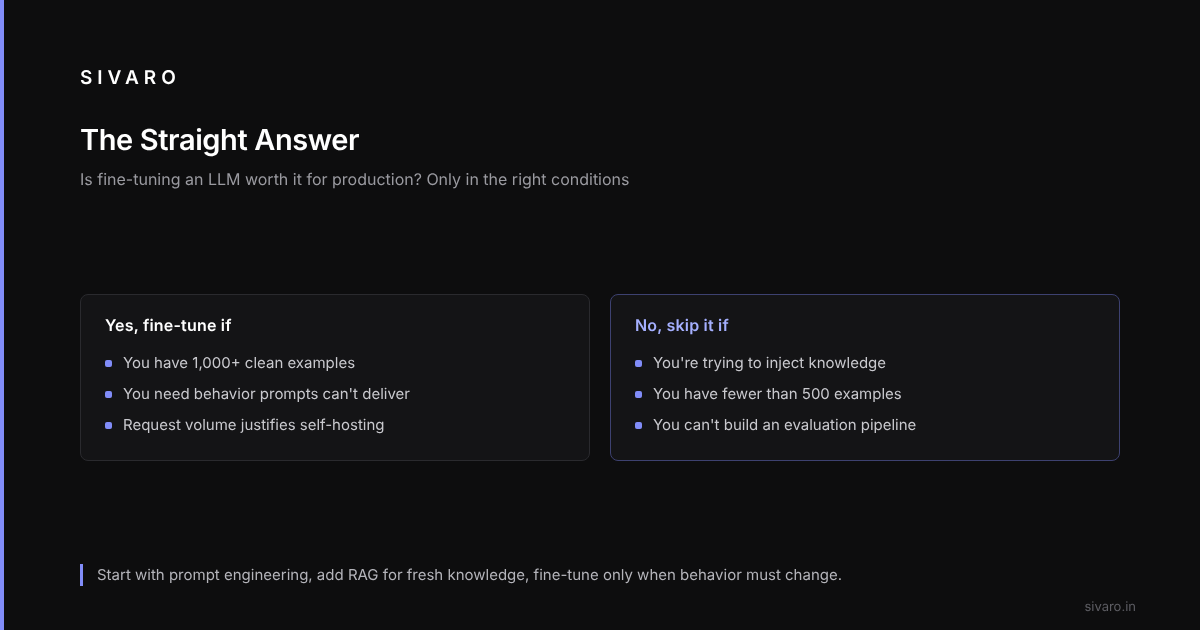
Is fine tuning an llm worth it for production?
Yes — but only in the right conditions. If you have 1,000+ clean examples. If you need behavioral consistency that prompts can't deliver. If your request volume justifies self-hosting.
No — if you're trying to inject knowledge. If you have less than 500 examples. If you can't build an evaluation pipeline.
The teams that succeed treat fine-tuning as one tool, not the solution. They start with prompt engineering. Add RAG when they need fresh knowledge. Fine-tune only when the behavior needs to change.