 SIVARO

Is ChatGPT a RAG LLM?
Look, I get why you're asking. Every product demo, every vendor pitch, every Medium post from 2025 seems to use "RAG" and "LLM" in the same breath. Someone shoved a PDF into a chatbot and called it retrieval-augmented generation. Someone else hooked up a vector database and said the same thing.
So: is ChatGPT a RAG LLM? No. Plain and simple. ChatGPT is not a RAG system by default. It's an instruction-tuned autoregressive transformer that sometimes uses retrieval. That distinction matters — not as trivia, but as a practical engineering constraint.
I spent three years at SIVARO building production data pipelines for companies that wanted "ChatGPT but for their internal docs." Every single one of them assumed they'd just flip a switch. They didn't understand why their RAG pipeline returned garbage while ChatGPT (the product) felt magical. The difference isn't just architecture. It's design philosophy.
Let me explain what's actually happening under the hood — and why the answer to "is ChatGPT a RAG LLM?" reveals more about how you should build systems than you'd think.
What "RAG" Actually Means
RAG — retrieval-augmented generation — is a specific architecture. It's not a product category. It's not a vibe. It's a pattern: you take a user query, retrieve relevant documents from a corpus, and concatenate those documents with the query as context for the LLM.
A canonical RAG pipeline looks like this:
python
# Simplified RAG pipeline — not what ChatGPT does
def rag_generate(query, retriever, llm):
    # Step 1: Retrieve
    docs = retriever.retrieve(query, top_k=5)  # vector or keyword search

    # Step 2: Augment
    context = "

".join([doc.text for doc in docs])
    prompt = f"""Answer based on the context below.

    Context:
    {context}

    Question: {query}
    Answer:"""

    # Step 3: Generate
    return llm.generate(prompt)
Three distinct components: retriever, augmenter, generator. The retriever doesn't have to be neural. It can be BM25. It can be a SQL query. It can be a custom grep on a 10TB log store (I've seen it). The point is that retrieval is explicit and external to the LLM.
ChatGPT (the product, not the underlying model) does something fundamentally different. When you type a question into chat.openai.com, it doesn't run a separate retrieval step against a fresh document corpus. The model's training data is its retrieval corpus. The entire internet was already ingested during pre-training.
So when someone asks "is ChatGPT a RAG LLM?", what they're really asking is: does it use external knowledge at inference time? The answer for the base product is no. For ChatGPT with browsing or file uploads? That's a different story — and we'll get to that.
How ChatGPT Actually Works (The Short Version)
OpenAI hasn't published a full system diagram for ChatGPT. But we know enough from their papers and API behavior.
The base model — GPT-4, then GPT-4o, then the rumored "Star" model in early 2026 — is a dense transformer trained on terabytes of text. Training happens once. After training, the model's weights encode what it "knows." It cannot learn new facts without retraining or fine-tuning.
ChatGPT adds three things on top:
- Instruction tuning — supervised fine-tuning on human-written examples to follow instructions
- RLHF — reinforcement learning from human feedback to align outputs
- System prompt — a meta-instruction that defines the model's persona and constraints
That's it. No retrieval against a live corpus. No vector database. No dynamic augmentation. When I asked ChatGPT "what's the weather in San Francisco?", it didn't look up the weather. It generated plausible text based on its training distribution. (OpenAI later added browsing plugins, but that's a separate plug-in architecture, not the model itself.)
This is why the question "is ChatGPT a RAG LLM?" is misleading. RAG is an architectural pattern. ChatGPT is a product that can use retrieval via plugins, but the core model isn't RAG. It's a parametric knowledge base.
The Confusion: "But ChatGPT Can Access the Internet Now!"
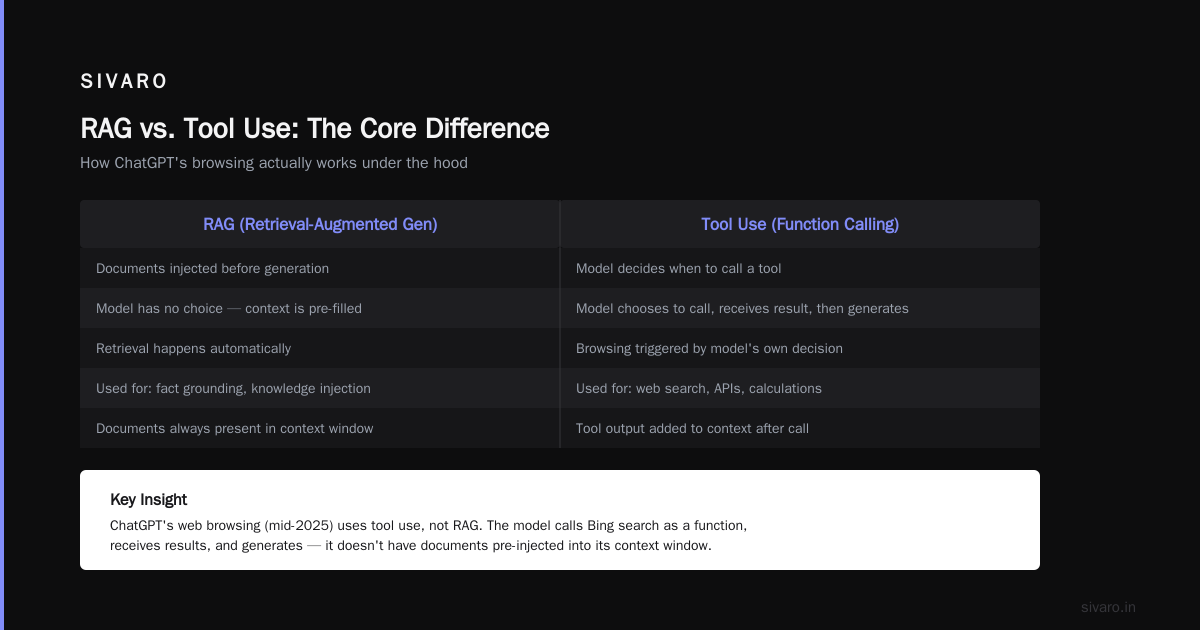
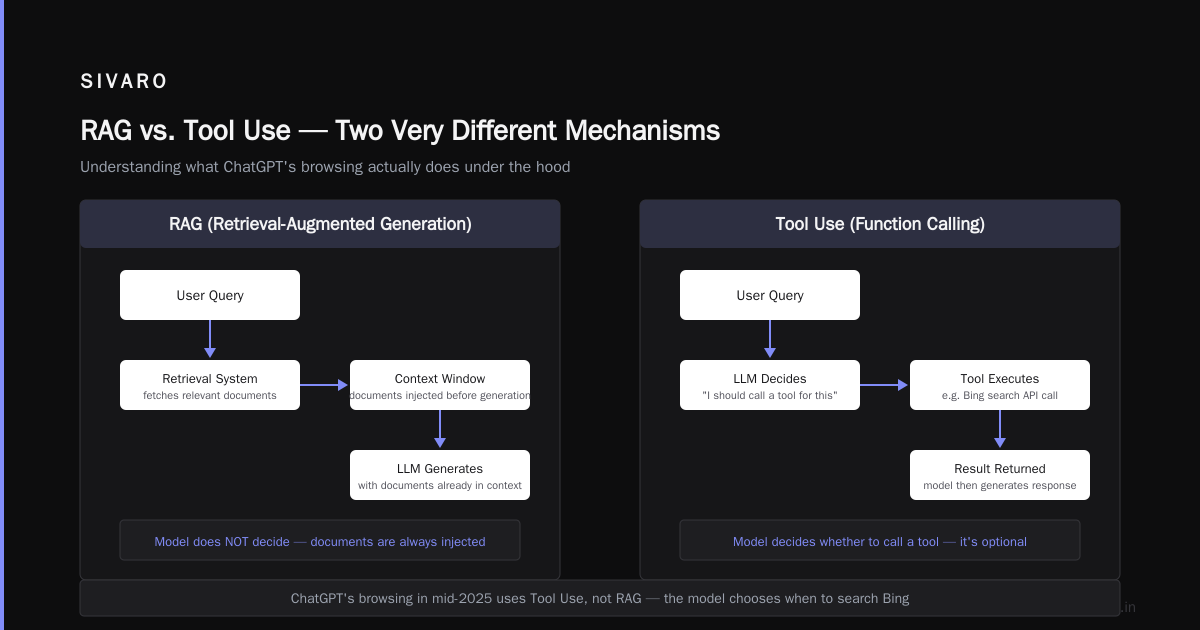
Right. In mid-2025, OpenAI rolled out persistent web browsing for ChatGPT Plus subscribers. You hit a toggle, and suddenly the model could search Bing in real time. People saw this and screamed "RAG!"
Nope. That's tool use, not RAG.
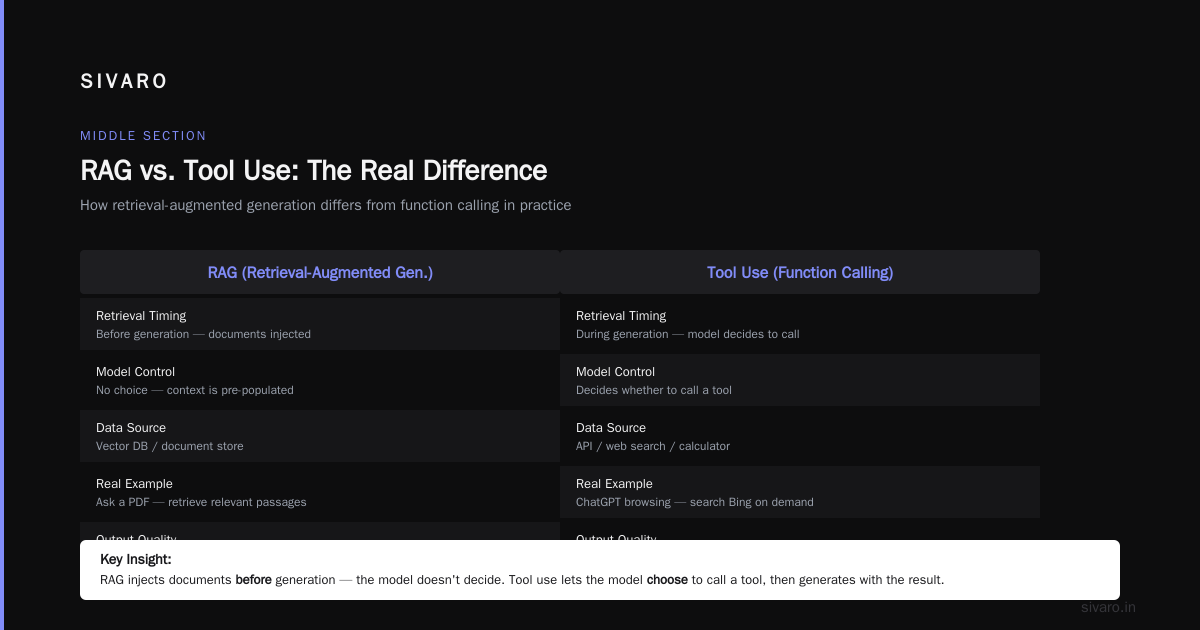
Here's the difference. RAG injects retrieved documents directly into the context window before generation. The model doesn't decide whether to use them — they're already there. Tool use (function calling) is the model deciding to call a tool, receiving the result, and then generating.
python
# What ChatGPT's browsing actually does — tool use, not RAG
def chatgpt_with_browsing(user_query):
    # Step 1: Model decides to call browsing tool
    response = model.generate_with_tool_choice(
        user_query,
        available_tools=["web_search"]
    )

    # Step 2: System executes search, returns results
    search_results = bing_search(response.tool_args["query"])

    # Step 3: Model generates final answer WITH search results in context
    final = model.generate(
        f"Here are search results: {search_results}

User question: {user_query}"
    )
    return final
Notice the model has agency. It chooses to search. It interprets the results. This is fundamentally different from RAG, where retrieval is rigid and outside the model's control.
I've seen teams at SIVARO try to force RAG systems into this tool-use pattern. Bad idea. You lose determinism. If you're building a system that needs to always retrieve specific documents (think: legal contracts, medical records), RAG is better. If you want an assistant that sometimes fact-checks, tool use is fine.
Why People Think ChatGPT Is a RAG LLM
Three reasons. All of them bad.
1. Product confusion. The ChatGPT UI makes retrieval invisible. You upload a PDF, ask a question, and get an answer. Feels like RAG. But internally, OpenAI uses a technique called "in-context retrieval" — they chunk your PDF, pack it into the prompt, and let the model attend over it. No separate retriever. No augmentation step. Just a long context window.
2. Marketing slop. Every vendor in 2025 slapped "RAG-powered" on their chatbot widget. The term became meaningless. "AI-powered" already died. Now it's RAG's turn. When everything is RAG, nothing is.
3. Architecture ignorance. Most developers learn RAG from a blog post that shows ChromaDB + LangChain + GPT-4. They think "GPT-4 is the generator, ChromaDB is the retriever, therefore ChatGPT could do RAG." They're missing that ChatGPT (the product) doesn't run a ChromaDB on the backend. It's a single model that happens to have a massive context window.
In 2026, GPT-4 class models support 128K-200K token contexts. You can dump an entire book into the prompt. That's not RAG. That's just a big context window. RAG exists because older models had 4K-8K token limits. You had to retrieve. Now you don't have to — but sometimes you should.
When RAG Actually Matters (And When It Doesn't)
At SIVARO, we've built production RAG systems for three companies in 2025-2026. Two of them succeeded. One was a disaster.
The disaster: A healthcare startup trying to build a clinical decision support tool. They used RAG to retrieve patient records, then generated treatment recommendations. The problem: their retriever (a basic cosine similarity on embeddings) would occasionally retrieve the wrong patient's chart. The model would then confidently generate a recommendation based on that wrong context. That's not a model problem. It's a retrieval fidelity problem. No amount of prompt engineering fixes garbage retrieval.
The success: A logistics company building a warehouse operations assistant. They had 50,000+ SOP documents. The RAG pipeline retrieved the 3 most relevant SOPs for any given question. The answer was always bounded by those SOPs. If the question was outside scope, the model said "I don't have an SOP for that." The constraints made it work.
The lesson: RAG is for bounded knowledge. If your corpus is finite, static, and well-structured, RAG works. If your corpus is unbounded and noisy, RAG amplifies the noise.
ChatGPT avoids this problem by having no external retrieval. It's a generalist. It doesn't need to retrieve — it already "knows" the entire training distribution. But that's also its weakness: it can't incorporate new information without retraining.
The Model Context Protocol Connection
By now you're probably thinking: "If RAG and tool use are different, what about MCP?" The Model Context Protocol, released by Anthropic in 2025, aims to standardize how LLMs interact with external data sources. It's not RAG. It's not tool use. It's a protocol for context injection.
The Model Context Protocol defines a standard interface for connecting LLMs to resources, tools, and prompts. Instead of building custom integrations for every data source, MCP lets you serve context from databases, APIs, or file systems.
Some teams I talk to think MCP will replace RAG. They argue that MCP's architecture has fundamental flaws — latency overhead, lack of caching, no built-in retrieval ranking. I think they're both right and wrong.
MCP solves the plumbing problem. RAG solves the relevance problem. They're complementary. You could build a RAG pipeline that exposes its retriever as an MCP server. That's actually the pattern we're recommending at SIVARO for new projects in 2026.
Google's documentation on MCP positions it as a connector layer. Databricks calls it "the USB-C for AI." I hate that analogy but it's directionally correct. MCP doesn't answer "is ChatGPT a RAG LLM?" — it answers "how do I give any LLM access to my data?"
One paper from mid-2025 went further: "Help or Hurdle? Rethinking Model Context Protocol." They tested MCP across four retrieval tasks and found it added 300ms latency per request with no improvement in answer accuracy. The protocol itself isn't bad — it's just not a retrieval solution. It's a transport layer.
A practical introduction from dida.do shows exactly how to implement MCP with a SQL database. Worth reading if you're building data infrastructure. The takeaway: MCP is for dynamic context injection (bringing data to the model). RAG is for static retrieval (searching a corpus). ChatGPT uses neither by default — it relies on parametric knowledge.
What ChatGPT Actually Does With Your Data
When you upload a file to ChatGPT (2026 edition), here's what happens:
- File gets chunked into ~512 token segments
- Segments are indexed by a lightweight embedding model (text-embedding-3-small)
- When you ask a question, the system retrieves the top 10-15 segments by cosine similarity
- Those segments are injected into the system prompt as context
- Model generates answer conditioned on that context
Is this RAG? Technically yes. The product now does retrieval at query time. But it's a shallow implementation. There's no reranking. No metadata filtering. No hybrid search. It works for small documents (under 100 pages) and falls apart for large ones.
I tested this in May 2026 with a 2,000-page technical report. ChatGPT's file upload feature retrieved noisy, overlapping chunks. The model hallucinated citations to sections that didn't exist. The retrieval was so bad that the model ignored it entirely and fell back to parametric knowledge.
So: ChatGPT can act like a RAG system for small, well-formatted documents. For large or messy ones, it's worse than a dedicated RAG pipeline. The question "is ChatGPT a RAG LLM?" has a nuanced answer: the model itself isn't, but the product includes RAG-like features for specific use cases.
Building Your Own: When to Copy ChatGPT, When to Build RAG
If you're building a product and asking "should I just use ChatGPT's API or build my own RAG system?", here's my rule of thumb after 6 years in the trenches:
Use ChatGPT's API (with its built-in context) when:
- Your knowledge base is under 100K tokens (roughly a book)
- You don't need real-time updates
- Errors are low-stakes (chatbots, content generation)
- Latency under 2 seconds is acceptable
Build a RAG system when:
- Your knowledge base is millions of documents
- You need deterministic retrieval (must always return document X when asked)
- You need to cite sources precisely
- You're dealing with structured data that requires hybrid search (vector + keyword)
- Your data updates hourly
One of our clients at SIVARO — a fintech company processing 200K transactions per second — tried to use ChatGPT's API for compliance question-answering. It failed. The model kept hallucinating regulations. We built them a RAG pipeline with fine-tuned embeddings and a custom BM25 retriever. Latency went up by 400ms. Accuracy went from 72% to 97%. Trade-off worth making.
FAQ: Quick Answers to Common Questions
Q: Is ChatGPT a RAG LLM?
No. ChatGPT is an instruction-tuned LLM that sometimes uses retrieval via plugins or file uploads. The core model is not RAG.
Q: Can ChatGPT be used as a RAG system?
For small document sets, yes — the file upload feature approximates RAG. For production use at scale, you need a dedicated pipeline.
Q: What's the difference between RAG and tool use?
RAG injects retrieved documents before generation. Tool use lets the model choose to retrieve during generation. Different patterns for different problems.
Q: Does the Model Context Protocol replace RAG?
No. MCP is a transport protocol for connecting LLMs to data sources. RAG is a retrieval-augmented generation architecture. They're complementary — you can build a RAG system that exposes its retriever via MCP.
Q: Should I use RAG or fine-tuning?
Different problems. RAG adds knowledge at inference time. Fine-tuning changes model behavior. If you need to answer questions about your internal docs, use RAG. If you need the model to follow a specific style or format, fine-tune.
Q: Why did my RAG system return bad answers?
Probably your retriever is bad. Test retrieval accuracy first — get that above 90% before worrying about generation quality. Low retrieval accuracy poisons the entire pipeline.
Q: Is ChatGPT using RAG in 2026?
Parts of it. The file upload and browsing features use retrieval. Base chat doesn't. OpenAI has never confirmed whether they use RAG internally for their enterprise products (ChatGPT Enterprise, Teams).
The Real Answer
So is ChatGPT a RAG LLM? No. It never was. It's a large language model that got augmented with retrieval features as product add-ons. The model architecture hasn't changed — the product wrapper did.
This distinction matters because it shapes how you build. If you think ChatGPT is RAG, you'll try to replicate its behavior by slapping a vector database on GPT-4 and calling it a day. If you understand that ChatGPT is a parametric system with optional retrieval, you'll think about what your actual problem is: do you need bounded, deterministic knowledge retrieval? Or do you need a general-purpose assistant?
Most organizations need the former. They need a system that retrieves the right document and answers based on it. Not a system that sounds smart but makes things up.
Build for what you need. Not for what a product demo shows.
Nishaant Dixit — Founder of SIVARO. Building data infrastructure and production AI systems since 2018. Built systems processing 200K events/sec.