 SIVARO
Agent to Agent Communication vs MCP: The Guide I Wished I Had in 2025
I’m Nishaant Dixit, founder of SIVARO. We [build data [[[infrastructure and [[[[production AI systems. And for the last eighteen months, I’ve watched the agentic AI space turn into a religious war.
Two camps. Two protocols. One huge misunderstanding.
On one side: Google’s Agent-to-Agent Protocol (A2A). On the other: Anthropic’s Model Context Protocol (MCP). Most people think they’re competing standards. That you have to pick one. That choosing wrong means [[[[rebuilding everything six months from now.
They’re wrong.
I’ve been hands-on with both since their early releases, and I've seen firsthand how easily production agents fail without proper monitoring. Drawing on lessons from our AI agent deployment pipeline, we’ve deployed agent systems in production at SIVARO that handle real customer workflows — not demo apps, not toy chatbots. And here’s what I learned: MCP and A2A solve different problems, and the smartest teams use both.
This article is the practical guide I couldn’t find in 2025. No fluff. No vendor cheerleading. Just what works, what doesn’t, and how to decide for your own [stack).
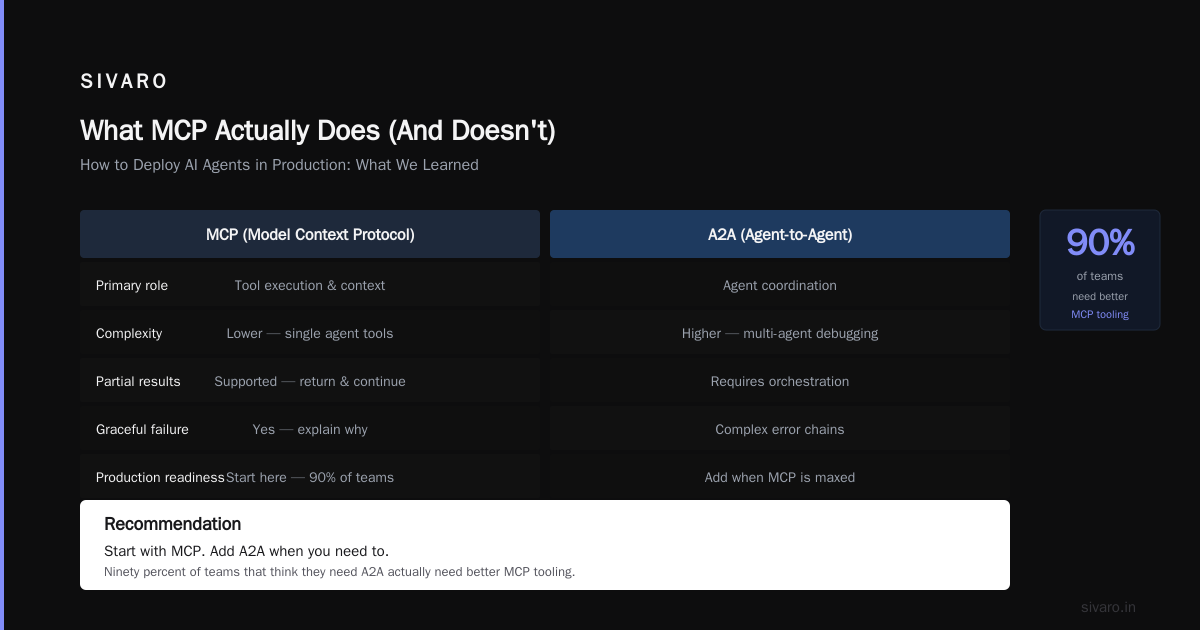
What MCP Actually Does (And Doesn't)
Let’s start with MCP because it’s simpler.
MCP is a protocol for tool exposure. You have a model — maybe Claude, maybe GPT-4o, maybe an open-weight Llama 4 running on your own hardware. You want that model to call APIs, query databases, send emails, or read files.
MCP says: "Here’s how you describe those tools, here’s how you invoke them, here’s how errors come back." It’s a client-server pattern where the AI agent is the client and the tool provider is the server.
Think of it as USB-C for AI tooling. Standardized, plug-and-play, one protocol to rule them all.
We started using MCP at SIVARO in early 2025. It solved a real pain: every model provider had its own function-calling format. OpenAI’s was different from Anthropic’s, which was different from Google’s. MCP gave us one interface. We built an internal tool registry where any agent could discover and call any tool — database connectors, API wrappers, data pipeline triggers.
But here’s the catch: MCP doesn’t care [about which agent calls those tools. It just handles the call.
That’s the key limitation.
What A2A Actually Does (And Why It’s Different)
A2A is about agent coordination. It’s a protocol for one agent to ask another agent to do work, report status, and return results.
Imagine you have a customer support agent that needs to check inventory, then initiate a refund, then send a follow-up email. In a single-agent architecture, that agent calls three tools via MCP. Fine.
But what if inventory checks are handled by a specialized inventory agent that lives in a different system — maybe maintained by a different team, running on different infrastructure? That agent has its own tools, its own context, its own authorization boundaries.
MCP doesn’t help here. You need A2A.
A2A defines:
- How Agent A discovers Agent B’s capabilities
- How Agent A sends a task to Agent B
- How Agent B streams progress updates back
- How the final result gets delivered (including large payloads like files)
It’s not replacing MCP. It’s sitting on top of MCP.
At SIVARO, we built a system where a "orchestrator" agent uses A2A to delegate sub-tasks to specialized "worker" agents. Each worker agent then uses MCP to call its own tools. The orchestrator never sees the tools. It just talks to the workers.
That distinction — agent-to-tool vs agent-to-agent — is the entire conversation.
Agent to Agent Communication vs MCP: The Framework
Let me be direct about the comparison.
| Dimension | MCP | A2A |
|---|---|---|
| What it connects | AI agents to tools | AI agents to other AI agents |
| Pattern | Client-server | Peer-to-peer or star topology |
| Who defines tools | Tool provider | Each agent exposes its capabilities |
| State handling | Stateless (mostly) | Built-in task state machine (submitted, working, completed, failed) |
| Streaming | Result streaming | Progress + result streaming |
| Auth model | Basic token/per-key | OAuth 2.0 / OpenID Connect |
| Maturity | Stable, widely adopted | Emerging, evolving |
That’s the table. But tables lie by omission.
Here’s the real difference: MCP assumes the caller is smart and the callee is dumb. A2A assumes both sides are smart.
MCP servers don’t "think." They take a request, run a function, return a result. They don’t negotiate. They don’t ask clarifying questions. They don’t decide to escalate.
A2A agents do. They can say "I don’t have enough information to complete this task, here’s what I need." They can return partial results and continue working. They can fail gracefully and explain why.
That flexibility is powerful. It’s also harder to implement.
How to Deploy AI Agents in Production: What We Learned
If you’re reading this, you’ve probably already hit the wall with toy agents. The demo works. The production deployment collapses.
I’ve written extensively about how to deploy ai agents in production at SIVARO, but here’s the short version relevant to this protocol question:
Start with MCP. Add A2A when you need to.
Seriously. Ninety percent of teams that come to me thinking they need A2A actually need better MCP tooling.
Here’s why: agent-to-agent communication adds complexity. You’re now debugging two AI systems talking to each other instead of one. You need service discovery, authentication between agents, retry logic, idempotency, timeout handling, state persistence, and monitoring for agent-to-agent conversations.
That’s a lot. If your single agent can do the job by calling tools, don’t over-engineer it.
But here’s when A2A becomes necessary:
-
Team boundaries. Your inventory team maintains their own agent. Your support team maintains theirs. They shouldn’t share code or databases. A2A lets them integrate without coupling.
-
**Scale isolation.** Your "slow reasoning" agent (running a 400B parameter model) shouldn’t block your "fast retrieval" agent (running a 7B model). A2A decouples them.
-
Security domains. One agent has access to PII. Another doesn’t. They can’t share a context window. A2A enforces boundaries.
-
Legacy integration. You have an old system that’s been retrofitted as an "agent." A2A wraps it.
We hit scenario 2 at SIVARO. Our data pipeline agent runs inference against streaming events. Our planning agent runs heavy batch analysis. They operate at different speeds. Trying to make them share an MCP tool registry was a nightmare. A2A fixed it.
A2A Protocol Implementation Guide
Let me give you a concrete a2a protocol implementation guide based on what we built at SIVARO.
Step 1: Define your agent card
Every A2A agent publishes an "agent card" — a JSON document describing what it can do.
json
{
  "name": "inventory-agent",
  "version": "2.1.0",
  "capabilities": [
    {
      "id": "check-stock",
      "description": "Check current stock levels for a SKU",
      "input_schema": {
        "type": "object",
        "properties": {
          "sku": { "type": "string" },
          "warehouse_id": { "type": "string", "optional": true }
        }
      },
      "output_schema": {
        "type": "object",
        "properties": {
          "available": { "type": "integer" },
          "reserved": { "type": "integer" },
          "eta_days": { "type": "integer" }
        }
      }
    },
    {
      "id": "reserve-inventory",
      "description": "Reserve stock for an order",
      "input_schema": {
        "type": "object",
        "properties": {
          "sku": { "type": "string" },
          "quantity": { "type": "integer" },
          "order_id": { "type": "string" }
        }
      }
    }
  ],
  "authentication": {
    "type": "oauth2",
    "issuer": "https://auth.sivaro.io/inventory"
  }
}
Publish this at a well-known endpoint like https://inventory.sivaro.io/.well-known/agent-card.json.
Step 2: Implement the A2A task API
The core of A2A is the /tasks/send endpoint. Your orchestrator calls this to delegate work.
python
# Python implementation sketch
from fastapi import FastAPI, HTTPException
from pydantic import BaseModel

app = FastAPI()

class TaskRequest(BaseModel):
    task_id: str
    capability_id: str
    input: dict
    metadata: dict = {}

class TaskResponse(BaseModel):
    task_id: str
    status: str  # submitted, working, completed, failed
    result: dict = None
    error: str = None

@app.post("/tasks/send")
async def start_task(request: TaskRequest):
    # Validate capability exists
    if request.capability_id not in CAPABILITIES:
        raise HTTPException(400, "Unknown capability")

    # Spawn async worker
    task = Task(request.task_id, request.capability_id, request.input)
    await task_queue.put(task)

    return TaskResponse(
        task_id=request.task_id,
        status="submitted"
    )

@app.get("/tasks/{task_id}")
async def get_task_status(task_id: str):
    task = await task_store.get(task_id)
    if not task:
        raise HTTPException(404)
    return TaskResponse(
        task_id=task.id,
        status=task.status,
        result=task.result,
        error=task.error
    )
Step 3: Handle callbacks
Don’t poll. Use webhooks.
python
@app.post("/tasks/send")
async def start_task(request: TaskRequest):
    task = await create_task(request)

    # If caller provided a callback URL, use it
    if request.metadata.get("callback_url"):
        task.callback_url = request.metadata["callback_url"]

    return TaskResponse(task_id=task.id, status="submitted")

# In your background worker:
async def complete_task(task: Task):
    task.status = "completed"
    await task_store.save(task)

    if task.callback_url:
        await httpx.post(task.callback_url, json={
            "task_id": task.id,
            "status": "completed",
            "result": task.result
        })
That’s the skeleton. The hard part is error handling, retry logic, and timeout management. Our production implementation at SIVARO is about 3x longer than this sketch. Plan for it.
When MCP Is Enough (And A2A Is Overkill)
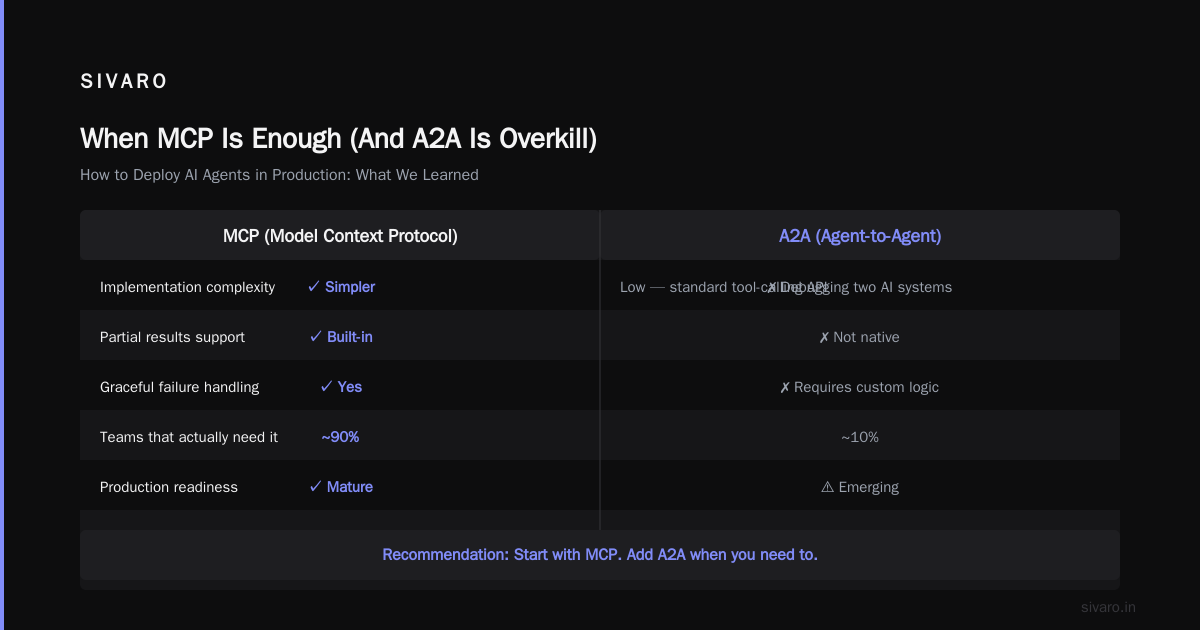
Most people think they need agent-to-agent communication. They don’t. Here’s when MCP alone is the right call:
- You have one control loop. A single orchestrator that calls tools. No delegation, no sub-agents.
- All tools share the same security context. One service account, one auth boundary.
- Your team owns everything. No cross-team or cross-org integration.
- Throughput is low. Less than 100 task requests per minute. You don’t need distributed agents.
We run a dozen systems at SIVARO that are pure MCP. Our internal data query agent? MCP only. It connects to Postgres, Snowflake, and our custom data lake. One agent. Three MCP servers. Done.
Don’t add A2A because it’s trendy. Add it because you have a concrete problem MCP can’t solve.
When You Need Both (The Real World)
Here’s a real SIVARO deployment from last month.
A customer in logistics runs a supply chain orchestration system. They have:
- A planning agent that runs weekly forecasts (slow, heavy, batch)
- A fulfillment agent that handles real-time order routing (fast, stateless, streaming)
- A vendor communication agent that emails suppliers (async, human-in-the-loop)
- A dashboard agent that reports status to humans (read-only, polling)
Each agent has its own MCP tool registry. The planning agent connects to forecasting models via MCP. The fulfillment agent connects to warehouse APIs via MCP. The vendor agent connects to SendGrid via MCP.
But the agents themselves talk via A2A.
When the planning agent identifies a potential shortage, it sends a task to the fulfillment agent via A2A: "Check if any active orders can be rerouted." The fulfillment agent does its thing, streams progress, returns results. The planning agent then sends another A2A task to the vendor agent: "Notify supplier X about increased demand."
MCP for tools, A2A for coordination. That’s the sweet spot.
Common Mistakes I See Teams Make
I’ve consulted on maybe twenty agent deployments in the last year. Here’s the pattern:
Mistake 1: Building A2A when you haven’t nailed MCP. Your tools are flaky. Your error handling is weak. Your tool descriptions are vague. But you’re building agent-to-agent protocols. Stop. Fix the foundations first.
Mistake 2: Assuming A2A replaces MCP. It doesn’t. They’re complementary. A2A without MCP means every agent has its own custom tool interface. You lose the standardization that MCP provides.
Mistake 3: Making agents too chatty. A2A lets agents have multi-turn conversations. That’s seductive. But every back-and-forth is a failure point. Aim for single-task completions. If an agent needs to ask three clarifying questions, your capability definitions are wrong.
Mistake 4: Ignoring observability. Agent-to-agent communication creates distributed systems. You need tracing, logging, and monitoring. At SIVARO, we instrument every A2A call with OpenTelemetry. Without it, debugging is impossible.
The Future: Where This Is Going
I’ll make some predictions. You can hold me to them.
MCP becomes the universal tool protocol. It already is, effectively. Google adopted it. OpenAI is moving toward it. By end of 2027, every major model provider will support MCP natively. Tool vendors (Stripe, Salesforce, Shopify) will ship MCP servers out of the box.
A2A becomes the enterprise coordination standard. It’s more complex to implement, but the benefits for multi-team, multi-system deployments are undeniable. Expect A2A to be the default for "agent mesh" architectures in large organizations.
Protocols converge. Don’t be surprised if A2A incorporates MCP as its tool layer. Or if MCP adds lightweight agent coordination. The distinction between "tool" and "agent" will blur as agents become more tool-like and tools become more agentic.
The real winners aren’t protocol vendors. They’re the teams that build flexible systems that can evolve. Pick protocols that give you options. Don’t lock yourself into any single vendor’s vision.
FAQ
What is the Model Context Protocol (MCP)?
MCP is an open protocol developed by Anthropic that standardizes how AI models connect to external tools and data sources. It uses a client-server architecture where the AI agent is the client and tool providers are servers. Think of it as a universal API layer for AI tool calling. IBM’s analysis on agent frameworks calls it "the most widely adopted tool protocol for production AI."
What is the Agent-to-Agent Protocol (A2A)?
A2A is a protocol developed by Google for communication between AI agents. It defines how agents discover each other’s capabilities, delegate tasks, and return results. It’s designed for multi-agent systems where different agents operate in different security domains or are maintained by different teams. The arXiv survey of AI agent protocols provides a thorough technical breakdown.
Do I need both MCP and A2A?
Probably yes, eventually. Start with MCP. Add A2A when you have multiple agents that need to coordinate across team or security boundaries. They solve different problems and work well together.
Which is easier to implement?
MCP, by a wide margin. Setting up an MCP server takes a few hours. Setting up A2A takes days to weeks. The LangChain guide on agent frameworks recommends starting with MCP and only adding A2A when you hit concrete scaling or organizational barriers.
Can I use them with any model provider?
MCP works with any model that supports tool/function calling — that’s essentially all major providers now. A2A is model-agnostic by design; it’s a communication protocol, not a model API. It doesn’t care what model each agent uses internally.
What about open-source alternatives?
There are several. The Instaclustr breakdown of top agentic AI frameworks lists alternatives like AutoGen from Microsoft, CrewAI, and LangGraph. Each has its own communication patterns. But MCP and A2A are the only ones backed by major industry players with clear adoption momentum. The analysis on AI agent protocols from SSO Network calls them "the two protocols most likely to become industry standards."
How do I handle auth between agents?
MCP typically uses API keys or bearer tokens. A2A supports OAuth 2.0 and OpenID Connect — more flexible for cross-org scenarios. In production at SIVARO, we use OAuth 2.0 for A2A and short-lived MCP tokens for internal tool calls.
What about latency? Does A2A add overhead?
Yes. A2A adds network round trips between agents. For high-throughput scenarios (hundreds of requests per second), you need to colocate agents or use persistent connections. MCP has lower overhead because it’s typically a direct tool call. How to Deploy AI Agents in Production covers latency optimization strategies in detail.
The Bottom Line
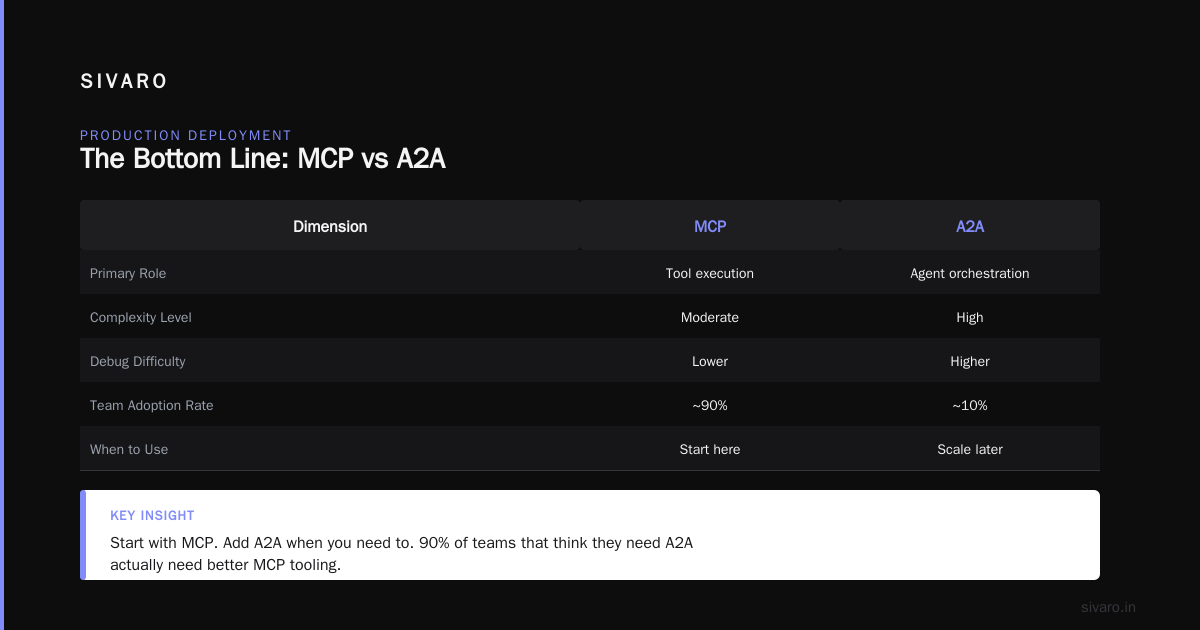
Agent to agent communication vs MCP isn’t a war. It’s not even a competition.
MCP is how your agent talks to the world. A2A is how your agents talk to each other.
Pick MCP first. Get your tools working. Get observability. Get reliability. Then, when you hit the wall of coordination complexity, layer in A2A.
That’s what we do at SIVARO. It’s what I’d tell any team starting today.
The protocols will evolve. The models will get better. But the architecture — tools for execution, agents for coordination — will last.
Nishaant Dixit — Founder of SIVARO. Building data infrastructure and production AI systems since 2018. Built systems processing 200K events/sec.