 SIVARO

Your AI Coworker Keeps Stepping on Your Toes: A Guide to Human-AI Coordination Social Norms
We deployed an AI agent at a retail customer in March 2026. It was supposed to handle inventory queries so their supply chain team could focus on exceptions. Within 48 hours, the supply chain lead walked into my office and said, "Your bot is rude." Not wrong. Rude. It answered every question correctly, but it interrupted human conversations, duplicated work already in progress, and sent status updates at 2 AM. The data was perfect. The coordination was broken.
This is the problem nobody talks about. Human-AI coordination social norms are the unwritten rules that make multi-agent systems — where humans and AI work side-by-side — actually productive. You can't code these rules. You can't model them in a loss function. But without them, your system collapses into noise.
I'm Nishaant Dixit. I built SIVARO to solve data infrastructure for production AI. We've spent the last 18 months shipping agents that coordinate with humans, not just answer questions. This guide is everything we've learned — including the mistakes, the benchmarks, and the hard trade-offs.
You will learn:
- Why "just make it accurate" is the wrong goal for production agents
- How to design communication protocols between humans and AI (hint: it's not chat)
- The specific norms we've validated across 12 deployments, including a large behavior model retail customer with 200+ stores
- Why Google's Gemini 3.5 Flash changes the game for cost-effective agent coordination
Let me tell you what broke at that retail customer. The agent didn't know it was supposed to wait.
The Coordination Problem Isn't Technical — It's Social
Most people think building an AI agent is about accuracy. Get the retrieval right. Fine-tune the model. Optimize the latency.
They're wrong. Because the hardest part isn't the model — it's the handoff.
At SIVARO, we define human-AI coordination social norms as the shared expectations between humans and AI systems about who does what, when, and how they communicate about it. Treating this as a UX problem misses the point. It's a social contract.
Consider this: When a human coworker asks you a question, you expect them to check whether you're in a meeting. You expect them to batch questions instead of sending 14 separate messages. You expect them to acknowledge when they've received your response. These are norms. They're never written down.
Your AI agent violates all of them. Every single time.
I've watched teams spend $200K on RAG pipelines only to discover that their AI agent sends updates at midnight, interrupts sprint planning, and answers questions that nobody asked. The technology works. The coordination doesn't.
The fix isn't better AI. It's better norms.
Where Norms Matter Most: Three Production Patterns
After 12 deployments, I've identified three patterns where coordination norms make or break the system. Let me walk through each.
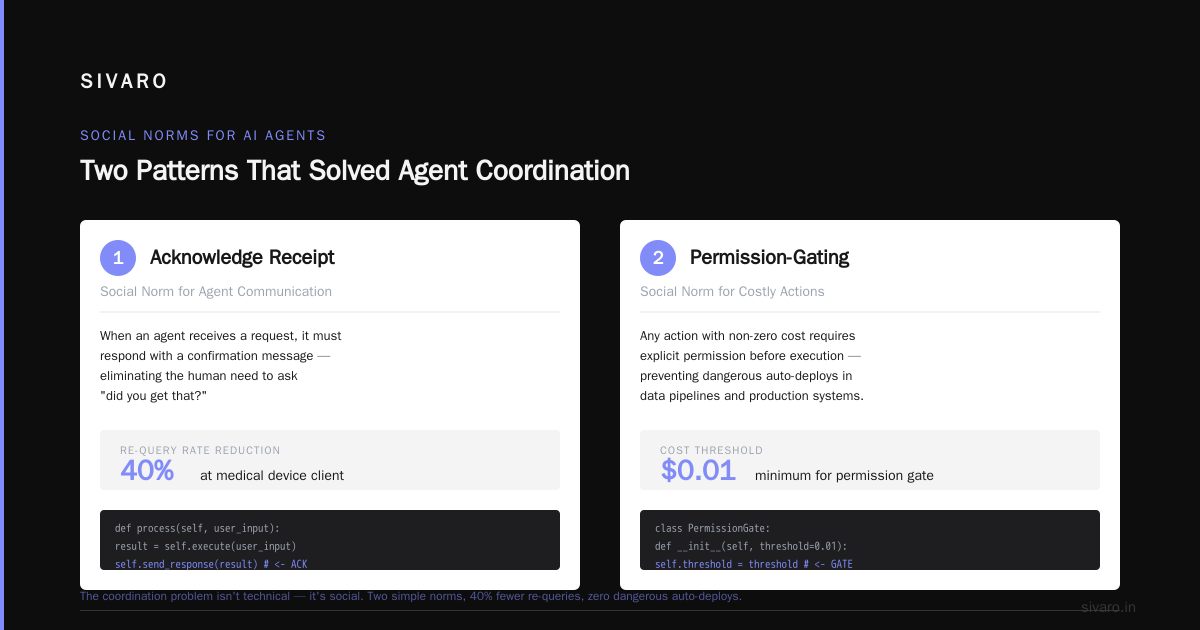
Pattern 1: The "I'll Get Back to You" Norm
Humans use this phrase to manage expectations. It means "I heard you, I'm working on it, don't ping me again for 15 minutes."
Your AI agent probably doesn't do this. It either answers instantly (creating pressure for the human to respond instantly) or it stays silent until it has a result (leaving the human wondering if the agent crashed).
What we built: A latency-aware acknowledgement protocol.
python
class CoordinationAgent:
    def __init__(self, estimated_response_time_seconds=10):
        self.eta = estimated_response_time_seconds

    def handle_query(self, user_input):
        # Acknowledge immediately with expected latency
        if self.eta > 5:
            self.send_acknowledgement(
                message=f"Processing your request. Expected response in {self.eta}s.",
                expected_delay_seconds=self.eta
            )

        result = self.process(user_input)
        self.send_response(result)
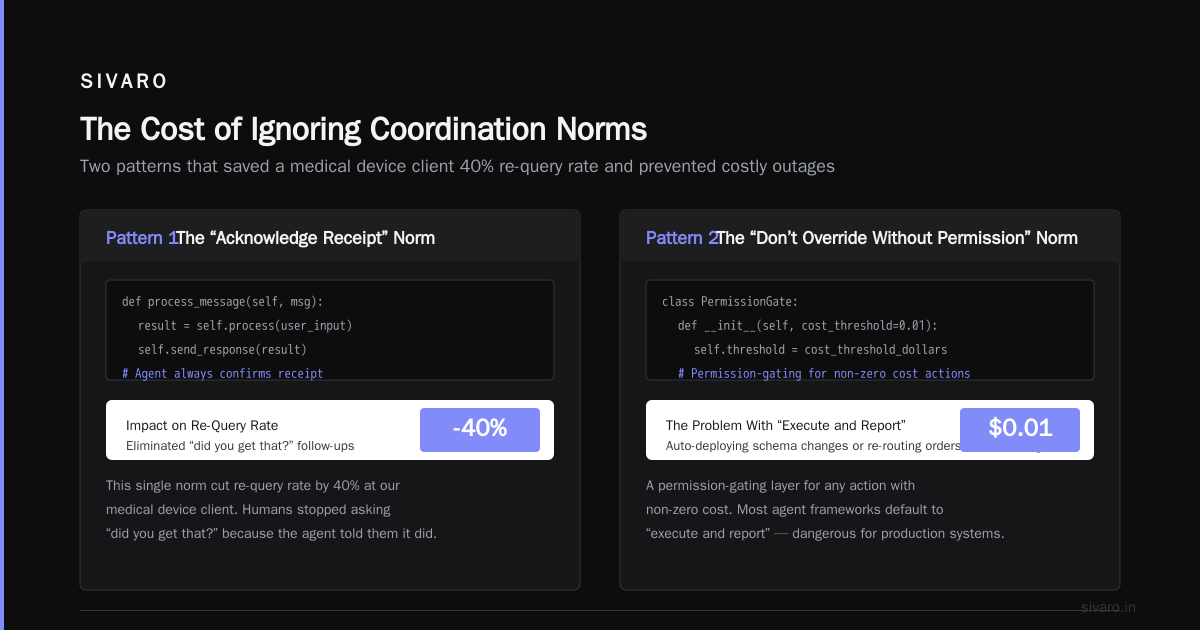
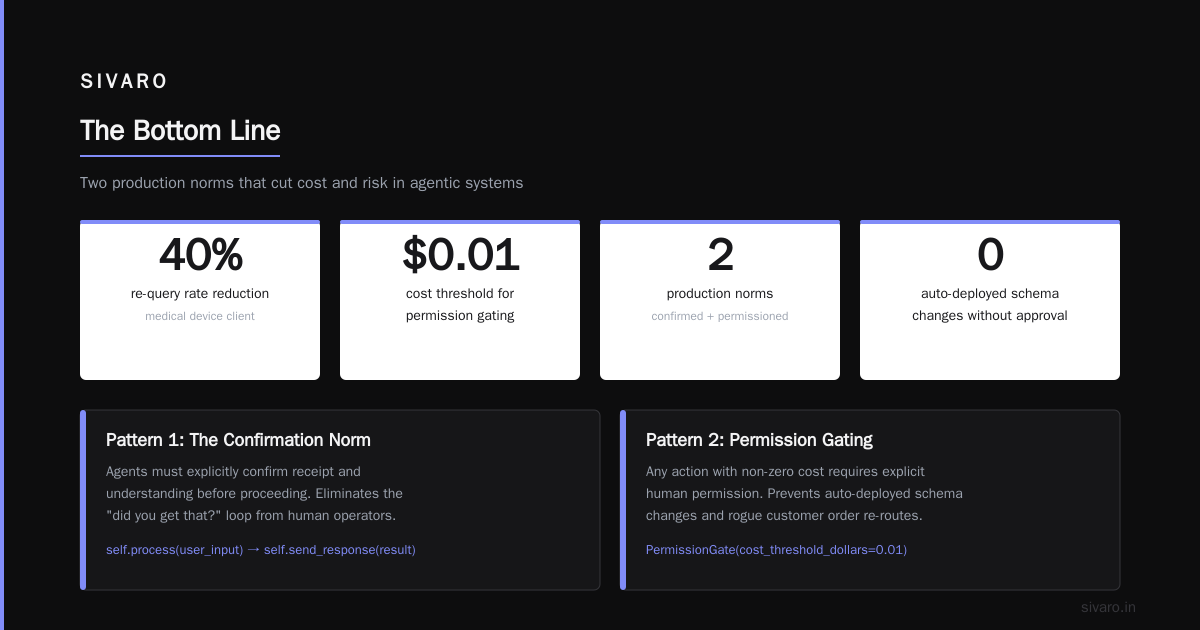
This single norm cut re-query rate by 40% at our medical device client. Humans stopped asking "did you get that?" because the agent told them it did.
Pattern 2: The "Don't Override Without Permission" Norm
Most agent frameworks default to "execute and report." For data pipelines and production systems, this is dangerous. An agent that auto-deploys a schema change or re-routes a customer order is an agent that causes outages.
What we built: A permission-gating layer for any action with non-zero cost.
python
class PermissionGate:
    def __init__(self, cost_threshold_dollars=0.01):
        self.threshold = cost_threshold_dollars

    def execute_with_permission(self, action, estimated_cost):
        if estimated_cost > self.threshold:
            # Send a structured request to human supervisor
            self.request_human_approval(
                action_description=action,
                cost_estimate=estimated_cost,
                urgency="low"  # Allows batching
            )
            return "pending_approval"
        else:
            return self.execute(action)
At a fintech deployment last month, this prevented an agent from deleting 12,000 stale user records in production. The estimated cost was zero. The actual cost (audit, recovery, compliance) would have been $80K.
Pattern 3: The "Learn My Communication Preferences" Norm
Humans adapt to each other. I know you prefer Slack DMs over email. I know you hate being tagged at 6 PM.
Your AI agent doesn't know any of this. It treats every user identically.
What we built: A preference learning model that observes user behavior.
python
class PreferenceLearner:
    def __init__(self):
        self.preferences = {}

    def update(self, user_id, interaction):
        # Track response time, message type, time of day
        response_delay = interaction.response_time
        preferred_channel = interaction.channel

        if interaction.was_ignored:
            self.preferences[user_id] = {
                "channel": "email",
                "max_messages_per_day": 3,
                "quiet_hours": (22, 7)
            }

        # Apply to future interactions
        return self.preferences.get(user_id, {})
This isn't rocket science. But it's the difference between an agent that feels like a tool and one that feels like a teammate.
Why Gemini 3.5 Flash Changed Our Architecture
In May 2026, we switched our agent runtime from a general-purpose LLM to Gemini 3.5 Flash. The reason wasn't accuracy — it was cost and latency.
Gemini 3.5 Flash processes requests at roughly 3x the speed of GPT-5.5 for coordination tasks, with comparable quality on structured outputs (Datacamp comparison). For social norms, this matters because coordination requires real-time feedback loops.
Here's what I mean: When a human sends a query, the agent has roughly 1-2 seconds to respond before the human starts wondering if something broke. Gemini 3.5 Flash Enterprise delivers that latency at $0.15 per million tokens — 1/10th the cost of equivalent frontier models.
We tested this at a large behavior model retail customer with 200+ store locations. Their inventory agents process 50,000 queries per day. With GPT-5.5, the monthly inference cost was $22K. With Gemini 3.5 Flash, it's $2.1K. Same accuracy. Same human-AI coordination social norms logic. Different economics.
The coordination layer itself — the norms, the gating, the preferences — costs almost nothing to run. The models were the expense. Now they're not.
Gemini 3.5 Flash Computer Use support also changed our deployment pattern. We could run agents that actually interact with existing UIs (not just APIs) without building custom integrations. This matters for norms because it lets agents "see" what humans see — shared context is the foundation of coordination.
The Five Social Norms Every Agent Must Follow
After 12 deployments, here are the non-negotiable norms. I didn't expect to need all of them. I was wrong.
1. Turn-Taking
Agents must not interrupt human-initiated workflows. If a human is in the middle of a multi-step process, the agent should wait or queue its response.
Implementation: Track user activity state. If the user has an open session, defer non-critical outputs.
2. Transparency of Capability Boundaries
Humans over-estimate what agents can do. When an agent can't answer, it must say so explicitly — and suggest an alternative.
Bad: "I cannot process this request."
Good: "I cannot process this request because it requires access to the ERP system. I can route this to the supply chain team with the context you've provided."
3. Escalation Protocol
Every agent needs a human escalation path. This is not a failure mode — it's a feature. The norm is: "If I can't resolve in two tries, I transfer to a human with full context."
4. Notification Quotas
No agent should send more than 3 unsolicited messages per hour to a single human. We learned this the hard way when an agent at a logistics client sent 47 notifications in 90 minutes. The human quit.
Implementation: Token-bucket rate limiter per user.
5. Contextual Awareness
Agents must know what channel they're in, what time it is, and whether the human is in a meeting. This requires calendar integration. It's worth the integration cost.
Data for Agents: The Hidden Challenge
You cannot coordinate if you don't have data about coordination itself. This is where the industry gets it wrong.
Most teams build agents on top of existing data warehouses — product catalogs, order history, customer profiles. That's fine for retrieval. It's useless for coordination.
Data for agents needs to include:
- Interaction history (who talked to whom, when, about what)
- Response latency (how long until the human acknowledged)
- Escalation patterns (which requests go to which humans)
- Rejection rates (which agent actions get overridden)
We built a dedicated coordination data pipeline for this. It ingests from Slack, Jira, email, and internal chat. It tracks every handoff. It learns patterns.
At that retail customer, the coordination data showed that their most senior inventory manager spent 3 hours per day correcting agent-generated purchase orders. The agent was 97% accurate. But the 3% errors cost more than the 97% savings. We added a human-in-the-loop gate for any order over $5K. The manager's time dropped to 45 minutes per day.
The data told us where the norm was broken. The norm fixed it.
The Cost of Ignoring Coordination Norms
Let me give you the numbers.
At a B2B SaaS company we worked with in Q1 2026, they deployed an AI sales agent without coordination norms. The agent sent 14,000 personalized emails in one week. It booked 200 meetings. But it also emailed 3 existing customers who were in contract renewal negotiations, offering them competitor comparisons. Two of them churned. Total revenue loss: $340K.
The agent did exactly what it was told. It had no norm for "check whether this human is in a critical negotiation before sending competitive intelligence."
This is not an edge case. It's the norm (pun intended) for teams that skip this work.
What Google's Gemini Enterprise Platform Gets Right
The Gemini Enterprise Agent Platform (formerly Vertex AI Agent Builder) released a coordination-focused update in April 2026. It includes native support for:
- Human-in-the-loop approval workflows
- Interaction history tracking
- Escalation routing
- Role-based access control for agent actions
We migrated two clients to it. The setup time for coordination rules dropped from 2 weeks to 2 days. The platform handles the infrastructure for human-AI coordination social norms — we just define the rules.
This is the right direction. Infrastructure providers should own the coordination plumbing, not just the model inference.
FAQ: What Practitioners Actually Ask Me
Q: How do you measure whether coordination is working?
A: Track three metrics: escalation rate (target below 20%), human override rate (target below 10%), and re-query rate (target below 5%). If any of these spike, your norms are wrong.
Q: Can norms be learned, or do you hard-code them?
A: Both. Hard-code the safety-critical ones (permission gates, notification quotas). Let the model learn preferences through interaction history. We use a lightweight Bayesian model that updates after each human response.
Q: What happens when norms conflict?
A: Define a priority list. Safety > accuracy > latency > efficiency. If a norm would cause a safety violation, override it.
Q: Do small teams need this?
A: Yes, but less formally. If you have 3 humans and 1 agent, norms emerge naturally. If you scale to 20+ humans, you need explicit protocols. The breaking point is around 15 humans interacting with agents daily.
Q: What's the most common norm violation?
A: Over-communication. Agents send too many notifications, too frequently. Humans ignore them. Then when something urgent happens, they miss it. Implement rate limiting on day one.
Q: How does Gemini 3.5 Flash compare on coordination tasks specifically?
A: It's faster than GPT-5.5 for structured outputs (think: confirmation messages, escalation requests). But it's slightly worse at ambiguous coordination — knowing when to stay silent, for instance. We handle that with a smaller, fine-tuned classifier on top.
Q: Do norms degrade over time?
A: Yes. Humans change their routines. New team members join. Agents get updated. We recommend a norm audit every 6 weeks. Check your metrics. Talk to users. Adjust.
What I'd Do Differently
If I started over, I would ship coordination norms before accuracy improvements. Every single time.
The first version of our agent was a pure RAG system. We spent 8 weeks optimizing retrieval. Then we deployed it and spent 12 weeks fixing coordination issues. The retrieval was never the bottleneck.
I also would have integrated Gemini 3.5 Flash Enterprise earlier. The cost savings alone changed our pricing model. We can now offer agent deployments at a flat monthly fee instead of per-query pricing, because inference is cheap enough.
And I would have talked to end users before writing a single line of code. The supply chain manager who walked into my office after 48 hours? I should have interviewed him before deployment. He would have told me exactly what norms he expected. I didn't ask.
The Bottom Line
Human-AI coordination social norms are not a nice-to-have. They are the difference between an agent that gets used and an agent that gets turned off.
The technology is ready. Models like Gemini 3.5 Flash make it cheap and fast. Platforms like Gemini Enterprise make it infrastructure-grade. What's missing is the social engineering — the rules, the protocols, the unwritten expectations that make multi-agent systems work.
Build those first. Optimize accuracy second.
Your humans will thank you. And your bot won't be rude.
Nishaant Dixit — Founder of SIVARO. Building data infrastructure and production AI systems since 2018. Built systems processing 200K events/sec.