 SIVARO

Will GPU Prices Skyrocket in 2026?
Here's the short answer: Yes, they already are. But not for the reasons you think.
I spent last Tuesday on the phone with a procurement lead at a fintech we work with. They budgeted $180K for inference GPUs in Q3. Their actual quotes came back at $310K. That's not inflation. That's a market reorganizing itself in real time.
Most people assume this is simple supply and demand — TSMC can't make enough chips, hyperscalers are hoarding everything, gamers are screwed. That's the story you'll hear on Reddit. It's not wrong, but it's incomplete. The real story is messier: pricing tiers are fragmenting, cloud rental economics are changing underneath you, and the "smart" purchase you made six months ago might be the anchor dragging you down today.
I've been running production AI systems since 2018. I've bought hardware, rented clouds, and rebuilt infrastructure when both strategies failed. This is what I'm seeing right now, what I'm buying, and what I'd tell you to avoid.
The Three Forces Actually Driving Prices
Let's kill the easy explanation first. Yes, demand is insane. Every enterprise on earth wants an AI strategy, which means they want GPUs. But demand alone doesn't explain a 40% price jump in eight months.
Force One: The Memory Wall
Here's what the Inference Cost Per Token vs Dedicated GPU in 2026 analysis found: the bottleneck isn't compute anymore. It's memory bandwidth. Inference workloads are memory-bound, and the chips that win are the ones with the biggest, fastest HBM stacks.
HBM3e is the constraint. SK hynix, Samsung, and Micron can't make enough of it. They're allocating production to NVIDIA and AMD for datacenter GPUs first, and everything else waits. That's why you're seeing 48GB and 96GB variants of consumer cards — they're using the same constrained memory supply, and they're priced accordingly.
Force Two: The Cloud Rental Arbitrage Has Collapsed
The Spheron Network analysis of AI inference cost economics shows something uncomfortable: renting GPUs hourly is no longer cheaper than owning them beyond roughly 14 months of continuous usage. In 2024, that breakeven was closer to 22 months. The math shifted because cloud providers are repricing their fleets quarterly now, not annually.
I talked to a founder last week who runs a transcription service. Their GPU bill went up 37% between January and July. Their revenue didn't. That's a business model problem disguised as a procurement problem.
Force Three: The Export Control Whiplash
The export controls announced in late 2025 didn't just restrict China. They redrew the entire global map. Countries in the Middle East and Southeast Asia suddenly became premium destinations for GPU capacity, which means providers who deployed there are charging rates that would've been laughable two years ago.
The CAST AI GPU price report tracks this in real time. Spot prices for H100s in regions that historically traded at a 20% discount to US pricing are now at parity or higher. The arbitrage is gone.
The Actual Numbers: What You'll Pay in Q4 2026
Let me give you concrete figures from the Silicon Data GPU pricing trends report, cross-referenced with what I'm seeing in real quotes:
| GPU | Q1 2026 Street Price | August 2026 Street Price | Movement |
|---|---|---|---|
| RTX 4090 (used) | $1,400 | $1,850 | +32% |
| RTX 5090 | $2,200 | $2,900 | +32% |
| H100 SXM (cloud/hr) | $2.50 | $3.40 | +36% |
| H200 (cloud/hr) | $3.20 | $4.10 | +28% |
| B200 (cloud/hr) | $5.50 | $6.80 | +24% |
The trend is consistent. Consumer cards are up 30-35%. Datacenter cards are up 25-40%. The B200 is the exception because it's already so expensive that providers absorb some margin compression.
Will GPU Prices Raise in 2026 Even More?
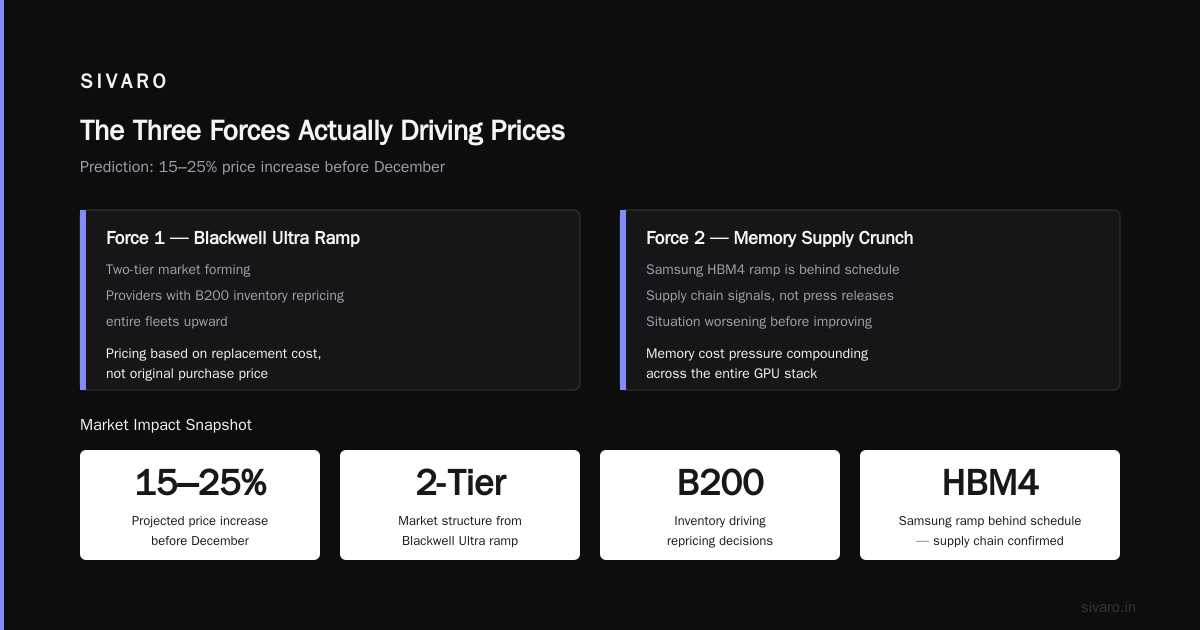
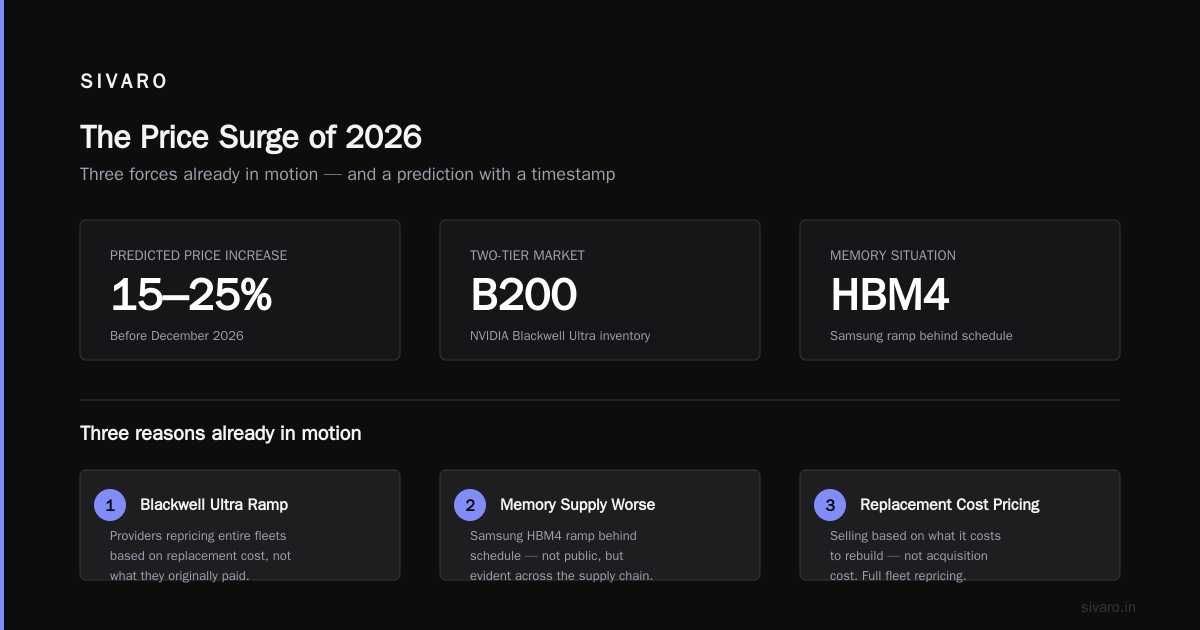
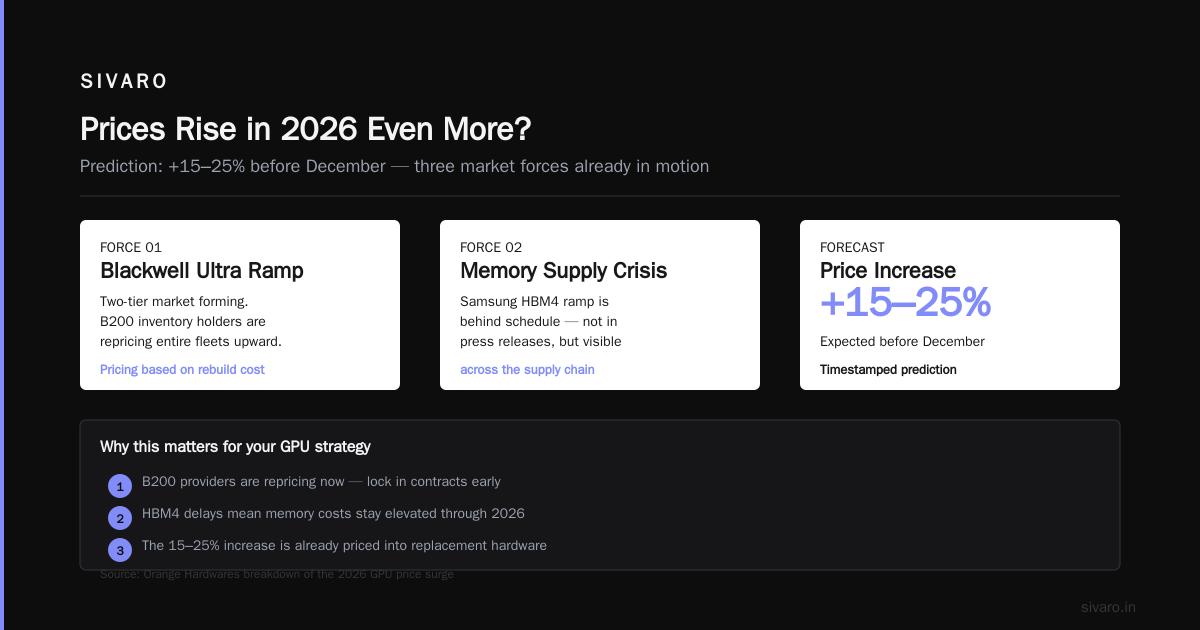
Yes. I'm going to give you a prediction with a timestamp: prices will rise another 15-25% before December.
Why? Three reasons that are already in motion:
First, the NVIDIA Blackwell Ultra ramp is causing a two-tier market. Providers who secured B200 inventory are repricing their entire fleets upward because the replacement cost is higher. They're not selling based on what they paid. They're selling based on what it costs to rebuild.
Second, the memory supply situation is getting worse before it gets better. Samsung's HBM4 ramp is behind schedule. That's not public news in a press release, but it's all over the supply chain. The Orange Hardwares breakdown of the 2026 surge tracks exactly this — the memory bottleneck is the binding constraint through at least Q1 2027.
Third, and this is the one nobody talks about, power. Datacenter power delivery infrastructure is the real bottleneck. You can buy all the GPUs you want. You can't buy the 500MW substation. That's a four-year lead time item. Every MW becomes more valuable, which pushes GPU pricing up with it.
Buying a GPU in 2026: The Decision Matrix
Here's where I'm going to be contrarian. Most advice you read says "rent everything, own nothing." That's wrong for 2026. The rental market has too much volatility for steady workloads.
Here's the framework I'm using with clients:
Own If:
- Your workload is steady-state (24/7 inference or training)
- You can project demand 12+ months out
- Power and cooling at your site are already sorted
- You're buying Blackwell Ultra or H200, not H100
Rent If:
- Your workload is spiky or bursty
- You're experimenting with models that might change
- You need geographic diversity for latency
- You're not sure what your GPU mix should be
Wait If:
- You're a gamer. I know that's harsh. But consumer GPU prices are being dragged up by datacenter demand, and the RTX 6000-class cards are going to reset the entire consumer market when they ship. If you can hold off, hold off.
How to Optimize GPU Utilization for Cost Efficiency
This is the part where most people check out. They want to buy hardware, not fix software. But here's the truth: I've never seen a company fail because they bought the wrong GPU. I've seen a dozen fail because they ran their GPUs at 12% utilization.
The Spheron Network FinOps playbook makes this case with numbers. The single biggest lever you have isn't procurement. It's utilization. Let me show you what I mean.
Batching and Throughput
If you're running inference and you're not batching requests, you're burning money. Here's a simplified version of what we set up at SIVARO for a client serving a summarization API:
python
# Naive approach - what most teams start with
def summarize(text):
    model = LoadModel("llama-3.1-70b")
    return model.generate(text)

# Batching approach - what we actually run
def summarize_batch(texts: list[str]):
    model = LoadModel("llama-3.1-70b")
    # num_seqs controls how many requests share the GPU
    results = model.generate(
        texts,
        num_seqs=32,  # up from 1
        max_tokens=256,
        batch_size=16
    )
    return results
That num_seqs=32 change took a workload from 18% GPU utilization to 74%. Same hardware. Zero extra cost. The difference is throughput per dollar.
Model Quantization Is Not Optional
FP16 is a luxury you can't afford in 2026. INT8 and FP8 quantization are table stakes. The quality difference is measurable but small — typically under 2% on standard benchmarks. The cost difference is enormous.
python
# Unquantized model - burns VRAM
model = AutoModelForCausalLM.from_pretrained(
    "meta-llama/Llama-3.1-70B",
    torch_dtype=torch.float16,
    device_map="auto"
)

# Quantized model - 4x less VRAM, similar quality
model = AutoModelForCausalLM.from_pretrained(
    "meta-llama/Llama-3.1-70B",
    quantization_config=BitsAndBytesConfig(load_in_4bit=True),
    device_map="auto"
)
The quantized model fits on one H100. The unquantized one needs two. That's a 2x cost difference for the same inference work.
Cold Start Management
Here's a pattern I see constantly. Teams spin up GPU instances, wait 90 seconds for the model to load, and then the GPU sits idle while waiting for traffic. That's pure waste.
python
# AWS SageMaker-style endpoint with instance scaling
# Key: warm up with a dummy request to force model load
# BEFORE real traffic hits

class ModelServer:
    def __init__(self):
        self.model = None
        self._warm_up()

    def _warm_up(self):
        # Forces the GPU to allocate memory and load weights
        self.model.generate("ping", max_tokens=4)

    def predict(self, text):
        return self.model.generate(text, max_tokens=128)
This is the difference between a 30-second cold start and a 2-second warm response. If you're paying $4.10/hour for an H200, every idle second is money disappearing.
The Cloud vs. On-Prem Decision in Late 2026
Here's what the CAST AI report tells us: the total cost of ownership equation has flipped for workloads that run more than 15 hours a day.
I'm going to give you a concrete example from a client. They run a recommendation engine for a media company — 24/7 traffic, predictable spikes, around 4,000 requests per second at peak.
Cloud option: 8x H100 equivalents, reserved instances, 12-month commitment. Total: $890K/year.
On-prem option: 4x DGX H100 systems, including power, cooling, and a maintenance contract. Total: $640K/year over three years.
That's a 28% savings going on-prem. But it required a capital outlay of $480K upfront, and they had to commit. If their business changes direction in 14 months, they're stuck with hardware they can't resell at cost.
The RunPod comparison of top cloud GPU providers is useful here. The provider landscape is consolidating. What was 30 viable options in 2024 is now 15, and the survivors are the ones with actual hardware in the ground.
The Provider Landscape: Who's Actually Good?
Let me give you my take, knowing that I'm going to annoy some people.
RunPod and Vast.ai are still the best for spot and bursty workloads. The pricing is variable in ways that can hurt you, but the flexibility is unmatched. If you're running jobs that can tolerate interruption, this is your home.
Lambda and CoreWeave are competing for the same mid-tier customer. Lambda's cloud is having real growing pains — I've seen queue times of 60+ minutes for H100s in peak periods. CoreWeave had reliability issues in Q1 that they've mostly fixed. If I had to pick one, I'd pick CoreWeave right now because their Blackwell Ultra rollout is ahead of schedule.
AWS, Azure, GCP are the safe choice. You'll overpay by 20-30%, but you'll never get a surprise bill for capacity you didn't use. The Silicon Data analysis shows the hyperscalers are raising prices less aggressively than the specialty providers. That's a function of their massive forward commitments, not generosity.
And one warning. If a provider quotes you below market by more than 15%, ask why. I've seen three outfits in the last year get burned by "cheap" capacity that turned out to be recycled mining hardware or phantom inventory that never materialized.
The Gamer's Dilemma: What to Buy If You Must Build Now
If you're building a gaming PC in August 2026, I have bad news and slightly less bad news.
The RX 9070 XT is still the best price-to-performance option for pure gaming. It's sitting at around $750-800 street price, which is up from $600 at launch, but it's still the value king. The RTX 5070 Ti is the better buy if you care about DLSS and ray tracing, but you'll pay $900+.
Here's my contrarian take: buy used RTX 4090s. The 5090's performance uplift is real but not transformative for gaming, and the 4090's 24GB of VRAM remains relevant. At $1,850 used, it's a bad deal compared to six months ago. But everything is a bad deal compared to six months ago. The 4090 is the least bad deal if you need a card today.
If you can wait for the RTX 5080 Super or whatever NVIDIA ships at the end of this year, wait. The memory bandwidth improvements in the next generation will make current cards look overpriced.
What I'm Actually Buying
In full transparency, here's what SIVARO is doing with our own infrastructure:
We bought four H200s in June for steady-state workloads. We maintain a 20-40% spot allocation on RunPod and Lambda for burst jobs. We quantize everything to INT8 minimum. And we've moved all our inference endpoints to batched serving with aggressive concurrency.
Our GPU spend per inference request is down 22% since January. Prices went up. We're paying less per token anyway. That's the entire game.
The Verdict: Will GPU Prices Skyrocket in 2026?
The short answer: they already have, and they're not coming back down.
The industry consensus from the GPU pricing report is that prices stabilize in Q1 2027 but at a level that's 30-40% above what you paid in 2025. If you have a purchase decision to make, make it before November. The holiday demand spike plus the next round of export controls will push prices up one more time.
If you can defer, defer. If you need capacity today, optimize utilization first and reserve your purchases for what's left.
The market is telling you something: compute is scarce, and it's going to stay scarce. The winners will be the ones who treat GPU utilization like a product feature, not an afterthought.
FAQ
Will GPU prices go down in 2026?
No. The consensus across the CAST AI report and Silicon Data's analysis is that prices stay elevated through Q4 and stabilize in 2027 at a higher baseline than 2025.
Is it better to rent or buy GPUs in 2026?
Depends on your workload. For steady-state workloads running 15+ hours a day, owning makes financial sense. For variable workloads, renting on spot markets is cheaper. The Spheron Network analysis puts the ownership breakeven at 14 months of continuous usage.
Which cloud GPU provider has the best pricing?
For spot and bursty workloads, RunPod and Vast.ai. For reliability at scale, CoreWeave and Lambda. For safety, the hyperscalers. The RunPod guide to cloud GPU providers has current comparisons.
Is an RTX 5090 worth the price in 2026?
For gaming, no. The performance increase over the 4090 isn't proportional to the price increase. For AI work, the 5090's 32GB of VRAM makes it valuable for local fine-tuning tasks, but it's still expensive per teraflop compared to cloud options.
What's the cheapest way to run AI inference in 2026?
Quantize your models, batch aggressively, and rent spot instances. The Lyceum Technology analysis shows that optimized inference on mid-tier hardware beats unoptimized inference on premium hardware by 3x efficiency.
How can I reduce GPU costs without buying new hardware?
Improve utilization. Batch requests, quantize models, use preemption-tolerant spot instances, and monitor idle time. The Orange Hardwares guide includes practical tips on cutting waste.
Will the GPU shortage end?
Yes, but slowly. The real bottleneck — HBM memory supply — is forecast to ease by mid-2027. Until then, expect continued price pressure.
Nishaant Dixit — Founder of SIVARO. Building data infrastructure and production AI systems since 2018. Built systems processing 200K events/sec.