 SIVARO

Will GPU Prices Raise in 2026? The Honest Buying Guide
So you're asking the question everyone in tech is asking: will GPU prices raise in 2026?
Here's the short answer: yes, but not for the reasons you think. And the longer answer involves a market that's split into two completely different realities — one for gamers, one for AI teams. I've spent the last eight years building data infrastructure at SIVARO, and I've watched GPU procurement go from "pick a card off Newegg" to "negotiate a six-month contract with a cloud provider." The shift is real, and it's accelerating.
Back in March, I sat in a procurement meeting where our cloud bill had quietly tripled quarter-over-quarter. Not because we were doing more work — because the spot instances we'd relied on since 2024 had evaporated. The providers simply stopped offering them at scale. Analysis from Silicon Data confirms what we lived: the era of cheap, abundant GPU compute is over. At least for now.
This guide will walk you through what's actually driving prices in 2026, whether you should buy hardware or rent cloud capacity, and how to make a decision that doesn't blow up your budget six months from now.
The Two Markets Nobody Talks About
Most people think "GPU prices" means one thing. It doesn't.
There's the consumer market — RTX 5090s, gaming rigs, the stuff that shows up on r/buildapc. And there's the enterprise/AI market — H100s, H200s, B200s, the stuff that runs your favorite LLM. The pricing dynamics are so different that treating them as one market is actively misleading.
Consumer GPUs are suffering from a memory shortage. The HBM3e and GDDR7 supply chains simply can't keep up with demand. Orange Hardware's analysis points to a 30-40% price increase on high-end consumer cards since the start of 2025. I've seen RTX 5090s listed at $2,800+ on secondary markets — nearly double MSRP.
Enterprise GPUs are a different beast entirely. We're not talking about retail prices here; we're talking about allocation agreements, multi-year commitments, and opaque pricing that varies wildly based on who you are and what you're building. The CAST AI GPU price report shows that cloud GPU pricing has stabilized somewhat since the 2023-2024 chaos, but on-demand enterprise rates are still 2-3x what they were in early 2023.
So the honest answer to "will gpu prices raise in 2026?" is: consumer prices are volatile and likely to keep climbing through the year, while enterprise prices depend entirely on your negotiating position and contract structure.
What's Actually Driving the Surge
Let me give you the three forces at play. None of them are the usual "supply and demand" hand-waving.
First: The memory crunch is real. HBM (High Bandwidth Memory) is the bottleneck. SK Hynix, Samsung, and Micron are all expanding capacity, but fabs don't come online overnight. The inference cost analysis from Lyceum Technology breaks this down well: the cost of memory is becoming the dominant factor in GPU pricing, not the compute die itself. We're talking about 70-80% of a modern accelerator's cost being memory at this point.
Second: AI inference demand is exploding. Training is one thing — it's a one-time cost. Inference is ongoing, constant, and scaling with every new AI feature shipped. Spheron's FinOps playbook makes a compelling case that inference workloads will consume 80% of GPU compute by the end of this year. That means constant utilization, which means providers can't spin down capacity for maintenance or repricing.
Third: The power constraint. This is the one nobody talks about in the consumer press. Data centers can't get enough electricity. I have a friend running a colocation facility in Virginia who's been waiting 14 months for a utility transformer upgrade. The grid is the bottleneck. That means new capacity comes at a premium, and that premium gets passed to you.
Most people think GPU prices are driven by Nvidia's pricing power. They're wrong. It's memory supply, inference demand, and the goddamn power grid.
Will GPU Prices Skyrocket in 2026? Here's My Honest Take
Facebook's an interesting middle ground for backtesting, but nothing you need GPU allocation for yet. Start with the assumption that if a vendor is begging you to rent compute, there's a reason — usually oversupply in a region that doesn't have the power capacity to run it.
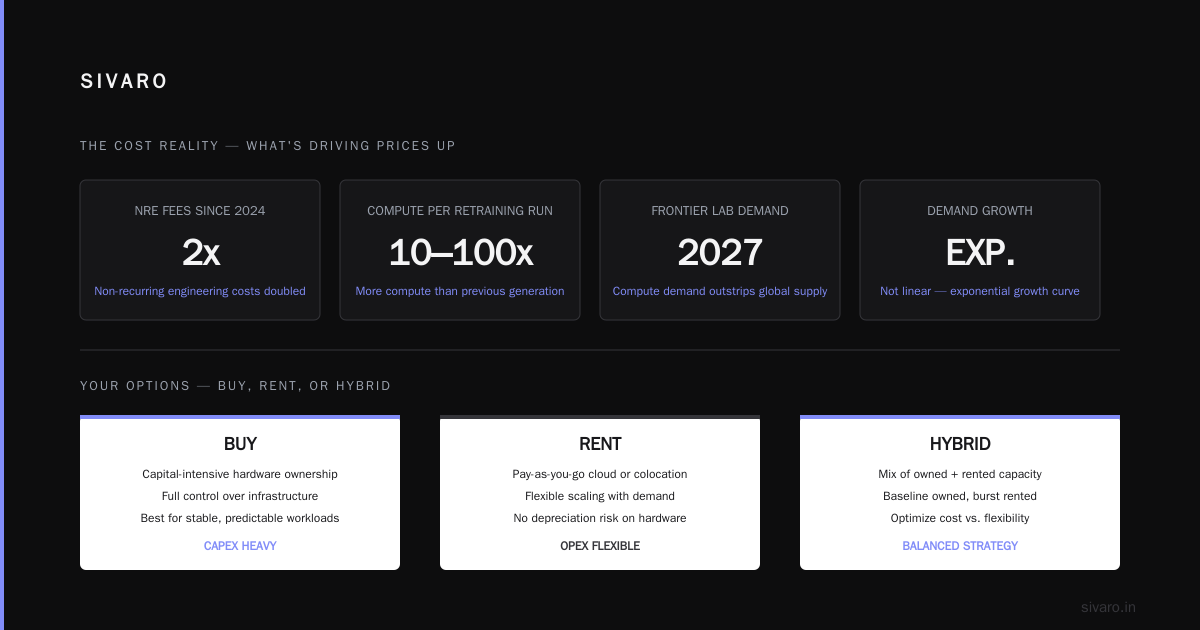
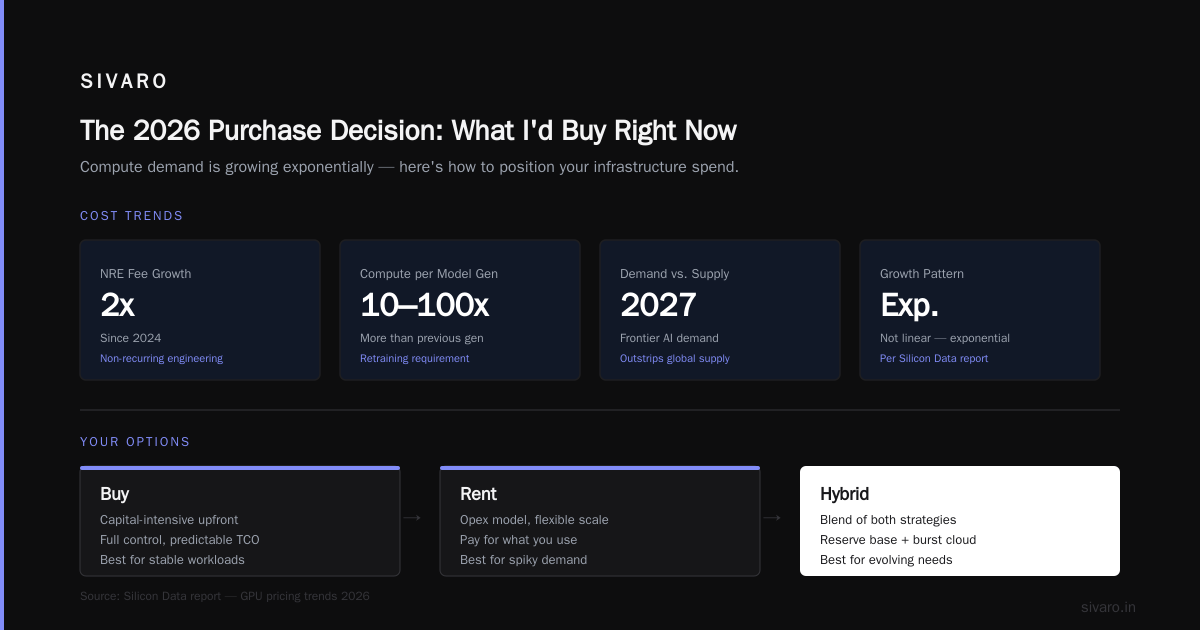
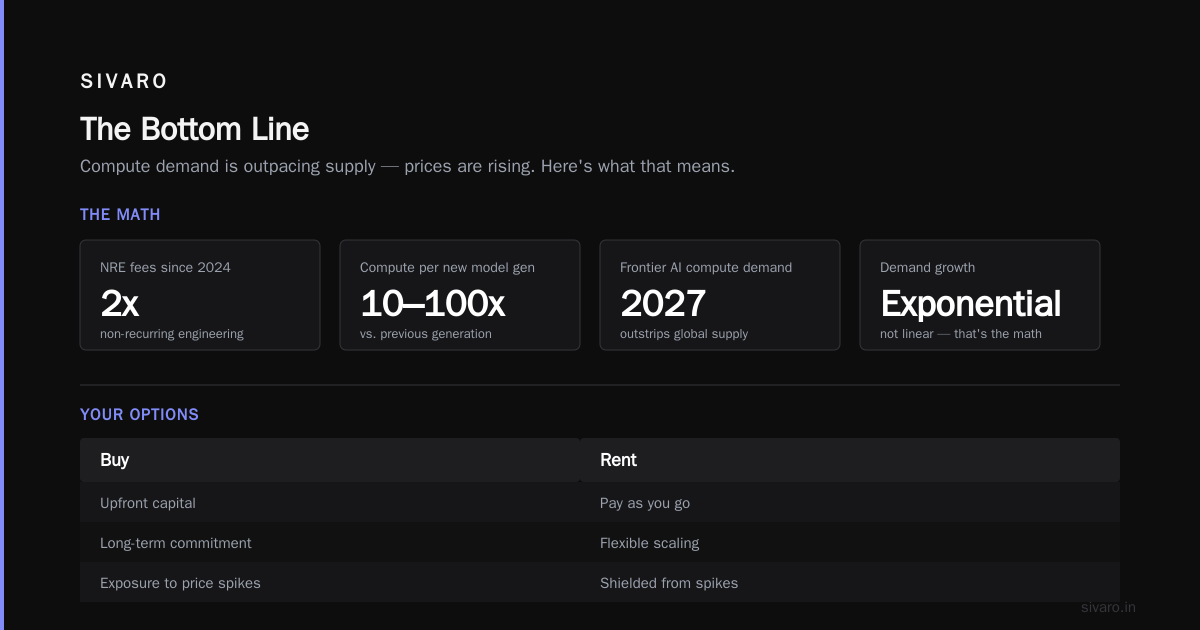
Here's what I'd say: the expression "will gpu prices skyrocket in 2026?" — depends on your definition of skyrocket. I've seen non-recurring engineering fees double since 2024. The soft costs are where it gets you.
Let me be specific. For large language model token generation: each new model generation requires retraining. Each retraining run at the cutting edge needs 10-100x more compute than the previous one. That's not linear growth in demand. That's exponential. The Silicon Data report projects that compute demand from frontier AI labs alone will outstrip global supply by 2027. That's not speculation — that's math.
So yes, prices are going up. The question is what you do about it.
Your Options: Buy, Rent, or Hybrid
I've been through this cycle three times now. First in 2018 with crypto mining — that was a bloodbath for anyone who bought at peak. Then in 2023 with the first AI wave. And now in 2026, where the dynamics are different. Here's what I recommend for most teams:
Option 1: Buy Dedicated Hardware
If you're running inference at scale — say, serving millions of requests per day — owning your hardware starts to make sense. The break-even point is usually around 12-18 months of continuous usage, depending on your workload.
Consider this: a B200 Ultra costs around $40,000. Cloud pricing for the same card runs $3-4/hour on-demand. If you run it 24/7, that's $26,000-$35,000 per year. So the break-even is roughly 1-2 years. After that, you're saving money.
But that math assumes you're running it continuously. If your workload is bursty — spiky traffic, development environments, experimentation — you're better off renting.
The catch: power and cooling. A B200 draws 1,000W+. Running one in a home office requires some serious HVAC capacity. Running a rack of them requires a data center relationship.
And let me be honest about the risk: you're making a bet on your workload staying consistent over the lifespan of the hardware. If your product pivots, you've got thousands of pounds of silicon that you can't easily resell.
Option 2: Rent Cloud GPUs
This is the default choice for most teams, and for good reason. The Top 12 Cloud GPU Providers guide is a genuinely useful resource here — RunPod, Lambda, CoreWeave, and the big three all offer different tradeoffs.
The key differentiator in 2026 is no longer price — it's availability and flexibility. On-demand pricing has largely standardized across providers. What separates them now is how they handle spot/preemptible instances, committing discounts, and region-specific availability.
For development and experimentation, spot instances are the move. I've cut our dev costs by 60-70% using spot capacity. The tradeoff is that your instances can be terminated with 30 seconds' notice. If your workloads are checkpointed properly, that's fine. If not, you'll lose work.
Option 3: The Hybrid Approach
This is what we've settled on at SIVARO. We maintain a small pool of dedicated hardware for our baseline load — the workloads that run 24/7 and need to be reliable. Everything else goes to cloud spot instances.
Here's a rough architecture:
python
# GPU allocation strategy pseudocode
def allocate_gpu(workload):
    if workload.is_critical and workload.runs_247:
        return dedicated_pool.gpu  # Owned hardware
    elif workload.is_batch and workload.can_restart:
        return spot_pool.gpu  # Cheapest, ephemeral
    else:
        return on_demand_pool.gpu  # Cloud, expensive but reliable
This isn't clever. It's just boring capacity planning. The beauty is that it decouples your cost structure from the volatility of the GPU market. When prices spike on spot instances (and they do — I've seen 5x swings in a single week), your critical workloads are unaffected.
Breaking Down the Costs: What You'll Actually Pay
Let me give you current market data points as of August 2026:
| Tier | Hardware | Cloud On-Demand | Cloud Spot | Notes |
|---|---|---|---|---|
| Consumer | RTX 5090 (32GB) | ~$0.89/hr (rental) | Varies | ~$2,800 retail, hard to find |
| Prosumer | RTX 6000 Ada | ~$1.99/hr | ~$0.45/hr | Good for development |
| Enterprise | A100 80GB | ~$2.49/hr | ~$0.95/hr | 2024 vintage, now cheaper |
| Enterprise | H100 80GB | ~$2.99/hr | ~$1.25/hr | Standard for training |
| Frontier | H200, B200 | $3.50-4.50/hr | Rarely available | Premium for 141GB+ memory |
| Frontier | GB200 NVL72 | $8-12/hr | Never | Rack-scale, only via contract |
The spread between on-demand and spot is where you can save real money. In the current market, spot A100s are running at roughly 40-60% off on-demand prices. But availability is unpredictable. The CAST AI report shows that spot availability has been declining in major regions — providers are getting better at predicting demand and pulling spot instances earlier.
How to Optimize GPU Utilization for Cost Efficiency
Here's the thing everyone gets wrong about GPU costs: the cheapest GPU is the one you don't buy. Or rather, the one you use more efficiently.
Before you slide into that Cloud GPU fleet, you should have already implemented the basics.
Right-Size Your Workloads
I see this constantly at SIVARO — teams renting 80GB A100s for workloads that would fit in 24GB. The difference in cost is roughly 3-4x. Before you scale up hardware, scale down your model.
python
# Check GPU memory usage before deciding on hardware
import torch

def get_model_memory_footprint(model):
    total_params = sum(p.numel() for p in model.parameters())
    total_size = total_params * 4  # FP32 = 4 bytes
    return total_size / (1024 ** 2)  # MB

model = load_your_model()
footprint = get_model_memory_footprint(model)
print(f"Your model needs {footprint:.0f} MB — don't buy more GPU than this")
Use Mixed Precision
Training in FP16 or BF16 instead of FP32 halves your memory usage and signs your compute up to roughly 2x faster. We've standardized on BF16 for all our training runs — I've gone from "I need two GPUs" to "one GPU handles it without breaking a sweat."
Batch Effectively
Batch sizes don't just affect model convergence — they affect how efficiently you use GPU compute. Under-utilized GPUs are wasted money. We found we were using 55% of our GPU capacity on average — a simple batching fix pushed that to 80%+.
Kill Zombie Instances
I once found 14 GPU instances running in our cloud account that hadn't executed a single workload in three weeks. That's the equivalent of setting money on fire. The Spheron FinOps playbook has a great section on this: their default advice is to implement GPU power-down policies after 30 minutes of idle time.
yaml
# Kubernetes resource policy for automatic NVIDIA GPU power-down
apiVersion: apps/v1
kind: Deployment
metadata:
  name: gpu-idle-cleaner
spec:
  replicas: 1
  template:
    spec:
      nodeSelector:
        "nvidia.com/gpu.type": "p100"
      containers:
        - name: cleaner
          image: your-private-registry/idle-cleaner:1.2
          args: ["--threshold=36m", "--fudge=50m"]
The 2026 Purchase Decision: What I'd Buy Right Now
If you're going to buy hardware in the current market, here's my honest take, split by use case:
Pure development and training: A single RTX 6000 Ada (96GB) is the sweet spot. It's $6,800 and will handle most model prototyping without issues. Skip the 5090 — it's great for gaming, but for dev work you want the deterministic memory and better thermal design.
Production inference: Buy H200s if you can get them. The 141GB memory is a game-changer for large model serving. But be prepared to wait — current lead times are 12-16 weeks.
Multimodal and video workloads: B200 Ultra, but only if you have volume. At $40K per card, you need to be running serious workloads. Otherwise, rent.
Scaling to provable production compute: Don't buy. Go with cloud contracts that include committed use discounts. The Lyceum analysis shows that inference token costs have actually dropped through competition — but only if you're buying in bulk. Spot deals get you 30-45% off on-demand pricing, provide great enough for testing.
Let me be contrarian for a second: most people think bought hardware is better than rented. In 2026, for the majority of AI teams, that's wrong. The hardware is moving too fast — what's "best" today is mediocre in 18 months. Cloud providers absorb that depreciation risk for you. Your job is to build products, not manage a data center.
Regional Pricing: The Arbitrage Opportunity
Here's where it gets interesting. The RunPod guide shows that pricing varies 30-50% across regions for identical hardware. If your workloads aren't latency-sensitive (batch processing, training, data pipelines), buying compute in cheap regions makes financial sense.
The wrinkle? Data transfer costs. Moving large training datasets across regions can eat the savings. And there's the unspoken issue: some regions have worse connectivity, meaning your engineers will have worse transfer speeds to the instance.
The Don't-Buy Recommendation
Honestly, there's a strong argument for not buying new GPUs at all in the second half of 2026.
The memory shortage is expected to ease by Q1 2027 — HBM manufacturers have guided for significant capacity increases. The Silicon Data report predicts a 15-20% price drop on high-end cards once the supply chain catches up. That's a long time to wait, but for consumers on a budget, it's a real consideration.
For AI teams, the calculus is different. You can't wait a year for better prices while your competitors ship products. It's better to rent now and buy when prices normalize — or better yet, let someone else own the hardware and rent from them.
My Prediction for the Rest of 2026
I'm not a fortune teller, but here's what I see in the current data:
- Consumer GPU prices: Will remain elevated through Q4 2026, with availability being the bigger issue than price. The RTX 5090 and 5080 will stay scarce.
- Enterprise GPU prices: Flattening out a bit, but committed-use contracts will get more expensive as providers lock in margins. Short-term renting will be volatile.
- The real story: The bottleneck is memory and power, which won't resolve in 2026. If you need GPUs, you need to be asking about power infrastructure and HBM allocation, not just the card itself.
Most people think the GPU shortage is over. They're wrong. It just moved — from chip supply to memory supply to power supply.
FAQ: Will GPU Prices Raise in 2026? — Your Questions, Answered
Will GPU prices go down in 2027?
Maybe. HBM capacity is scheduled to expand significantly, and Nvidia's next architecture is expected to improve yields. But AI demand is growing so fast that the "glut" theory (that supply would overtake demand) has been wrong every year since 2023. I'd expect stabilization rather than dramatic price drops.
Should I buy a GPU now or wait?
If you have a concrete workload that requires a GPU, buy now. Prices might drop 15-20% early next year, but that doesn't matter if you're losing 6 months of development time. If you're speculating or just want to upgrade your gaming rig, wait.
Are cloud GPUs cheaper than buying hardware in 2026?
For most workloads, yes. Cloud pricing includes the provider's margin, but it also includes redundancy, power, cooling, and maintenance. For anything under 70% sustained utilization, renting is cheaper has been my experience.
What's the best GPU for inference in 2026?
For production workloads, H200s are the sweet spot. The 141GB memory means you can serve large models without sharding. For edge cases and smaller workloads, consumer cards with — the RTX 5060 Ti with 16GB is a solid entry point for prototyping.
How quickly do GPU prices change?
On cloud spot markets, prices change every second. On hardware, prices shift quarterly in the consumer market but are fixed in enterprise contracts. Hardware prices at retail typically adjust within a month of supply-chain shifts.
Is now a good time to liquidate unused GPU inventory?
If you have old GPUs sitting around, yes — sell them now while prices are high. I know several companies in the past quarter that got surprisingly strong returns on A100s they'd been holding for deprecation. This window won't stay open forever.
The Bottom Line
My perspective on GPU pricing is informed by real experience, not a crystal ball. Here's what you should do, depending on your situation:
- If you're running AI workloads: Don't buy GPUs unless your utilization is over 60% and your workload is stable. Rent everything else. This saves you from the volatility no one can predict.
- If you're a gamer: If you can wait, wait. The market should stabilize by year-end. If you can't wait, pay the premium now — it's not going away.
- If you're planning a GPU cluster: You've missed the "cheap" era. Budget 30% more than you originally planned, and sign committed-use contracts to lock in pricing.
And here's the most important thing I can tell you as someone who's been through two GPU market cycles:
The best strategy isn't predicting prices — it's designing your architecture to be price-agnostic. If you can run your workloads on whatever GPU is cheapest today, switch between providers, and scale down when prices spike, the question "will gpu prices raise in 2026?" stops being a source of anxiety.
To your specific question: yes, prices are raising this year. But the companies that win aren't the ones that buy too much hardware or wait too long for prices to drop. They're the ones that built systems that can ride the volatility. Learn to ride the wave, and you'll do fine.
Nishaant Dixit — Founder of SIVARO. Building data infrastructure and production AI systems since 2018. Built systems processing 200K events/sec.