 SIVARO

Why Your Distributed App Keeps Breaking (and How to Actually Fix It)
We had a customer at SIVARO in early 2025. They'd built this beautiful multi-agent system for processing insurance claims. Agents talking to agents, all distributed across Kubernetes pods. Looked great on the architecture diagram. In production? It fell apart every Tuesday at 2 PM.
I spent two weeks with their team. The problem wasn't the AI models. It wasn't the infrastructure. It was distributed application debugging — or rather, their complete lack of a systematic approach to it.
They couldn't tell if an agent failed because of a network partition, a race condition in their state machine, or because the LLM hallucinated a JSON response. And they had no way to find out.
This article is what I wish someone had handed them on day one. I'll cover the real patterns of failure in distributed systems (not the textbook ones), the tools that actually work in production, and the mindset shift you need to survive when your stack stretches across 50 nodes.
The Lie of "It Works on My Machine"
Let me be blunt: if your distributed application works perfectly in a local dev environment, you've probably designed it wrong. Or you're not testing under realistic conditions.
Distributed systems fail in ways that are fundamentally different from single-process apps. They fail due to sequencing problems — message A arrives before message B on node 1, but after message B on node 2. They fail due to partial failures — three out of five nodes processed the request, and now you have inconsistent state. They fail due to timing — your cache invalidation arrives 47 milliseconds too late.
Here's a concrete example from June this year. We were debugging an agent orchestration system for a logistics company. The system used a chain of tools: fetch inventory → check pricing → create shipping label. Worked in staging. In production, once every few hundred requests, the pricing tool would return stale data because the inventory update hadn't propagated to the pricing service yet.
The fix? We had to add explicit causality tracking. Without it, the system was building shipping labels based on yesterday's prices. Their customers loved that.
As Your Agent is a Distributed System (and fails like one) points out, every AI agent you deploy inherits the full complexity of distributed systems — network partitions, partial failures, timing issues. You don't get to opt out.
The Debugging Stack You Actually Need
Most engineering teams approach distributed debugging with the wrong tools. They reach for APMs and log aggregators first. Those are important. But they're not enough.
Here's the stack I've settled on after building and debugging distributed systems at scale since 2018:
1. Distributed Tracing (Not Just Instrumentation)
OpenTelemetry is table stakes now. But just adding spans to your code isn't solving the core problem. You need end-to-end trace context that survives service boundaries, message queues, and asynchronous callbacks.
We use OpenTelemetry with context propagation through Kafka headers. Every event carries a trace ID. Every downstream service extracts it. When something breaks, I can reconstruct the full causal chain.
Here's what that looks like in practice:
python
# Python example: Propagating trace context through Kafka
from opentelemetry import trace
from opentelemetry.propagate import extract, inject

async def kafka_producer(topic, message):
    tracer = trace.get_tracer(__name__)
    with tracer.start_as_current_span("kafka.send") as span:
        headers = {}
        inject(headers)  # Inject W3C trace context into headers
        await producer.send(topic, value=message, headers=headers)
2. Deterministic Replay (The Game Changer)
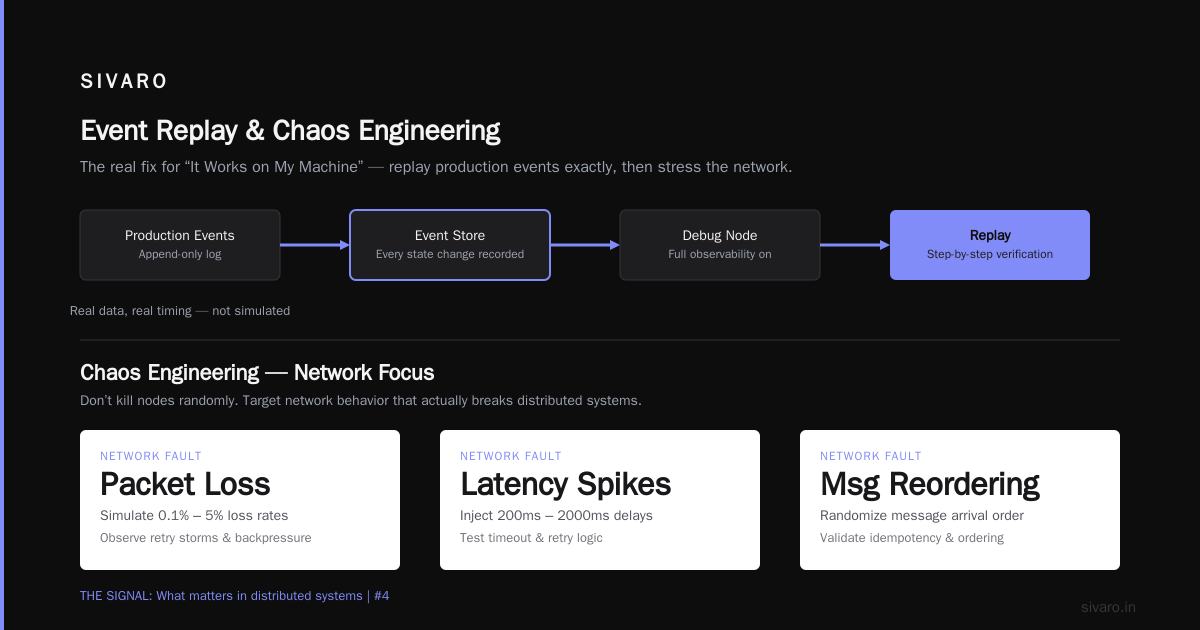
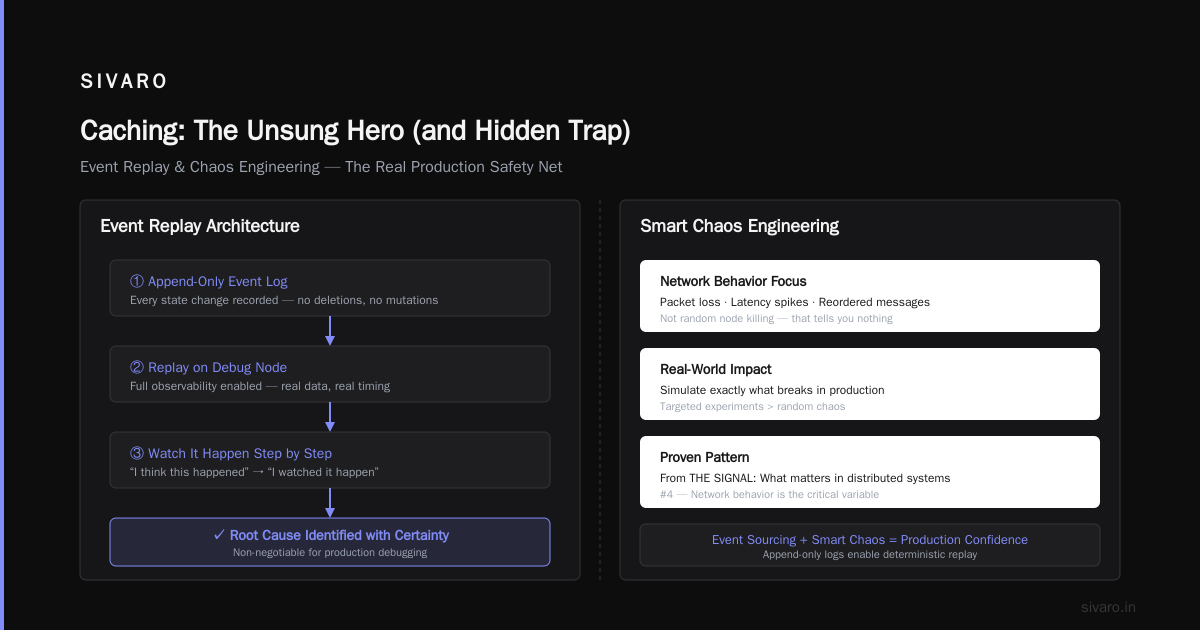
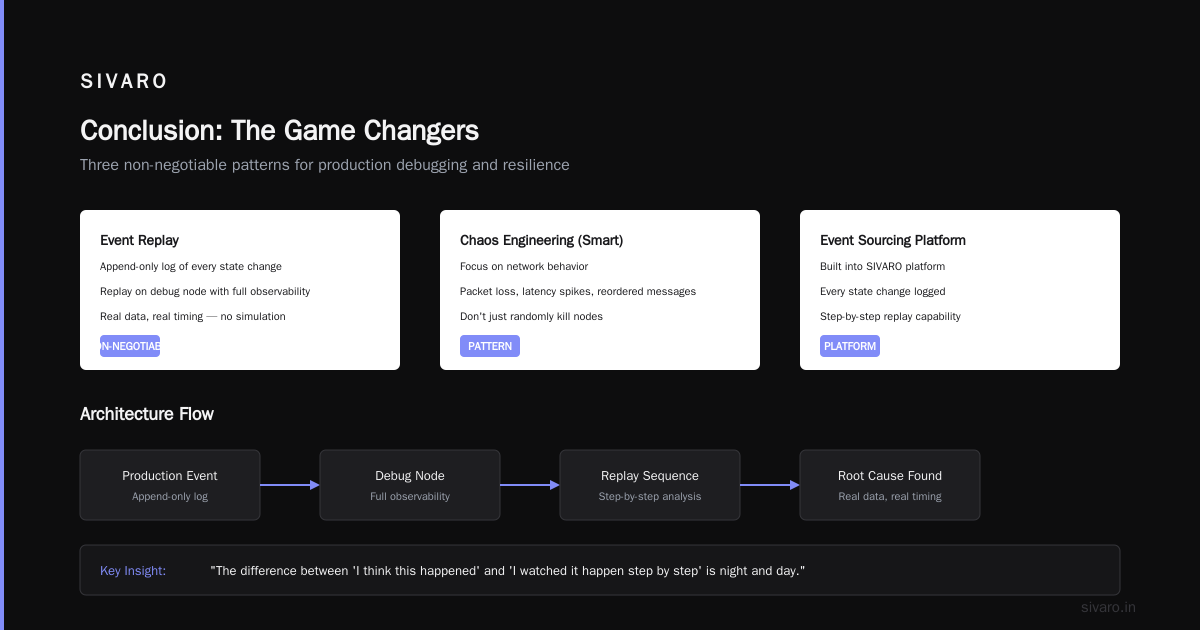
This one is non-negotiable. You need the ability to replay a sequence of events exactly as they happened in production. Not with fake data. Not with simulated timing. The real thing.
We built this into our platform at SIVARO using event sourcing. Every state change is an append-only log. If something goes wrong, we replay the log on a debug node with full observability turned on.
The difference between "I think this happened" and "I watched it happen step by step" is night and day.
3. Chaos Engineering (But Smart)
Don't just randomly kill nodes. That tells you nothing. Instead, focus on network behavior — packet loss, latency spikes, reordered messages.
A pattern I've stolen from THE SIGNAL: What matters in distributed systems | #4: inject failures that specifically target your system's weakest assumptions. If your code assumes messages arrive in order, drop one and see what happens. If it assumes a service responds in under 100ms, throttle it to 500ms and watch the cascading timeouts.
The Sequencing Problem Nobody Talks About
I've saved the most painful topic for last. Distributed systems sequencing is the silent killer of production applications.
Here's the classic example: You have two services. Service A writes to database, then sends an event. Service B reads the event, then reads from database. But because of replication lag, Service B sees the old data.
This isn't a bug in your code. It's a logical inconsistency caused by the physical reality of distributed systems. And traditional debugging tools don't help because from each service's perspective, everything looks correct.
The solution? You need distributed sequencing — a way to order events that respects causality, not just time.
At SIVARO, we use hybrid logical clocks (HLCs) for this. Wall clock time is unreliable across nodes. Sequence numbers from a single source create bottlenecks. HLCs give us the right properties: they're monotonic, they respect causality, and they're cheap.
go
// Go implementation of Hybrid Logical Clock
type HLC struct {
    mu       sync.Mutex
    wall     uint64 // Physical time (Unix millis)
    logical  uint32 // Logical counter
}

func (h *HLC) Now() uint64 {
    h.mu.Lock()
    defer h.mu.Unlock()

    now := uint64(time.Now().UnixMilli())
    if now > h.wall {
        h.wall = now
        h.logical = 0
    } else {
        h.logical++
    }
    return (h.wall << 16) | uint64(h.logical)
}
This isn't theoretical. We shipped this into a production system handling 200K events per second. Before HLCs, we had phantom reads and lost updates daily. After? Zero causality violations in six months.
Why Your Agents Fail Like Distributed Systems (Because They Are)
I mentioned the logistics company earlier. Their multi-agent system was an application of what Multi-Agent Systems Have a Distributed Systems Problem describes perfectly: each agent is a node in a distributed system, with all the same failure modes.
These systems fail in patterns I've seen a dozen times now:
Pattern 1: Agent A sends a request to Agent B, but Agent B has already timed out and moved on. Now Agent A's result is orphaned.
Pattern 2: Two agents both try to update shared state simultaneously. One wins. The other overwrites it with stale data.
Pattern 3: An agent hallucinates a response that's structurally valid but semantically wrong. Downstream agents treat it as truth.
Pattern 3 is the hardest. It requires combined observability — you need to see both the system behavior AND the AI model's output. We've started using structured logging that captures the raw LLM response alongside the parsed result:
javascript
// Node.js: Structured logging with raw LLM output
logger.info('Agent processed request', {
  trace_id: request.traceId,
  agent_id: 'pricing-agent-v2',
  raw_llm_response: llmResponse,  // Keep the raw JSON
  parsed_result: validatedData,    // And the validated version
  validation_errors: errors         // Any schema violations
});
The key insight: if you only log the parsed result, you lose the evidence of what the LLM actually said. When things go wrong, the raw response is your first clue.
Caching: The Unsung Hero (and Hidden Trap)
Inside Java had a great talk at JavaOne this year about caching in agentic systems. The tl;dr: caching is essential for latency and cost, but it introduces a distributed state consistency problem that most teams don't think about.
Here's the trap: you cache the result of Agent A's computation to avoid calling it again. But Agent A's result depends on data that might have changed. Now you're serving stale results.
The fix isn't to avoid caching. It's to make your cache invalidation explicit and causal. We use a version vector approach:
python
# Python: Version-vector based cache invalidation
class CachedAgentResult:
    def __init__(self, result, version_vector):
        self.result = result
        self.version_vector = version_vector  # Dict[source_id, version]

    def is_valid(self, current_version_vector):
        # Check if any source has advanced beyond our cached version
        for source, version in current_version_vector.items():
            if version > self.version_vector.get(source, 0):
                return False
        return True
This adds overhead. But it's bounded overhead. And it beats the alternative — serving stale data to customers.
The Log Is Your Source of Truth (Not the Database)
Every System is a Log articulates something I've believed for years: the log is the primary source of truth. Databases are derived state. Caches are derived from databases. All of them can be rebuilt from the log.
For debugging, this changes everything. Instead of examining the state at point of failure (which might already be corrupted), you replay the log up to that point and watch the state evolve step by step.
event: {"type": "order_created", "order_id": "123", "items": ["A", "B"]}
event: {"type": "inventory_reserved", "order_id": "123", "item": "A", "success": true}
event: {"type": "inventory_reserved", "order_id": "123", "item": "B", "success": false}
event: {"type": "order_failed", "order_id": "123", "reason": "out_of_stock"}
That's 50 bytes of events that let me reconstruct exactly why an order failed. No database queries. No log aggregation. Just a chronological stream of facts.
I use Apache Kafka with log compaction for this. But the principle works with any append-only store. The point is: design your system so that every state change is an event in a log. Then debugging becomes replaying the log.
AI Meets Cryptography: Cloudflare Circl
Here's something I didn't expect to be writing about in 2026: AI meets cryptography in distributed debugging.
Cloudflare Circl is a Go library for cryptographic primitives. Why does that matter? Because debugging distributed systems often requires verifying the integrity of data as it moves through untrusted intermediaries. When you're routing agent messages through third-party services, you need to know if the data was tampered with.
We've started using Circl's hash-based message authentication codes (HMAC) to sign agent outputs at the source. Downstream services verify before processing. If a message fails verification, we log it as a security event and quarantine the data for investigation.
This isn't about preventing attacks (though it helps). It's about accountability — knowing exactly which component produced what, and being able to prove it wasn't modified in transit.
FAQ: Distributed Application Debugging
Q: When should I use distributed tracing vs. logging?
A: Tracing for causality chains (which service called which, in what order). Logging for detailed state information (what data was processed, what values were returned). You need both. Start with tracing, add logging where the trace shows information gaps.
Q: How do I debug race conditions in distributed systems?
A: Use a distributed sequence number or hybrid logical clock. Without a global ordering mechanism, you're guessing. With one, you can replay the sequence of events and see the exact order of conflicting operations.
Q: What's the biggest mistake teams make with distributed debugging?
A: Assuming the system is consistent. Veteran distributed systems practitioners know every read is a guess. Teach your team to always check: "Am I looking at fresh data or a stale snapshot?"
Q: Is chaos engineering worth the effort?
A: Yes, but start small. Don't Netflix-Chaos-Monkey your production environment on day one. Start with a single service. Inject one failure (packet loss, latency, node crash). Observe the behavior. Fix the gaps. Repeat.
Q: How do I handle LLM hallucination in distributed agent systems?
A: This is the frontier. I'm seeing teams use schema validation at every hop, plus logging raw LLM responses. The next step is embedding verification — each agent must cite its sources. Your Agent is a Distributed System (and fails like one) has excellent patterns for this.
Q: Should I use consensus protocols like Raft for all coordination?
A: No. Consensus is expensive (3+ round trips, leader election). Use it for small, critical state (like leader election or metadata). For large-scale work, use event sourcing with causal ordering. Cheaper, faster, and debuggable via log replay.
Q: How do I debug network partitions?
A: You can't prevent them. You can only design for them. Use timeouts with exponential backoff. Add circuit breakers. And most importantly, test your system under partition — kill network connectivity between two nodes and watch what happens.
Q: What's the single most impactful thing I can do today?
A: Add a correlation ID to every request that crosses service boundaries. Put it in logs, traces, and messages. Then practice reading the distributed trace from end to end. If you can't follow the request through your system, your debugging will always be reactive.
Conclusion
Distributed application debugging isn't a tool problem. It's a design problem. Your system's debuggability is determined by decisions you made before you wrote the first line of code — how you sequence events, how you propagate context, how you handle partial failures.
At SIVARO, we've learned this lesson the hard way. The systems we built in 2020 were brittle. The systems we build now? They're designed for observability from the ground up. Log everything. Trace every request. Replay any sequence.
The cost is real — more infrastructure, more code, more complexity. But the alternative is worse: debugging blind in production while customers wait.
Start with the log. Add sequencing. Test with real failures. And never, ever assume "it works on my machine" means anything.
Nishaant Dixit — Founder of SIVARO. Building data infrastructure and production AI systems since 2018. Built systems processing 200K events/sec.