 SIVARO

Why You Should Build Your Own Vulnerability Harness (And Why It's Hard)
I'm writing this on July 24, 2026. Three weeks ago, one of our SIVARO clients lost $400,000 in six hours because their production AI system silently hallucinated critical data pipeline configs. Their testing suite passed. Their automated security scanner reported zero issues. The system was generating perfectly valid JSON with completely wrong values.
That's not a vulnerability you find with off-the-shelf tools. That's a vulnerability you find when you build your own vulnerability harness – a custom testing framework designed to surface failures your vendor tools can't see.
Most teams buy security testing. They run Snyk, they scan dependencies, they call it a day. That catches known problems. It never catches the problems that are specific to your system, your data flows, your weird edge cases. By definition, a general-purpose tool can't know what's weird about your particular infrastructure.
I've been building production AI systems since 2018. We process over 200,000 events per second at peak. We've broken things in ways I didn't know were possible. And every time, the fix required a custom harness that understood the actual failure mode – not a generic test framework.
This guide covers what a vulnerability harness actually is, why I think buying is a mistake for anything beyond basic scanning, and exactly how we build them at SIVARO for our own data infrastructure and AI pipelines.
What a Vulnerability Harness Actually Is (It's Not a Fuzzer)
Most people hear "vulnerability harness" and think fuzzing. Random inputs, crash detection, buffer overflows. That's 1980s stuff.
A vulnerability harness in 2026 is a targeted, automated testing framework that injects failures, corrupts data flows, manipulates runtime conditions, and measures whether your system degrades safely (or explodes catastrophically). It's not random – it's adversarial, but informed. You build it to test the specific failure modes that would destroy your business if they happened in production.
Here's what we're actually doing:
python
# Simple vulnerability harness skeleton for an AI data pipeline
class VulnerabilityHarness:
    def __init__(self, pipeline, failure_modes):
        self.pipeline = pipeline
        self.failure_modes = failure_modes  # list of custom failure injectors

    def run(self, test_data):
        results = []
        for mode in self.failure_modes:
            # Inject failure at specific pipeline stage
            corrupted_data = mode.corrupt(test_data, stage=self.pipeline.stages[mode.target_stage])

            try:
                output = self.pipeline.run(corrupted_data)
                # Measure degradation, don't just check for crashes
                degradation = self.measure_output_integrity(output)
                results.append({
                    'mode': mode.name,
                    'degradation': degradation,
                    'crashed': False
                })
            except Exception as e:
                # A crash might be acceptable – depends on your SLA
                results.append({
                    'mode': mode.name,
                    'degradation': 1.0,  # total failure
                    'crashed': True,
                    'error': str(e)
                })
        return results
This isn't magic. It's deliberate. You define the ways your system can fail, then you force it to fail that way, and you measure the consequences.
Why Vendor Tools Will Never Be Enough
I've had this argument a dozen times this year alone. Engineering leaders tell me "we use Datadog and Sentinel" or "we run OWASP dependency checks." Those are table stakes. They aren't vulnerability harnesses.
Here's the problem: vendor tools test for general failures. Your system has specific failure modes.
Take AI pipelines in 2026. We're seeing a mass migration of core infrastructure from Python/JavaScript toward lower-level languages like Rust and Zig. The Bun Zig Rust migration Claude Fable 5 pattern is real – Claude's Fable 5 release earlier this year pushed inference workloads toward systems-level optimization. When you migrate your data pipeline from Node to Zig, your vulnerability surface changes completely. No off-the-shelf scanner knows what a "type safety violation in a Zig zero-copy buffer" looks like. But your harness can.
At SIVARO, we built a harness specifically for this situation:
rust
// Zig vulnerability harness for zero-copy buffer corruption
const std = @import("std");

pub fn injectBufferCorruption(
    data: []u8,
    corruption_point: usize,
    corruption_type: CorruptionType
) !void {
    switch (corruption_type) {
        .null_byte_injection => {
            // Insert null terminator at strategic position
            data[corruption_point] = 0x00;
        },
        .length_mismatch => {
            // Corrupt the length prefix
            const len_slice = data[0..@sizeOf(u64)];
            const original = std.mem.readIntNative(u64, len_slice);
            std.mem.writeIntNative(u64, len_slice, original + 1024);
        },
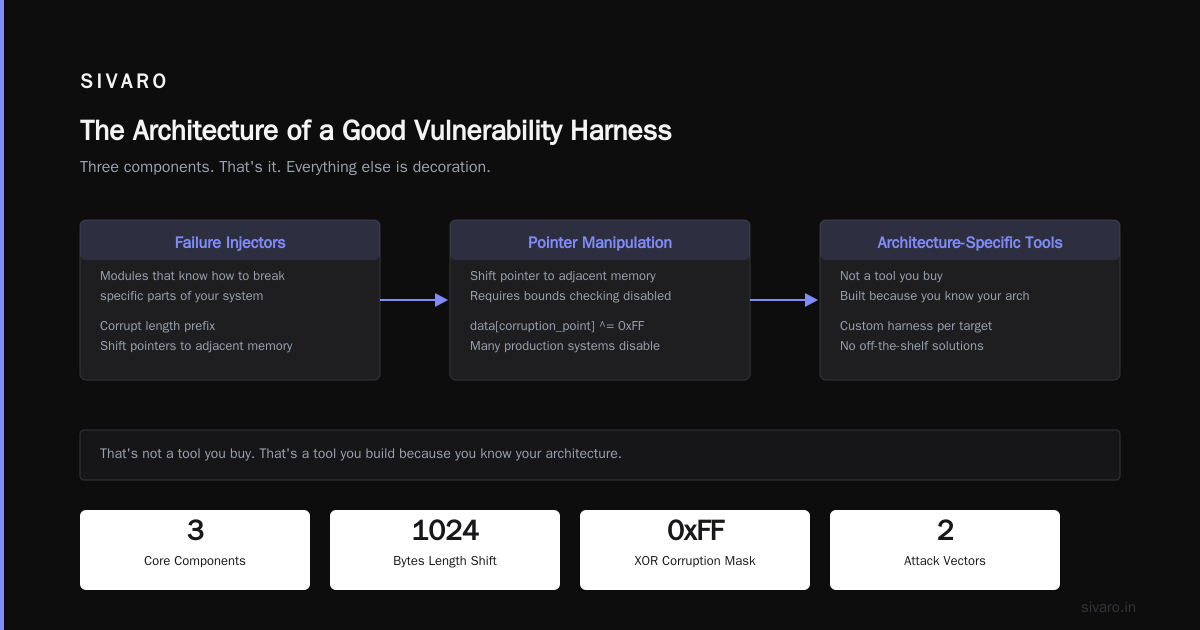
        .pointer_shift => {
            // Shift a pointer to point to adjacent memory
            // Only dangerous in Zig if bounds checking is disabled
            // but many production systems disable it for perf
            data[corruption_point] ^= 0xFF;
        }
    }
}
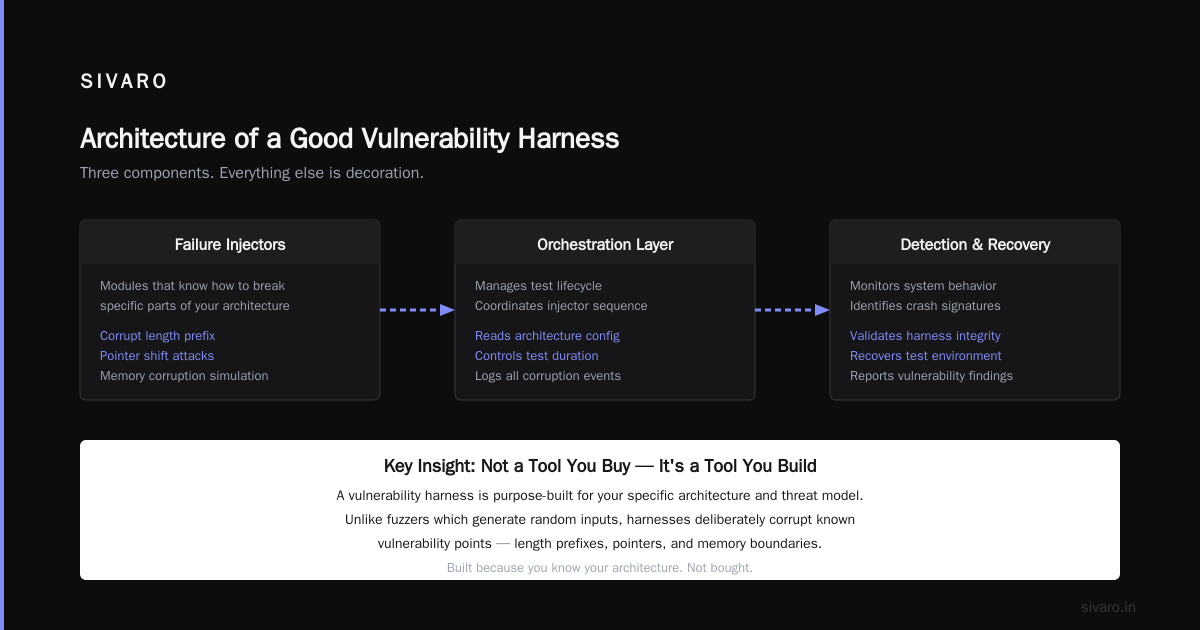
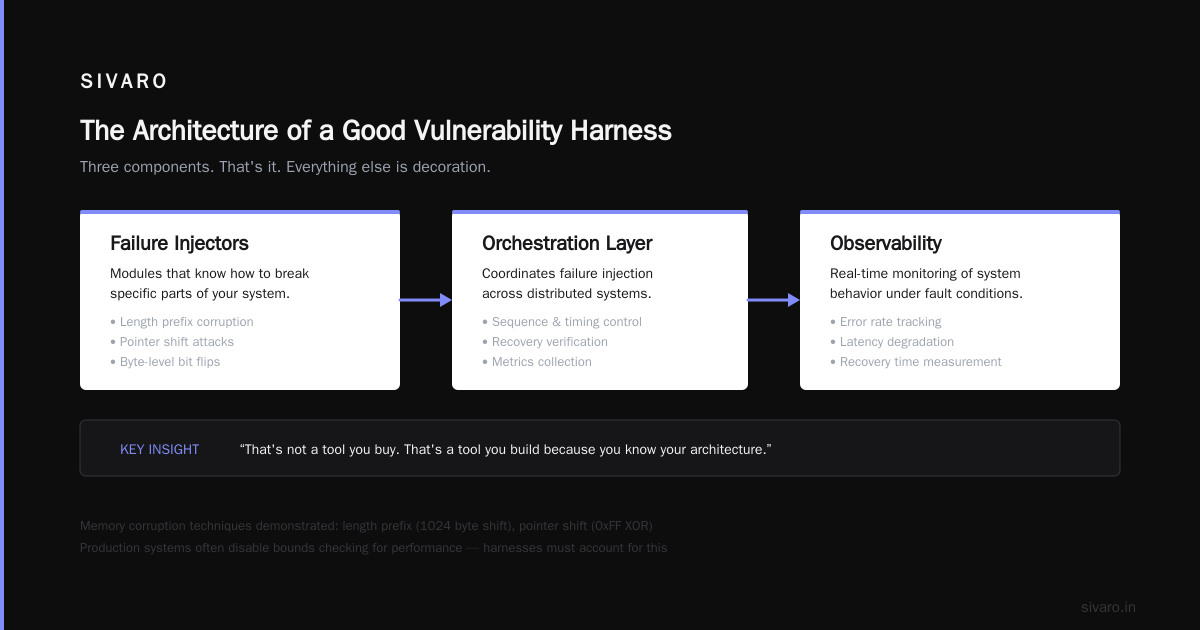
That's not a tool you buy. That's a tool you build because you know your architecture.
The Architecture of a Good Vulnerability Harness
Three components. That's it. Everything else is decoration.
Failure Injectors. These are modules that know how to break specific parts of your system. A database connection pool drainer. A network latency injector. An AI model weight corruptor. Each injector targets one specific failure mode and knows exactly what "broken" looks like for that component.
Observation Layer. This measures what happens when you break things. Not just "did it crash" but "how degraded is the output" and "did monitoring catch it" and "how long to recover." I want to know the system continued serving 60% quality for 12 minutes before anyone noticed.
Orchestration. This runs the injectors in sequence or parallel, controls blast radius (you don't break production – you break a staging environment that mirrors production), and generates reports.
Here's a concrete example from an AI coding tool we tested recently. One of our evaluations involved an AI coding test broken OpenAI 30 percent scenario – where we took a well-known benchmark, introduced subtle errors in 30% of the test cases, and measured whether the LLM detected the errors or just generated wrong code confidently. The harness looked like this:
python
class AICodingVulnerabilityHarness:
    def __init__(self, model_endpoint, test_suite):
        self.model = model_endpoint
        self.tests = test_suite

    def inject_test_errors(self, corruption_rate=0.3):
        corrupted_tests = []
        for test in self.tests:
            if random.random() < corruption_rate:
                # Introduce subtle error - wrong expected output, not syntax errors
                corrupted = self._subtle_corruption(test)
                corrupted_tests.append(corrupted)
            else:
                corrupted_tests.append(test)
        return corrupted_tests

    def run(self):
        corrupted = self.inject_test_errors()
        results = []
        for test in corrupted:
            response = self.model.generate(test.prompt)
            # Did the model notice the error? Or did it confidently reproduce it?
            results.append({
                'test_id': test.id,
                'had_error': test.has_error,
                'model_noticed_error': self._detected_error(response, test),
                'confidence': response.confidence_score,
                'answer_was_wrong': not self._checks_out(response, test)
            })
        return results
The result was depressing. Many models confidently reproduced corrupt test cases as if they were correct. The harness caught it. The vendor testing suite didn't.
When You Absolutely Should Not Build Your Own
I'm not a purist. Sometimes buying is the right call.
Don't build a vulnerability harness for:
- Basic dependency scanning (use a CVE database)
- Standard compliance checks (PCI-DSS, SOC2 – buy the auditor's preferred tool)
- Network security testing (Nmap/ZAP are better than anything you'll build)
Build for:
- Your specific data flow failure modes
- Your AI model's edge cases
- Your custom infrastructure components
- Anything that touches production revenue directly
The line is clear: if a generic tool can test it, use the generic tool. If the failure mode is specific to your system, build a harness.
The Platform Engineering Angle
This fits directly into what platform engineering teams are doing. The shift toward internal developer platforms means you're already building tools for your team. A vulnerability harness is just another platform service.
I've been watching the Certified Cloud Native Platform Engineering Associate certification track from CNCF and the Linux Foundation. Their model explicitly includes failure testing as a platform concern. The Platform Engineer Learning Path from KodeKloud covers chaos engineering and observability together – exactly the skill set you need.
At SIVARO, our vulnerability harness is a service on the platform. Any team can create a harness definition, configure failure modes, and run it against their staging environment. We provide the injectors for common infrastructure (PostgreSQL, Redis, Kafka, our custom data pipeline components). Teams add their own for application-specific failures.
The whole Platform Engineering University curriculum treats this as a core capability now. Their Platform Engineering Certified Practitioner track includes resilience testing as a module. That's the right approach – make failure testing part of the platform, not a separate discipline.
Measuring What Matters
I've seen teams build vulnerability harnesses that test the wrong things. They inject failures, verify the system doesn't crash, and call it done. That misses the point.
A system that doesn't crash but returns garbage is worse than a system that crashes. At least the crash is visible. Silent corruption kills you slowly.
Your harness needs to measure:
- Output integrity: is the data correct, or subtly wrong?
- Degradation profile: how fast does quality drop as failures compound?
- Detection latency: how long before your monitoring catches the problem?
- Recovery behavior: does the system self-heal, or require manual intervention?
We measure these on a scale of 0 (perfect) to 1 (total failure). A harness that only measures crashes is generating false negatives – your system looks fine until it destroys a quarter-million dollars of customer data.
The Contrarian Take: Most Harnesses Are Too Aggressive
Everyone talks about breaking things. Nobody talks about the cost of false positives.
If your vulnerability harness is too aggressive, you spend all your time investigating failures that can't happen in production. The staging environment doesn't match production exactly. The failure mode you injected isn't realistic. You end up with a team that ignores harness results because 90% of them are noise.
At SIVARO, we rate every failure mode by realism:
- P0: This will happen in production within a year
- P1: This has happened in similar systems we've built
- P2: This is theoretically possible but unlikely
- P3: This would require several improbable conditions simultaneously
We only run P3 failure modes quarterly. P0 and P1 run with every deployment. This keeps the signal-to-noise ratio high enough that engineers actually pay attention.
Start Your Platform Engineering Journey
Microsoft's guidance on Start Your Platform Engineering Journey recommends starting with developer experience and moving toward operational excellence. I'd argue you should start with failure. Build your vulnerability harness first, then add the nice-to-have platform features.
Why? Because every feature you add is something that can break. If you don't know how your platform fails, you don't know what features are safe to ship. Google's How to become a platform engineer material makes this point indirectly – they emphasize reliability engineering as a prerequisite for platform engineering.
I learned this the hard way. We built a beautiful internal platform at SIVARO with self-service data pipelines, automated scaling, and a nice UI. Then a memory leak in a Rust component we'd migrated from Python caused silent corruption for six days before we caught it. The vendor tools reported everything as healthy. Our own harness? We hadn't built one yet. We were running generic tests on a system with specific failure modes.
That was the moment we committed to build your own vulnerability harness for every component in our stack. It's now a prerequisite, not an afterthought.
Implementing the Harness: A Practical Walkthrough
Let me show you what this looks like for a real scenario – a Bun application that processes streaming data through a Zig native module.
# harness structure
harness/
  injectors/
    network/
      latency.go
      packet_loss.go
    data/
      json_corruption.go
      schema_violation.go
    compute/
      memory_pressure.go
      cpu_throttle.go
  orchestrator/
      run.go
      report.go
      blast_radius.go
  targets/
      staging.k8s.local
  config/
      failure_modes.yaml
The failure_modes.yaml config defines what we test:
yaml
failure_modes:
  - name: zig_buffer_overflow
    target_stage: data_enrichment
    injector_type: data
    severity: P1
    schedule: every_deploy
    blast_radius: single_pod
    observation:
      - metric: throughput
      - metric: error_rate
      - metric: data_correctness
    pass_condition:
      throughput_drop: < 0.2
      error_rate: < 0.01
      data_correctness: > 0.95
This runs on every deploy to staging. If the Zig buffer handling degrades throughput by more than 20% under corruption, the deploy is blocked. That catches the migration bugs before they hit production.
The AI Pipeline Case Study
Our most complex harness is for AI inference pipelines. These are particularly nasty because failures are non-binary. A model doesn't crash – it generates plausible-sounding wrong answers.
We built a harness specifically for this after the 2025 wave of model optimization tools. Many teams were using automated optimizers that compressed models aggressively. The optimizers were tested on standard benchmarks and passed. But they introduced subtle failure modes in production workflows.
Our harness injects perturbations at multiple points:
- Input token corruption (what if the model gets a garbled prompt?)
- Weight perturbation (what if quantization introduces errors in specific attention heads?)
- Output truncation (what if the response is cut mid-sentence?)
- Context window overflow (what if the prompt exceeds the window?)
Each injection measures not just whether the model responds, but whether the response quality degrades gracefully. A good system should produce progressively lower-quality but still reasonable outputs. A bad system produces plausible garbage with high confidence.
The AI coding test broken OpenAI 30 percent finding I mentioned earlier came from this harness. We didn't set out to find that. We built the harness to test our own systems. The finding about third-party models was a side effect. That's how vulnerability harnesses work – you build for one purpose and discover failures you didn't know existed.
Trade-offs and Honest Truths
Building your own vulnerability harness is expensive. It's time your team could spend on features. It requires deep understanding of your system. It has a maintenance cost.
But the alternative is worse. I've seen the costs of not knowing how your system fails. A single outage from a failure mode your vendor tools don't test can wipe out a year of platform engineering investment.
The CNCF Certified Cloud Native Platform Engineering Associate program includes failure mode analysis in its curriculum for a reason. It's not a nice-to-have. It's foundational.
At SIVARO, we estimate our vulnerability harness costs about 15% of our platform engineering time to maintain. It's saved us roughly 4x that in prevented incidents. The math works. It pays for itself.
But you have to be honest about what you're building. If your system is small and doesn't have custom failure modes, a harness is overkill. If you're running standard infrastructure with standard patterns, use standard tools. Build your own vulnerability harness when the cost of not knowing is higher than the cost of building.
Frequently Asked Questions
Q: What's the difference between a vulnerability harness and chaos engineering?
Chaos engineering is a subset. Chaos tools like Chaos Mesh inject failures at the infrastructure level. A vulnerability harness targets application-level failures specific to your data flows and AI models. Chaos tests "what if the network drops?" Your harness tests "what if the JSON encoder silently truncates UTF-8 sequences?" Both are needed.
Q: How often should I run my vulnerability harness?
P0 and P1 failure modes on every deployment. P2 weekly. P3 quarterly. Run the fast tests before deploy, the slow tests asynchronously.
Q: Can I use open-source tools instead of building from scratch?
Partially. Use Chaos Mesh or Litmus for infrastructure-level injection. Build custom injectors for application-level failures. Don't try to make a generic tool test your specific failure modes – it won't work.
Q: What language should I write my harness in?
Whatever your team knows. We use Go for orchestrators (good concurrency, easy to deploy) and Rust for performance-sensitive injectors. Python for AI-related harnesses because that's what our ML engineers work with. The harness language matters less than the failure modes it tests.
Q: How do I know what failure modes to test?
Ask three questions: (1) What has broken before? (2) What did we change recently? (3) What would destroy the business if it failed? Your failure mode list is a living document. It grows as you learn.
Q: Is a vulnerability harness worth it for a small team?
Depends on your risk tolerance. I'd say yes for any team running production AI or data infrastructure. For a simple CRUD app, probably not. Be honest about your surface area.
Q: How do I convince my manager to invest in this?
Show them the math. Find the last production incident. Calculate the cost (time, revenue, reputation). Estimate how many similar incidents a harness could prevent. Present the return on investment. Platform engineering is a business decision, not an engineering purity test.
Nishaant Dixit — Founder of SIVARO. Building data infrastructure and production AI systems since 2018. Built systems processing 200K events/sec.