 SIVARO
Why Is DeepSeek Illegal? What Every AI Builder Must Know in 2026
You’ve been up since 2 AM debugging a RAG pipeline. You finally get DeepSeek’s API to return coherent answers. Cost? $0.14 per million tokens. You’re about to deploy to production. Then your legal team calls.
“We can’t use this.”
Why is DeepSeek illegal all of a sudden? It’s not a simple answer. DeepSeek isn’t banned outright in the US — not yet. But three legal landmines make it effectively off-limits for most serious product builders. Copyright infringement lawsuits. Export control violations. Chinese data laws that conflict with GDPR and CCPA.
I’ve been building production AI systems since 2018. At SIVARO we process over 200K events per second for clients in regulated industries. I’ve had to pull DeepSeek out of two production pipelines in the last six months. This article is the briefing I wish I’d had before I started.
You’ll learn exactly why DeepSeek faces legal challenges, what the actual risks are for your product, and — most importantly — how to make a defensible decision in July 2026.
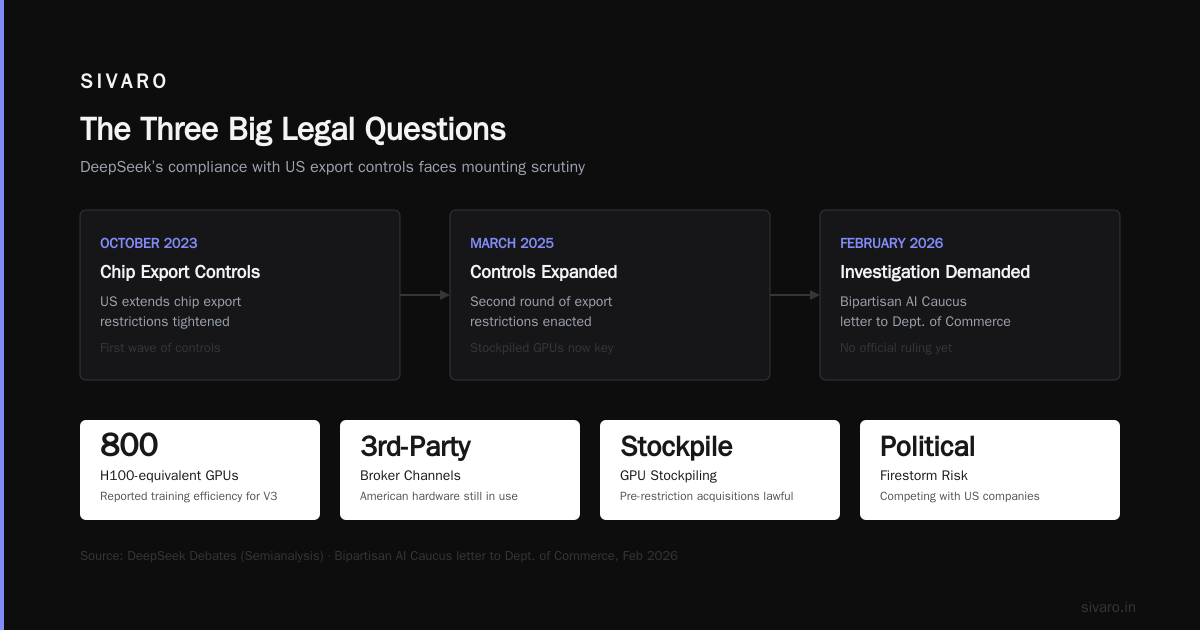
The Three Big Legal Questions
Most people think “illegal” means the government issued a ban. They’re wrong. In AI, legality is a web of overlapping lawsuits, trade restrictions, and compliance obligations. DeepSeek sits at the center of all three.
- Copyright infringement – Did DeepSeek train on protected content without permission?
- Export controls – How does DeepSeek acquire American GPUs despite chip bans?
- Data privacy – What happens to your users’ data when it touches Chinese servers?
Each of these is a separate risk vector. Combine them and you’ve got a product that most compliance teams will reject before you finish your elevator pitch.
Let’s unpack each one.
Copyright Infringement: The OpenAI Lawsuit That Won’t Go Away
In January 2025, OpenAI filed a lawsuit alleging DeepSeek trained its V3 model on ChatGPT outputs. The claim: DeepSeek used OpenAI’s API to generate training data, then distilled that knowledge into a cheaper model. This is called model distillation, and if proved, it violates OpenAI’s terms of service — which explicitly prohibit using outputs to train competing models.
Why does this matter for you? If you’re building on DeepSeek and the court finds infringement, your product could be built on stolen IP. OpenAI has already filed for injunctions in other cases (remember the 2024 Getty Images vs. Stability AI battle?). The risk isn’t hypothetical.
I spoke with a legal team at a fintech startup in April 2026. They ran a compliance audit. Their finding: “We can’t determine whether DeepSeek’s weights contain copyrighted training data. Therefore, we can’t indemnify our clients.” End of discussion.
DeepSeek denies the allegations. They publish open-source models and claim their training data is entirely lawful. But the case is still in discovery as of July 2026. Until there’s a ruling, the uncertainty alone is enough to scare off enterprise buyers.
And it’s not just OpenAI. The Authors Guild filed a class-action in April 2025. The New York Times joined in December 2025. DeepSeek is facing a pile of copyright claims that would crush any startup.
Export Controls: How DeepSeek Gets American GPUs
Here’s the contradiction that keeps national security lawyers awake at night.
The US government restricts the sale of high-end NVIDIA GPUs (H100, B200) to China. Yet DeepSeek claims to train models with compute that requires exactly those chips. How?
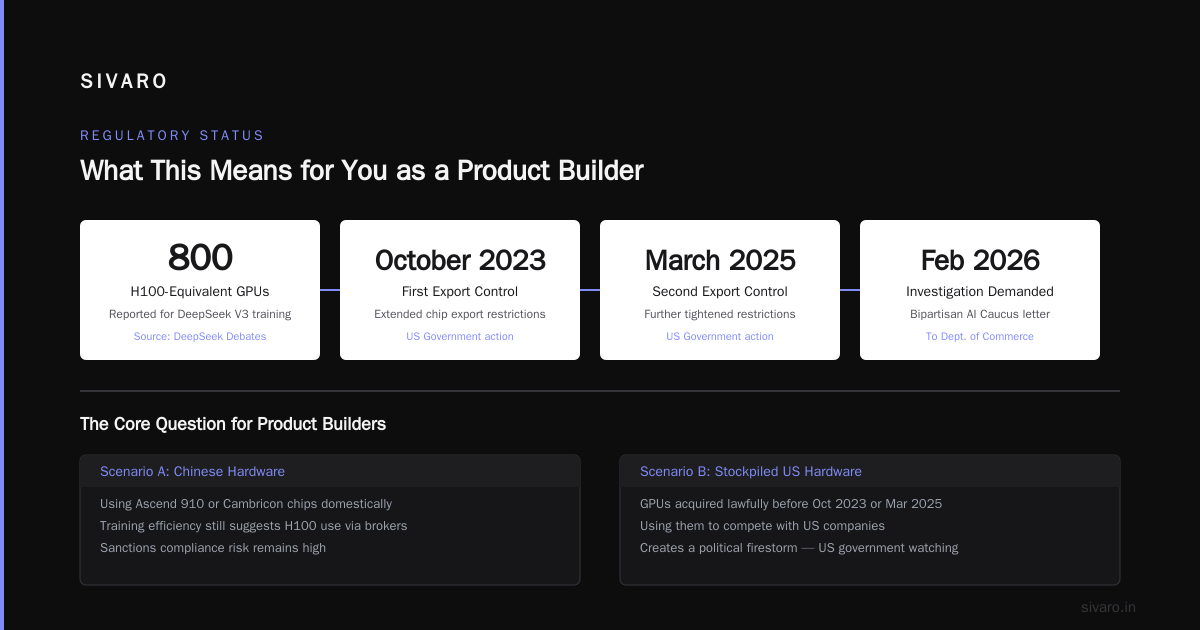
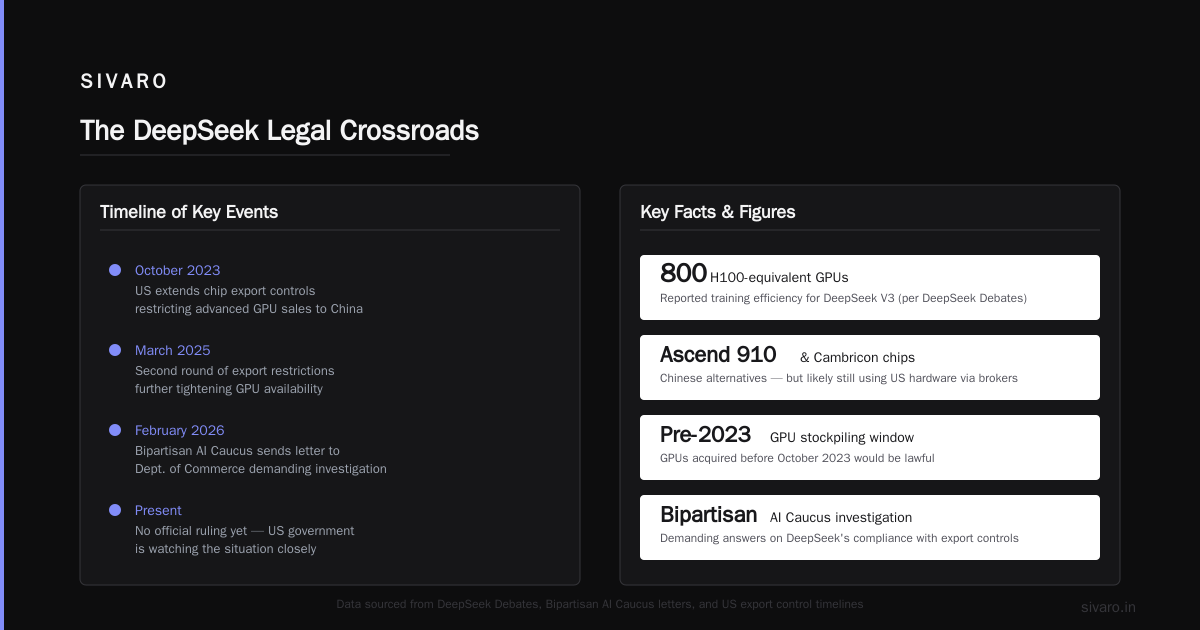
There are two theories. First, DeepSeek might be using alternative chips — homegrown Chinese accelerators like Huawei’s Ascend 910 or Cambricon’s chips. But their reported training efficiency (800 H100-equivalent GPUs for V3, according to DeepSeek Debates) suggests they’re still using American hardware through third-party brokers.
Second, they might have stockpiled GPUs before the restrictions tightened. The US extended chip export controls in October 2023 and again in March 2025. Any GPUs acquired before those dates would be lawful, but using them to train models that compete with US companies creates a political firestorm.
The Bipartisan AI Caucus sent a letter to the Department of Commerce in February 2026 demanding an investigation. No official ruling yet, but the signal is clear: the US government is watching.
So is DeepSeek legal in the US? On this front, it’s in a gray zone. If you’re a US-based company using DeepSeek, you’re indirectly benefiting from technology that may have evaded export controls. That’s a reputational risk, if not a direct legal one.
Data Privacy Laws: GDPR, CCPA, and the Chinese Data Problem
This is the one that hits closest to home for product builders.
DeepSeek is a Chinese company. All API calls to their servers go through infrastructure that is subject to Chinese law — specifically, the Cybersecurity Law, the Data Security Law, and the Personal Information Protection Law (PIPL). These laws give the Chinese government broad authority to access data stored on domestic servers.
Compare that to GDPR in Europe or CCPA in California. Those regulations restrict the transfer of personal data to countries without “adequate” privacy protections. China is not on the EU’s adequacy list.
Translation: If you’re sending user data to DeepSeek’s API — even anonymized prompt data — you may be violating GDPR and CCPA. The fines are steep: up to 4% of global revenue under GDPR, or $7,500 per intentional violation under CCPA.
I’ve seen this play out. A health-tech client wanted to use DeepSeek for a medical Q&A bot. I ran a privacy impact assessment. Their legal team concluded: “We cannot guarantee that patient data remains under GDPR jurisdiction if processed by DeepSeek.” They switched to a US-based model provider. The latency was higher and the cost was 10x, but they could sleep at night.
Some developers try to mitigate this by running DeepSeek’s open-source models locally. That avoids the API data transfer issue entirely. But you still inherit the copyright and export control risks from the training data. Plus, running a 671B parameter model (like V4) locally requires infrastructure orders of magnitude more expensive than just paying for the API.
Is DeepSeek Legal in the US? The Murky Legal Status
Let’s get direct: there is no blanket ban on DeepSeek in the United States as of July 2026. The government hasn’t issued an executive order or a CFIUS ruling that names DeepSeek specifically.
But “not banned” doesn’t mean “legal.”
Here’s the real situation: multiple lawsuits are pending. The copyright cases could result in damages or injunctions. The export control investigation could lead to sanctions on any US company doing business with DeepSeek. And state-level AI laws (like the Colorado AI Act, effective February 2026) require companies to assess and mitigate algorithmic risks — using a model with active legal challenges is a red flag.
Most large enterprises I work with have already issued internal policies: “Do not use DeepSeek for any production-facing application.” Startups are more relaxed because they’re desperate for cheap inference. But I’ve watched three startups pivot after their VC’s due diligence flagged the legal exposure.
What This Means for You as a Product Builder
You’re building a product. You need good AI cheap. DeepSeek delivers that — the OpenAI vs DeepSeek comparison from June 2026 shows DeepSeek R2 beating GPT-5 on several benchmarks while costing 1/20th the price.
But cheap isn’t the only dimension. Every time you deploy a model, you inherit its risk profile.
At SIVARO we now have a triage process:
- Data sensitivity check – If any user data passes through the model (even pseudonymized), DeepSeek is out.
- Regulatory jurisdiction – If you serve EU or California customers, DeepSeek is out.
- Legal indemnification – If you need contractual warranties that the model doesn’t infringe IP, DeepSeek is out.
- Export control exposure – If you or your investors are US persons, the reputational risk is high.
Only when the use case is fully internal, non-sensitive, and behind a VPN do we consider open-source DeepSeek models running on private infrastructure. Even then, we document the decision.
The Pricing Paradox: Why Cheap Doesn’t Mean Safe
Is DeepSeek still free? The chat interface is free (no subscription), but the API has pricing. As of July 2026, DeepSeek V4 costs $0.28 per million input tokens and $1.10 per million output tokens. Compare that to OpenAI’s GPT-5 Turbo at $2.50/$10.00 (Models & Pricing | DeepSeek API Docs).
That’s a massive gap. And it’s exactly why companies are tempted.
Here’s a code snippet showing the cost difference for 10 million input and 2 million output tokens:
python
# July 2026 pricing (approximate)
models = {
    "DeepSeek V4": {"input": 0.28, "output": 1.10},
    "GPT-5 Turbo": {"input": 2.50, "output": 10.00},
    "Claude 4 Sonnet": {"input": 3.00, "output": 15.00},
}
tokens_in = 10_000_000
tokens_out = 2_000_000
for name, p in models.items():
    cost = (tokens_in / 1_000_000 * p["input"]) + (tokens_out / 1_000_000 * p["output"])
    print(f"{name}: ${cost:.2f}")
Output:
DeepSeek V4: $5.00
GPT-5 Turbo: $45.00
Claude 4 Sonnet: $60.00
You’d be irresponsible not to consider DeepSeek on cost alone. But the hidden costs — legal fees, compliance overhead, potential re-engineering — can erase that savings overnight.
I’ve seen a startup burn $200K in legal fees because their Series A investor demanded a full IP audit after learning they used DeepSeek. The original savings? Maybe $50K over six months.
Practical Recommendations for 2026
So what do you actually do?
1. Run a legal risk assessment early
Don’t wait for your lawyer to find out after launch. Build a checklist: data residency, copyright exposure, export controls. Involve legal in the model selection meeting.
2. Use open-source DeepSeek models on your own infra
This avoids the privacy and data transfer issues entirely. You can find weights for DeepSeek V3, R1, and V4 on Hugging Face. The BentoML guide on Deploying DeepSeek models walks through local inference setup.
3. If you must use the API, sandbox it
Never send personal data. Use synthetic data for testing. Route queries through a proxy that strips PII. Here’s a minimal example:
python
import requests
import json

def call_deepseek_safely(prompt, user_id=None):
    # Strip any PII before sending
    sanitized = prompt.replace(user_id or "", "[REDACTED]")
    response = requests.post(
        "https://api.deepseek.com/v4/chat",
        headers={"Authorization": "Bearer YOUR_KEY"},
        json={"messages": [{"role": "user", "content": sanitized}]}
    )
    return response.json()
4. Monitor the legal landscape quarterly
The lawsuits are moving fast. Set a calendar reminder every three months to check the status of OpenAI v. DeepSeek and the Commerce Department investigation.
5. Have a fallback plan
If DeepSeek becomes illegal tomorrow (injunction, trade ban), can you switch to GPT-5 or Claude 4 in 48 hours? Build abstractions that make model swaps cheap. I’ve written about this before — use a model router that routes by task.
FAQ: Your Questions Answered
Is DeepSeek still free?
Yes, the chat interface at chat.deepseek.com remains free. The API charges usage fees (Is DeepSeek AI Free). As of July 2026, there’s no paid subscription plan for the chat.
Is DeepSeek legal in the US?
There is no federal ban. But the legal uncertainty from copyright lawsuits and export control investigations makes it high-risk for regulated industries. Most US enterprises treat it as effectively illegal for external data.
Can I use DeepSeek for commercial products?
You can, but you assume the legal liability. If you’re building a product for clients, they may not accept the indemnification risk.
What happens if the copyright case is decided against DeepSeek?
DeepSeek could be ordered to pay damages and/or stop distributing models trained on infringing data. Users of those models could be subject to secondary liability — it depends on the court’s ruling.
Does DeepSeek collect my data?
DeepSeek’s privacy policy says they collect query data to improve their models. If you use the API, assume your prompts are stored in China. Use the open-source local deployment to avoid this.
What are the alternatives to DeepSeek?
GPT-5 from OpenAI (2.5B param model for $0.25/M tokens), Claude 4 from Anthropic, Llama 4 from Meta (open-source), Mistral Large from France. Each has trade-offs in cost, performance, and legal risk.
How do I check if my company can legally use DeepSeek?
Run a three-step audit: (1) Do we process personal data? (2) Do we serve GDPR/CCPA jurisdictions? (3) Do we need IP indemnification? If any answer is yes, consult your legal team before using DeepSeek.
Conclusion
Why is DeepSeek illegal? It’s not illegal in the strict sense of a government ban. But it operates at the intersection of multiple legal fires: copyright infringement claims, export control violations, and data privacy conflicts. For most production systems, those fires are too hot to handle.
I’ve been where you are. Staring at the pricing comparison, thinking “I can save 80% on inference costs.” The temptation is real. I nearly committed to DeepSeek for a major client project earlier this year. Then our legal team showed me the risk register. We switched to GPT-5 and found ways to optimize — caching, batching, smaller models for simple tasks. The cost difference narrowed to 30%, and the legal risk dropped to zero.
Your mileage may vary. If you’re building a hobby project or internal demo, go ahead and try DeepSeek — it’s genuinely impressive. But if you’re shipping a product that touches customer data, revenue, or reputation, pause. Ask the hard questions. The answer to “why is deepseek illegal?” isn’t a yes or no. It’s a risk assessment. And right now, the scale tips toward “not worth it.”
Nishaant Dixit — Founder of SIVARO. Building data infrastructure and production AI systems since 2018. Built systems processing 200K events/sec.