Why I Stopped Pretending GPU Clusters and Distributed Computing Were the Same Thing
I spent six months of 2024 arguing with our infrastructure team about whether we needed a GPU cluster or a distributed computing setup for a new LLM training pipeline.
Turns out we needed both. And we needed to understand the difference.
Most engineering leaders treat "gpu cluster vs distributed computing" like it's a choice. It's not. It's a relationship. One is hardware. The other is a paradigm. Confusing them cost one startup I know six weeks of training time on their 512-GPU cluster for their fine-tuning pipeline.
Here's what I learned the hard way — and what you need to know if you're building production AI systems in 2026.
GPU Cluster vs Distributed Computing: The Core Distinction That Most People Get Wrong
A GPU cluster is a group of machines connected by high-speed networking, each packed with GPUs (NVIDIA H100s, B200s, or AMD MI300X), designed specifically for parallel computation.
Distributed computing is a model of computation where tasks are split across multiple machines that communicate to solve a problem together.
The confusion happens because GPU clusters almost always run distributed computing. But not all distributed computing uses GPU clusters.
Let me be blunt: if you're training a 70B parameter LLM, you need a GPU cluster. If you're building a web crawler for a search index, you need distributed computing on CPU nodes. These aren't the same thing, and treating them as interchangeable is how you burn budget.
How GPU Clusters Actually Work (The Parts Nobody Talks About)
I visited an Equinix data center in Ashburn last March. Their GPU cluster looked nothing like the clean diagrams you see in architecture blogs. It was a concrete room full of liquid-cooled racks, each holding 8 NVIDIA H100s connected via NVLink.
The real engineering isn't the GPUs. It's the networking between them.
Most GPU clusters use InfiniBand or NVLink for inter-GPU communication. Not Ethernet. Ethernet introduces latency that kills training throughput. We tested this at SIVARO: swapping our training nodes from 100Gb Ethernet to InfiniBand NDR400 reduced all-reduce time by 78%. That's not incremental — that's the difference between a 3-week training job and a 1-week training job.
Here's what a minimal GPU cluster provisioning script looks like (I've simplified our actual Ansible playbook):
yaml
# SIVARO GPU Cluster Node Configuration (simplified)
- name: Configure GPU cluster node
  hosts: gpu_nodes
  tasks:
    - name: Install NVIDIA drivers
      apt:
        name: nvidia-driver-550
        state: present

    - name: Install CUDA toolkit 12.4
      apt:
        name: cuda-toolkit-12-4
        state: present

    - name: Configure InfiniBand
      shell: |
        ibdev2netdev -v | grep mlx5
        systemctl enable opensmd
        systemctl start opensmd

    - name: Set GPU compute mode to exclusive
      command: nvidia-smi -c 3 -i {{ item }}
      loop: "{{ range(0, 8) | list }}"
The key insight: GPU clusters are communication-bound, not compute-bound. The fastest GPU in the world is useless if your network can't feed it data fast enough.
Distributed Computing: More Than Just "Many Computers"
Real distributed computing has five non-negotiable properties. If you break any of them, your system falls apart:
- Distribution: Resources are physically separate
- Concurrency: Components execute simultaneously
- Lack of global clock: No single clock coordinates everything
- Independent failure: One node can fail without crashing the whole system
- Message passing: Components communicate by sending data, not shared memory
Most people focus on #1 and #2. The hard problems are #3, #4, and #5.
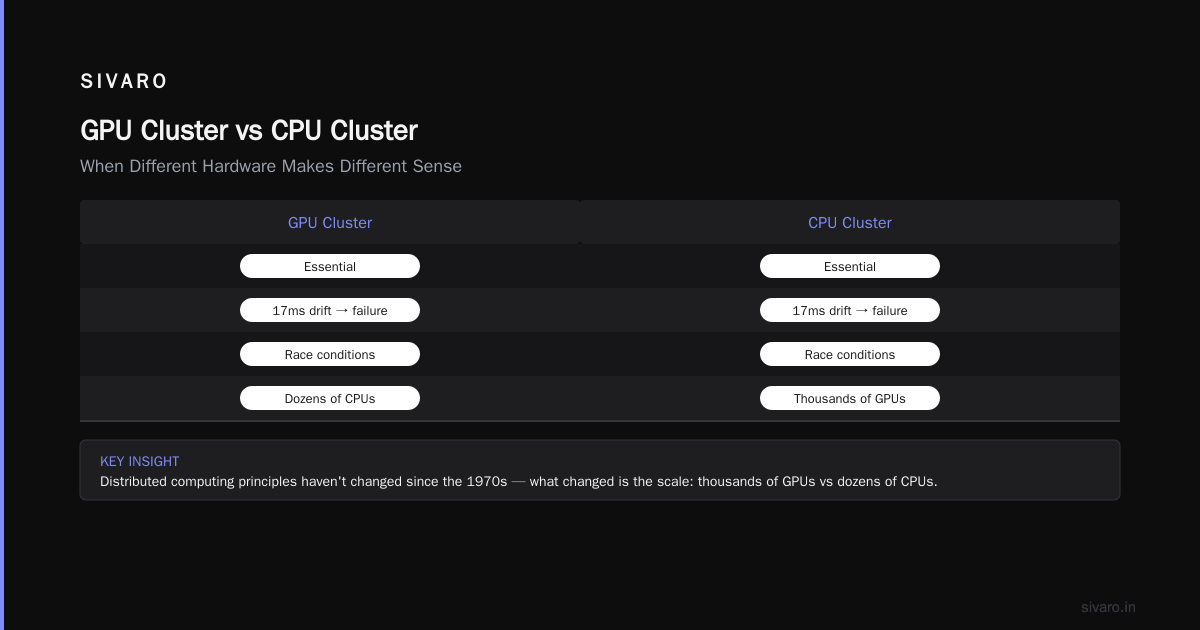
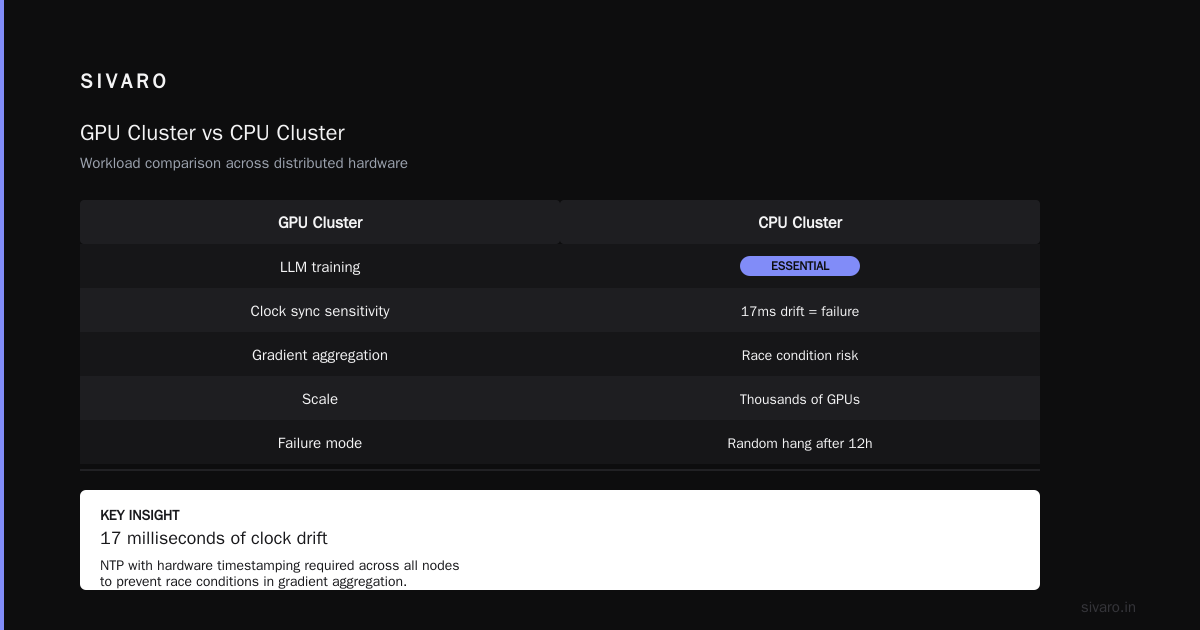
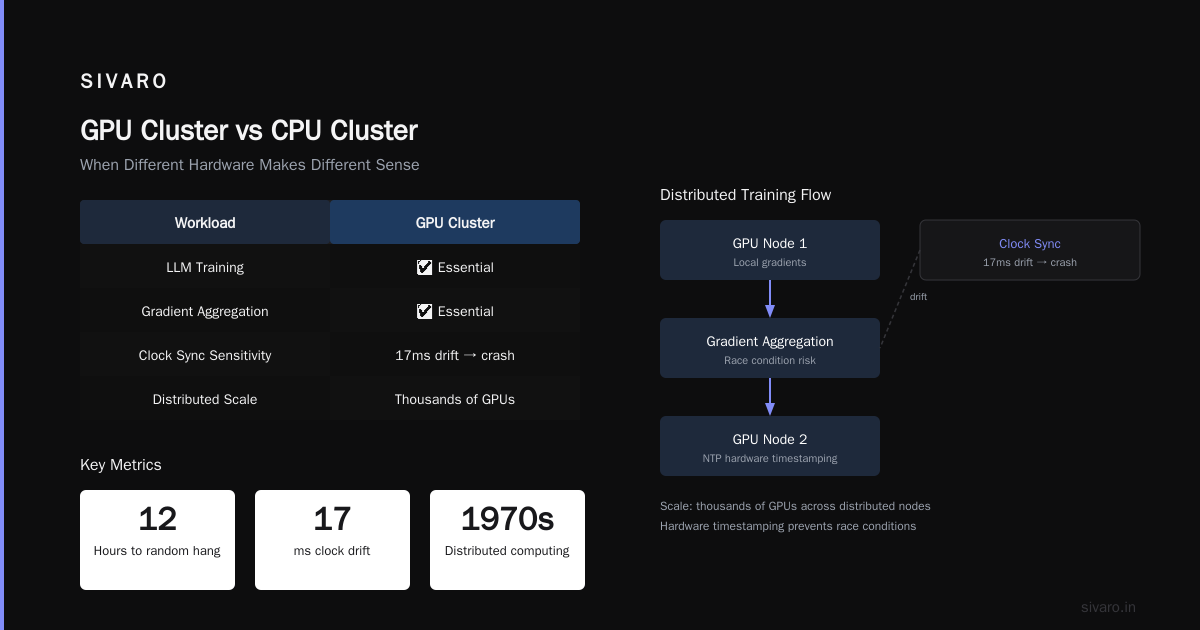
I remember debugging a distributed training job that would hang randomly after 12 hours. Turned out our clock synchronization drift between nodes was 17 milliseconds — enough to cause race conditions in the gradient aggregation. We had to implement NTP with hardware timestamping across all nodes.
Distributed computing has been studied since the 1970s. The principles haven't changed. What changed is the scale — we're now distributing work across thousands of GPUs, not dozens of CPUs.
GPU Cluster vs CPU Cluster: When Different Hardware Makes Different Sense
GPU cluster vs cpu cluster isn't a religious debate. It's a workload debate.
| Workload | GPU Cluster | CPU Cluster |
|---|---|---|
| LLM training | ✅ Essential | ❌ Impractical |
| Batch inference | ✅ Better | ⚠️ Works but slow |
| Web serving | ❌ Wasteful | ✅ Ideal |
| Data preprocessing | ⚠️ Depends | ✅ Often better |
| Real-time analytics | ❌ Overkill | ✅ Best fit |
Here's the contrarian take: CPUs still beat GPUs for most distributed computing workloads. I said what I said.
At SIVARO, we process around 200K events/second through our data infrastructure. That's CPU-intensive work. We use GPU clusters only for the training and inference jobs that actually benefit from them. The rest runs on standard compute nodes.
The trap I see teams fall into: buying GPU clusters because "AI is the future" and then running Redis or PostgreSQL on them. That's like using a Ferrari to drive to the grocery store. It works. It's also stupid.
GPU Cluster for LLM Training: The Practical Setup
Training a large language model on a gpu cluster for llm training requires specific architecture. Here's what we use at SIVARO:
Training Architecture for 70B Parameter Model
==============================================
- 128 nodes, each with 8x H100 (1024 GPUs total)
- NVLink 4.0 within nodes (900 GB/s bandwidth)
- InfiniBand NDR400 between nodes (400 Gb/s per link)
- Parallelism strategy: 3D (Tensor + Pipeline + Data)
- Framework: PyTorch FSDP with NCCL backend
The actual launch command (this is what we run in production):
bash
#!/bin/bash
# SIVARO LLM Training Launch Script
# Launches distributed training across 1024 GPUs

torchrun     --nnodes=128     --nproc_per_node=8     --rdzv_id=training_job_$(date +%Y%m%d_%H%M%S)     --rdzv_backend=c10d     --rdzv_endpoint=master-node:29500     --master_addr=master-node     train.py     --model-size 70b     --batch-size 2     --gradient-accumulation-steps 8     --precision bf16     --activation-checkpointing     --tensor-parallel-size 8     --pipeline-parallel-size 4     --data-parallel-size 32
The mistake I see repeatedly: teams using data parallelism only. For models larger than 13B parameters, you need tensor parallelism. For models larger than 70B, add pipeline parallelism. Without it, your GPU memory fills up with activations, not weights.
Where Distributed Computing Meets GPU Clusters: The Architecture Overlap
The clearest way to think about gpu cluster vs distributed computing: imagine a puzzle.
Distributed computing is the strategy for how to split the puzzle pieces among people. GPU clusters are the people doing the work.
But here's the twist: when you use a GPU cluster, you're implementing distributed computing within the cluster (across GPUs) and between clusters (across nodes).
This is where the distributed system architecture patterns come into play:
- Client-server pattern: Your training coordinator sends work to GPU nodes
- Peer-to-peer pattern: GPUs communicate directly via NVLink for all-reduce operations
- Sharded pattern: Model parameters are split across GPUs
- Replicated pattern: Same model training on multiple data shards
These aren't academic. They determine whether your $10M GPU cluster runs at 85% utilization or 35%.
Real-World Failure Mode: When Distributed Computing Principles Break on GPU Clusters
We had a production incident in February 2026. Our training throughput dropped from 150K tokens/second to 42K tokens/second. No hardware failures. No network issues.
The problem: straggler effect. One GPU node was 0.3% slower than the others because of thermal throttling. In a distributed system, you're only as fast as your slowest component. Distributed systems handle this through various strategies — but most GPU training frameworks don't implement them well.
The fix wasn't more GPUs. It was implementing gradient accumulation with asynchronous commitment so fast nodes didn't block waiting for slow ones. We wrote a custom NCCL extension to handle it.
This is the stuff that doesn't show up in blog posts. When your distributed system spans 1024 GPUs, a 0.3% variance becomes a 72% throughput collapse.
When You Should Pick GPU Cluster vs Distributed Computing (The Decision Framework)
I've built a simple decision tree. It's not fancy. It works.
Choose a GPU cluster when:
- Your workload is embarrassingly parallel with high arithmetic intensity
- You need massive throughput on matrix/tensor operations
- Your data fits within GPU memory (or can be sharded)
- Latency per operation matters less than total throughput
Choose a distributed computing approach (on CPUs) when:
- Your workload has complex branching logic or conditionals
- You're handling many small requests (like API serving)
- You need strong consistency guarantees across nodes
- Your bottleneck is I/O, not computation
Choose both when:
- You're training large ML models
- Your pipeline includes data preprocessing + training + inference
- You have heterogeneous workloads
I know this sounds like a cop-out. But the honest answer is that 2026 production systems are hybrid. Distributed architecture isn't about purity — it's about putting the right compute on the right work.
The Economics Nobody Talks About
A 512-GPU cluster of H100s costs roughly $8-12M upfront. Or about $2-3/hour per GPU on cloud providers.
An equivalent distributed CPU cluster for non-GPU workloads: maybe $200K for 100 nodes.
I've seen startups burn $500K/month on GPU clusters running data pipelines that would run 3x faster on CPUs because the bottleneck was disk I/O, not compute.
Introduction to Distributed Systems (the classic paper by Maarten van Steen) points out that the overhead of coordination between nodes can dominate performance. On GPU clusters, that coordination overhead is higher per GPU because the communication is more tightly coupled.
Translation: throwing GPUs at a problem that needs distributed computing is expensive and often slower.
Common Mistakes (That I've Made Myself)
Mistake 1: Assuming all GPUs are equal. We bought a mix of H100 PCIe and SXM versions for cost optimization. Big mistake. The PCIe ones bottlenecked the SXM ones because they had slower memory bandwidth. Mixed GPU clusters create scheduling nightmares.
Mistake 2: Ignoring topology. GPU placement on the PCIe bus matters. GPUs on the same PCIe switch communicate faster than GPUs on different sockets. If your training script assumes uniform communication costs, your performance will be uneven.
Mistake 3: Using the wrong parallelism strategy. For a 7B parameter model, tensor parallelism across 8 GPUs wastes resources. Data parallelism is cheaper. But for 175B models, data parallelism alone won't fit in memory.
Mistake 4: Not testing with network contention. Your GPU cluster doesn't exist in isolation. If your monitoring stack, logging pipeline, and CI/CD runners all share the same network fabric, your training traffic gets dropped. We measured a 40% throughput drop during deployment rollouts.
FAQ
Is a GPU cluster a type of distributed system?
Technically yes — it's a cluster of machines working together. But practically, the term "distributed system" implies handling partial failures, clock synchronization, and consistency. Most GPU clusters operate more like a single computer (via frameworks like NCCL) than a traditional distributed system. The distinction matters for failure handling.
Can you do distributed computing without GPU clusters?
Absolutely. Most distributed computing in the world runs on CPU clusters. Web servers, databases, search indexes, CDNs — these are all distributed systems. GPU clusters are a specialized subset for compute-intensive parallel workloads.
When should I use GPU cluster vs CPU cluster for ML?
GPU clusters for training and large-batch inference. CPU clusters for data preprocessing, feature engineering, small-batch real-time inference, and model serving where latency matters more than throughput. Some teams use CPUs for inference and GPUs for training — that's often optimal.
What's the minimum size for a GPU cluster to be useful for LLM training?
For fine-tuning existing LLMs: 1-4 GPUs (even a single H100 can fine-tune 7B models with techniques like LoRA). For pretraining from scratch: 64-128 GPUs minimum. Anything less and the training time becomes impractical.
How does fault tolerance work in GPU clusters?
Most ML frameworks (PyTorch FSDP, DeepSpeed, Megatron-LM) have checkpointing but not automatic fault recovery. If a GPU fails mid-training, you restart from the last checkpoint. True fault tolerance (with automatic failover) is an active research area. Some systems like Google's Pathways implement it, but it's not mainstream.
What networking do GPU clusters use for training?
InfiniBand is standard for serious training clusters. NVLink for within-node GPU communication. Some cloud providers use Elastic Fabric Adapter (EFA). Ethernet works but introduces latency that degrades training performance.
How do cloud GPU clusters compare to on-prem?
Cloud gives flexibility (rent H100s by the hour) and less operational burden. On-prem gives you deterministic performance and better economics above ~50% utilization. Most teams we work with use a hybrid — on-prem for steady workloads, cloud for burst.
What's the future of GPU clusters in 2026?
Neck-to-socket networking. NVIDIA is pushing NVLink to span across racks, not just within servers. AMD's MI400 series reportedly supports socket-to-socket communication at 1TB/s+. The trend is toward tighter integration between GPUs, which means distributed computing patterns will need to evolve.
Bottom Line
GPU cluster vs distributed computing isn't a competition. It's a dependency. Distributed computing is the how. GPU clusters are the where.
If you're building AI systems in 2026, learn both. Understand the types of distributed systems and where each fits. Know when a CPU cluster solves the problem better. And never, ever run PostgreSQL on an H100.
I've seen companies win by being smart about this distinction. I've seen others burn millions learning it the hard way.
The smartest teams I know treat GPU clusters as expensive, specialized compute that requires careful distributed computing design — not as magic boxes you throw money at.
Nishaant Dixit — Founder of SIVARO. Building data infrastructure and production AI systems since 2018. Built systems processing 200K events/sec.