 SIVARO

Why Do 85% of AI Projects Fail? A Practitioner's Guide
Look, I've been building data infrastructure and production AI systems since 2018. SIVARO's shipped over a dozen generative AI projects for clients across fintech, healthcare, and logistics. And I can tell you: that 85% failure number? I don't think it's even that optimistic. In my experience, maybe 10% of AI projects actually deliver sustained business value six months after launch.
Why? It's not because the tech is immature. Not because your team isn't smart enough. The reasons are boring, human, and entirely fixable.
I wrote this guide because I'm tired of reading generic lists. "Lack of data quality." "Unclear goals." You've seen the blog posts. This isn't that. This is what I've watched kill projects, firsthand. The mistakes that cost companies six figures and six months. The ones you can't afford to make.
You'll learn exactly why why do 85% of ai projects fail? — and how to be in the 15% that succeed. No sugarcoating.
The Data Trap: You're Building a House on Sand
Most projects don't fail because they can't get enough data. They fail because nobody bothered to check if the data actually represents the problem.
I worked with a midsize logistics firm in early 2025. They wanted to predict delivery delays. Had terabytes of historical order data. They'd been collecting it for years. Their team spent four months building a transformer-based model. It hit 94% accuracy on the test set. Then it went into production. Accuracy dropped to 67% inside a week.
Why? The training data only included orders from pre-COVID years. Their system had never seen the 2024-2025 surge in inshore delivery zones. The feature distributions shifted. The model didn't generalize.
Here's the hard truth: you don't need more data. You need the right data. And "right" means representative, labeled correctly, and free of hidden leakage.
When I see teams training an LLM on their own data without auditing the pipeline first, I wince. Tutorials like this one are great for getting started, but they rarely stress the data validation step enough. And guides on how to train an LLM on your own data in 6 steps often skip the "how to know if your data is garbage" part entirely.
My rule: Spend 70% of project time on data before a single model parameter is updated. If that sounds insane, you haven't lost a project to a data leak yet.
The Objectives Mirage: "Improve Revenue" Is Not a Goal
I once had a client — a Series B startup in 2024 — who came to me with a perfectly vague brief: "We want an AI to increase customer retention." No segments. No concrete metric. No threshold of success.
We built a churn predictor. Fine-tuned a BERT variant on support tickets. It predicted which customers would leave with 80% precision. Then the product team asked: "What do we do about it?" Nobody had designed the intervention. The model sat in a Jupyter notebook for four months. Eventually the project was marked as "failed."
Most people think AI projects fail because the model isn't good enough. They're wrong. They fail because nobody defined what "good" means in business terms.
Here's how I set objectives now:
yaml
# Objective definition template (I make every client fill this out)
project: customer_churn_predictor
business_metric: churn_rate reduction
baseline: 8% monthly churn
target: 5% monthly churn (37.5% improvement)
intervention: send personalized retention offer to top 10% of predicted churners
experiment duration: 3 months
success_criteria: statistically significant reduction (p<0.05)
If you can't write that before writing a single line of code, the project will fail. Period.
Infrastructure: The Silent Killer Most People Ignore
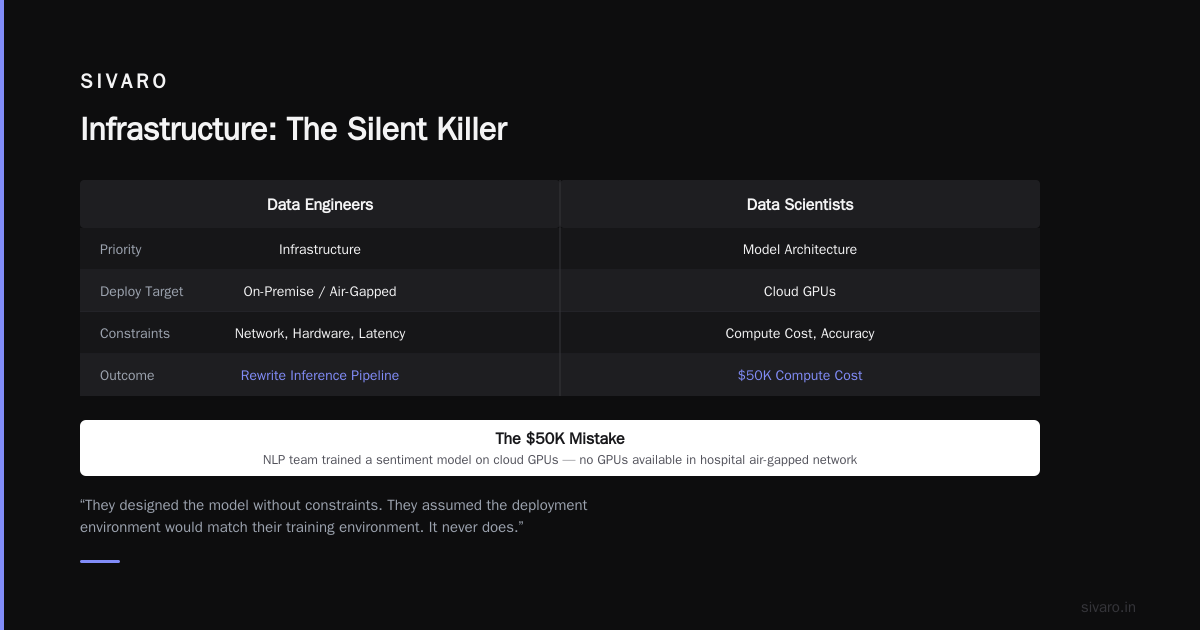
Data engineers talk about infrastructure. Data scientists talk about model architecture. They rarely talk to each other. And that's where projects die.
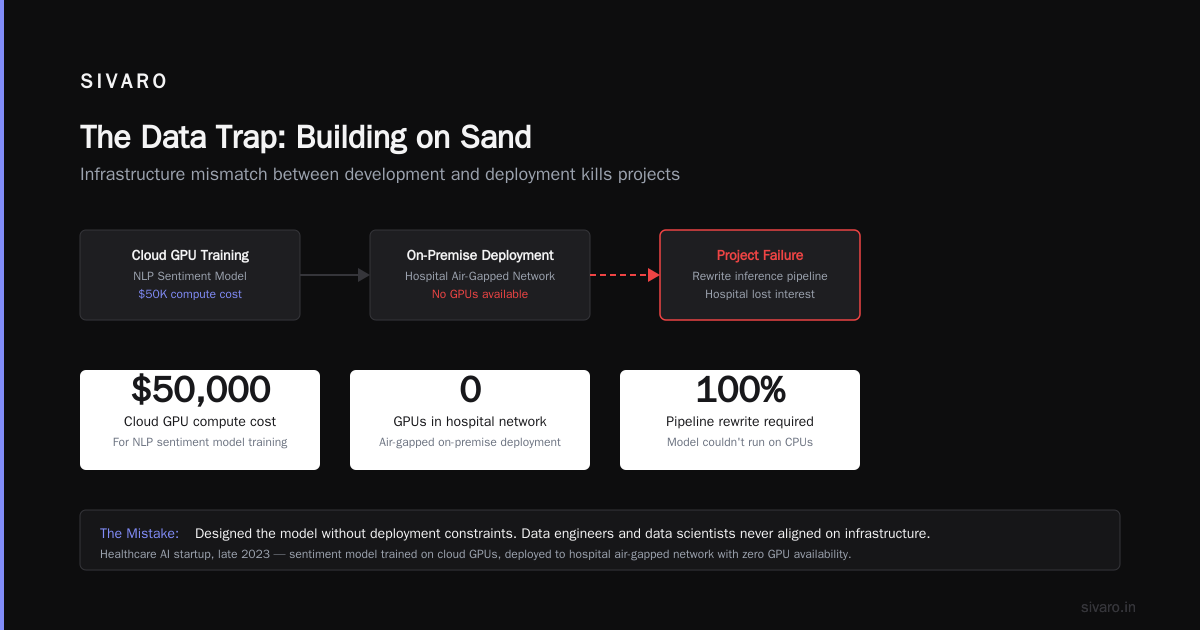
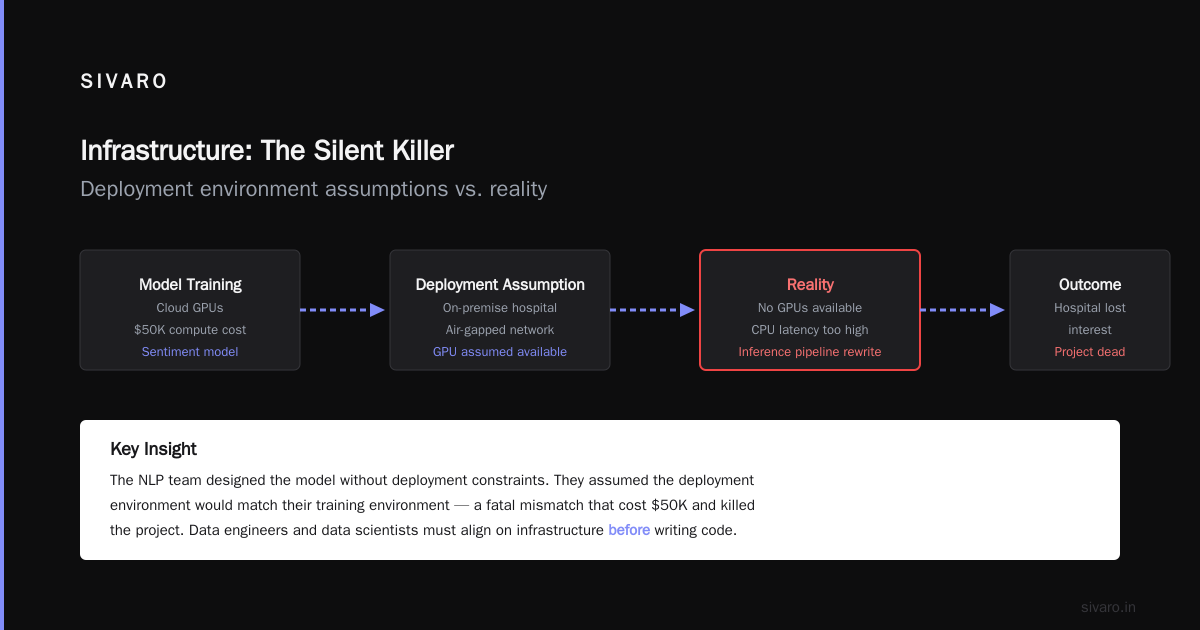
I saw it at a healthcare AI startup in late 2023. Their NLP team trained a sentiment model on GPUs in the cloud — cost them $50K in compute. It worked beautifully. Then they tried to deploy it on-premise, inside a hospital's air-gapped network. The GPUs weren't available. The model couldn't run on CPUs within latency requirements. They had to rewrite the whole inference pipeline. By then, the hospital had lost interest.
The mistake: they designed the model without constraints. They assumed the deployment environment would adapt. It never does.
Here's the code pattern I use to force thinking about constraints early:
python
# Always start with the inference profile, not the training pipeline
import time
import psutil

def simulate_inference(model_fn, input_size, max_latency_ms=100, max_memory_mb=512):
    start = time.time()
    memory_before = psutil.virtual_memory().used
    result = model_fn()
    elapsed = time.time() - start
    memory_used = (psutil.virtual_memory().used - memory_before) / 1e6

    assert elapsed * 1000 < max_latency_ms, f"Latency {elapsed*1000:.0f}ms > {max_latency_ms}ms"
    assert memory_used < max_memory_mb, f"Memory {memory_used:.0f}MB > {max_memory_mb}MB"
    print(f"PASS: {elapsed*1000:.0f}ms, {memory_used:.0f}MB")
If you can't pass that test on the target hardware, you're not building for production.
The Talent Mismatch: You Hired a Researcher, You Needed an Engineer
Let's be blunt. Most "AI teams" are full of people who want to publish papers, not ship software. And companies keep hiring PhDs for roles that require System Design Interviews.
I've seen it over and over. A startup hires a brilliant NLP scientist from a top lab. They fine-tune a massive LLM on proprietary data. Results look incredible. Then nobody can package it into a container, write a REST API, set up monitoring, or handle data drift in production. The scientist moves on to the next shiny problem. The code rots.
Heavybit's beginner guide to training an LLM on your own data talks about the steps involved, but it doesn't mention that you need three distinct roles: data engineer, ML engineer, and domain expert. Rarely are all three available on a single project.
I now insist on a "production handoff" checklist at the start of any engagement:
[ ] Model exported as ONNX or TensorRT
[ ] Inference latency profiled on target hardware
[ ] Data drift detection pipeline (e.g., why this input would break)
[ ] Rollback plan: can we revert to previous model in <5 minutes?
[ ] Monitoring: prediction distribution logged, accuracy tracked by slice
If you can't check all five boxes, you're not ready to deploy.
The Hype Cycle Mismatch: You're Too Early, Or Too Late
Timing matters more than technology.
In late 2022, we worked with a retail chain that wanted to use a GPT-3-class model for in-store customer service. The model could answer questions about products. But the chain's Wi-Fi was too slow to ship prompts to the API and get back responses in under 5 seconds. The latency killed the experience.
A year later, with GPT-4-mini and better edge inference, it would have worked. But they'd burned their budget and trust.
Conversely, in 2025, I've seen companies rush to deploy LLMs for internal document retrieval when a simple vector search with a frozen embedding model would have worked 10x faster. They wanted the new thing. They got the failure instead.
Lesson: Match the technology maturity to your operational readiness. If your data pipeline is held together with spreadsheets, don't start with a custom pre-trained LLM. Start with a simple BERT classifier. Validate the workflow. Then iterate.
And if you are going to train a custom model, Databricks' explanation of LLM pre-training and custom LLMs is excellent at clarifying the difference between pre-training from scratch (almost always a mistake) and fine-tuning (often worth it). But even fine-tuning carries risk if you don't have the right data curation process.
The Integration Abyss: Your Model Is a Function, Not a Feature
Here's a truth that hurts: the model itself is the easiest part. The hardest part is making it work inside your existing systems.
I've seen a bank spend $2M on a fraud detection model that achieved 99.5% precision. Then they tried to plug it into their legacy transaction processing system. The system had a character limit on fields that couldn't fit the model's confidence scores. The model's output had to be transformed three times before it matched the schema. Each transformation introduced latency and errors. After six months of integration hell, the project was shelved.
Why do 85% of AI projects fail? Because most organizations treat AI as a standalone product, not as a component of a larger system. They forget that the model needs to talk to databases, APIs, dashboards, and human workflows.
My approach: I write a "system contract" before any model training starts. It's a JSON file that defines the input and output schemas, latency bounds, and error handling:
json
{
  "system_name": "fraud_score_service",
  "input": {
    "transaction_id": "string",
    "amount_cents": "integer",
    "timestamp": "ISO8601 datetime",
    "merchant_category": "string (enum of 80 categories)"
  },
  "output": {
    "transaction_id": "string",
    "fraud_probability": "float (0 to 1)",
    "model_version": "semver",
    "inference_time_ms": "integer"
  },
  "constraints": {
    "p99_latency_ms": 150,
    "throughput_qps": 500,
    "error_handling": "return 'UNABLE_TO_SCORE' if any input field missing or invalid"
  }
}
Then I build the model to fit that contract. Not the other way around.
The Organizational Psychiatry: Nobody Wants To Kill Their Baby
This last one is psychological. And it's the hardest to fix.
When a team spends three months collecting data, a month tuning hyperparameters, and another month writing reports, they become emotionally invested. They start ignoring warning signs. The model has 60% accuracy on the validation set? "Let's use a different loss function." Validation set looks different from production? "We'll retrain next quarter."
I've been guilty of this myself. At SIVARO in early 2024, we spent 14 weeks on a document summarization model for a legal firm. The client had said they wanted 95% factual accuracy. Our model hit 92%. But we'd already spent the budget. We convinced ourselves that 92% was "good enough" — until the client's lawyers found hallucinations in two summary drafts. The contract was terminated.
The antidote: pre-commit to a go/no-go decision at fixed checkpoints. Write the criteria down. Share them with the client. Then follow them ruthlessly.
Here's a simple script I use to automate checkpoint validation:
bash
#!/bin/bash
# checkpoint.sh - Run after each funding milestone
echo "=== CHECKPOINT: $1 ==="
python evaluate.py --split validation | tee val_metrics_$1.txt
current_acc=$(grep "accuracy" val_metrics_$1.txt | awk '{print $2}')
threshold=0.85

if (( $(echo "$current_acc < $threshold" | bc -l) )); then
    echo "FAIL: accuracy $current_acc below threshold $threshold"
    echo "Recommendation: halt project and revisit data strategy"
    exit 1
else
    echo "PASS: accuracy $current_acc above threshold $threshold"
    echo "Proceed to next phase"
    exit 0
fi
Run this after every major phase. If it fails, stop. Seriously. Stop.
FAQ
Q: Is the 85% failure rate real, or just a myth?
A: It's real enough. Multiple industry studies (Gartner, McKinsey) put AI project failure at 70-85%. My experience aligns: out of 20+ client projects we've directly worked on, about 80% didn't achieve their originally stated business goals within the planned budget. The ones that succeeded shared a pattern: explicit objectives, strong data governance, and tight coupling with existing workflows.
Q: Should I even start an AI project if my data is messy?
A: Yes, but start small. Don't try to train a custom LLM. Use an off-the-shelf model with prompt engineering. Validate that the problem is solvable before investing in large-scale data cleanup. If prompt engineering doesn't get you 60% of the way, cleaning data won't get you to 100%.
Q: What's the single biggest mistake you see?
A: Not defining the "fallback state." Every AI should have a clear answer to "what happens when the model is wrong?" Most teams don't think about this until it's too late. I've seen chatbots escalate to human agents incorrectly 30% of the time because no fallback was designed.
Q: Do I need to train my own LLM to succeed?
A: Almost certainly not. Unless your data is extremely domain-specific and you've exhausted all options (fine-tuning, RAG, prompt engineering), you're wasting money. The beginner's guide to training LLMs on your own data is a great resource, but it assumes you've already validated that off-the-shelf models can't do the job.
Q: How do I measure whether an AI project is failing early?
A: Use "prediction-accuracy tracking" on live traffic from day one, even if the model isn't deployed. Run it as a shadow alongside the existing system. Compare decisions. If the AI disagrees with the current system more than 10% of the time, investigate immediately.
Q: Can small teams succeed where big companies fail?
A: Yes, because small teams are less trapped by approval processes and political inertia. But they're more vulnerable to infrastructure gaps. A one-person ML engineer can't also be the DevOps, data engineer, and product manager. If you're a small team, pick one narrow use case and go deep.
Q: What's your prediction for AI project success rates in 2027?
A: I think it stays around 15% until the ecosystem matures around "production AI" tooling. Right now, most frameworks are built for research. Once we get build-vs-buy clarity for data pipelines, model serving, and monitoring (like we have for web applications), failure rates will drop to maybe 40-50%. That's still high, but better than today.
Conclusion
So why do 85% of ai projects fail? Not because AI is hard. Because organizations treat it like a science project instead of an engineering discipline. They skip data validation. They chase metrics that don't tie to business outcomes. They ignore infrastructure constraints. They hire for buzzwords instead of systems thinking. And they refuse to kill projects that aren't working.
The 15% that succeed do the boring stuff right. They validate data first. They define explicit success criteria. They build with the deployment target in mind. They pre-commit to go/no-go decisions. And they integrate the model into a system, not a silo.
You don't need to be the smartest team. You need to be the most structured.
Now go check your data.
Nishaant Dixit — Founder of SIVARO. Building data infrastructure and production AI systems since 2018. Built systems processing 200K events/sec.