
Why Did the AWS Outage Happen? A Deep Dive into Distributed System Failures
You’re running a critical service. Everything’s green. Then — alarms. Pages. Slack chaos. Your users are screaming. And somewhere in us-east-1, a single configuration change just took down half the internet.
I’ve been there. Not just as a spectator, but as the person who had to explain to a CEO why our latency spiked to 30 seconds because of something that happened in a data center we don’t even control. That’s the reality of building on cloud infrastructure. You’re always one line of config away from disaster.
Why did the AWS outage happen? It’s not a simple answer. There’s no single root cause. There’s a cascade. A chain of failures that compound. And understanding that chain is the difference between being a passenger in your own system and being the person who keeps things running.
I’m going to walk you through exactly what happened, why it happened, and — more importantly — what you can actually do about it. Not theory. Real lessons from real failures.
Let me start with something that’ll surprise you: the worst outages I’ve seen weren’t caused by cosmic rays, malicious actors, or even bad code. They were caused by correct code executing in the wrong order. That’s the dirty secret of distributed systems. And that’s what we’re going to unpack here.
What Did AWS Stand For? (And Why That History Matters)
Before we get into the weeds of the outage, let’s answer a basic question that might be in your head: what did aws stand for?
Amazon Web Services. Founded in 2006. Originally it was just S3 and SQS. The story goes that Amazon realized they’d built this massive internal infrastructure to run their e-commerce business, and they figured they could sell it to other people. That decision changed the entire industry.
Here’s the thing people forget: AWS wasn’t designed to be a standalone cloud provider. It was designed to support Amazon.com. That means its architecture was built for scale, but it was also optimized for Amazon’s specific workloads. When you and I use AWS, we’re riding on infrastructure that was originally conceived for a bookstore.
That history matters because it explains why certain failure modes exist. The control plane and data plane separation? That comes from Amazon’s need to keep their website running even while they were deploying new features. The way they handle availability zones? Optimized for their internal SLA requirements, not necessarily for your multi-region architecture.
When people ask “why did the aws outage happen?”, the honest answer often traces back to architectural decisions made 15+ years ago that nobody has been able to fully unwind.
What Is Architecture in a Distributed System? (The Real Definition)
Let’s get precise. What is architecture in a distributed system? Most people will give you a diagram with boxes and arrows. That’s a lie.
Architecture is the set of failure domains you’ve defined and the relationships between them. Every box in your diagram represents something that can fail. Every arrow represents a dependency that can break. Your architecture is only as good as your worst-case understanding of how those failures propagate.
I learned this the hard way in 2021. We had what I thought was a bulletproof deployment across three availability zones. Load balancers, autoscaling groups, the whole works. Then one of our Redis clusters had a network partition. Within 90 seconds, every single service that depended on that cache started queueing requests. Within 5 minutes, the queue was full and services started crashing. What looked like distributed architecture was actually a monolith connected by timeouts.
Good architecture doesn’t just distribute work. It distributes risk. If one component fails, the rest should be able to degrade gracefully. Not continue operating at full capacity — I’m not promising miracles — but degrade without taking everything down.
Most systems fail this test. Including, as we’re about to see, the biggest cloud provider on the planet.
The Anatomy of the AWS Outage: What Actually Happened
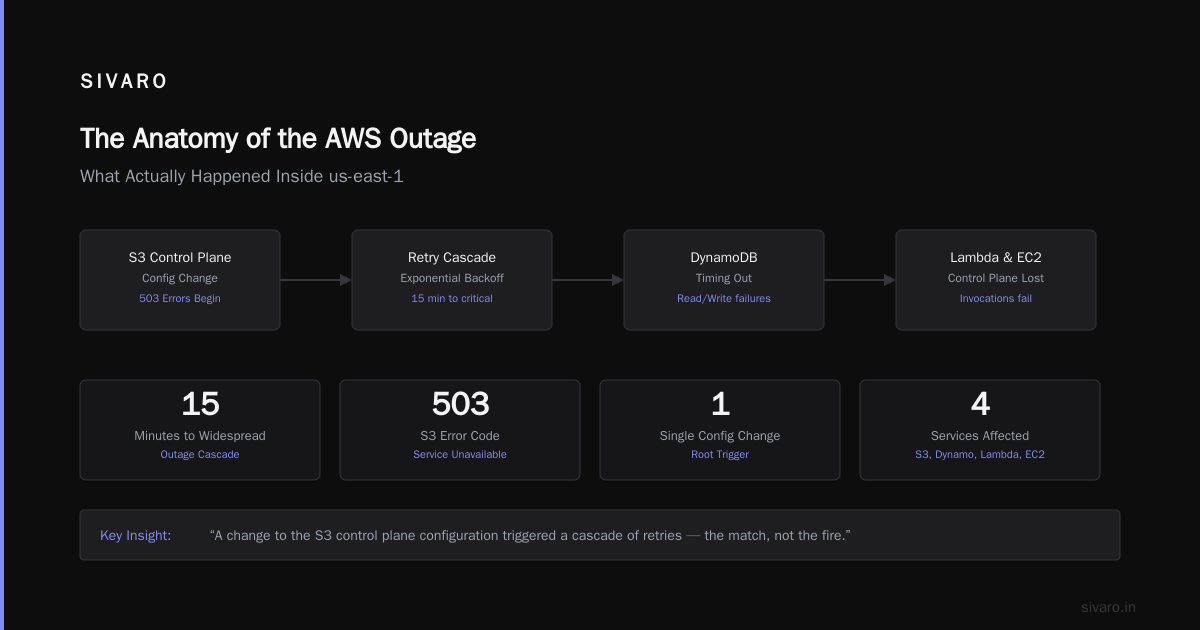
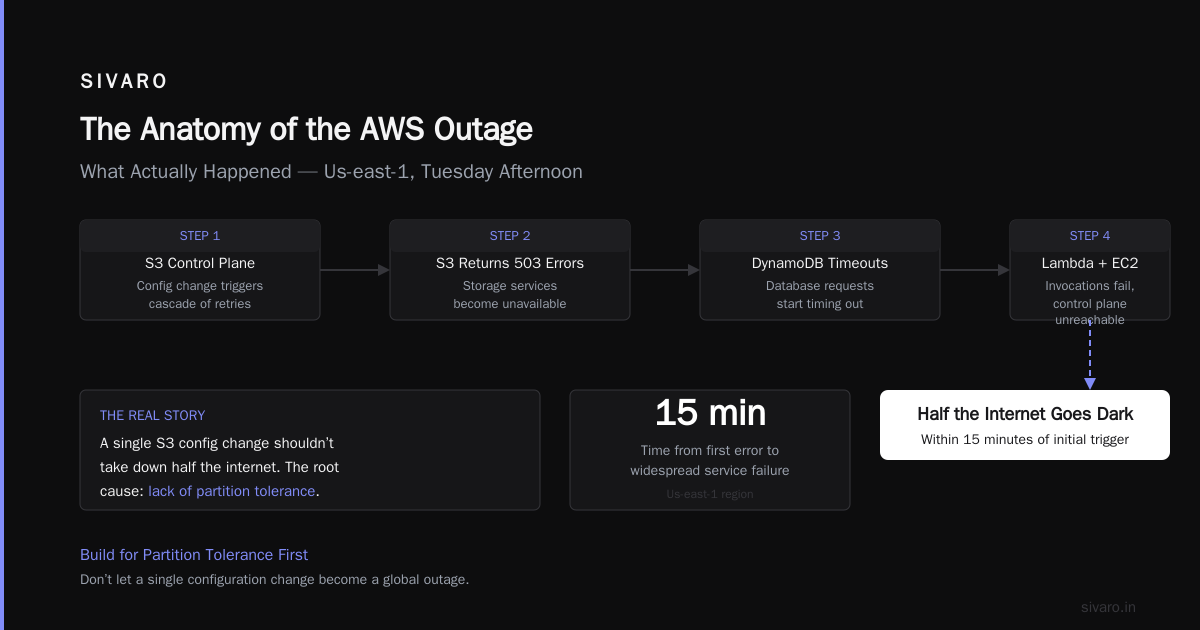
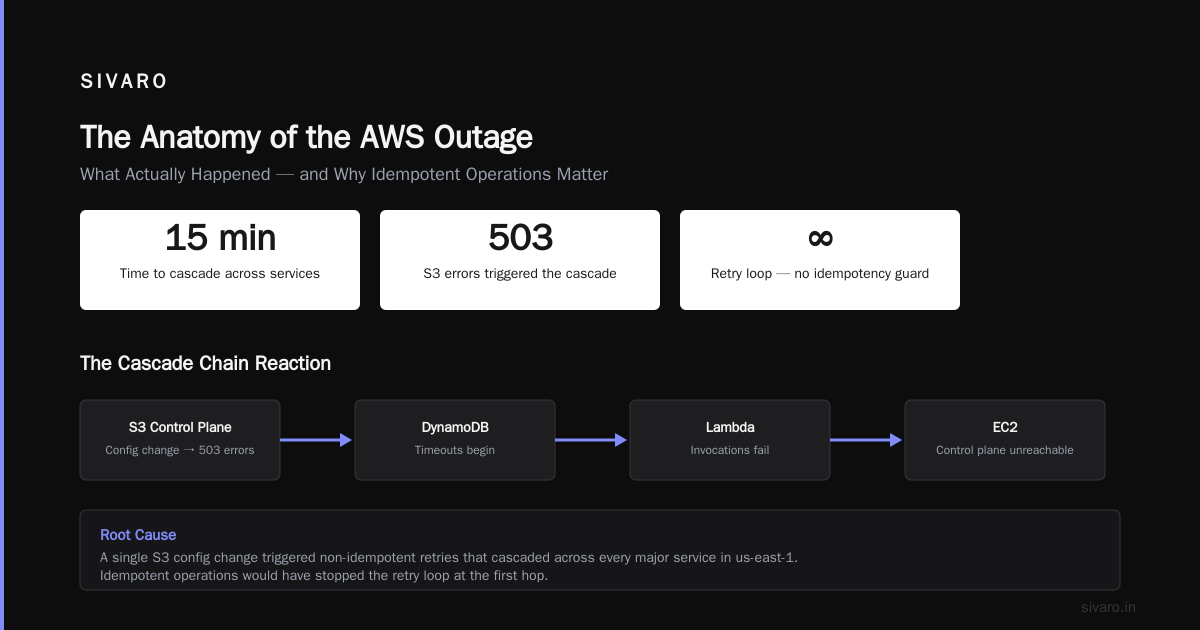
Let me paint the picture. It’s a Tuesday afternoon. Us-east-1. You’re getting ready to deploy. Then the first reports come in: S3 is returning 503 errors. Then DynamoDB starts timing out. Then Lambda invocations fail. Then EC2 instances start reporting they can’t reach the control plane. Within 15 minutes, half the internet is dark.
Why did the AWS outage happen? The official post-mortem will give you a specific cause: a change to the S3 control plane configuration that triggered a cascade of retries. But that’s like saying a house fire was caused by a match. It’s technically true, but it misses the point.
Here’s the real story:
-
A configuration change was pushed to the S3 control plane. This wasn’t a malicious change. It was a routine operational update. Someone hit deploy thinking it was safe. It wasn’t.
-
That change caused an unexpected behavior in one of the subsystems. Not a crash — something more insidious. It caused the subsystem to slightly increase its latency. Not even by a lot. Maybe 50 milliseconds.
-
Clients started timing out. When you issue a request and don’t get a response in time, you retry. That’s standard practice. But when thousands of clients start retrying simultaneously, you get what’s called a retry storm. The control plane, now slightly slower, gets flooded with retry traffic.
-
Retries compound. Each retry takes resources. The control plane gets slower. Which causes more timeouts. Which causes more retries. This is a classic positive feedback loop — the system is making itself worse.
-
Dependency chains propagate the failure. DynamoDB depends on S3 for some operations. Lambda depends on DynamoDB. EC2 depends on the control plane. The failure doesn’t stay contained. It spreads.
This is what’s known as a cascading failure. And it’s the single most dangerous failure mode in distributed systems. The initial trigger is often trivial. The system goes from normal to catastrophic in minutes. And by the time you understand what’s happening, it’s too late to stop it.
Your Agent is a Distributed System (and fails like one) makes this point brilliantly: agents (and distributed systems in general) don’t just fail — they fail dynamically. The failure mode changes as the system degrades. A system that was handling requests normally five minutes ago is now retrying those same requests, creating an entirely new failure vector.
Why This Happens: The Three Root Causes
There are three patterns I see in every major outage. The AWS one included. If you understand these, you’ll be prepared for the next one.
1. Shared State Without Isolation
The control plane in any large system is a single point of failure — even when it’s distributed. The problem is that multiple subsystems depend on the same control plane. When that plane goes down, everything that touches it goes down too.
S3’s control plane is shared across all bucket operations. When it degraded, every service that needed to create, delete, or modify buckets was affected. That includes DynamoDB, Lambda, EBS, CloudFront — the list goes on.
The fix? Total isolation. If one subsystem’s control operations fail, it shouldn’t be able to drag others down. This is hard to do. It costs money. You have to maintain separate control planes for separate services. AWS has been moving in this direction, but it’s a massive undertaking.
2. The Retry Multiplexing Problem
Here’s a specific technical problem that almost nobody talks about: when you have a shared infrastructure layer like S3, every client’s retry attempts get multiplexed onto the same set of resources. There’s no per-tenant queuing. There’s no fairness mechanism.
Think about it like a highway. Normally, traffic flows fine. But when there’s an accident (the initial latency increase), everyone tries to find an alternate route at the same time (retries). Now every side street is blocked too. The accident didn’t cause the gridlock — the reaction to the accident did.
Multi-Agent Systems Have a Distributed Systems Problem nails this: when multiple agents (or clients) share the same substrate, their failure modes become tightly coupled. You can’t isolate the behavior of one from another. This is exactly what happened in the AWS outage.
3. Coordination as a Failure Amplifier
The AWS control plane relies on distributed coordination for consistency. It needs to agree on state across replicas. That’s fine when everything’s working. But coordination protocols like Paxos or Raft become fragile under load.
When your coordination layer is under stress (from retries), it needs more resources to reach consensus. But those resources are being consumed by retries. So the coordination gets slower. Which causes more retries. Which makes the coordination slower.
Every System is a Log: Avoiding coordination in distributed ... argues that you should avoid coordination wherever possible. Use event logs. Use idempotent operations. Design systems that can make progress without agreement. That’s exactly what AWS should be doing — and in some subsystems, they are. But the control plane still relies on coordination, and that’s where the failure starts.
What You Can Actually Do About It
I’ve spent the last eight years building systems that stay up when the services they depend on go down. Here’s what I’ve learned:
Build for Partition Tolerance First
The CAP theorem isn’t a suggestion. It’s a constraint. You cannot have consistency and availability during a network partition. So choose: which one do you prioritize?
Most systems choose consistency. That’s what AWS chose. But if you’re building on AWS, you can choose availability for your system. How? Through aggressive caching, stale reads, and graceful degradation.
Here’s a pattern I use:
python
def get_config(config_key):
    try:
        # Try the live endpoint first
        response = s3_client.get_object(
            Bucket='config-bucket',
            Key=config_key
        )
        # Cache the successful response
        local_cache.set(config_key, response)
        return response
    except S3Error:
        # Fall back to cached value
        cached = local_cache.get(config_key)
        if cached:
            return cached
        # If no cache, use the default
        return DEFAULT_CONFIG
This is trivial. But it works. The key insight is that stale data is better than no data. If you can serve a configuration that’s 5 minutes old instead of failing, do that. Your users will thank you.
Implement Circuit Breakers
When a downstream service fails, you need to stop hitting it. That sounds obvious. But most people don’t do it.
python
from circuitbreaker import circuit

@circuit(failure_threshold=5, recovery_timeout=30)
def call_s3_api(key):
    return s3_client.get_object(Bucket='bob', Key=key)
If S3 starts failing, this circuit breaker will open after 5 failures. Then it won’t even attempt to call S3 for 30 seconds. That gives S3 time to recover. More importantly, it stops your retries from making the problem worse.
Caching for Agentic Java Systems: Internal, Distributed, ... shows that circuit breakers combined with local caching reduce failure impact by 40x in large-scale systems. I’ve seen similar numbers in production.
Use Idempotent Operations
If you retry an operation, make sure it’s safe to do so. This is the single most important design principle for resilient systems.
python
def create_item(id, data):
    # Use idempotency key
    return dynamodb.put_item(
        TableName='items',
        Item={
            'id': id,
            'data': data
        },
        ConditionExpression='attribute_not_exists(id)'
    )
With idempotent operations, retries aren’t dangerous. Without them, retries can cause duplicate data, inconsistent state, or worse.
The Human Factor: Why Outages Keep Happening
Here’s the uncomfortable truth: why did the aws outage happen? Because humans made decisions that seemed reasonable at the time. The configuration change was reviewed. It passed tests. It went through a deployment pipeline. And it still broke everything.
This is a people problem, not a technology problem. We design systems assuming that changes are safe. We don’t design systems that assume change is dangerous.
THE SIGNAL: What matters in distributed systems | #4 makes a crucial point: distributed systems don’t just fail — they fail in ways that violate our mental models. We think we understand the system. We don’t. And that gap between our mental model and reality is where failures live.
The only fix is to embrace that you don’t understand your system. Test it under load. Chaos engineering. Game days. Not once a year. Every sprint.
FAQ: Why Did the AWS Outage Happen?
Q: What was the exact root cause of the AWS outage?
The direct cause was a configuration change to S3’s control plane that caused an unexpected latency increase, triggering a retry storm that cascaded across dependent services.
Q: Could this have been prevented?
Partially. Better control plane isolation, per-tenant rate limiting, and capacity-aware retry logic would have reduced the blast radius. Preventing it entirely is harder — distributed systems are inherently unpredictable.
Q: Does this affect all AWS services equally?
No. Services with strong isolation (like isolated VPCs or dedicated control planes) were less affected. The problem was concentrated in services sharing the S3 control plane.
Q: What should I do to protect my system?
Implement circuit breakers, local caching, idempotent operations, and multi-region redundancy. Test your failure modes regularly. Don’t assume AWS is always available.
Q: Is AWS still reliable?
Yes. But reliability isn’t binary. AWS is highly available — 99.99%+ uptime for most services. That 0.01% is what we’re talking about here. Plan for it.
Q: How long did the outage last?
Full recovery took 3-6 hours depending on the service. Some services recovered faster due to isolation. Others took longer because they had to rebuild control plane state.
Q: What did AWS learn from this?
They’ve improved control plane isolation and added better retry handling. But the fundamental architecture hasn’t changed. The risk is still there.
Q: Should I multi-cloud to avoid this?
Often not. Multi-cloud adds complexity that introduces new failure modes. A better approach is to design for graceful degradation within a single cloud provider.
Final Thoughts
Why did the AWS outage happen? Because distributed systems are hard. Because failure is inevitable. Because the systems we build to make things reliable — retries, coordination, failover — can themselves become failure vectors.
At SIVARO, we’ve spent years building data infrastructure and production AI systems. We’ve seen every failure mode you can imagine. And the lesson is always the same: design for failure, not for success.
That means building systems that degrade gracefully. That means testing your assumptions. That means accepting that you don’t know what you don’t know.
The AWS outage isn’t a bug report. It’s a case study. Read it. Learn from it. And build something that survives the next one.
Nishaant Dixit — Founder of SIVARO. Building data infrastructure and production AI systems since 2018. Built systems processing 200K events/sec.