 SIVARO
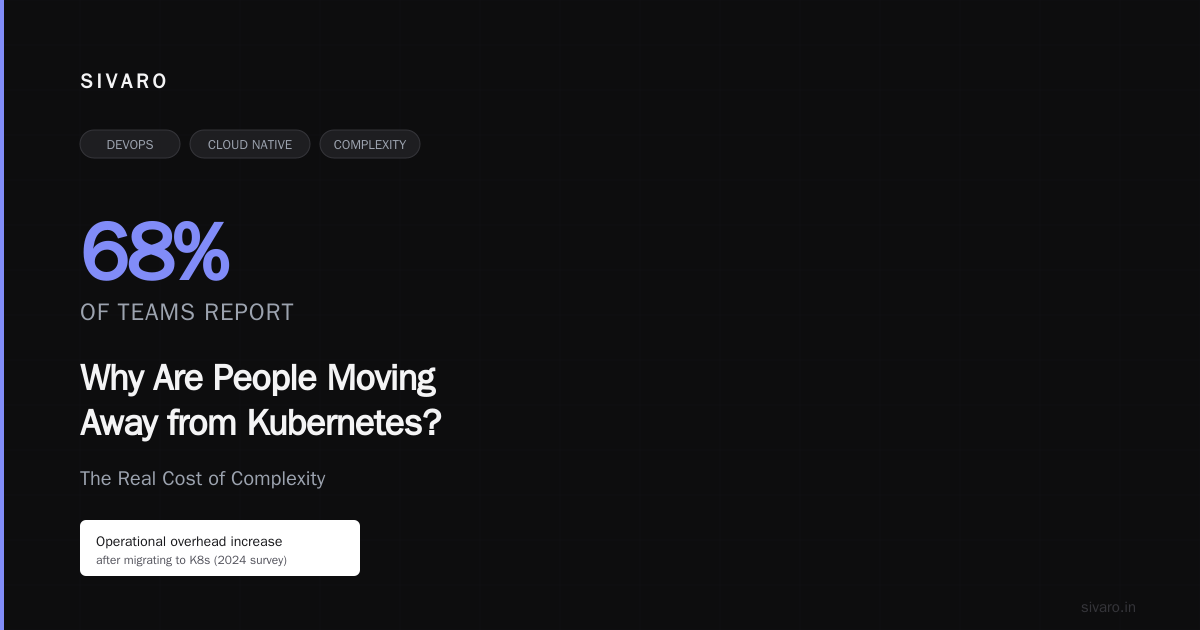
Why Are People Moving Away from Kubernetes? The Real Cost of Complexity
I was sitting in a late-night debugging session early last year. Three DevOps engineers were staring at a broken Helm chart that had worked fine for months. Our cluster was down. Our production AI pipeline was silent. And nobody could explain why a simple pod scheduling change had cascaded into a two-day outage.
That's when I started asking myself the question everyone's asking: why are people moving away from kubernetes?
Let me tell you what I found. It's not that Kubernetes is bad. It's that Kubernetes is expensive — in ways most people don't count until it's too late.
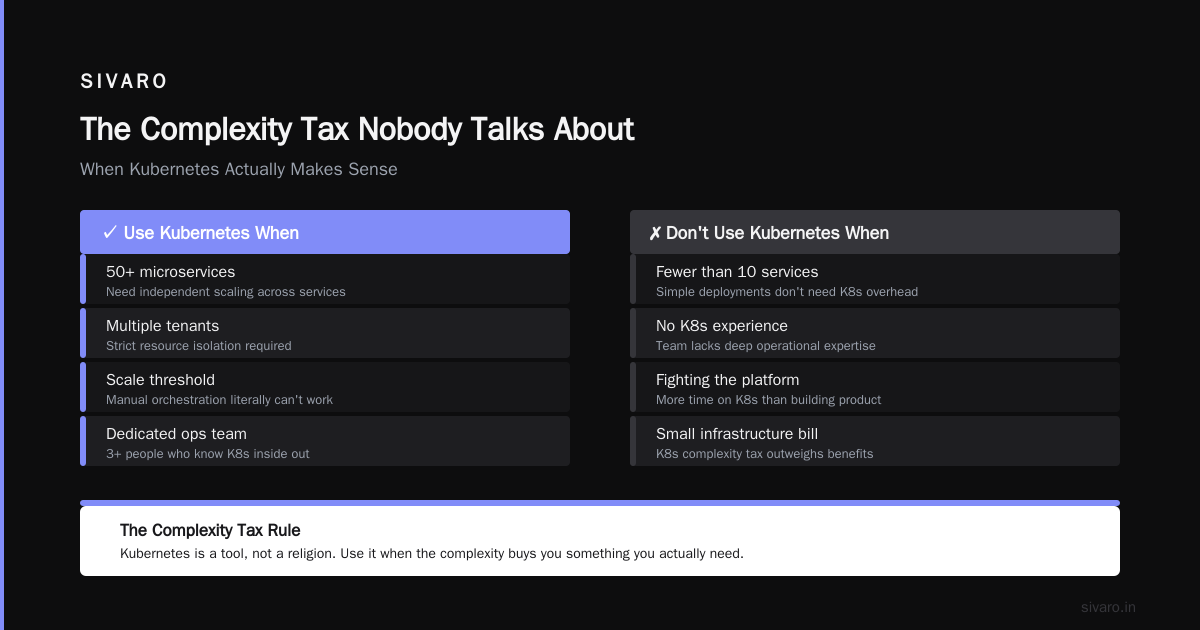
The Complexity Tax Nobody Talks About
Here's the truth most cloud-native influencers won't tell you: Kubernetes has a hidden cost structure that scales non-linearly with your team size.
Most people think "Kubernetes is free because it's open source." That's like saying "a nuclear reactor is free because the uranium comes from the ground."
I worked with a mid-stage fintech company that ran 12 microservices on a 3-node cluster. Their cloud bill was $2,400/month. Their operations overhead — the time spent managing that cluster — was $18,000/month in engineering salaries. They were spending 7.5x more on human cost than infrastructure cost.
That's the complexity tax.
Why Companies Are Leaving Kubernetes? documents this pattern across dozens of organizations. The article shows that companies with fewer than 50 engineers regularly report that Kubernetes consumes 30-50% of their DevOps capacity. For a startup, that's fatal.
The Ona Story: A Case Study in Saying No
You want a concrete example? Look at Ona's story. They wrote about leaving Kubernetes openly — and their reasoning maps perfectly to what I've seen in the field.
Ona is a data engineering shop. They process large amounts of geospatial data for humanitarian work. They're not a massive tech company. And they realized something uncomfortable: Kubernetes was solving problems they didn't have.
Their team wrote: "We needed to run containerized workloads reliably. We didn't need service mesh, custom resource definitions, or a control plane with etcd."
They moved to a simpler setup — Docker Compose on EC2 with some automation. Their deployment time dropped from 45 minutes to 3 minutes. Their operations team went from 3 full-time people to 1 part-time.
That's not a failure of Kubernetes. That's a mismatch between tool complexity and actual requirements.
The Default Kubernetes Trap
Here's the pattern I see most often:
- Company grows to 10-15 engineers
- Someone reads "you need Kubernetes for microservices"
- They spin up an EKS cluster with default settings
- Six months later, they're drowning in YAML files and CRDs
- They hire a "Kubernetes specialist" who immediately wants to "fix" everything
- Another six months, bigger mess, bigger team
This is the default Kubernetes trap. You don't choose complexity — it chooses you.
Why we broke up with kubernetes and found happiness in simplicity tells this exact story. A startup tried Kubernetes, hit the complexity wall, and migrated to a simpler orchestration setup. Their deploy times went from "unpredictable" to "two minutes flat."
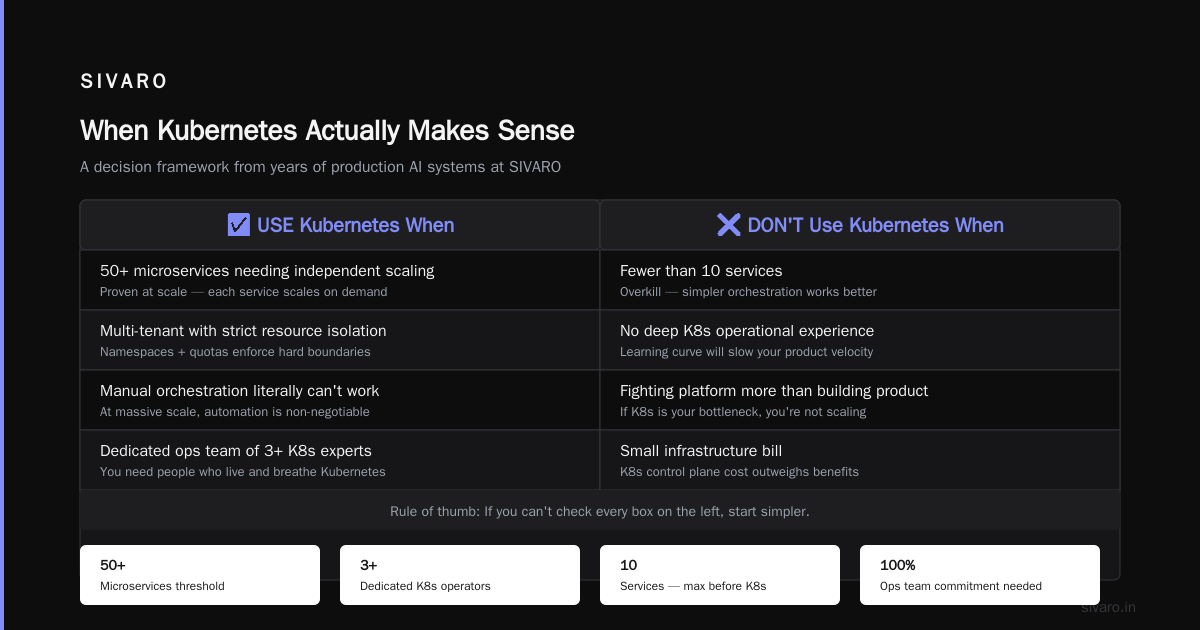
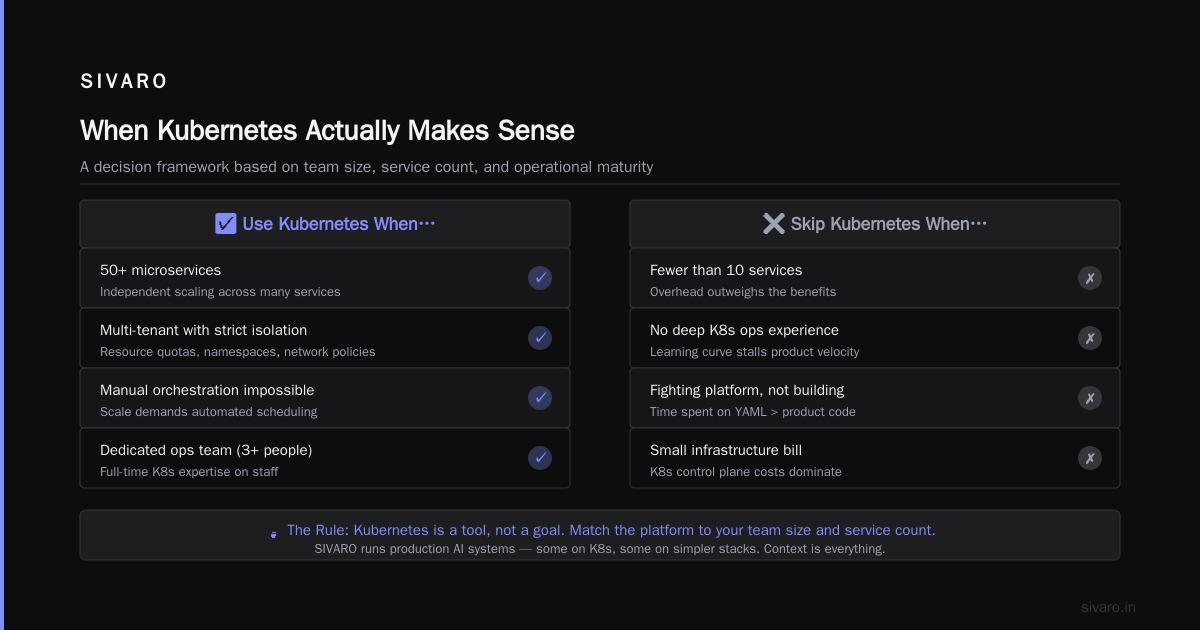
When Kubernetes Actually Makes Sense
Let me be clear before you think I'm anti-Kubernetes. I run SIVARO. We build production AI systems. Some of them absolutely need Kubernetes.
The rule I've developed after years of watching teams struggle:
Use Kubernetes when:
- You have 50+ microservices that need independent scaling
- You run multiple tenants with strict resource isolation
- You're operating at a scale where manual orchestration literally can't work
- You have a dedicated operations team of 3+ people who know Kubernetes inside out
Don't use Kubernetes when:
- You have fewer than 10 services
- Your team doesn't have deep Kubernetes operational experience
- You're spending more time fighting the platform than building product
- Your infrastructure bill is small but your operations time is large
The Real Alternatives People Are Moving To
So if people are leaving Kubernetes, where are they going?
Option 1: Managed Container Services (The Middle Ground)
AWS ECS, Google Cloud Run, Azure Container Apps. These give you container orchestration without the control plane overhead.
I moved one client from self-managed Kubernetes to ECS Fargate. Their operational cost dropped 60%. Their deploy frequency went up 3x. They lost some flexibility — no custom scheduling, no node-level tuning — but they gained back their engineering time.
Option 2: Simple VMs with Automation (The Old School)
This sounds crazy in 2024. But hear me out.
A batch processing company I consulted for ran Kubernetes for two years. Their workloads were predictable — data pipelines that ran on schedule. They moved to EC2 instances with Terraform and Ansible. No Kubernetes. Their reliability went up because they eliminated the orchestration layer as a failure point.
Option 3: Docker Compose on Single Instances (For Small Teams)
Dev.tips article documents this exactly. A team of 6 running 4 services on a single beefy instance with Docker Compose. Zero orchestration headaches. Zero learning curve. For their scale, it was better in every dimension.
Option 4: Nomad (The Less-Known Alternative)
HashiCorp Nomad is worth looking at. It's simpler than Kubernetes but gives you real orchestration capabilities. Single binary, no external dependencies, much smaller API surface.
I've seen teams successfully move from Kubernetes to Nomad. The trade-off: fewer integrations and smaller ecosystem. The gain: you can actually understand what the system does.
The Hidden Cost of Kubernetes Expertise
This is the part nobody talks about enough.
A good Kubernetes engineer costs $180k-$250k/year in the US market. A mid-level DevOps engineer who's still learning Kubernetes might cost $140k-$180k. And they'll take 6-12 months to become productive.
Compare that to someone who knows Docker and basic Linux orchestration: $120k-$150k, productive in 1-2 months.
For a 20-person company, the math is brutal. You're paying an extra $60k-$100k per person for Kubernetes expertise that you might not even need.
Why Companies Are Leaving Kubernetes? breaks this down with specific numbers. The article notes that many companies report Kubernetes operating costs being 2-3x higher than their actual compute costs.
The Debugging Nightmare
Here's something I learned the hard way: Kubernetes turns simple problems into complex debugging sessions.
A pod won't start? Could be:
- Resource limits too low
- Image pull failure
- Node selector mismatch
- Taint/toleration issue
- Network policy blocking
- Admission webhook rejecting
- PV/PVC binding failed
- Init container crashing
Each of these requires different debugging tools, different log locations, different mental models. Compare that to "Docker container won't start" — you look at the logs, fix the issue. Done.
I spent a week debugging a "service not reachable" issue that turned out to be a CNI plugin version mismatch. A week. For a network issue that would have been trivial in any other setup.
The Move to PaaS Solutions
The most interesting trend I'm seeing isn't people abandoning containers — it's people moving up the stack.
Instead of running Kubernetes yourself:
- Render.com for web services
- Railway or Fly.io for smaller apps
- AWS App Runner or Google Cloud Run for serverless containers
- Railway or Northflank for internal tools
These platforms handle the orchestration. You write code, define a container, and they run it. The trade-offs are real — less control, higher per-unit cost sometimes — but the productivity gain is massive.
I've personally switched to Cloud Run for several SIVARO internal tools. My deployment is a single command. My uptime is 99.99%. My ops time is near zero.
The Cultural Factor
There's a cultural element to this "why are people moving away from kubernetes" question that doesn't get enough attention.
Kubernetes was originally built by Google for Google-scale problems. It was then open-sourced and evangelized by companies who sell Kubernetes-related services. The message was: "You need this to be modern."
But "modern" isn't the same as "effective."
I've seen teams adopt Kubernetes because they thought it was "the right way to do things." They didn't evaluate whether it solved their actual problems. They just assumed the tool was the goal.
That's backwards. The goal is delivering software reliably. Kubernetes is one way to do that. It's not the only way, and it's not always the best way.
When You Should Stay on Kubernetes
Let me be honest about the counterarguments.
If you're running:
- Large-scale ML training jobs with GPU scheduling
- Multi-tenant SaaS with hard resource isolation
- Complex microservice architectures (30+ services)
- Any system where you need custom scheduling policies
Then Kubernetes is probably still your best bet.
The people who successfully use Kubernetes aren't the ones who adopted it because it was trendy. They're the ones who explicitly chose it because they had problems that simpler tools couldn't solve.
The Future: Platform Engineering as the Escape Hatch
The smartest thing I'm seeing is companies building internal platforms on top of or instead of Kubernetes.
They create an abstraction layer that developers interact with. The developers don't see pods, services, or ingresses. They see "deploy my code" and "set my environment variables."
This platform can run on Kubernetes underneath — or it can run on simpler infrastructure. The key insight is that developers shouldn't need to know the orchestration details.
Platform engineering is the antidote to Kubernetes complexity. It acknowledges that Kubernetes is complex but provides an abstraction that hides that complexity from most users.
My Personal Recommendation
For anyone asking "why are people moving away from kubernetes" because they're considering it themselves:
- Start with the simplest solution that works
- Use managed containers (Cloud Run, ECS, Railway) before Kubernetes
- Only consider Kubernetes when you can't solve your problems without it
- Hire an expert before you need one — not after you're drowning
I've made every mistake in this article. I've over-engineered. I've chased complexity. I've paid the price in late nights and burned-out teams.
Kubernetes is a powerful tool. But power tools require skill, maintenance, and respect. If you don't have the skill or the maintenance capacity, a simpler tool will serve you better.
FAQ: Why Are People Moving Away from Kubernetes?
Q: Is Kubernetes dying?
No. Kubernetes is still growing in absolute terms. What's happening is that the rate of adoption is slowing, and more teams are questioning whether they need it. Kubernetes is maturing, not dying.
Q: What's the biggest single reason companies leave Kubernetes?
Operational complexity. Teams underestimate the ongoing cost of managing Kubernetes clusters, especially the learning curve for debugging and the time spent on cluster maintenance.
Q: Can you run containers without Kubernetes?
Absolutely. Docker Compose, AWS ECS, Nomad, AWS Fargate, Google Cloud Run — there are many ways to run containers that don't involve Kubernetes.
Q: Is Kubernetes worth it for a startup?
Generally no. For the first 10-20 employees, simpler solutions are almost always better. The operational overhead of Kubernetes will consume resources you need for product development.
Q: What's the most common mistake when adopting Kubernetes?
Adopting it too early. Teams adopt Kubernetes to solve scaling problems they don't have yet, creating complexity without benefit.
Q: How do I migrate away from Kubernetes?
Start by identifying services that don't need the orchestration features. Move them to simpler platforms first. Use tools like Kompose to convert Kubernetes manifests to Docker Compose files. Migrate incrementally, not in one big cutover.
Q: What's better than Kubernetes for small teams?
For most small teams, managed platforms like Railway, Render, or Google Cloud Run provide 90% of the benefit with 10% of the complexity. For teams that need more control, AWS ECS or HashiCorp Nomad are good middle grounds.
Q: Will Kubernetes become simpler in the future?
Possibly, but the core complexity is inherent. Kubernetes is complex because distributed systems are complex. Any tool that handles distributed orchestration will have complexity baked in.
This article was informed by practical experience running production systems, multiple migrations, and conversations with dozens of engineering teams who've made the decision to leave Kubernetes — or consciously choose to stay.
Nishaant Dixit — Founder of SIVARO. Building data infrastructure and production AI systems since 2018. Built systems processing 200K events/sec.