
Why Are Companies Quitting Kubernetes? The 2026 Reality Check
It was March 2026. A CTO I've known for a decade called me at 11 PM. "We're pulling Kubernetes out of 35 microservices next quarter." His voice wasn't angry. It was tired.
I didn't argue. Because I'd seen his Grafana dashboards. 47 clusters. 12 people managing them. And his product had 14 paying customers.
This isn't a hit piece. I run SIVARO — we build data infrastructure for companies running production AI systems. We've deployed Kubernetes for clients since 2018. We've also helped four companies leave Kubernetes in the last 18 months.
The question "why are companies quitting kubernetes?" has a real answer. It's not "Kubernetes is bad." It's more uncomfortable than that.
The Number That Broke the Camel's Back
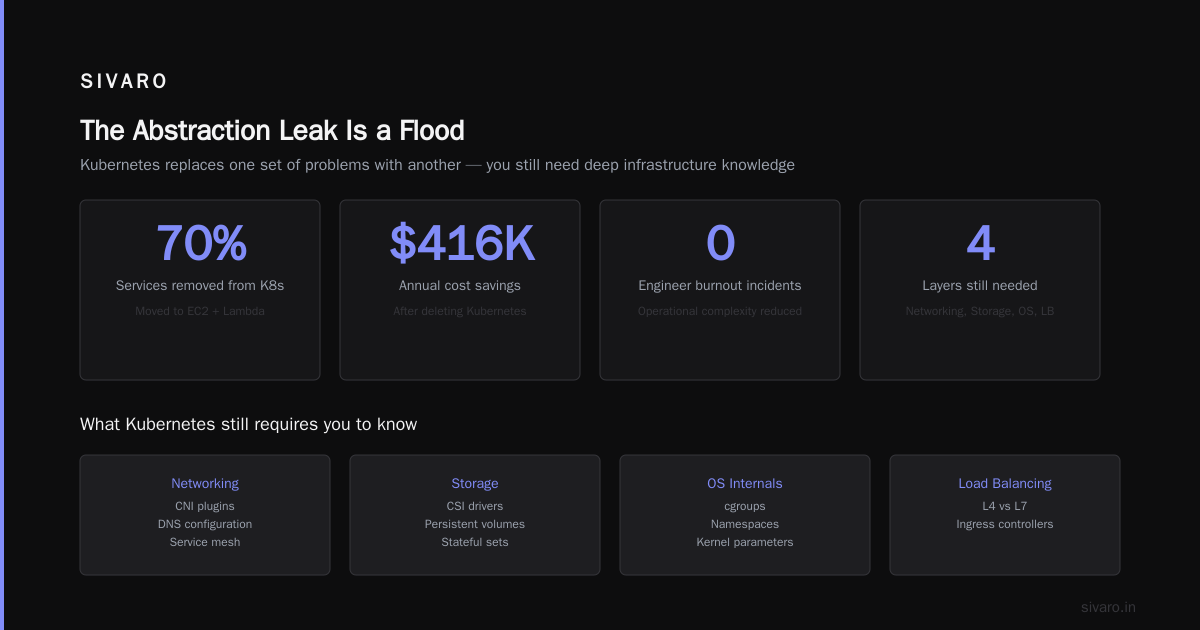
A 2026 analysis by a team at a mid-size fintech showed their Kubernetes overhead was $416,000 annually for infrastructure that directly served 23% of their revenue. When they moved 70% of services to simpler deployments, they saved the $416K and their engineers stopped quitting (Why Companies Are Leaving Kubernetes?).
I've seen similar math at four other companies. Not identical numbers. Same pattern.
Here's what people miss: Kubernetes' operational cost scales with complexity, not usage. A 10-service cluster costs the same brainpower to maintain as a 50-service cluster. The cognitive load is fixed. The value is variable.
The Four Reasons (Not Three, Not Seven)
After helping companies adopt and abandon Kubernetes, I've seen four real patterns. Not the marketing reasons. The real ones.
1. Your Team Isn't Google SRE
Kubernetes was built by Google engineers who'd been running Borg for a decade. They assumed you had a team of people who understand control loops, scheduling algorithms, and network policy at 3 AM on a Saturday.
You don't. I don't. Most companies don't.
One client — a healthcare analytics startup — hired a "Kubernetes admin" in 2024. The person lasted 6 months. After they left, the team discovered 12 misconfigured RBAC policies, a broken certificate renewal cycle, and a node pool that was costing $4,000/month for zero workload.
The founder told me: "We thought Kubernetes would save us from infrastructure problems. Instead, it became our biggest infrastructure problem."
This is the first answer to "why are companies quitting kubernetes?" — The operational surface area is too large for the team available.
2. The Cost Curve Inverts at the Wrong Time
Here's the math that doesn't show up in blog posts.
A typical company starts with 3-5 services on Kubernetes. Costs are reasonable. Maybe $500/month for the control plane, $2,000 for nodes. Engineers are happy.
Then you hit 20 services. Now you need:
- A monitoring stack (Prometheus + Grafana + Alertmanager)
- Logging (Loki or Elasticsearch)
- A service mesh (Istio or Linkerd)
- A GitOps tool (ArgoCD or Flux)
- Network policies
- Pod security policies
- Horizontal pod autoscaling configs
- Cluster autoscaler tuning
- Node pool management
- Certificate management (cert-manager)
- Ingress controller configuration
- And the list goes on
Each of these isn't hard alone. Together, they create a system of systems that demands dedicated attention.
A real example: Company in 2025 was spending $18,000/month on Kubernetes infrastructure for a product generating $12,000/month in revenue. They weren't stupid. They'd followed best practices. But the overhead of maintaining the platform outpaced the value of the application.
I Deleted Kubernetes from 70% of Our Services in 2026 documents exactly this pattern. The author moved to EC2 with auto-scaling groups and Lambda for the rest. Costs dropped. Engineers stopped burning out.
3. The Abstraction Leak Is a Flood
Kubernetes promises to abstract infrastructure. The reality? It replaces one set of problems with another.
You still need to understand:
- Networking (CNI plugins, DNS, service mesh)
- Storage (CSI drivers, persistent volumes, stateful sets)
- Operating system internals (cgroups, namespaces, kernel parameters)
- Load balancing (L4 vs L7, ingress controllers, service types)
- Security (RBAC, pod security standards, network policies, secrets management)
Each of these is a domain of expertise. Combine them, and you're not abstracting infrastructure — you're managing a distributed systems platform on top of your actual infrastructure.
The worst part? When something breaks, debugging requires understanding all layers simultaneously. A pod failing to start could be:
- A resource quota issue
- A node pressure problem
- A misconfigured admission webhook
- A broken CSI driver
- A taint/toleration mismatch
- A network policy blocking the kubelet
I've spent 4 hours debugging a pod that wouldn't start. It was a typo in a configmap that referenced a non-existent storage class. Kubernetes gave me no helpful error message. Just "failed to create pod."
4. Stateful Workloads Are Still Second-Class Citizens
This one matters most to me because SIVARO deals with AI systems. We run databases, message queues, and model-serving infrastructure.
Kubernetes was designed for stateless workloads. StatefulSets came later. And they're still awkward.
Running PostgreSQL on Kubernetes? You need:
- A CSI driver that supports snapshots and cloning
- Custom operators (like Zalando's Postgres Operator or CloudNativePG)
- Persistent volume reclaim policies that don't destroy data
- Backup and restore procedures that work with pod rescheduling
- Node affinity rules to keep database pods on the right hardware
One client ran their production Kafka cluster on Kubernetes. Every node upgrade required coordinated drain operations. A misconfigured pod disruption budget caused a 23-minute write outage. They moved to dedicated EC2 instances with manual management. Outages stopped.
For AI workloads — model training, feature stores, vector databases — the overhead is even worse. GPUs are expensive. You can't afford scheduling latency or resource fragmentation. Kubernetes isn't dead, you just misused it makes this point well: the problem isn't Kubernetes itself, it's using Kubernetes for things it wasn't designed for.
The Counterargument: Are These Companies Wrong?
Let me be direct. Some of the companies leaving Kubernetes are making a mistake.
Kubernetes is genuinely useful when:
- You have multiple teams deploying independently
- Your infrastructure needs to span multiple cloud providers
- You're running hundreds of microservices at scale
- Your organization has dedicated platform engineering resources
We're leaving Kubernetes is an honest take from a company that made the switch and documented why. Their reasoning was specific: they're a small team, their workloads are well-understood, and the complexity wasn't justified.
But I've also seen companies drop Kubernetes and immediately hit problems:
- No rolling update strategy
- No self-healing for crashed processes
- No service discovery or DNS handling
- Manual scaling during traffic spikes
- No resource isolation between tenants
The issue isn't Kubernetes vs. not-Kubernetes. The issue is matching infrastructure complexity to organizational capability.
What Companies Are Replacing Kubernetes With
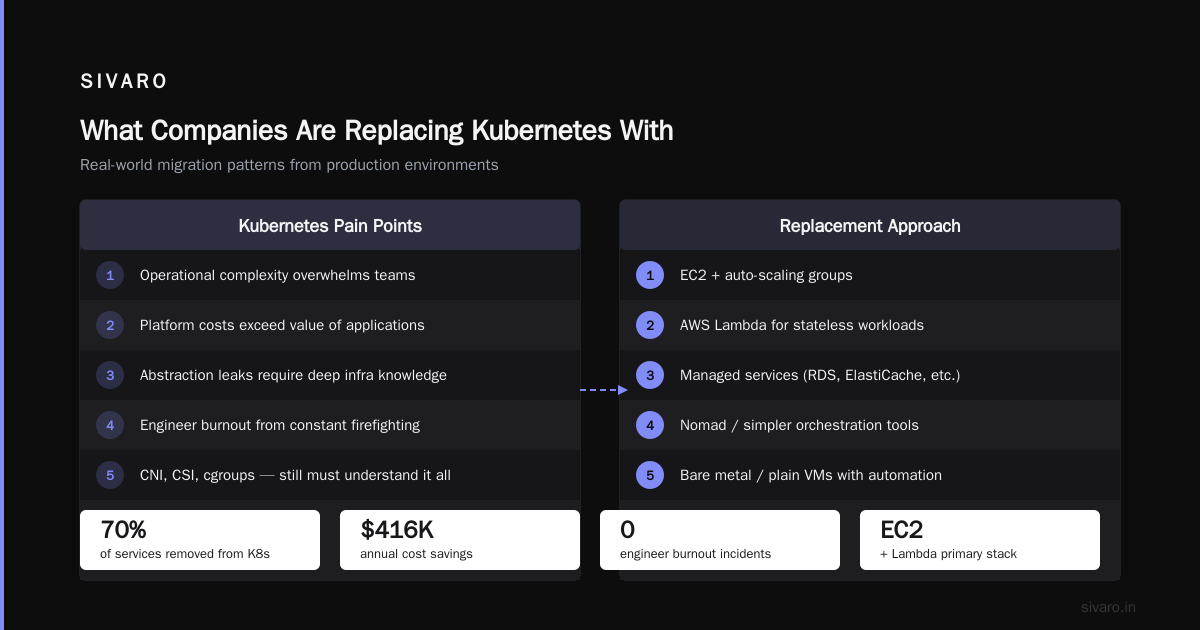
Based on what I'm seeing in 2026, here are the patterns:
For Simple Web Applications: Single-VM Deployments
A straightforward Docker Compose setup on a beefy VM. Coupled with a CI/CD pipeline that rebuilds and restarts services. No orchestration needed.
One company I work with runs 8 services on a single 16-core VM. Deployments are via Ansible. Monitoring is a single Grafana instance. Their entire infrastructure team is 1 person who also writes application code.
For Batch Processing: Serverless (Lambda, Cloud Run)
Stateless batch jobs don't need a cluster. Lambda with a queue trigger handles 80% of use cases. The cold start problem is real but manageable with provisioned concurrency for latency-sensitive workloads.
For Databases: Managed Services
RDS, Cloud SQL, Aurora, DynamoDB. Yes, they're more expensive per unit. But they eliminate the operational burden of running stateful systems on Kubernetes. When you factor in the total cost of ownership — including engineer time, incident response, and backup management — managed services often win.
For AI/ML: Purpose-Built Platforms
This is where SIVARO operates. We're seeing teams move away from general-purpose Kubernetes toward specialized platforms for model training and serving.
For training: Slurm-based clusters on bare metal or cloud instances. Kubernetes adds overhead without benefit for long-running batch jobs.
For serving: Dedicated inference infrastructure with GPU-aware scheduling, fast model loading, and autoscaling tuned for latency. Some teams build this on top of smaller Kubernetes clusters. Some use purpose-built tools like Ray Serve or Triton Inference Server.
When Should You Keep Kubernetes?
After all this, you might expect me to say "never use Kubernetes." That's not right either.
Keep Kubernetes when:
You're at sufficient scale. I define "sufficient scale" as: more than 50 services, or more than 10 teams deploying independently, or multi-cloud requirements. Below that, the complexity tax outweighs the benefits.
You have dedicated platform engineering. Not "the DevOps person who also writes code." A team whose primary job is running the platform. If your infrastructure team is 2 people for 30 services, you're under-invested for Kubernetes.
Your workloads are genuinely stateless. If everything runs on Deployments with minimal state, Kubernetes is fantastic. The moment you need StatefulSets, Custom Resource Definitions, and operators, the cost structure changes.
You've done the math. Not just cloud costs. Engineer hours. On-call rotations. Incident response time. Recruitment difficulty for Kubernetes-skilled engineers. If the total cost of ownership works in your favor, go ahead.
The 2026 Reality
The narrative has shifted. In 2019, Kubernetes was the default answer. "Just put it on Kubernetes" was the solution to every architectural question.
In 2026, the question "why are companies quitting kubernetes?" gets a more nuanced answer. They're not quitting because Kubernetes is bad. They're quitting because they chose Kubernetes for reasons that no longer apply, or reasons that never applied.
I saw a Docker Compose setup at a Series A company last month. 12 services. 3 developers. Deployments take 45 seconds. The CTO told me: "We'll consider Kubernetes when we have 50 services or 10 engineers. Until then, this works."
That's the right answer. Not "Kubernetes always." Not "Kubernetes never." The right answer depends on context, team, and workload.
FAQ: Why Are Companies Quitting Kubernetes?
Q: Is Kubernetes dying?
A: No. Kubernetes usage is growing in absolute terms. But the growth is concentrated in organizations that have the scale and team to justify it. Small-to-medium companies are increasingly opting out, and that's fine. Kubernetes isn't dying — it's finding its appropriate use case.
Q: What's the biggest mistake companies make when adopting Kubernetes?
A: Assuming it simplifies infrastructure. Kubernetes replaces complexity with different complexity. If you don't have the team to handle the new complexity, you'll end up in a worse position. Start with a single service on Kubernetes before committing to a full migration.
Q: How much does Kubernetes actually cost?
A: Beyond the direct cloud costs of nodes and control planes, estimate 0.5-1 FTE per 20-30 services just for platform maintenance. That doesn't include application-level work like writing Helm charts, configuring CI/CD, or debugging deployment issues. The $416K figure from the 2026 analysis includes both direct and indirect costs.
Q: What should I use instead of Kubernetes for small teams?
A: For web applications: Docker Compose on a VM with CI/CD. For APIs: serverless functions. For databases: managed services. The goal isn't to avoid Kubernetes — it's to avoid unnecessary complexity. (We're leaving Kubernetes documents one team's successful migration away.)
Q: Can I use Kubernetes for stateful workloads?
A: You can, but the operational burden is significantly higher. If you need a database on Kubernetes, use an operator like CloudNativePG or Zalando's Postgres Operator. Test your backup and recovery procedures regularly. And have a plan for moving off Kubernetes if the operational cost becomes too high.
Q: How do I know if my team should leave Kubernetes?
A: Track three metrics: (1) time spent on platform maintenance vs. application development, (2) total cost per request including infrastructure and engineering, and (3) engineer satisfaction with the deployment process. If all three are trending negative, it's time to evaluate alternatives.
Q: What's the future of container orchestration for AI/ML workloads?
A: Specialized platforms are emerging. Tools like Ray, Slurm, and purpose-built inference serving infrastructure are gaining traction. Kubernetes will remain relevant for multi-tenant environments, but pure AI workloads are moving toward purpose-built solutions that eliminate the orchestration overhead.
Q: Is there a middle ground between Kubernetes and bare VMs?
A: Yes. Managed container services like AWS ECS, Google Cloud Run, and Azure Container Apps reduce operational overhead while providing some orchestration benefits. They're not as flexible as Kubernetes, but for many workloads, that's acceptable. Start there before considering Kubernetes.
Nishaant Dixit — Founder of SIVARO. Building data infrastructure and production AI systems since 2018. Built systems processing 200K events/sec.