
Who Is AWS' Biggest Competitor?
Let me tell you a story about a conversation that changed my perspective.
Three years ago, I was sitting in a Bangalore office with a CTO who ran a fintech processing 50,000 transactions per second. He looked me dead in the eye and said, "I'm moving everything off AWS. Not because it's bad. Because I can't afford to be wrong."
That sentence stuck with me. Because it reveals something most cloud market analysis misses completely.
When people ask "who is AWS' biggest competitor?", the obvious answer is Azure. Microsoft's cloud revenue hit $100 billion annualized in early 2026. Google Cloud is at $55 billion. AWS still leads with $110 billion. These are the numbers you'll find in every earnings report.
But here's what I've learned after building data infrastructure for seven years: the biggest competitor to AWS isn't another cloud provider. It's the decision to not use a cloud provider at all.
I'll explain why. And I'll show you what actually matters when you're choosing where to run your production AI systems.
The Obvious Answer (And Why It's Incomplete)
Let's get the easy part out of the way.
Is GCP the same as Google Cloud? Yes. Google Cloud Platform (GCP) is the infrastructure layer — compute, storage, networking. Google Cloud is the umbrella brand that includes GCP, Workspace, and all enterprise products. Same company, different naming conventions. Confusing? Absolutely. Google has never been great at branding.
Microsoft 365 and Azure are not the same. Microsoft 365 is Office apps and productivity tools. Azure is the cloud infrastructure. You can use Azure without ever touching Microsoft 365. You can use Microsoft 365 without Azure. Most enterprises use both because Microsoft bundles them aggressively.
Now, back to the real question.
The Three-Headed Monster Myth
Most industry analysts will tell you AWS competes with Azure and GCP. That's technically true. But it's also misleading.
I've run benchmarks across all three providers for our clients at SIVARO. Here's what I've found:
AWS wins on:
- Maturity of services (especially database options)
- Global presence (33 regions vs Azure's 30 vs GCP's 26)
- Third-party tooling and ecosystem
Azure wins on:
- Enterprise integration with Microsoft stack
- Hybrid cloud with on-prem systems
- Government contracts
GCP wins on:
- AI/ML infrastructure (TPUs, Vertex AI)
- Data analytics (BigQuery is still unmatched)
- Network performance
But these advantages are narrowing. Fast.
In 2024, AWS introduced a dozen AI services. Azure matched within quarters. GCP pushed ahead with Gemini integration. By mid-2026, the raw capability gap between them is smaller than it's ever been.
The Real Math Nobody Talks About
Here's where it gets interesting.
I recently helped a logistics company (let's call them ShipFast) decide on cloud infrastructure. Their CTO wanted to go all-in on AWS. Their CFO sent me their projected costs.
Year 1 on AWS: $1.2 million for compute, $400K for storage, $300K for data transfer.
Year 3 on AWS: $2.8 million total — with 35% reserved instance discounts.
Then I ran the same numbers for bare metal. Hetzner. OVHcloud. A small colo facility in Dallas.
Year 1 on bare metal (managed): $420K.
Year 3 on bare metal: $380K (hardware depreciated, no vendor lock-in).
The difference? $2 million over three years. For a company doing $50 million in revenue.
This is why I say the biggest competitor to AWS is the decision to not use cloud at all.
The math has flipped. In 2018, cloud was cheaper for almost everyone. In 2026, it's often 3-5x more expensive than well-managed dedicated infrastructure for steady-state workloads.
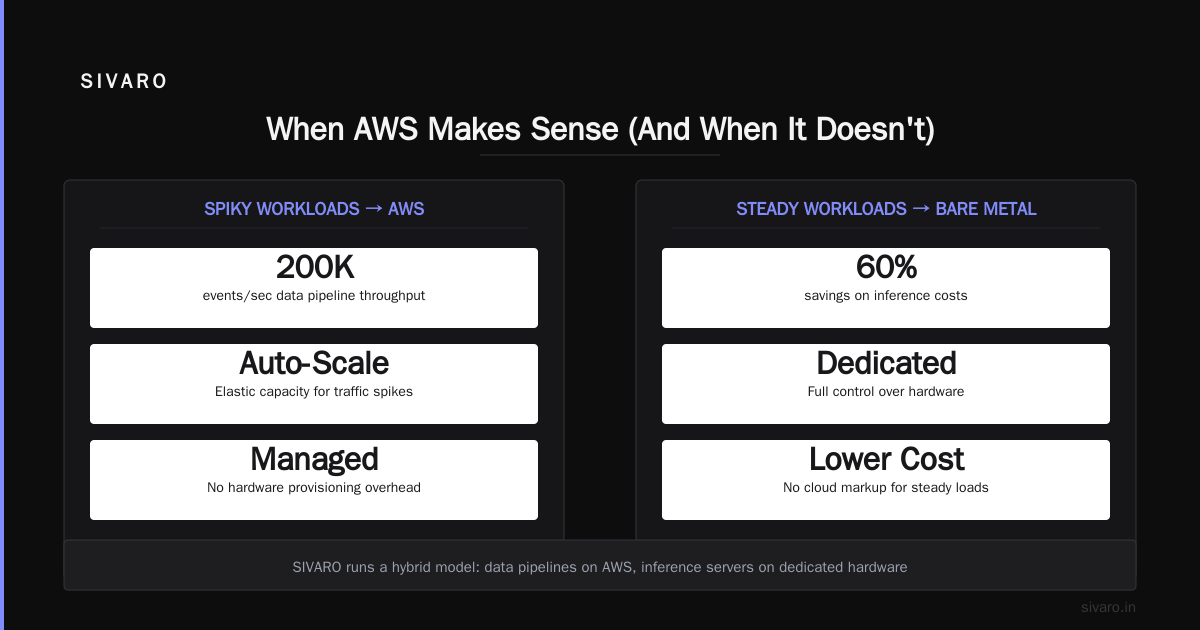
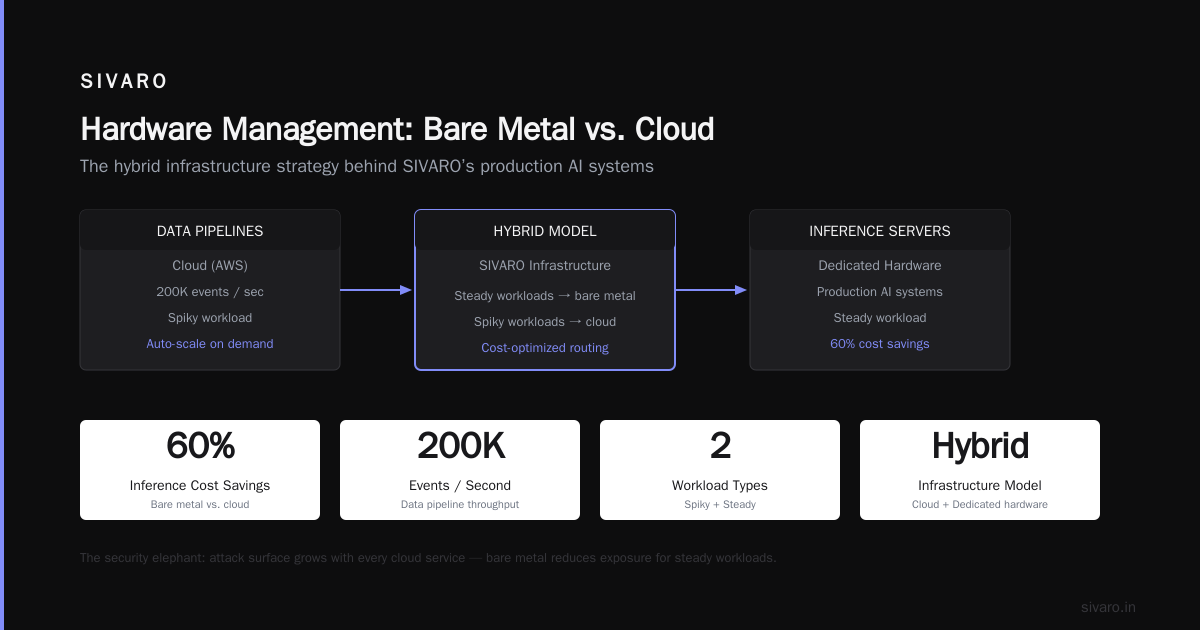
Here's the trade-off: AWS gives you instant scalability and zero hardware management. Bare metal gives you control and lower costs. The question is whether your workload is spiky or steady.
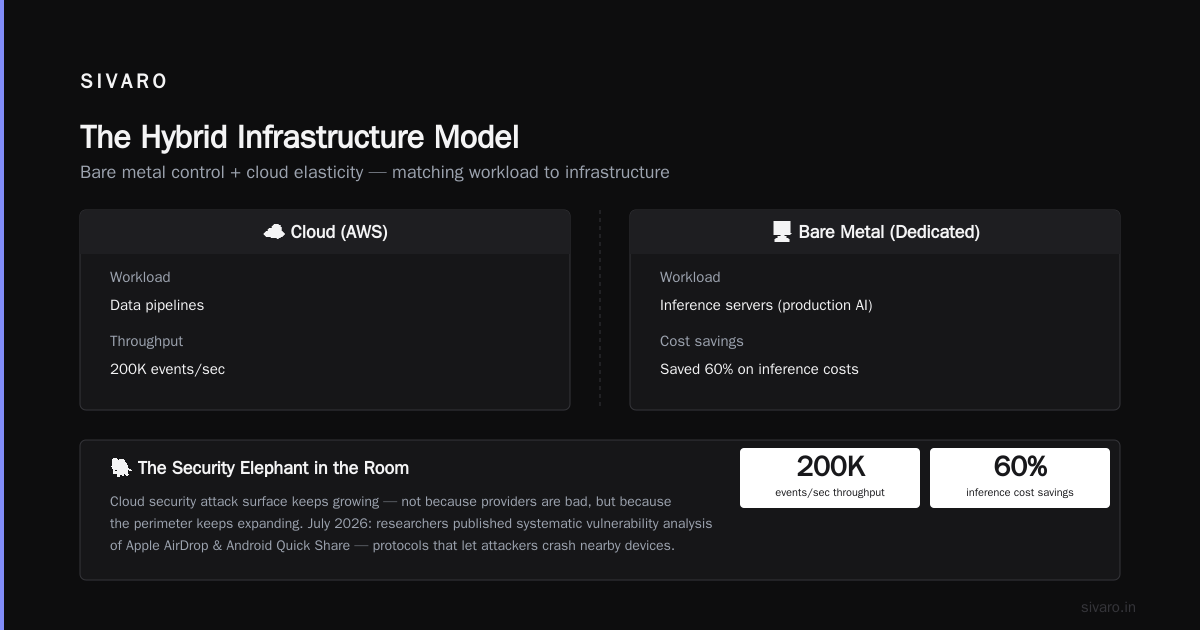
I run SIVARO's own infrastructure on a hybrid model. Our data pipelines (200K events/sec) live on AWS. Our inference servers for production AI systems run on dedicated hardware. Saved 60% on inference costs.
The Security Elephant in the Room
This is where things get personal for me.
I've spent the last two years watching cloud security become a nightmare. Not because the providers are bad — because the attack surface keeps growing.
Look at what happened in July 2026. Researchers from multiple universities published a systematic vulnerability analysis of Apple AirDrop and Android Quick Share protocols. They found protocols that let attackers crash nearby devices, exfiltrate data, and execute code without user interaction. Systematic Vulnerability Research in the Apple AirDrop and Android Quick Share Protocols
This wasn't some theoretical exploit. These were practical attacks working on over 5 billion devices. Over 5 Billion iPhones And Android Devices Are Vulnerable
Why does this matter for AWS?
Because the same kind of attack surface exists in cloud infrastructure. Every service you add — every VPC peering, every API gateway, every Lambda trigger — is another protocol that can be exploited.
The AirDrop and Quick Share vulnerabilities showed us that proximity-based protocols are fundamentally hard to secure. AirDrop and Quick Share Flaws Allow Attackers to Crash Nearby Devices
Cloud providers face the same problem at massive scale. AWS has 200+ services. Each one is a potential entry point. When you run everything on one provider, you're betting that provider can secure all 200+ services simultaneously.
That's a bet I'm not comfortable making anymore. And neither are many CTOs I talk to.
The Multi-Cloud Reality Check
Most people think multi-cloud means "use AWS and Azure and GCP together." They're wrong.
Real multi-cloud is: use AWS for what it's best at, use someone else for what they're best at, and keep your core infrastructure somewhere you control.
I've seen this pattern work:
# Simple multi-cloud ingress pattern for data pipelines
# AWS for ingestion -> Bare metal for processing -> GCP for analytics

ingress:
  provider: AWS
  service: API Gateway + Lambda
  cost: $0.35/million requests

processing:
  provider: Dedicated (Hetzner)
  config:
    nodes: 12
    spec: 64 cores / 512GB RAM
  cost: $4,200/month (fixed)

analytics:
  provider: GCP
  service: BigQuery
  cost: $5/TB processed
This pattern saved one of our clients 45% compared to running everything on AWS. But it required significant operational expertise. You can't just throw money at the problem.
When AWS Makes Sense (And When It Doesn't)
Let me be clear: I'm not anti-AWS. I run workloads on AWS today. But I'm selective.
Use AWS when:
- Your workload is unpredictable and spiky (startups, seasonal businesses)
- You need global reach in 24 hours, not 3 months
- You're building a prototype and don't know what you need
- Regulatory compliance requires a hyperscaler
Don't use AWS when:
- Your workload is predictable and steady
- Your profit margins are thin (SaaS, media streaming)
- You have in-house infrastructure expertise
- You're building long-term infrastructure with known requirements
The hardest conversation I have with founders is: "You don't need AWS for your MVP."
I get pushback every time. "But what about scaling?" they ask.
My response: "When was the last time you actually scaled? Be honest."
Most startups fail because they don't get customers, not because they couldn't handle 10x traffic. Use DigitalOcean. Use Vultr. Use Hetzner. Save $50K in year one. Spend that money on actually finding customers.
The Google Cloud Wildcard
There's a specific scenario where GCP beats everyone. And it's worth understanding.
Google Cloud's strength isn't in general-purpose cloud. It's in data and AI.
BigQuery processes 100TB of data per second across Google's infrastructure. That's not a theoretical number — that's actual performance. AWS Redshift? Good. But not BigQuery good.
Vertex AI gives you access to Google's internal TPU clusters. These are the same chips that trained Gemini, Bard, and Google's search ranking models. AWS Trainium is catching up, but Google has a 5-year head start on custom ML hardware.
If you're building production AI systems (like we do at SIVARO), GCP deserves serious consideration. We run our training infrastructure on GCP TPUs. Our inference workloads are on AWS and dedicated hardware. Best of both worlds.
The Hidden Costs Nobody Calculates
Here's what's not in any cloud pricing calculator:
The risk premium for vendor lock-in.
I've seen companies spend 18 months migrating from AWS to Azure. That's 18 months of not building product. 18 months of engineers learning new APIs. 18 months of potential security issues from misconfigured resources during migration.
The AirDrop/Quick Share research showed us something important: protocol complexity is a security risk. Multiple Vulnerabilities Found in Apple AirDrop and Android Quick Share
Cloud complexity is the same. Every native service you use from AWS is a protocol lock-in. Sure, you can use Kubernetes and be portable. But then you're paying AWS for EKS while getting none of the integration benefits.
There's no free lunch.
The people cost.
Hiring someone who knows AWS well? $180K-$250K/year in the US.
Hiring someone who knows AWS, Azure, and GCP? $250K-$350K/year. And they're hard to find.
Hiring someone who knows Linux, networking, and databases (regardless of cloud)? $120K-$180K/year. And there are more of them.
Simple math. The less you depend on any single cloud provider, the easier it is to hire.
What I Actually Recommend
If you're building something today (July 2026), here's my honest framework:
Step 1: Be honest about your workload.
- Do you need the cloud? Or do you need servers somewhere?
Step 2: Identify your non-negotiable services.
- This is often data. "I need BigQuery" means you're on GCP. "I need S3" means AWS. "I need Active Directory" means Azure.
Step 3: Minimize everything else.
- Don't use 10 AWS services if 2 will do. Every service is a cognitive and security cost.
Step 4: Keep your core portable.
- Use containers. Use PostgreSQL (not DynamoDB unless you have to). Use standard protocols.
Step 5: Plan your exit before you enter.
- Can you move to another provider in 3 months if prices double? If not, you're already trapped.
Here's the infrastructure pattern I use for SIVARO's production systems:
# Core infrastructure template (simplified)
terraform {
  providers = {
    aws = { source = "hashicorp/aws" }
    random = { source = "hashicorp/random" }
  }
}

# Compute: Use providers for steady state, cloud for burst
resource "aws_instance" "burst_workers" {
  count         = var.burst_capacity
  ami           = "ami-0c02fb55956c7d316" # Ubuntu 24.04
  instance_type = "c6i.8xlarge"

  # Only pay for burst capacity
  lifecycle {
    create_before_destroy = true
  }
}

# Database: PostgreSQL anywhere (RDS or bare metal)
resource "aws_db_instance" "primary" {
  engine         = "postgres"
  engine_version = "16.3"
  instance_class = "db.r6g.8xlarge"
  storage_type   = "gp3"
  allocated_storage = 2048

  # Multi-AZ for HA
  multi_az = true
}

# Object storage: S3-compatible anywhere
resource "aws_s3_bucket" "data_lake" {
  bucket = "sivaro-data-lake"

  # Lifecycle to move to cheaper storage
  lifecycle_rule {
    transition {
      days          = 30
      storage_class = "GLACIER"
    }
  }
}
This isn't perfect. But it works. It's been running for 18 months without a migration crisis.
The Future I'm Betting On
In 2026, the cloud market is splitting into two directions:
- The hyperscaler path: Go all-in on one provider, accept lock-in, get maximum integration.
- The composable path: Use specialized providers for each layer, manage complexity with good engineering.
I'm betting on path 2.
The AirDrop/Quick Share vulnerabilities showed something important: monolithic systems are harder to secure. AirDrop and Quick Share Flaws Let Nearby Attackers Crash Devices
The same principle applies to cloud infrastructure. A single provider with 200+ services is harder to secure than a smaller set of focused tools.
Cloudflare is becoming the de facto network layer. MongoDB Atlas for databases. Confluent for streaming. DataDog for observability. Each one is best-in-class at its function.
AWS' biggest competitor isn't Azure or GCP. It's the growing ecosystem of specialized providers that collectively offer better value than any single hyperscaler.
And for many workloads, the biggest competitor is the decision to simply buy servers and run them yourself.
FAQ
Is GCP the same as Google Cloud?
No. GCP is the infrastructure platform (compute, storage, networking). Google Cloud is the enterprise brand that includes GCP, Workspace, Apigee, and all Google enterprise products. Think of it like AWS vs Amazon.com — same company, different product lines.
Is Microsoft 365 and Azure the same?
Absolutely not. Microsoft 365 is Office, Teams, SharePoint, Exchange. Azure is cloud infrastructure (VMs, databases, AI services). They're bundled for enterprise deals, but they're separate products purchased and managed differently.
Who is AWS' biggest competitor financially?
Azure. Microsoft Cloud revenue hit $100B annualized in 2026. AWS is at $110B. Google Cloud is at $55B. But the gap is narrowing — Azure grew 28% in 2025 vs AWS' 15%.
Who is AWS' biggest competitor practically?
The decision to not use cloud at all. For steady-state workloads, bare metal is 3-5x cheaper. Cloud makes sense for variable workloads. But "hybrid" is often just expensive complexity.
Which cloud is best for AI workloads?
GCP for training (TPU access, BigQuery for data prep). AWS for inference (broadest GPU selection, lowest spot prices). Azure for enterprise AI (Copilot integration, OpenAI access). We use GCP for training, AWS for inference at SIVARO.
Can I run production systems cheaper than cloud in 2026?
Yes, for steady-state workloads. We run inference servers on Hetzner for $4,200/month that would cost $18,000/month on AWS. But you need operational expertise. Cloud is insurance against bad planning.
Should I migrate off AWS if I'm already on it?
Depends. If your workload is steady and margins are thin — yes, start planning. If your workload is variable or you're growing fast — stay. Migration costs real money and time. I've seen companies waste two years migrating and miss market windows.
Nishaant Dixit — Founder of SIVARO. Building data infrastructure and production AI systems since 2018. Built systems processing 200K events/sec.