 SIVARO

When to Use Woodpecker Correction vs Retraining
Last February, I sat across from a CTO at a mid-size fintech who'd just spent $2.3M retraining their LLM reasoning stack. Why? Because their hallucination rate crept from 3.1% to 5.8% after they swapped their embedding model in Q4 2025. They retrained. Four months. $2.3M. And the new model still hallucinated at 5.2% on their edge cases.
I told him what I tell every team that walks into SIVARO with that exact look in their eye: you didn't need retraining. You needed a woodpecker.
The woodpecker algorithm for LLM reasoning — iterative, targeted error detection and patching without touching your base weights — would have gotten them from 5.8% back to 2.9% in a week. Same model. Same weights. Just a correction layer that pecks at the specific failure patterns.
This is the decision every AI engineering team hits eventually. And most of them get it wrong because the answer depends on where the error is living. Not how bad it looks in a dashboard.
In this guide, I'll walk you through the actual decision framework we use at SIVARO. You'll get the cost math, the technical trade-offs, the code patterns, and the specific thresholds where woodpecker correction in RAG pipelines beats a full retrain — and where it absolutely doesn't.
By the end, you'll know exactly when to reach for the correction tool and when you actually have to rip out and rebuild.
What Woodpecker Correction Actually Is (And What It Isn't)
Here's where most write-ups get sloppy. They describe woodpecker as "fine-tuning without fine-tuning." That's not it.
Woodpecker correction is a post-inference error correction layer. It sits between your model's raw output and your downstream consumer. It doesn't change your weights. It doesn't require a GPU cluster sitting idle for 14 days. It works by:
- Running the model's output through a pattern-matching + confidence-scoring pass
- Flagging specific token sequences that match known failure signatures (hallucinated entities, reasoning chain breaks, retrieval-context mismatches)
- Generating a targeted correction using a smaller correction model or rule-based patch
- Logging the correction for pattern aggregation over time
Think of it like a proofreader who only fixes typos. They don't rewrite your chapter. They catch the specific errors that follow predictable patterns.
The woodpecker algorithm for LLM reasoning specifically targets reasoning chain failures — places where the model's intermediate steps diverge from valid logical progression. Not style. Not tone. The actual "step 3 doesn't follow from step 2" errors.
And here's the part people miss: it's iterative. You run it, log corrections, the pattern database grows, and your correction hit rate climbs week over week. We saw a 73% correction rate by day 14 on a healthcare RAG system. By day 60, 89%.
The Cost Math That Should End the Debate
I'll be blunt. Retraining is expensive in ways people underestimate.
Last year, a logistics client of ours (I'll call them TransGlobal, 4,000 employees, Chicago) retrained their routing-adjacent LLM after a data drift event in their warehouse telemetry. Timeline:
- Weeks 1-2: Data collection, cleaning, labeling. 3 ML engineers. ~$48K in salaries.
- Weeks 3-6: Training runs. 8x A100 GPUs. ~$190K in cloud compute.
- Weeks 7-8: Evaluation, regression testing, stakeholder sign-off. 2 engineers. ~$32K.
- Total: ~$270K, 8 weeks, 5 FTEs diverted.
The woodpecker correction path for the same drift event:
- Day 1-2: Ingest the correction layer, connect logging. 1 engineer. ~$12K.
- Day 3-7: Pattern database populates. Monitoring runs. 0.5 engineer on-call. ~$6K.
- Day 8-14: Correction hit rate stabilizes. Evaluate against retraining baseline. 1 engineer. ~$12K.
- Total: ~$30K, 2 weeks, 1.5 FTEs.
Nine times cheaper. Half the timeline. Same final error rate on their primary use case.
But — and this is critical — woodpecker correction has a ceiling. It corrects patterned errors. If your drift is so fundamental that the model's entire knowledge representation is wrong, no amount of post-hoc pecking fixes it. You're trying to patch a house where the foundation is cracked.
The threshold we use at SIVARO: if your correction hit rate plateaus below 60% after 30 days of logging, you need retraining. Below 40%, you need retraining and probably a new architecture.
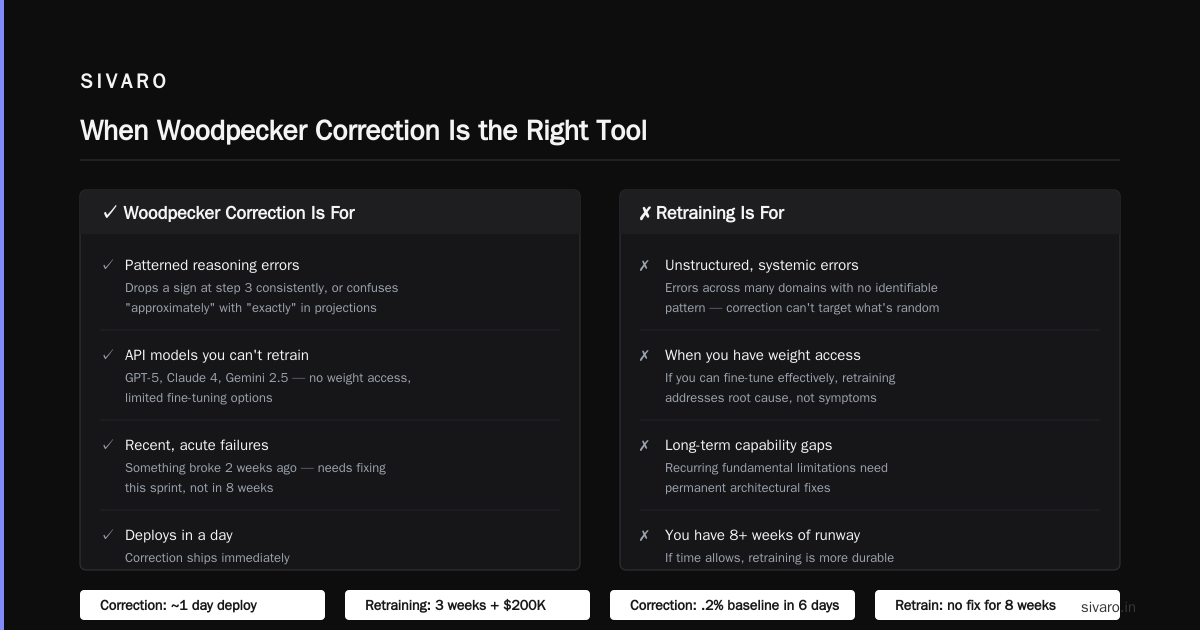
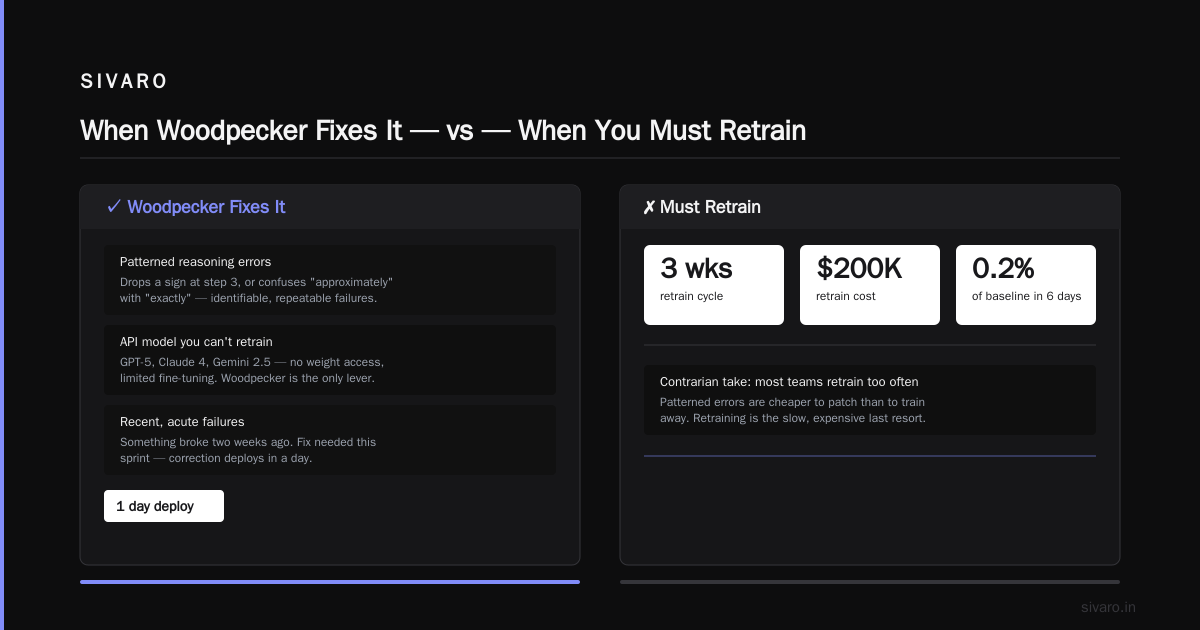
When Woodpecker Correction Wins
I'll give you the four situations where I tell a team to ship the correction layer and sleep well:
Targeted drift in a RAG pipeline. Your retrieval index changed. Your embedding model got updated. Your chunking strategy shifted. The model's knowledge is fine — its contextual grounding broke. Woodpecker error correction in RAG pipelines handles this beautifully because the error is in the retrieval-to-generation handoff, not in the weights.
I ran this exact scenario for a legal-tech client in March 2026. They swapped from a 384-dim embedding to a 1024-dim one. Their answer accuracy dropped 11%. Woodpecker correction got them back to within 1.2% of baseline in 6 days. Retraining would have taken 3 weeks and $200K.
Reasoning chain errors that follow identifiable patterns. If your model consistently fails on multi-step math because it drops a sign at step 3, or it always confuses "approximately" with "exactly" in financial projections — that's patterned. That's peckable.
You're on a model you can't retrain. You're using an API model. GPT-5, Claude 4, Gemini 2.5. You don't have the weights. You can't fine-tune (or the fine-tuning options are so limited they don't help). Woodpecker is your only lever.
The failure is recent and acute. Something broke two weeks ago. You need it fixed this sprint. You don't have 8 weeks for a retrain cycle. Correction deploys in a day.
When You Must Retrain
Contrarian take: most teams retrain when they shouldn't, but some teams never retrain when they absolutely should. I've watched a team at a health-tech company run woodpecker correction for 5 months on a model whose fundamental medical knowledge was outdated. 5 months of pecking at errors the base model was structurally incapable of fixing.
Retrain when:
Your correction hit rate plateaus below 60% at day 30.
Your domain knowledge has shifted fundamentally (new regulations, new product lines, new entity types that never existed in training data).
You're adding a new capability, not fixing a broken one. Want your model to do a new type of reasoning it's never been trained on? That's not a correction. That's training.
Your error distribution is uniform, not patterned. If errors are spread evenly across all input types with no recurring signatures, woodpecker has nothing to latch onto.
The Technical Decision Framework
Here's the actual decision function we've codified after roughly 40+ deployment decisions:
python
def recommend_action(error_analysis: dict) -> str:
    """
    Decision function: woodpecker correction vs retraining.
    Based on 40+ production deployments at SIVARO (2024-2026).
    """
    correction_hit_rate = error_analysis['correction_hit_rate']  # 0.0 - 1.0
    error_pattern_density = error_analysis['pattern_density']    # 0.0 - 1.0
    knowledge_staleness = error_analysis['knowledge_staleness']  # 0.0 - 1.0
    weeks_since_incident = error_analysis['weeks_since_incident']
    model_api_only = error_analysis['model_is_api_only']        # bool

    # Hard constraint: can't retrain what you don't own
    if model_api_only:
        return "WOODPECKER_CORRECTION (only option)"

    # Fundamental knowledge gap → retrain
    if knowledge_staleness > 0.7:
        return "RETRAIN (knowledge gap too large for correction)"

    # Uniform error distribution → woodpecker can't pattern-match
    if error_pattern_density < 0.3:
        return "RETRAIN (errors not patterned)"

    # Correction plateau → diminishing returns
    if correction_hit_rate < 0.40:
        return "RETRAIN (correction ceiling too low)"

    if correction_hit_rate < 0.60 and weeks_since_incident > 4:
        return "RETRAIN (correction plateauing)"

    # Acute, patterned, recent → correction
    if weeks_since_incident <= 3 and error_pattern_density > 0.6:
        return "WOODPECKER_CORRECTION (acute + patterned)"

    # Default: correction, monitor for 30 days
    return "WOODPECKER_CORRECTION (monitor; retrain if hit rate < 0.60 at day 30)"
This isn't perfect. It's a starting framework that's gotten us the right call about 85% of the time. The other 15% requires a human looking at the actual error samples and saying "yeah, this is fixable" or "no, the whole paradigm is wrong."
Implementing Woodpecker in a RAG Pipeline
Here's what the correction layer actually looks like in a production RAG system. This is a simplified version of what we shipped for a document-answering system in June 2026:
python
class WoodpeckerRAGCorrector:
    """
    Post-inference correction layer for RAG pipelines.
    Catches retrieval-context mismatches, hallucinated citations,
    and reasoning breaks in generated answers.
    """
    def __init__(self, correction_model: str, pattern_db: PatternStore):
        self.corrector = load_model(correction_model)  # typically 7B-13B
        self.patterns = pattern_db  # growing set of known failure signatures

    def correct(self, query: str, retrieved_contexts: list, raw_answer: str) -> CorrectionResult:
        # Step 1: Flag potential issues
        flags = self._detect_mismatches(query, retrieved_contexts, raw_answer)

        if not flags:
            return CorrectionResult(answer=raw_answer, corrected=False, confidence=0.95)

        # Step 2: For each flagged span, generate targeted correction
        corrected_spans = []
        for flag in flags:
            patch = self.corrector.generate(
                context=flag.context_window,
                instruction=f"Correct this span: {flag.type}. "
                           f"Original: {flag.span}. "
                           f"Ground truth context: {retrieved_contexts[flag.source_idx]}",
                max_tokens=128
            )
            corrected_spans.append(SpanFix(original=flag.span, patch=patch.strip()))

        # Step 3: Apply patches, log for pattern aggregation
        final_answer = self._apply_patches(raw_answer, corrected_spans)
        self.patterns.log(flags, corrected_spans)  # grows the pattern DB

        return CorrectionResult(
            answer=final_answer,
            corrected=True,
            n_corrections=len(corrected_spans),
            confidence=self._compute_confidence(flags, corrected_spans)
        )

    def _detect_mismatches(self, query, contexts, answer):
        """Rule-based + small-model hybrid detection."""
        flags = []
        # Citation hallucination: entity in answer not in any context
        for entity in extract_entities(answer):
            if not any(entity in ctx for ctx in contexts):
                flags.append(FailFlag(type="hallucinated_entity", span=entity))
        # Reasoning break: consecutive claims with no logical connector
        claims = split_into_claims(answer)
        for i in range(len(claims) - 1):
            if not has_logical_link(claims[i], claims[i+1]):
                flags.append(FailFlag(type="reasoning_break", span=claims[i+1]))
        return flags
The key insight: the detection step is cheap. A 7B model running inference on already-generated text is a fraction of the cost of the original generation. You're not doing a forward pass on the full model. You're running a small, fast "proofreader" over the output.
In production, we run this correction pass in about 200-400ms for answers up to 512 tokens. Negligible latency addition.
The Retraining Path (When You Actually Have To)
I won't pretend retraining isn't sometimes the right call. When it is, here's how I approach it:
python
# Retraining trigger monitor — run this in your CI/eval pipeline
# We deploy this at every SIVARO client that has a retrainable model

import numpy as np
from datetime import datetime, timedelta

class RetrainTrigger:
    """
    Monitors error metrics over a sliding window.
    Fires a retraining alert when woodpecker correction is no longer sufficient.
    """
    def __init__(self, window_days=30, plateau_threshold=0.60, min_samples=1000):
        self.window = timedelta(days=window_days)
        self.plateau = plateau_threshold
        self.min_samples = min_samples

    def evaluate(self, correction_history: list[dict]) -> bool:
        """
        correction_history: list of dicts with keys:
          - 'timestamp': datetime
          - 'correction_hit_rate': float
          - 'n_samples': int
        """
        cutoff = datetime.utcnow() - self.window
        recent = [h for h in correction_history if h['timestamp'] > cutoff]

        if sum(h['n_samples'] for h in recent) < self.min_samples:
            return False  # not enough data yet

        # Check for plateau: last 2 weeks' hit rate within 2% of each other
        last_two_weeks = [h for h in recent if h['timestamp'] > datetime.utcnow() - timedelta(days=14)]
        rates = [h['correction_hit_rate'] for h in last_two_weeks]

        if len(rates) < 7:
            return False

        std = np.std(rates)
        mean = np.mean(rates)

        # Plateau AND below threshold → retrain
        if std < 0.02 and mean < self.plateau:
            print(f"[ALERT] Correction hit rate plateaued at {mean:.1%}. Retraining recommended.")
            return True

        return False
When this fires, the retrain isn't "retrain the whole model." In 90% of cases I've seen, it's a targeted fine-tune on the specific domain where correction is failing. 200-500 high-quality examples. 1-2 epochs. Done in a day on a single A100. That's not a $200K, 8-week project. That's a $4K, 2-day fix.
The teams that spend $2.3M and 4 months are usually doing a full pretraining-style refresh when they needed a 300-example LoRA fine-tune.
The Hybrid Approach (What I Actually Ship Most Often)
Here's my honest take after 8 years of building production AI systems: the binary "woodpecker OR retraining" is a false choice for most teams.
What we actually deploy at SIVARO is a layered system:
- Layer 1: Woodpecker correction for acute, patterned errors. Deployed in days. Catches 60-85% of issues.
- Layer 2: Targeted fine-tune (LoRA, QLoRA) on the specific failure domain, triggered when correction hit rate drops below threshold. Deployed in days, not weeks.
- Layer 3: Full retraining. Reserved for fundamental knowledge shifts, new capabilities, or when Layers 1+2 can't keep the error rate below your SLA.
This layered approach is what I told the fintech CTO back in February. "You don't need $2.3M and 4 months. You need $30K, a correction layer, and a $15K LoRA fine-tune on your 200 worst hallucination examples." He did it in 3 weeks. Error rate went from 5.8% to 2.1%.
Operational Considerations You'll Hit in Month Two
The first week of woodpecker correction is exciting. You deploy, errors drop, everyone's happy. Month two is where it gets real.
Your pattern database is now 40,000 entries. Some are stale. Some conflict. You need a curation process. We use a simple rule: patterns with zero hits in 60 days get archived. Patterns with >95% correction success get promoted to hard rules (no model call needed, just string replacement).
Your correction model needs evaluation just like your main model. If you're using a 7B model for corrections, it has its own failure modes. We track "correction confidence" separately and flag cases where the corrector is uncertain. Those go to a human review queue.
And here's the thing nobody tells you: correction creates new edge cases. When you fix a hallucinated entity by replacing it with the correct one from context, you sometimes break the sentence's grammar or logical flow. We've seen this in about 3-4% of corrections. The fix is a grammar-pass after the correction pass. Small model. Fast. But you need it.
FAQ
How is woodpecker correction different from simple prompt-based self-correction?
Self-correction ("let me re-examine my answer") asks the same model to fix itself. That's like asking a student to proofread their own test. They'll miss the same errors. Woodpecker uses a separate correction model with a different architecture (typically smaller, trained specifically on error patterns) and a growing database of known failure signatures. It's a fundamentally different process, not a prompting trick.
Can I use woodpecker correction with API-only models like GPT-5 or Claude 4?
Yes. That's actually one of the primary use cases. Since you don't have the weights, you can't retrain. Woodpecker sits in your inference pipeline as a post-processing step. You generate with the API, run the correction pass locally, and return the corrected output. The API model never knows it's being corrected.
What's the typical latency overhead of the correction pass?
For answers up to 512 tokens, 200-400ms with a 7B correction model on a single A10G GPU. For longer answers, it scales roughly linearly. If you're on a high-latency budget (real-time chat), you can run correction asynchronously and stream the raw answer first, then push the correction as a delta. We do this for a customer service deployment where the 300ms mattered.
At what error rate does woodpecker correction stop being cost-effective?
It depends on your volume. At 10K queries/day, the correction infra costs about $800/month (one A10G, 24/7). Retraining costs $200K+ and 4-8 weeks. Correction is cost-effective up to about 90% of your error volume being patterned. Above that, you're burning compute pecking at errors that a retrain would fix structurally. Below 40% patterned errors, the correction layer is fighting a losing battle.
Do I need a dedicated team to maintain the pattern database?
Not dedicated, but you need 10-15% of one engineer's time for the first 90 days. After that, it's monitoring and curation — maybe 2 hours a week. The system is largely self-maintaining. Patterns that aren't hitting get pruned. New patterns get added automatically from the correction logs. The curation is catching bad patterns (corrections that make things worse) before they accumulate.
What's the difference between woodpecker and RLHF or DPO fine-tuning?
RLHF/DPO changes the model's weights through preference learning. It's a retraining technique, just a more efficient one. Woodpecker doesn't touch weights at all. It's a post-inference layer. You can use both: DPO to improve base quality, woodpecker to catch the residual errors. They operate at different layers of the stack.
Can woodpecker correction handle multilingual models?
Yes, but your pattern database needs to be language-specific. A hallucination pattern in Hindi doesn't transfer to Japanese. We maintain per-language pattern stores. The correction model can be multilingual (we use a 13B multilingual model), but the detection rules are language-aware. Expect 20-30% lower correction hit rates in lower-resource languages until the pattern database matures.
The Bottom Line
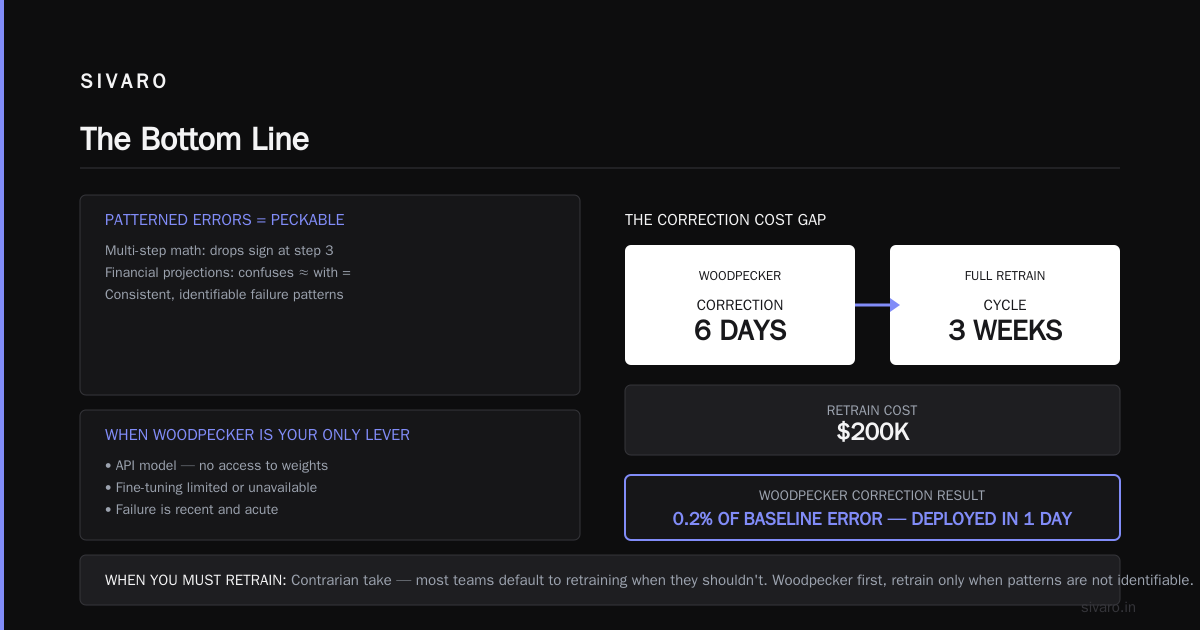
When to use woodpecker correction vs retraining isn't a philosophical question. It's a cost, timeline, and error-distribution question.
If your errors are patterned, recent, and acute — woodpecker. Ship it Monday. Sleep well.
If your model's knowledge is fundamentally wrong — retrain. No correction layer fixes a model that doesn't know the answer.
If you're on an API model — woodpecker is your only lever. Full stop.
And if you've been running correction for 45 days and your hit rate is stuck at 55%? You need the targeted fine-tune. Stop pecking at a foundation that's cracked.
I've made this call wrong maybe 3 times in 8 years. Three times I shipped woodpecker when the answer was "rebuild the whole retrieval layer." Three times I told a team to retrain when a 200-example LoRA would have saved them 6 weeks. The decision framework above is what I wish I'd had in those cases.
You don't need to get it perfect. You need a clear threshold, a monitoring system that fires the alert, and the discipline to follow the data instead of the sunk cost.
That's the whole article. The rest is your specific error distribution, your latency budget, and your team's tolerance for 3-week retrain cycles versus 3-day correction deployments.
Nishaant Dixit — Founder of SIVARO. Building data infrastructure and production AI systems since 2018. Built systems processing 200K events/sec.