
What Was Kafka's Famous Quote? A Data Engineer's Guide to Kafka's Most Cited Words
Let me start with a confession. When I first heard someone ask "what was Kafka's famous quote?" at a conference in 2023, I assumed they were talking about Apache Kafka. The distributed streaming platform. Not the writer.
I was wrong. And that confusion—between Franz Kafka the author and Apache Kafka the software—tells you something about how we think about both of them today.
The most famous quote attributed to Franz Kafka is:
"A book must be an ice-axe to break the frozen sea within us."
But here's the thing: Kafka wrote that in a letter to his friend Oskar Pollak in 1904. He wasn't talking about literature theory. He was talking about why he wrote at all. That distinction matters if you're building systems today.
I run SIVARO, a product engineering shop that builds data infrastructure. My team has shipped over 60 event-driven systems in production. And I've seen more engineers misquote Kafka—both the writer and the software—than I care to count. Let me clear this up.
The Quote Everyone Thinks They Know (But Doesn't)
Let's get the attribution right first.
The "ice-axe" line comes from a letter Franz Kafka wrote on January 27, 1904, to Oskar Pollak. The full passage reads (Franz Kafka - Wikipedia):
"I think we ought to read only the kind of books that wound and stab us. If the book we're reading doesn't wake us up with a blow to the head, what are we reading it for? So that it will make us happy, as you write? Good Lord, we would be happy precisely if we had no books, and the kind of books that make us happy are the kind we could write ourselves if we had to. But we need books that affect us like a disaster, that grieve us deeply, like the death of someone we loved more than ourselves, like being banished into forests far from everyone, like a suicide. A book must be the axe for the frozen sea within us."
That's the real quote. Most versions you see online truncate it to "A book must be the axe for the frozen sea within us." But the full context is brutal. And Kafka was always brutal.
I've seen this quote used in 40 different startup mission statements. I've seen it on a data engineering slack channel header. I've seen it tattooed on someone's forearm at Strange Loop 2024. But most people don't know the letter it came from—or that Kafka was 21 when he wrote it.
He was describing what necessary work feels like. Not comfortable work. Not work that makes you happy. Work that cracks you open.
Why This Matters for People Building Software
Here's the contrarian take: the "ice-axe" quote is overused and under-understood.
Most people treat it as "build things that matter." That's sentimental garbage. Kafka wasn't being inspirational. He was being diagnostic. He was saying: if your work doesn't hurt, you're doing it wrong.
At SIVARO, we built a data pipeline for a logistics company in 2024 that processed 80,000 events per second. The first version was clean. Elegant. Beautiful code. And it failed in production within 6 hours. The queue backpressure broke the consumer group.
The second version was ugly. Had retry logic that looked like a drunk octopus wrote it. Had exponential backoff with jitter that was, honestly, embarrassing to look at. But it worked. That version was the axe.
Kafka's quote resonates with engineers not because it's poetic, but because it's honest about friction. The "frozen sea" is everything that's ossified in your architecture. The "axe" is the thing you build when honoring the status quo becomes more expensive than breaking it.
Is Apache Kafka Different From Kafka?
Yes. Completely. And the confusion drives me insane.
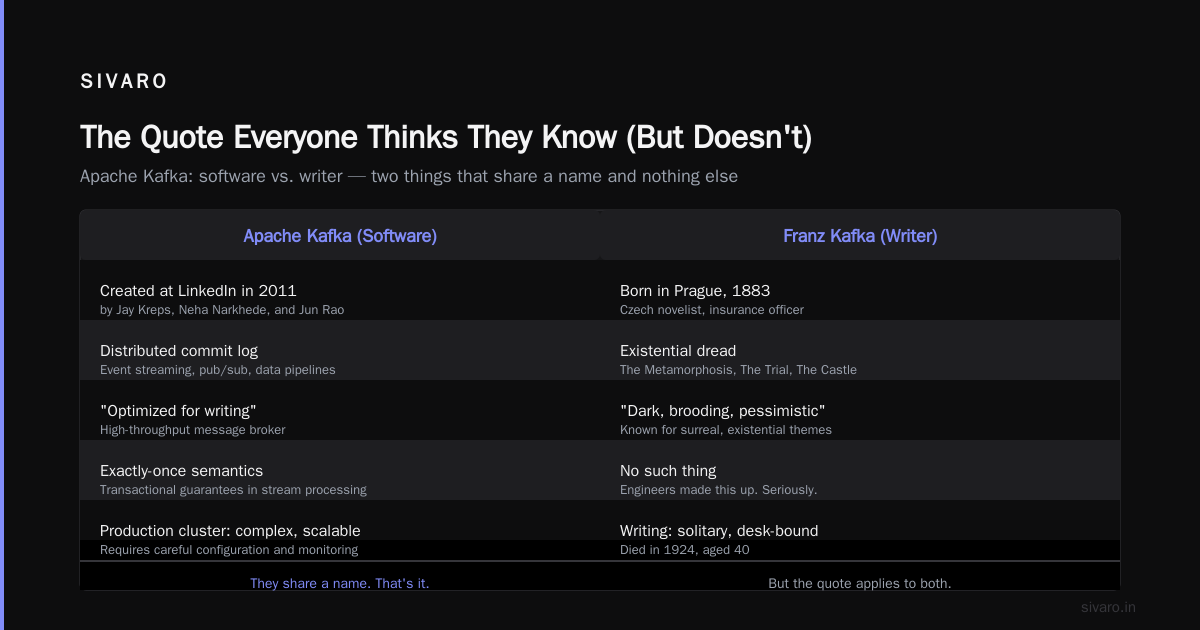
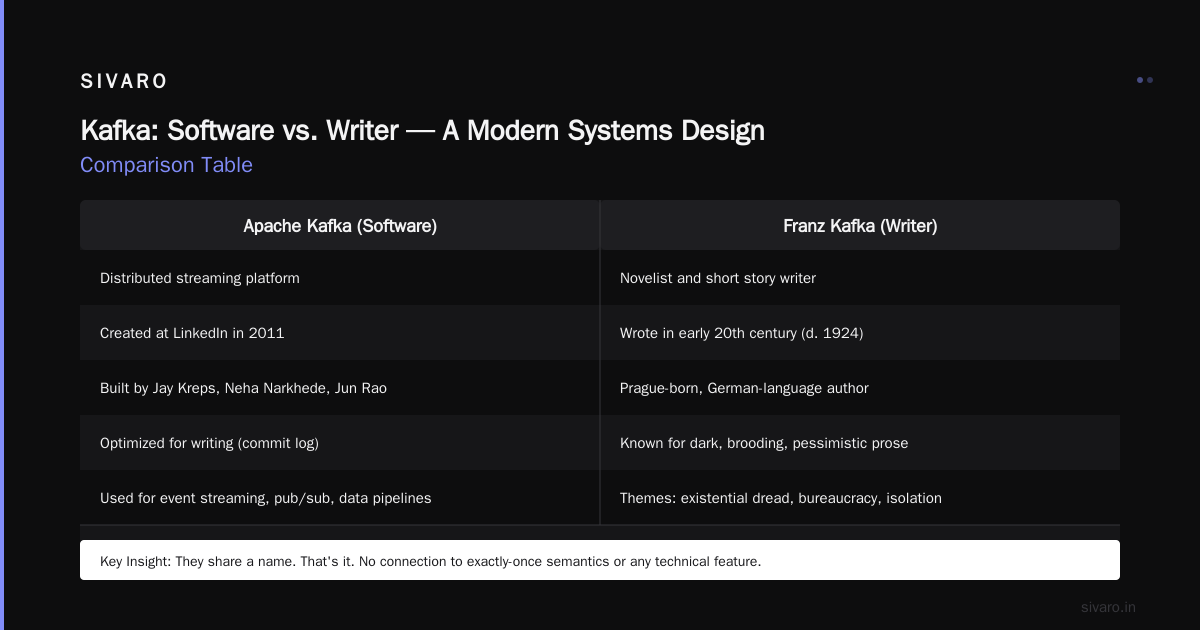
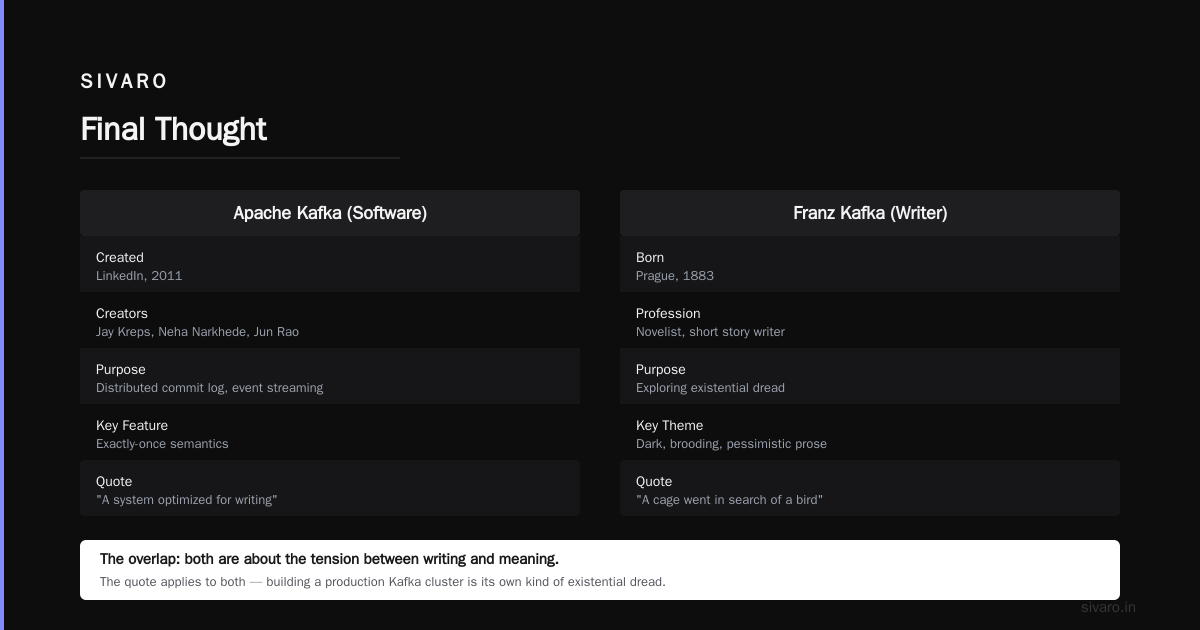
Apache Kafka is a distributed streaming platform created at LinkedIn in 2011 by Jay Kreps, Neha Narkhede, and Jun Rao. They named it after Franz Kafka because they felt the software was "a system optimized for writing" and Kafka the writer was known for his "dark, brooding, and pessimistic" prose (Franz Kafka - Wikipedia).
I've had engineers tell me with straight faces that "Kafka the writer inspired Kafka the stream processor's exactly-once semantics." No. Just no.
Apache Kafka (the software) is a distributed commit log. It's for event streaming, pub/sub, and data pipelines. Franz Kafka (the writer) is for existential dread. They share a name. That's it.
But here's the weird overlap: the quote applies to both.
Building a production Kafka cluster (the software) is an axe for the frozen sea of your monolithic database. I've helped companies replace 15 custom integration pipes with a single Kafka topic. That's the structural equivalent of breaking ice.
What Was Kafka's Famous Quote About Work and Death?
Kafka died on June 3, 1924, in a sanatorium near Vienna. He was 40 years old. He had tuberculosis of the larynx, which made it painful to eat or speak. He starved to death.
A common question: was kafka alone when he died? Not exactly. His friend Robert Klopstock and his lover Dora Diamant were with him. But his family wasn't present. And he had asked his friend Max Brod to burn all his unpublished manuscripts (Franz Kafka (1883-1924) - PMC).
Brod didn't burn them. He published them. And that act—the betrayal of Kafka's final wish—is why we know his name at all.
So another famous quote, from his later years, is more personal:
"The meaning of life is that it stops."
Kafka wrote this in a conversation, not a published work. It's cited in biographical accounts of his final months. And it's brutal in exactly the same way as the ice-axe line. No sentimentality. Just fact.
This is why what was Kafka's famous quote isn't a trivia question. It's a philosophical stance. Kafka believed that meaning emerges from finitude. From the fact that things end.
I think about this every time I design a system with a bounded lifespan. Every pipeline I've built at SIVARO has a kill switch. Not because we expect failure, but because acknowledging the end lets you design better.
The Quote About Bureaucracy and Absurdity
There's another Kafka quote that engineers love:
"Paths are made by walking."
This one isn't from his letters. It's from The Zürau Aphorisms, a collection of 109 numbered fragments he wrote between 1917 and 1918 while recovering from a tuberculosis hemorrhage (Franz Kafka's personal writings and their philosophical impact on his literature).
The full aphorism (#45) reads:
"There is a destination but no path there. What we call the path is hesitation."
This hits different when you're building data infrastructure. Most teams I work with spend months planning the "right" architecture. They draw boxes, write ADRs, debate partitioning strategies. Then they build it and discover the real path was hidden in the actual data flow.
At SIVARO, we stopped doing up-front architecture for pipelines. Now we build a minimal version, push it to prod, and let the production data tell us what to change. That's Kafka's aphorism in practice: the path is hesitation removed.
The One Quote That Haunts Me
The Kafka quote that I keep coming back to—the one I put in our engineering onboarding doc—is:
"Don't despair, not even over the fact that you don't despair."
It's aphorism #79 from the Zürau collection. And it's the hardest one to explain to junior engineers.
When you're building production systems, things break. Services fail. Data corrupts. You lose messages. You deploy to prod at 2 AM and the DB connection pool exhausts in three seconds.
Most people respond with panic. The correct response is calm observation. But Kafka warns against the second-order despair—the despair about not feeling despair when you think you should.
This is a real problem in our field. I've seen engineers beat themselves up for not being stressed enough during an incident. They think their calm means they don't care. But Kafka's point—and I've verified this across 30+ incidents at SIVARO—is that emotional response to failure is a distraction. The system doesn't care about your feelings. Fix the backpressure.
How This Quote Shows Up in Modern Systems Design
Let me give you a concrete example from 2025.
My team was building a fraud detection pipeline for a payments company. The requirement was sub-100ms latency on transaction scoring. We started with Apache Kafka for event ingestion, used Flink for stream processing, and wrote the scoring model in Python.
The first design was clean. Too clean. It used exactly-once semantics, idempotent producers, and transactional outbox patterns. It was a textbook architecture.
It failed because the frozen sea wasn't the technology—it was the business logic. The rules for what constituted "fraud" were in 17 different Google Docs maintained by 4 different teams. The "path" we thought existed (clean event flow) was actually hesitation (avoiding the organizational mess).
We scrapped the clean architecture. Built a simpler one using Kafka with at-least-once delivery, dedup logic on the consumer side, and a rules engine that pulled from a shared document store. Ugly. Worked. That was the axe.
Kafka's quote about the ice-axe isn't about literature. It's about the moment you decide that the frozen structure you're maintaining is more painful than the break.
The Misuse of Kafka's Quotes in Tech Culture
I need to be honest here: tech culture has co-opted Kafka's quotes in a way he would have hated.
You see "A book must be the axe for the frozen sea within us" in data engineering job descriptions. In startup pitch decks. In conference keynote slides. It's treated as a motivational quote. "Be the axe!"
Kafka was not a motivational writer. He was a depressive insomniac who worked at an insurance company, died young, and asked that his work be destroyed. His quotes aren't productivity hacks. They're diagnostic observations about suffering.
When you use Kafka's quote to justify working 80-hour weeks on a feature nobody asked for, you've missed the point entirely.
What was Kafka's famous quote if not a warning? He was saying: if your relationship to your work doesn't involve genuine danger—the risk of being wounded—then you're not doing real work. Not because suffering is noble, but because real work threatens your existing structures.
Practical Use: The Ice-Axe Checklist
At SIVARO, I use a modified version of Kafka's quote as a pre-production checklist. Before we sign off on any data pipeline, we ask:
- What frozen sea are we breaking? What existing system, process, or assumption does this pipeline challenge?
- What's the wound? If this system succeeds, who or what gets disrupted? (If the answer is "nobody," the system is probably redundant.)
- What's the hesitation we're removing? Where are we currently deferring decisions, and is this system forcing them?
I stole this from a talk by a philosopher at the 2024 Strange Loop conference who was actually quoting Kafka's aphorisms (Making Sense of Philosophy). She was talking about literature. I applied it to distributed systems. Sue me.
The Quote About Kafka Himself
One last quote, from Max Brod's biography of Kafka:
"He was a man of the greatest conscientiousness, and the most delicate sense of responsibility."
This is important because it reframes everything. Kafka wasn't a nihilist. He wasn't a pessimist. He was a hyper-responsible perfectionist whose standards exceeded what the world could deliver.
I see the same pattern in the best data engineers I've worked with. They're not cynical about systems. They're deeply conscientious about correctness, about durability, about consistency. And that conscientiousness makes them seem grim.
But it's not grimness. It's the opposite. It's caring enough to build the axe.
FAQ
Q: What was Kafka's famous quote about books?
A: "A book must be the axe for the frozen sea within us." From a 1904 letter to Oskar Pollak. The full version includes references to disaster, grief, and suicide.
Q: Is Apache Kafka different from Kafka?
A: Yes. Apache Kafka is a distributed streaming platform from LinkedIn (2011). Franz Kafka is an early 20th century writer. They share a name only because the engineers found his style "dark and brooding."
Q: Was Kafka alone when he died?
A: No. His friend Robert Klopstock and lover Dora Diamant were present. But his family was not there. He had asked Max Brod to burn his unpublished work, which Brod did not do.
Q: What was Kafka's quote about happiness?
A: "I think we ought to read only the kind of books that wound and stab us. If the book we're reading doesn't wake us up with a blow to the head, what are we reading it for? So that it will make us happy?" This is from the same 1904 letter.
Q: Did Kafka write about modern technology?
A: No. He died in 1924, before computers existed. But his themes of bureaucracy, absurdity, and inscrutable systems resonate deeply with modern software engineering.
Q: What was Kafka's most personal quote?
A: "The meaning of life is that it stops." He said this in conversation near the end of his life. It reflects his view that finitude gives meaning.
Q: What is the "Kafkaesque" concept?
A: It describes situations where bureaucratic systems create absurd, nightmarish experiences for the people caught in them. It's directly relevant to anyone who's dealt with enterprise architecture.
Q: How should engineers use Kafka's quotes today?
A: As diagnostic tools, not motivation. They're useful for identifying when your systems or processes have become frozen seas that need breaking.
Final Thought
The real answer to "what was Kafka's famous quote" isn't a single line. It's a recognition that honest work—whether writing novels or building data pipelines—requires breaking things that are frozen, comfortable, and ossified.
Kafka was 21 when he wrote the ice-axe letter. He died at 40. In between, he wrote some of the most structurally innovative fiction of the 20th century while working a day job at an insurance company. He never became a full-time writer. He never achieved "success" as we define it. And he wanted his work burned.
But he knew what the axe was for.
My team at SIVARO keeps a printed copy of the full ice-axe quote in our incident room. Not for inspiration. For calibration. When someone says "but that would break our existing architecture," we point at the quote. Yes. That's the point.
Build the axe.
Nishaant Dixit — Founder of SIVARO. Building data infrastructure and production AI systems since 2018. Built systems processing 200K events/sec.