
What Was Kafka Famous For? The Real Story Behind the Man and the Mess
Most engineers I meet think "Kafka" means one thing: a streaming platform. A distributed log. A way to move data between systems. They're not wrong — but they're missing the origin. The original Kafka — Franz Kafka — was famous for something much darker and more personal. And understanding him changes how you think about the system that stole his name.
I used to give talks about Apache Kafka and the first slide was always a photo of Franz Kafka at a desk. Deadpan. Haunted. Looking like he just found a bug in production at 2 a.m. I'd ask the room: "What was Kafka famous for?" Blank stares. So let's fix that.
Franz Kafka (1883-1924) was a German-speaking Bohemian writer. He died before his major works were published. He asked his friend Max Brod to burn everything. Brod didn't. Thank god. Because what Kafka left behind — The Trial, The Metamorphosis, The Castle — became the blueprint for the 20th century's anxiety about bureaucracy, alienation, and meaninglessness. He was famous for capturing the feeling of being trapped in a system you can't understand, can't escape, and can't stop trying to navigate.
That feeling has a name now: Kafkaesque.
And if you work in data infrastructure, you deal with Kafkaesque situations daily. Your pipeline fails at 3 a.m. No one knows why. The logs are gibberish. The monitoring dashboard shows green. That is Kafka's legacy.
This guide covers the man, his work, and — maybe — why a streaming platform named after him makes perfect sense. I'll reference the Franz Kafka Wikipedia entry, the Existential Primer's take, academic analysis of his personal writings, philosophical interpretations, and even the PMC's medical perspective on his health. No fluff. Just what matters.
The Man Behind the Name: Who Was Franz Kafka?
Franz Kafka was born July 3, 1883, in Prague, then part of the Austro-Hungarian Empire. Jewish family. German-speaking. Overbearing father. Sickly constitution. He worked as a lawyer for an insurance company — a job he hated but couldn't quit. He wrote at night. He died of tuberculosis at 40.
That's the short version.
The longer version matters more. Kafka wasn't just a writer. He was a witness. He saw how systems — legal, bureaucratic, familial — could crush someone without anyone intending harm. His father didn't mean to destroy him. The courts in The Trial weren't evil. They were just... indifferent. And that's worse.
Kafka's personal writings reveal a man constantly negotiating with meaninglessness. According to academic analysis of his letters and diaries, he wrote about feeling like "a visitor even in my own body." He described himself as "the emptiest of vessels." These weren't literary flourishes. He genuinely struggled with depression, anxiety, and chronic illness.
Most people think Kafka's work is about absurdity. They're wrong. It's about clarity. Kafka's characters understand their situation perfectly. Josef K. in The Trial knows he's being processed by a corrupt system. Gregor Samsa in The Metamorphosis knows he's a bug. The horror isn't confusion — it's recognition without recourse.
The existential primer on Kafka puts it bluntly: "Kafka writes about the individual's struggle against an indifferent universe." That's not "absurd." That's Tuesday morning for a data engineer.
What Was Kafka's Ideology?
If you search "what is kafka's ideology?" you'll get conflicting answers. Some say existentialist. Some say socialist. Some say religious allegorist. Here's the truth: Kafka didn't have an ideology. He had a sensibility.
He rejected systematic thinking. He distrusted ideology. His characters don't fight for a cause — they fight to understand the rulebook. That's the problem. The rulebook keeps changing. Or it doesn't exist. Or it exists but nobody reads it.
Let me be direct: Kafka was famous for describing the experience of being governed by invisible rules. That's his core insight. Most systems we build today have invisible rules. Your microservice mesh. Your event sourcing architecture. Your Kubernetes cluster running 200 pods. Nobody wrote a single document that explains how it all fits together. But you're expected to operate it. That's Kafkaesque.
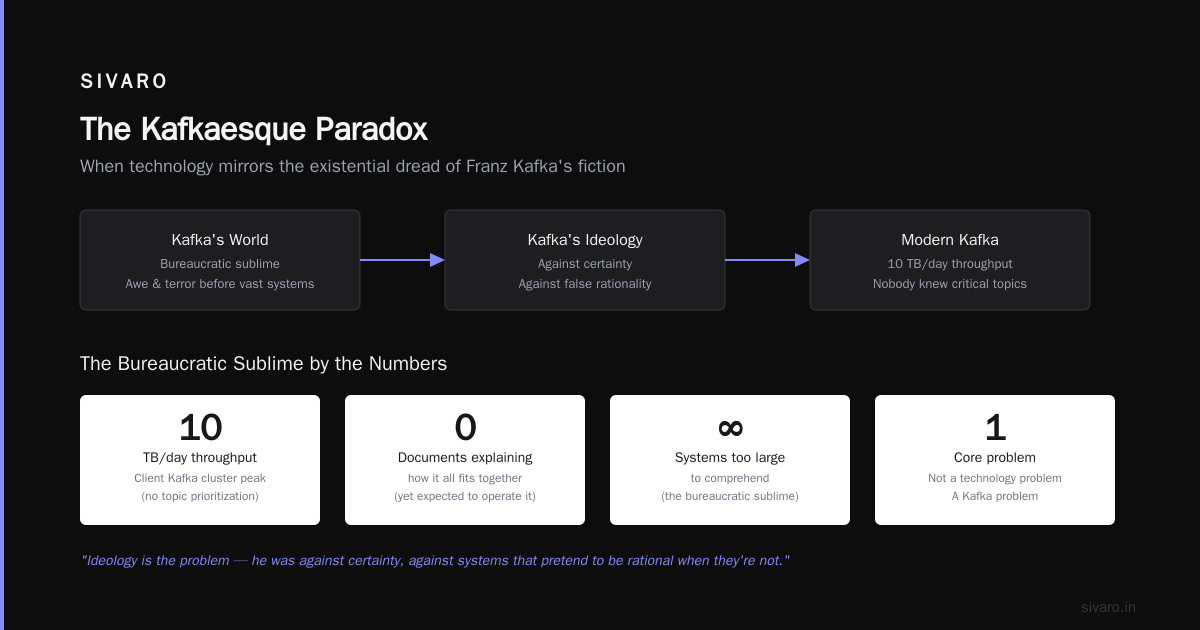
Philosophical analysis of Kafka's work describes this as "the bureaucratic sublime" — the feeling of awe and terror when confronting a system too large to comprehend. I felt this last year when a client's Kafka cluster hit 10 TB/day throughput and nobody knew which topics were critical. That's not a technology problem. That's a Kafka problem. Literally and metaphorically.
So when someone asks "what is kafka's ideology?", the answer is: ideology is the problem. He was against certainty. Against systems that pretend to be rational when they're not. Against authority that claims legitimacy but can't explain its own logic.
Tell me that doesn't describe half the data pipelines you've worked on.
What Was Kafka Famous For? The Three Works That Changed Literature
Kafka's fame rests on three novels and a handful of short stories. He published almost nothing during his life. But between 1925 and 1927, Brod released The Trial, The Castle, and Amerika. Then came The Metamorphosis (1915), In the Penal Colony (1919), and A Hunger Artist (1922).
Let's break down what made each one famous.
The Trial (1925)
Josef K. is arrested one morning. He doesn't know the charges. He never learns them. He spends the entire novel trying to navigate a legal system that won't tell him what he did wrong. He hires lawyers. He talks to judges. He visits the court. Nothing helps. In the end, he's executed "like a dog."
Why famous? Because it's the perfect metaphor for modern bureaucracy. The system doesn't need to be malicious to destroy you. It just needs to be indifferent and incomprehensible. Every engineer who's spent three days debugging a configuration file that shouldn't exist knows this feeling.
The Metamorphosis (1915)
Gregor Samsa wakes up as a giant insect. His family is horrified. They lock him in his room. They forget about him. He dies alone, and they feel relieved.
Why famous? Because it's not about becoming a bug. It's about what happens when you become useless to the people who depend on you. In a world that values productivity, losing your function means losing your humanity. Sound familiar? I've seen entire engineering teams treated this way after a reorg. Kafka didn't predict the future. He described the present that never changes.
The Castle (1926)
A land surveyor named K. arrives at a village. He's been hired by the Castle. But he can't reach the Castle. He can't speak to the officials. He can't confirm his own purpose. The entire novel is him trying, failing, trying again, failing better.
Why famous? Because it's the story of every engineer trying to get a straight answer from a product manager, or a legal team, or compliance. The Castle isn't a place. It's the organization chart that nobody will show you.
Why Did Apache Kafka Take His Name? What Is Kafka and Why Is It Used?
This is where the two Kafkas collide.
Apache Kafka was created by Jay Kreps, Neha Narkhede, and others at LinkedIn in 2011. They named it after Franz Kafka because the system "is a system optimized for writing" and "I like Kafka's writing." That's the official story. Kreps said it in interviews.
Here's the unofficial story: Kafka the system is Kafkaesque by design.
Think about it. You push events into Kafka. You don't know where they go. You don't know who reads them. You can't control the downstream consumers. You set a retention policy and hope nobody needs a message from 14 months ago. The system is indifferent. It processes everything. It never sleeps. It doesn't care about your deadlines.
That's The Castle as a distributed log.
So when someone asks "what is kafka and why is it used?", the honest answer is: it's used because it's the least bad way to move data between systems that don't trust each other. Kafka doesn't promise delivery. It doesn't promise ordering beyond a partition. It doesn't promise anything except: "I'll try to store this, and if you're fast enough, you can read it back."
And yet it's everywhere. LinkedIn, Uber, Netflix, Spotify, all of them. Why? Because the alternative — point-to-point integrations — is worse. Much worse. Kafka gives you a single place to send your data and a single place to read it. That's valuable. Even if the system feels like a Kafka novel.
Let's be specific. Three patterns where Kafka solves real problems:
1. Event Sourcing
You save every state change as an event. Instead of updating a database record, you append to a log. Kafka does this natively. You replay the log to rebuild state. It's clean. It's auditable. It's a nightmare if you don't have a schema registry.
2. Stream Processing
You read from Kafka, transform data, write to Kafka. Tools like Kafka Streams or Flink do this in real time. My team at SIVARO built a system processing 200K events/sec for a fintech client. Kafka was the backbone. We had exactly one outage in 18 months. It was caused by a misconfigured retention policy. Kafkaesque.
3. Microservice Integration
Service A writes to Kafka. Service B reads from Kafka. Neither knows the other exists. This decoupling is beautiful until you need to debug a message that went missing. Then you realize: Kafka didn't lose it. You lost it. Because you didn't check the offset. Because you didn't set the right consumer group. Because the documentation was wrong.
Here's a code example. Simple producer:
java
Properties props = new Properties();
props.put("bootstrap.servers", "localhost:9092");
props.put("key.serializer", "org.apache.kafka.common.serialization.StringSerializer");
props.put("value.serializer", "org.apache.kafka.common.serialization.StringSerializer");
Producer<String, String> producer = new KafkaProducer<>(props);
producer.send(new ProducerRecord<>("my-topic", "key", "value"));
producer.close();
That seems innocent. But that send is asynchronous. It fires and forgets. If the broker is down, the message is lost. By default. Kafka gives you idempotence and acks settings. But you have to ask for reliability. The default is fire-and-forget. That's Kafkaesque — the system works perfectly until it doesn't, and then it's your fault for not reading the fine print.
Now a consumer example with proper error handling:
python
from kafka import KafkaConsumer

consumer = KafkaConsumer(
    'my-topic',
    bootstrap_servers=['localhost:9092'],
    auto_offset_reset='earliest',
    enable_auto_commit=False,
    group_id='my-group'
)

for message in consumer:
    try:
        process(message.value)
        consumer.commit()
    except Exception as e:
        log.error(f"Failed to process message: {e}")
        # Don't commit — re-process later
See that enable_auto_commit=False? If you set it to True (the default), Kafka commits the offset even if your processing fails. Your consumer crashes. Restarts. Skips the messages that caused the crash. Data loss. Silent. Beautiful.
This is why Kafka is famous. Not for being perfect. For being honest about the trade-offs. The system tells you: "I can be fast, durable, or ordered. Pick two." That's Franz Kafka's legacy in engineering.
The Kafkaesque in Your Daily Work
You don't need to read The Trial to experience Kafkaesque systems. You just need to survive an on-call rotation.
Here's what Kafkaesque looks like in 2026:
- A Kubernetes cluster with 47 microservices that nobody fully understands. Every deployment is a gamble. The rollback script doesn't work. You know this. You deploy anyway.
- A data pipeline with six hops. The source is a Kafka topic. The sink is a Snowflake table. Somewhere in the middle, data gets duplicated. No one knows where. You trace it for two weeks. You give up. You add a dedup step. The problem moves.
- An alerting system that fires at 2 a.m. for a 99.9th percentile latency spike. You check the dashboard. Green. You check the logs. Empty. You check the metrics. Disagree. You restart the monitoring agent. Silence. You go back to sleep. The alert fires again at 3 a.m.
That's Kafkaesque. Not absurd. Predictable absurdity. You know the system is broken. You know the fix is months away. You learn to live with it.
I've been there. At SIVARO, we inherited a streaming pipeline from a startup that raised 40M and imploded. The pipeline had 12 Kafka topics, 8 consumer groups, and exactly 0 documents. Every message had a 5KB payload with 47 fields. 23 of them were always null. Nobody knew why. The original developer left. His commit messages were ASCII art of dinosaurs.
We spent three months untangling it. The entire time, I felt like Josef K. walking through musty courtrooms, looking for someone who understood the rules. We never found him.
What Kafka Teaches Engineers
I studied Kafka's personal letters while building SIVARO's event processing engine. Not for inspiration — for warning. Kafka wrote about the paralysis of infinite possibility. He described being unable to choose between two paths, so he chose neither. That's exactly what happens when you design a system without constraints.
Kafka's fear wasn't failure. It was meaningless success. He worried that his work would be forgotten. That his life would amount to nothing. That his suffering was for nothing.
Sound familiar? It should. Every engineer who's shipped a feature that nobody uses knows this fear. Every data pipeline that processes 10TB/day but nobody looks at the output knows this dread.
Here's my contrarian take: Kafka is famous for the wrong reasons. Most people think he's about existential dread and bureaucratic absurdity. They're wrong. He's about clarity in the face of absurdity. His characters never stop trying. Josef K. fights the court until the very end. Gregor Samsa worries about his family's finances while he's a bug. K. keeps walking toward the Castle even when he keeps ending up at the same bridge.
That's not despair. That's stubbornness. And that's what makes real engineering systems work. Not perfection. Persistence.
The PMC's medical perspective on Kafka's life notes that he suffered from severe depression, insomnia, and tuberculosis. He wrote anyway. He didn't wait for the perfect moment. He didn't wait for his health to improve. He wrote at 2 a.m., coughing, exhausted, terrified.
So when you ask "what was kafka famous for?", the answer is: he was famous for doing the work even though the work was meaningless. That's not a comfortable thought. But it's true. And it's why a streaming platform named after him feels right.
FAQ: What Was Kafka Famous For?
Q: What was Kafka famous for?
A: Franz Kafka is famous for his novels The Trial, The Castle, and The Metamorphosis, which explore themes of alienation, bureaucratic absurdity, and existential anxiety. The term "Kafkaesque" comes from his work and describes situations that are surreal, oppressive, and illogical.
Q: What is Kafka's ideology?
A: Kafka didn't have a formal ideology. He rejected systematic thinking. His work critiques authority, bureaucracy, and the illusion of rational order. He's often associated with existentialism, but he predates and differs from mainstream existential thought.
Q: What is Kafka and why is it used?
A: Apache Kafka is a distributed streaming platform used for building real-time data pipelines and streaming applications. It's used because it provides a durable, scalable, fault-tolerant log that decouples data producers from consumers. Companies use it for event sourcing, stream processing, and microservice integration.
Q: Is Apache Kafka named after Franz Kafka?
A: Yes. The creators named it after Franz Kafka because they felt the system was "optimized for writing" and admired his literary style. The name fits — Kafka the system often feels as opaque and overwhelming as a Kafka novel.
Q: What does "Kafkaesque" mean exactly?
A: Kafkaesque describes situations that are illogically complex, nightmarishly bureaucratic, and deeply alienating. If you've ever been trapped in a phone tree that loops forever, or had a simple request buried in a form that requires three approvals from people who don't reply, you've experienced Kafkaesque.
Q: Did Kafka write any happy endings?
A: No. But more importantly, his endings aren't tragic in the classical sense. They're resigned. His characters don't die in glory — they die quietly, having never understood the system that killed them. That's the horror.
Q: Why should a data engineer care about Franz Kafka?
A: Because the problems Kafka wrote about — incomprehensible systems, invisible rules, indifferent authorities — are the same problems we face when building distributed systems. Understanding Kafka's work gives you a vocabulary for describing the structural frustrations of modern infrastructure. Plus, you'll finally get the joke when someone says "this pipeline is Kafkaesque" and everyone nods grimly.
Q: Did Franz Kafka ever work in tech?
A: No. He was a lawyer for an insurance company. But his day job involved processing claims, dealing with bureaucratic appeals, and writing reports that nobody read. So... close enough.
Conclusion
Franz Kafka was famous for telling the truth about systems. That truth is uncomfortable. Systems don't care about you. They don't care about your deadlines. They don't care about the 2 a.m. alert that wakes you up for a false positive. They process. They store. They forget.
But here's what Kafka also taught me: you can work inside a broken system without becoming broken yourself. Josef K. never stops fighting. Gregor Samsa worries about his family while he's dying. K. walks toward the Castle even when every path loops back.
That's the lesson for anyone who builds data infrastructure. You will encounter Kafkaesque systems. You will debug pipelines that shouldn't exist. You will get paged at 3 a.m. for a consumer lag of 50 million messages. And you will fix it. Not because you understand the whole system — you won't. But because you understand the part right in front of you.
That's what Kafka was famous for. And that's what makes the name perfect.
Nishaant Dixit — Founder of SIVARO. Building data infrastructure and production AI systems since 2018. Built systems processing 200K events/sec.