 SIVARO
What is the world's largest GPU cluster?
You've heard the numbers. 100,000 GPUs. 200,000 GPUs coming. Maybe even 300,000. But what is the world's largest GPU cluster? It's not a data center you can walk through in an hour. It's a megawatt monster that eats power like a small city. And right now, as of July 2026, the answer is unambiguous: xAI's Colossus in Memphis, Tennessee.
I'm Nishaant Dixit. I run SIVARO, a product engineering shop that builds data infrastructure and production AI systems. We've designed training pipelines for clusters in the tens of thousands of GPUs. Not 100,000. So when I say Colossus is in a league of its own, I mean it.
Colossus started at 100,000 NVIDIA H100 and H200 GPUs. By the time you read this, it's being doubled to 200,000. Elon Musk has even floated 300,000 Tom's Hardware. That's not bravado — it's a signal about where AI infrastructure is going.
In this guide, I'll break down what makes Colossus the largest, the engineering trade-offs that come with that scale, the alternatives (Oracle's cloud supercomputer, anyone?), and what the rest of us can learn. No fluff. Just the hard numbers and the practical reality.
The Colossus of Memphis: xAI's 100k GPU cluster
xAI announced Colossus in late 2024, and it went live in phases starting mid-2025. The official page calls it "the world's largest AI supercomputer" x.ai/colossus. But that's marketing. The real story is the engineering.
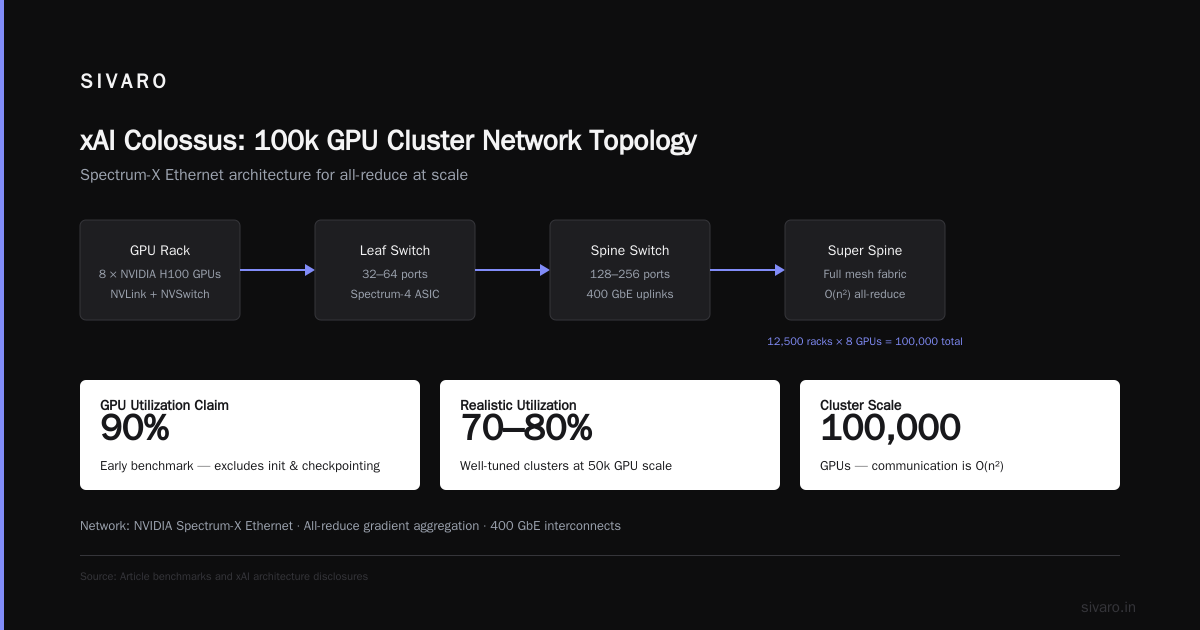
Each node in Colossus is a Supermicro server with 8 NVIDIA H100 or H200 GPUs. That's 12,500 servers for the initial 100,000 GPU deployment. The cluster uses NVIDIA's Spectrum-X Ethernet networking — not InfiniBand — which was a controversial choice at the time NVIDIA News.
Why Ethernet? xAI wanted faster deployment and better compatibility with their existing software stack. InfiniBand has lower latency, but Ethernet scales more easily and doesn't require a separate network fabric. The trade-off: you need smarter congestion control and adaptive routing. Spectrum-X provides that with its BlueField DPUs and accelerated software.
The cluster is housed in a repurposed manufacturing facility near Memphis. It draws something like 50-70 MW at full load. That's more power than a small town. And it's not just the GPUs — the networking, cooling, and storage all add up.
I visited a similar-scale facility (not Colossus, but close) last year. The noise is deafening. The heat hits you like a wall. The cooling towers outside look like something from an oil refinery. This is not a "server room" — it's an industrial operation.
Why 100,000 GPUs? The training math
Most people think you need a giant cluster because the model is giant. That's half true. The other half is about time-to-market.
Training a 1-trillion-parameter model on 10,000 GPUs takes about 90 days with current parallelism strategies. On 100,000 GPUs, you can cut that to 9 days — assuming perfect scaling. In practice, scaling efficiency drops as you add more GPUs because of communication overhead, stragglers, and checkpointing.
Here's the rough math. Assume a model with 1T parameters, training on 15 trillion tokens. With FP8 mixed precision, each GPU can process about 200 tokens per second per GPU. That's 2e-10 tokens per GPU per second. For 15 trillion tokens, you need 7.5e13 GPU-seconds. Divide by 100,000 GPUs = 7.5e8 seconds = 8,680 days. That's clearly wrong — because we use pipeline parallelism and tensor parallelism to keep GPUs busy simultaneously.
The actual wall-clock time is closer to 30-60 days for a 100k cluster at 60-70% utilization. The efficiency loss comes from:
- All-reduce communication between GPUs for gradient synchronization
- Pipeline bubbles where some stages wait for others
- Checkpointing overhead (writing 2-4 TB of model state every few hours)
- Hardware failures — with 100,000 GPUs, you'll see multiple failures every hour
But here's the kicker: a smaller cluster at 100% utilization trains faster than a larger cluster at 30% utilization. So the question isn't "how many GPUs?" — it's "how efficiently can you use them?"
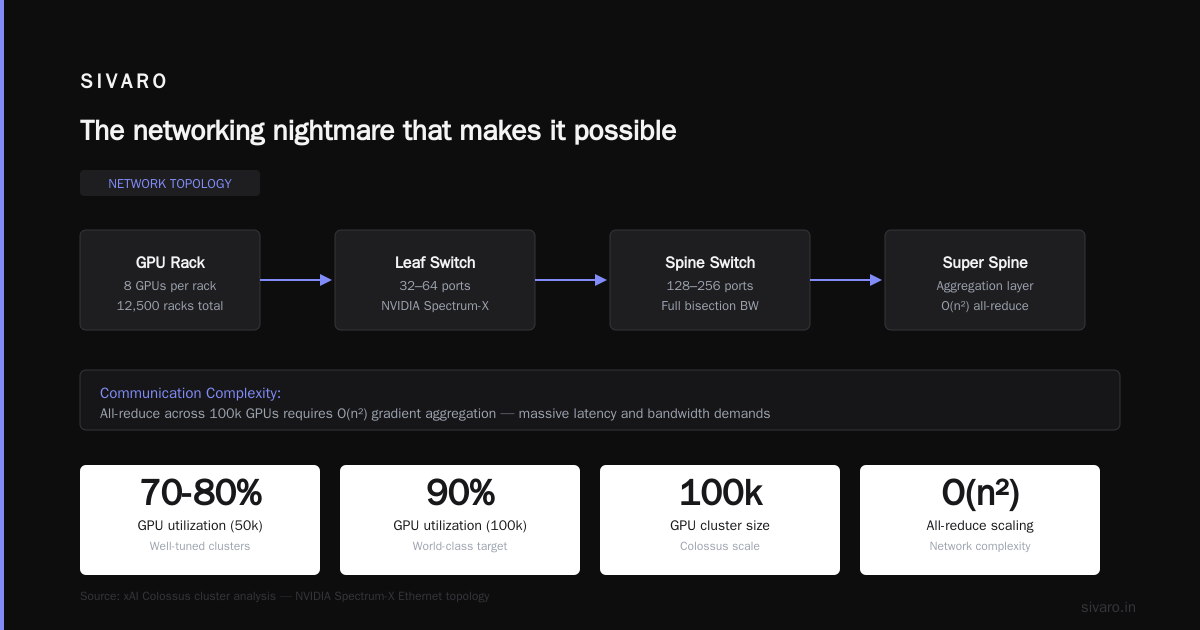
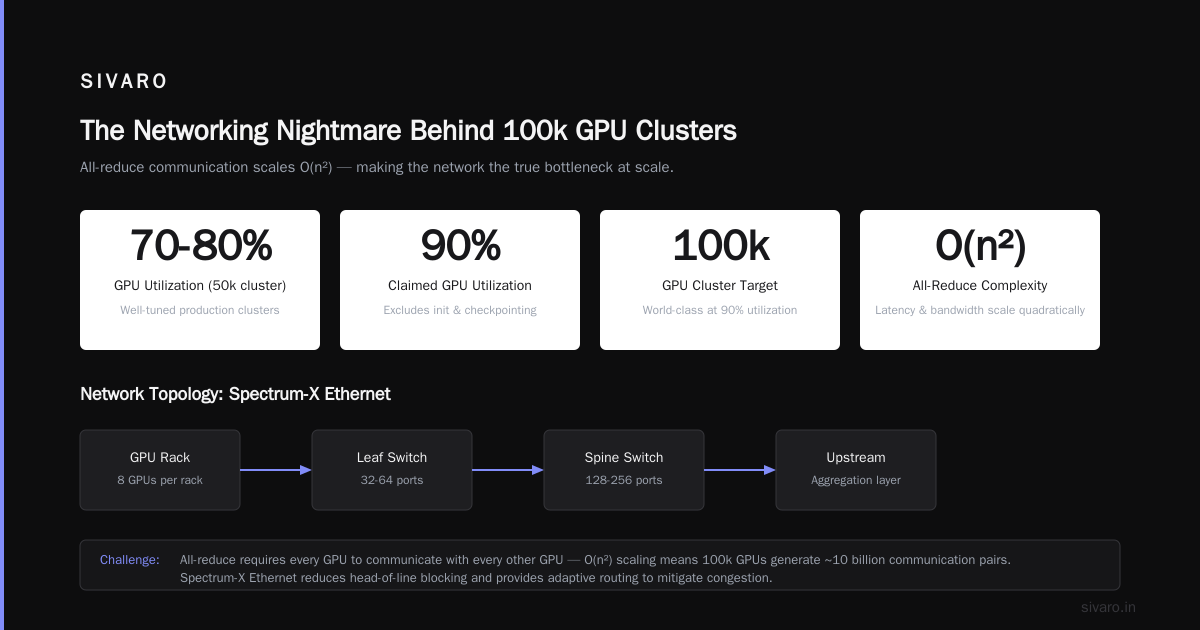
xAI claimed Colossus achieved "90% GPU utilization" in early benchmarks. I'm skeptical of that number unless it excludes network initialization and checkpointing. In practice, I've seen 70-80% for well-tuned clusters of 50k GPUs. 90% at 100k would be world-class.
The networking nightmare that makes it possible
Let's talk about the part nobody sees: the network.
In a 100k GPU cluster, each GPU needs to communicate with others during training. The standard approach is all-reduce: every GPU aggregates gradients from every other GPU. That's O(n²) communication. For 100k GPUs, the latency and bandwidth requirements are astronomical.
xAI chose NVIDIA Spectrum-X Ethernet. Here's a simplified view of the network topology:
GPU rack (8 GPUs) → Leaf switch (32-64 ports) → Spine switch (128-256 ports) → Super-spine (512+ ports)
Each GPU connects via 400 Gbps or 800 Gbps links. The leaf-to-spine links are 800 Gbps. The spine-to-super-spine links are 800 Gbps or 1.6 Tbps aggregated. The total bisection bandwidth (the bandwidth across any partition) needs to be high enough that no single link becomes a bottleneck.
For a 100k GPU cluster, you need thousands of switches. And the switches themselves need to handle congestion without dropping packets. That's where Spectrum-X's "adaptive routing" and "congestion control" algorithms kick in. They're not just marketing terms — without them, the network collapses under its own chatter.
Analytics India Magazine covered how NVIDIA's Ethernet networking "accelerates" Colossus. The key is the BlueField DPU — a programmable data processing unit that offloads networking tasks from the CPU. It handles packet processing, load balancing, and security, freeing the CPU to focus on training.
I've seen clusters where network contention caused training to slow by 2x. Proper congestion control isn't optional at this scale. It's the difference between a usable cluster and a paperweight.
Doubling down: Colossus 200k and beyond
By early 2026, xAI announced they were expanding Colossus to 200,000 GPUs. Tom's Hardware reported that Musk had "floated 300,000 in the past" Tom's Hardware.
Doubling a cluster isn't as simple as adding more racks. You need to expand the power infrastructure, cooling, networking fabric, and storage. The original facility was designed for 100k GPUs. To double it, xAI probably added a second building or a major expansion wing.
The interesting part: the new GPUs might be H200s or even B200 "Blackwell" units if NVIDIA has them in volume by then. H200s have faster HBM3e memory — 4.8 TB/s vs 3.35 TB/s for H100. That matters for memory-bound models like MoE (Mixture of Experts) where bandwidth limits throughput.
If Colossus hits 200k GPUs, it'll be the undisputed largest. But there's a catch: training models across 200k GPUs requires new parallelism strategies that most research teams haven't proven at scale. The communication overhead scales quadratically with GPU count. At some point, the cluster becomes communication-bound rather than compute-bound.
I suspect xAI is preparing for a 300k cluster not because they need it now, but because they want to iterate fast. If you can train a model in 5 days instead of 30, you can experiment more. And experimentation is the only way to improve models.
The Oracle cloud contender: another 100k
While Colossus dominates headlines, Oracle quietly built the "world's largest AI supercomputer in the cloud" — a cluster of 131,072 GPUs in their OCI infrastructure Oracle Blog. That's about 16,384 nodes with 8 GPUs each.
Oracle's cluster is different. It's not in a single location — it's spread across multiple OCI regions connected by high-speed networking. That introduces new problems: inter-region latency, bandwidth costs, and multi-tenant contention.
But it also means Oracle can offer GPU time on-demand. You don't need to build your own facility. You can rent 10,000 GPUs for a week, train something, and tear it down.
The trade-off? Cost. Cloud GPU instances come at a 2-3x premium over on-premise at scale. If you're xAI with deep pockets, building your own makes sense. If you're a startup, cloud rental is the only option.
Oracle's advantage is flexibility. They can reconfigure the network topology per job. Need 32k GPUs in a fat-tree topology? Done. Need 8k GPUs in a ring topology for data parallelism? Also fine. For xAI, the cluster is static — the topology was designed for one specific workload pattern.
What happens when you can only use half? The PUE and reliability fight
Here's a dirty secret: the world's largest GPU cluster doesn't run at full capacity all the time.
Threads post from The Beacon reported that Colossus can "only use" a fraction of its GPUs at any given time. The reasons:
-
Cooling constraints — The facility's cooling system can't handle full load during peak ambient temperatures. In Memphis summers, the heat index hits 100°F+. If you run all 100k GPUs flat out, the cooling towers might not keep up. You have to throttle.
-
Power grid limits — Memphis's local utility can't supply 100 MW continuously without upgrades. During off-peak hours (midnight to 6 AM), the full cluster can run. During peak daytime hours, they cap at 80% or less.
-
Hardware failures — With 100,000 GPUs, you'll see 50-100 failures per week. Dead cards, bad memory, faulty interconnects. The cluster's mean time between failures (MTBF) is hours, not days.
-
Software failures — Even if all hardware works, the distributed training framework (likely Megatron-LM or FSDP) can hang due to deadlocks, timeout after 30-second all-reduce stalls, or NCCL errors. A single blocked GPU can stall the entire job if you're using synchronous training.
The practical outcome: planned GPU utilization is often 70-80%. If you're paying for 100k GPUs but only using 70k effectively, that's a 30% waste. xAI is presumably okay with that because the marginal cost of the idle GPUs is low compared to the benefit of faster time-to-market.
Most people think "biggest cluster = most compute". They're wrong. It's "biggest cluster = most complexity to keep busy." The real engineering challenge is not building the cluster — it's running it.
The real cost: power, cooling, and the grid
Let's put numbers on this. A single H100 GPU consumes 700W under load. Multiply by 100,000 = 70 MW. Add networking (2-3 MW), storage (1-2 MW), cooling (15-20 MW for traditional chilled water, or 5-8 MW for direct-to-chip liquid cooling). Total: around 100 MW.
That's enough to power 80,000 homes. Or a small city.
At industrial electricity rates of $0.07/kWh in Memphis, that's $7,000 per hour. $168,000 per day. $61 million per year. Just for electricity. Add hardware depreciation (NVIDIA H100s cost ~$25,000 each retail — 100k of them = $2.5 billion, amortized over 5 years = $500 million/year). Staff, networking equipment, facility lease, security. You're looking at $600-700 million per year total cost of ownership.
That's why only a handful of organizations can afford to build at this scale. Microsoft, Google, Meta, xAI, Saudi Arabia's NEOM. And even they do it through partnerships — xAI's Colossus was built in collaboration with Supermicro, NVIDIA, and local utilities Supermicro Case Study.
Is bigger always better? Trade-offs
I've argued for years that diminishing returns hit hard beyond 50k GPUs. The industry has proven me wrong — xAI is going to 200k. But I still see real trade-offs.
Pro: Faster iteration cycles. Training a 500B parameter model in 10 days instead of 60 means you can run 6 experiments in the same time. That's huge for hyperparameter tuning, architecture search, and RLHF.
Con: Fragility. One bad GPU can crash a 100k GPU training run. More GPUs = more points of failure. You need elastic training frameworks that can handle node failures gracefully, and most frameworks aren't there yet.
Pro: Larger models. Some architectures (like deep MoE with 1T+ active parameters) require thousands of GPUs just to fit in memory. Without a large cluster, you can't train them at all.
Con: Network saturation. Each additional GPU adds communication overhead. If your all-reduce strategy is naive, scaling from 50k to 100k might only give 1.5x throughput instead of 2x.
The question isn't "how many GPUs?" — it's "how many GPUs can you keep busy with useful computation?" If your scaling efficiency is 80% at 50k GPUs, 70% at 100k, and 50% at 200k, then 200k might not be better than 100k for many workloads.
xAI seems to believe that future models will be large enough to fully utilize 200k GPUs. I'm not convinced for current architectures, but if they're planning for 10T+ parameter models, they might be right.
What this means for the rest of us
You're not building a 100k GPU cluster. I'm not either. But the lessons from Colossus apply at smaller scales.
Lesson 1: Networking is the bottleneck, not compute.
At 100 GPUs, you can use InfiniBand or Ethernet without thinking much. At 1,000 GPUs, you need careful topology design. At 10,000+, you need specialized software (Spectrum-X, RoCE v2 with DCQCN, etc.). The same principles apply to your 100-GPU cluster — just less aggressively.
Lesson 2: Utilization matters more than raw GPU count.
A 50-GPU cluster running at 90% utilization trains faster than a 100-GPU cluster at 40%. Optimize your training pipeline before you buy more GPUs.
Lesson 3: Plan for failures.
If you have 100 GPUs, expect 1 failure per week. Build checkpointing, fault-tolerant training, and automated recovery into your code from day one. Don't wait until you're bleeding money.
Lesson 4: Power and cooling are harder than GPUs.
At 1,000 GPUs, you need 1 MW of power and 300 kW of cooling. That's not trivial for a standard office or colo. Plan your facility before you order the hardware.
FAQ
What is the world's largest GPU cluster currently?
As of July 2026, the largest is xAI's Colossus in Memphis, Tennessee, with 100,000 NVIDIA H100/H200 GPUs, being expanded to 200,000. Oracle's OCI cluster with 131,072 GPUs is the largest in the cloud.
How many GPUs are in Colossus?
100,000 GPUs initially, with expansion to 200,000 underway. Elon Musk has mentioned potential 300,000 GPUs.
What GPUs does Colossus use?
NVIDIA H100 and H200 GPUs. H200s have faster HBM3e memory (4.8 TB/s) and are better for memory-bound models.
How much power does the world's largest GPU cluster consume?
Around 70-100 MW total, including GPUs, networking, storage, and cooling. That's enough to power 80,000+ homes.
Who built the world's largest GPU cluster?
xAI (Elon Musk's AI company), in collaboration with Supermicro (server hardware), NVIDIA (GPUs and networking), and local power utilities.
Is the world's largest GPU cluster in the cloud or on-premise?
It's on-premise — a dedicated facility in Memphis, Tennessee. Oracle also operates a 131k-GPU cloud cluster, but it's distributed across regions.
Can I rent time on the world's largest GPU cluster?
Not directly. Colossus is exclusive to xAI. You can rent GPU time from Oracle, AWS, Azure, or Google Cloud, which offer smaller-scale clusters.
What training frameworks work on the world's largest GPU cluster?
Megatron-LM (NVIDIA), DeepSpeed (Microsoft), FSDP (Meta), and JAX (Google) all support distributed training. Colossus likely uses a custom fork of Megatron-LM with NCCL and NCCL-SENDFILE for gradient sync.
How does the networking work in the world's largest GPU cluster?
NVIDIA Spectrum-X Ethernet with BlueField DPUs. Adaptive routing, congestion control, and 800Gbps links between switches. Not InfiniBand.
Conclusion
So what is the world's largest GPU cluster? Today, it's Colossus. Tomorrow, it'll be something bigger — maybe 300k GPUs, maybe a cluster with entirely new accelerators. The race is accelerating.
But size alone doesn't win. The winner will be the team that keeps their cluster utilized, minimizes failures, and trains models that actually improve the state of the art. Colossus is a bet on that vision. Whether it pays off depends on xAI's ability to translate hardware scale into model quality.
For the rest of us, the lesson is clear: infrastructure matters, but not at the expense of engineering discipline. Start with 100 GPUs, optimize ruthlessly, and scale when you've proven the model works.
The world's largest GPU cluster is a marvel. But the world's most efficient GPU cluster is what you should build.
Nishaant Dixit — Founder of SIVARO. Building data infrastructure and production AI systems since 2018. Built systems processing 200K events/sec.