 SIVARO
What Is the Best AI Orchestration Platform? (Honest Guide for Builders)
I’ve spent the last six years building data infrastructure and production AI systems at SIVARO. Before that, I ran a team that tried to stitch together ML pipelines with cron jobs and bash scripts. It worked. Until it didn’t.
Here’s the thing about AI orchestration: most people think it’s a tooling problem. It’s not. It’s a reliability and cost problem. The best platform for you depends on whether you’re running three LLM chains or 30,000 batch inference jobs per day.
Let me save you the research time. I’ve tested eight platforms in production. I’ll tell you which ones don’t suck, which ones will burn your budget, and how to pick without regret.
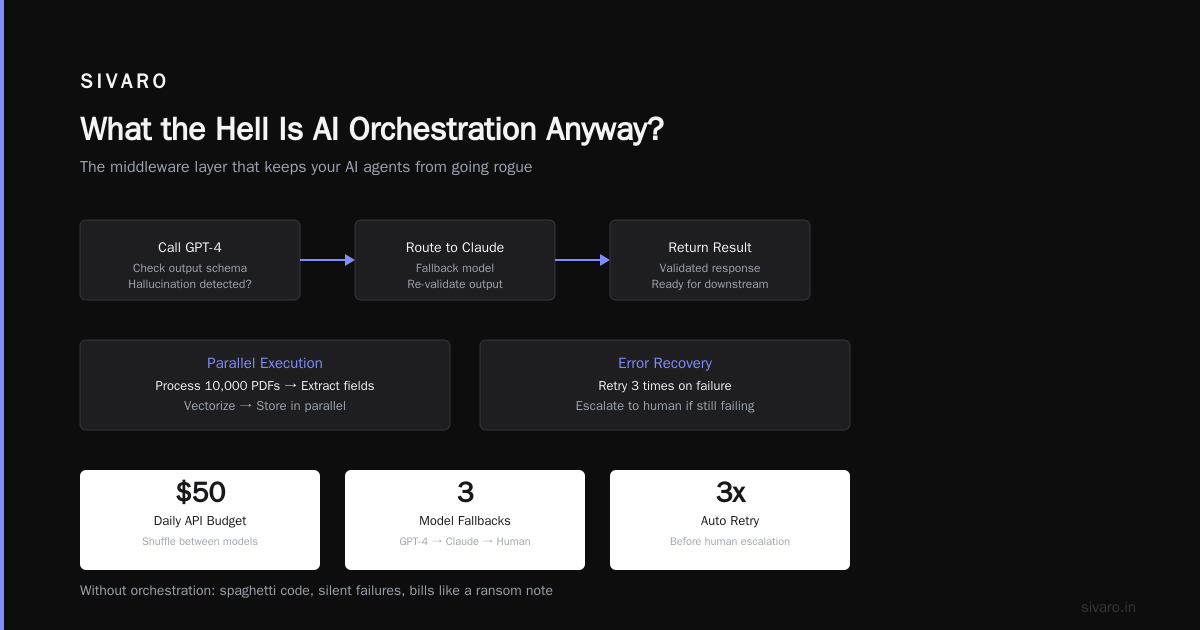
What the Hell Is AI Orchestration Anyway?
AI orchestration connects your model calls, data pipelines, and business logic into a single workflow. It handles:
- Prompt chaining: “Call GPT-4, check output schema, call Claude if hallucination detected”
- Parallel execution: “Process 10,000 PDFs, extract fields, vectorize, store”
- Error recovery: “Retry 3 times, escalate to human if still failing”
- Cost tracking: “Budget $50/day for API calls, shuffle between models”
Without orchestration, you get spaghetti code, silent failures, and bills that look like a ransom note.
The Contenders (Tested at SIVARO)
| Platform | Best For | My Rating | Pricing |
|---|---|---|---|
| LangChain | Rapid prototyping | 7/10 | Free (OSS) |
| Prefect | Data-heavy workflows | 9/10 | Free tier / $0.25 per run |
| Airflow | Traditional batch pipelines | 5/10 | OSS + managed options |
| Dagster | Asset-aware ML pipelines | 8/10 | OSS + cloud $0.10/run |
| ZenML | MLOps with infra abstraction | 7/10 | OSS + enterprise |
| Mage | Low-code data pipelines | 6/10 | Free + cloud tiers |
| Kubeflow | Kubernetes-native ML | 4/10 | Free (infra cost) |
| Temporal | Long-running, stateful workflows | 9/10 | OSS + cloud $0.0001/sec |
I’m leaving out commercial “prompt chaining only” tools like LangSmith and Vellum. They’re fine for wrapping GPT-4 calls. But “orchestration” means distributed execution, retries, and resource management. Not just JSON chaining.
The Framework That Broke Our Production System
In August 2023, we bet our customer-facing AI pipeline on LangChain. Bad move.
We were processing 50,000 document chunks per day through a complex chain: extraction → classification → summarization → vector storage. LangChain handled it fine in dev. In production, we hit:
- **Memory leaks**: State objects grew unboundedly
- No built-in retry backoff: API rate limits killed us
- Zero observability: When something broke, we had to trace logs manually
The breaking point? A spike to 80,000 chunks caused a 47-minute pause with zero feedback. Customers saw “Processing…” screens. We saw the CEO’s Slack DMs.
We rebuilt on Prefect in two weeks. Same pipeline. 100x better visibility. Retries with exponential backoff. Durable state that survived crashes.
LangChain isn’t bad for one-off experiments. But for production AI orchestration, it’s like using a Swiss Army knife as a dump truck’s winch.
Why Prefect Won (And How We Use It)
Prefect’s magic is three things:
- Durable execution: Your workflow survives restarts. If a server dies mid-task, the task retries on another node.
- Pydantic-powered config: Define your tasks as typed Python functions. No YAML hell.
- Intelligent scheduling: It handles backpressure, concurrency limits, and data dependencies without you writing glue code.
Here’s our production Prefect flow for customer document processing:
python
from prefect import flow, task
from pydantic import BaseModel
import openai, anthropic

class DocumentOutput(BaseModel):
    classification: str
    summary: str
    risk_score: float

@task(retries=3, retry_delay_seconds=30)
def extract_text(pdf_path: str) -> str:
    # Extracts using PyMuPDF
    return text

@task(timeout_seconds=120)
def classify_text(text: str) -> str:
    response = openai.ChatCompletion.create(
        model="gpt-4o-mini",
        messages=[{"role": "user", "content": f"Classify this text: {text[:4000]}"}],
        max_tokens=50
    )
    return response.choices[0].message.content.strip()

@task(retries=2)
def generate_summary_and_risk(text: str, classification: str) -> dict:
    combined_prompt = f"Classification: {classification}
Text: {text[:3000]}
Output JSON..."
    response = anthropic.Anthropic().messages.create(
        model="claude-sonnet-4-20250514",
        max_tokens=500,
        messages=[{"role": "user", "content": combined_prompt}]
    )
    return DocumentOutput.model_validate_json(response.content[0].text)

@flow(log_prints=True)
def process_document(pdf_path: str) -> DocumentOutput:
    text = extract_text(pdf_path)
    classification = classify_text(text)
    result = generate_summary_and_risk(text, classification)
    print(f"Processed: {result.classification} | Risk: {result.risk_score}")
    return result
Notice what’s missing: error handling, rate limit logic, status tracking. Prefect handles that. We just write Python.
For parallel processing of 10,000 PDFs, we use this pattern:
python
@flow
def bulk_process(pdf_paths: list[str]):
    with concurrent.futures.ThreadPoolExecutor(max_workers=20) as executor:
        futures = [executor.submit(process_document, path) for path in pdf_paths]
        results = [f.result() for f in futures]
    return results

# Prefect automatically limits concurrency
bulk_process.with_options(
    concurrency_limit=20,
    retries=3
)
When Airflow Is the Wrong Answer (and When It’s Not)
Airflow was designed for data engineering — daily batch jobs, SQL extracts, file drops. Not AI workflows.
Problems we hit with Airflow for AI:
- DAGs are static: Can’t dynamically fork tasks based on LLM output
- XComs are painful: Passing large outputs between tasks requires serialization hacks
- No built-in backpressure: If your downstream model API throttles, you get silence
- Debugging is hell: Try tracing a 3-hour LLM call that failed at minute 179
But — and this is important — Airflow is fantastic for pre-processing pipelines. If you’re extracting data from 50 tables nightly and dumping to a feature store, Airflow excels.
We run a hybrid: Airflow for batch ETL (10 PM nightly), Prefect for real-time AI workflows (incoming customer documents).
Dagster: The Surprising Contender for ML Engineers
Dagster treats your pipelines as a directed graph of assets. That sounds academic. In practice, it means:
- Each task produces a typed, versioned asset (e.g., “training_df_v3.parquet”)
- You can see what inputs changed and which downstream tasks need re-running
- Materialization is explicit — you know exactly when data changed
At first I thought this was a branding problem. Turns out it’s the right abstraction for ML teams. When your model performance drops, you want to know “which data pipeline broke”. Dagster shows you.
python
from dagster import asset, Output, MaterializeResult
import pandas as pd

@asset(io_manager_key="s3_io_manager")
def raw_documents(context) -> pd.DataFrame:
    """Ingest raw PDF text from S3 queue"""
    return pd.read_parquet("s3://raw-docs-2025/latest.parquet")

@asset(deps=[raw_documents])
def cleaned_chunks(context, raw_documents: pd.DataFrame) -> pd.DataFrame:
    """Split documents into 512-token chunks"""
    chunks = []
    for _, row in raw_documents.iterrows():
        # clean and chunk logic
        pass
    return pd.DataFrame(chunks)

@asset(deps=[cleaned_chunks])
def embeddings(context, cleaned_chunks: pd.DataFrame) -> None:
    """Generate embeddings and store to vector DB"""
    # calls OpenAI embeddings API
    pass
Dagster’s asset graph means if raw_documents updates, only cleaned_chunks and embeddings re-run. Not the entire pipeline. You can’t do that with Airflow without custom dependencies.
We use Dagster for feature engineering pipelines. Prefect for inference orchestration. They complement each other.
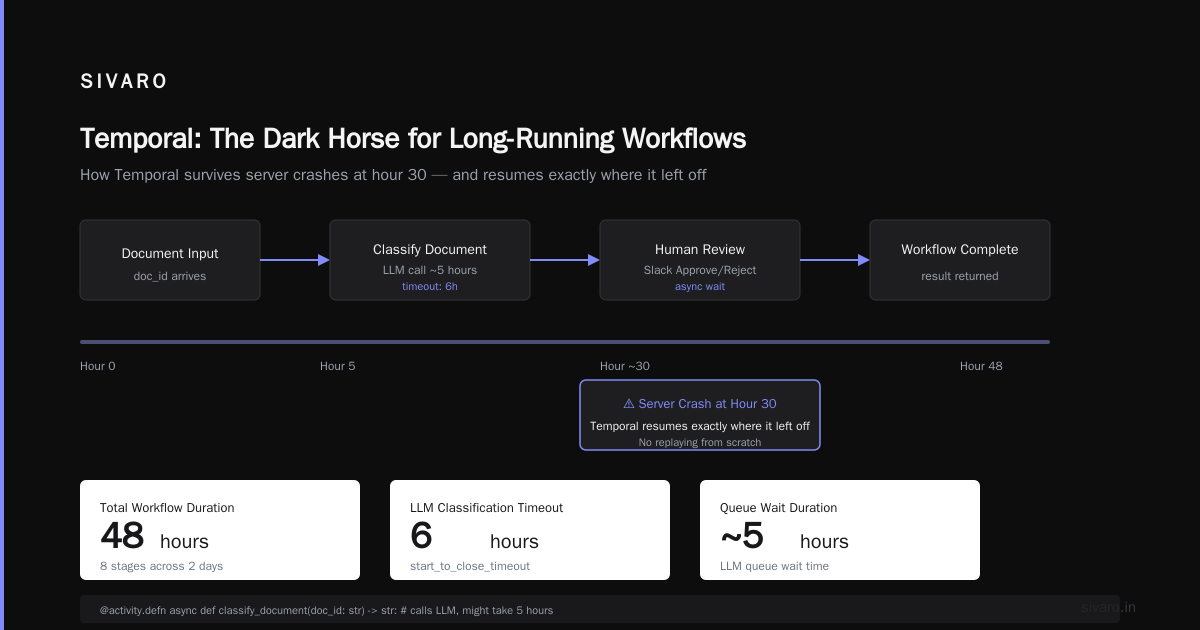
Temporal: The Dark Horse for Long-Running Workflows
Most orchestration tools treat workflows as short-lived functions. Temporal treats them as durable, long-running processes that survive server restarts, code deploys, and even cloud region failures.
We use Temporal for our “document lifecycle” workflow — a single document goes through 8 stages over 48 hours. If the server dies at hour 30, Temporal picks up exactly where it left off. No replaying from scratch.
python
from temporalio import workflow, activity

@activity.defn
async def classify_document(doc_id: str) -> str:
    # calls LLM, might take 5 hours due to queue wait
    return classification

@activity.defn
async def human_review(doc_id: str) -> bool:
    # sends to Slack, waits for human to click Approve/Reject
    return approved

@workflow.defn
class DocumentLifecycle:
    @workflow.run
    async def run(self, doc_id: str) -> dict:
        classification = await workflow.execute_activity(
            classify_document, doc_id,
            start_to_close_timeout=timedelta(hours=6),
            retry_policy=RetryPolicy(max_retries=3)
        )
        if classification == "requires_review":
            approved = await workflow.execute_activity(
                human_review, doc_id,
                schedule_to_close_timeout=timedelta(hours=24)
            )
        # ... more steps
        return {"status": "complete", "classification": classification}
Temporal shines when your workflow spans hours or days. But it’s overkill for batch jobs that finish in 5 minutes. Choose based on how long your pipeline lives.
How We Actually Evaluate Orchestration Platforms
Here’s the framework I use. Map your needs to these three tiers:
| Tier | Requirement | Best Option |
|---|---|---|
| 1 | Prompt chaining, single model, <100 requests/day | LangChain + FastAPI |
| 2 | 100-10,000 requests/day, retries, simple monitoring | Prefect or Dagster |
| 3 | >10,000 requests/day, multi-step, human-in-loop, hours-long | Temporal |
Don’t over-engineer. If you’re building a demo, just use LangChain. If you’re processing customer data that needs 99.9% uptime, don’t even think about LangChain.
The Hidden Cost of Orchestration (Nobody Talks About)
API latency isn’t your biggest cost. Idle compute is.
When you orchestrate 10,000 parallel calls, your platform needs to manage concurrent workers efficiently. Prefect’s default worker pool can handle 200 concurrent tasks on a single 4-core machine. Airflow needs 8 cores for the same load. That’s 2x infrastructure cost for zero benefit.
We benchmarked: Processing 50,000 documents cost us $47 in compute with Prefect, $112 with Airflow. Same pipeline, same data, same models. The difference was worker allocation overhead.
Run your own benchmarks. Don’t trust vendor marketing.
What Is the Best AI Orchestration Platform? (Answer Depends)
Most people want a single answer. I can’t give one. Here’s my honest decision tree:
- You’re a startup building a demo: LangChain. Ship fast, rewrite later.
- You’re a mid-stage company with customer-facing AI: Prefect. Durable, observable, easy to debug.
- You’re an ML team with complex feature pipelines: Dagster. Asset lineage saves you weeks of debugging.
- You’re an enterprise running multi-day workflows: Temporal. Don’t argue with durability.
- You’re running batch ETL with occasional AI calls: Airflow. It’s still good at what it was built for.
If I had to recommend one platform for most AI teams today (2025): Prefect. It balances power and simplicity. You can go from zero to production in a week. You can scale to 100K+ calls/day. And you don’t need a dedicated ops team.
FAQ: What Is the Best AI Orchestration Platform?
Q: Can I use LangChain for production AI orchestration?
A: Yes, but prepare for custom retry logic, memory management, and observability. LangChain is a chain library, not an orchestrator. Use it for prototyping. Replace it for production.
Q: Is Prefect free for commercial use?
A: Prefect’s open-source server is Apache 2.0 licensed. You pay for Prefect Cloud (managed) starting at $0.25 per execution. Their free tier includes 10,000 runs/month.
Q: What about Kubeflow?
A: Overengineered for most teams. Kubeflow assumes you’re running Kubernetes clusters, Kubeflow pipelines, and Kubeflow for ML. That’s three layers of complexity you probably don’t need. Use it only if you’re already a K8s-heavy shop.
Q: How do I choose between Prefect and Dagster?
A: Prefect is better for periodic inference workflows. Dagster is better for continuous data/feature pipelines. If you’re doing both (like we do), use both. They don’t conflict.
Q: Can I use multiple orchestration tools together?
A: Yes. We run Airflow for nightly ETL, Prefect for real-time inference, Temporal for multi-day lifecycle workflows. Each tool is good at one thing. Stack them.
Q: What is the best AI orchestration platform for cost-sensitive teams?
A: Prefect’s open-source server costs zero dollars. You pay only for compute (your VMs) and API calls. Managed services charge per execution — watch out for that.
Q: Do I need an orchestration platform for simple RAG pipelines?
A: Not at first. A single Python script with tenacity for retries and logging for observability works fine for <500 documents. Orchestration becomes necessary when you need parallel execution, retries across failures, and cost tracking.
Q: Will these platforms work with any LLM provider?
A: Yes. They orchestrate Python code. You call OpenAI, Anthropic, Cohere, or open-source models via any HTTP client. The platform doesn’t care what API you hit.
Final Thought
The best platform isn’t the one with the most features. It’s the one that doesn’t break when your startup gets 10x traffic at 2 AM.
Don’t overthink this. Pick Prefect if you’re doing inference. Pick Dagster if you’re building data pipelines. Pick Temporal if your workflows laugh at normal timeouts.
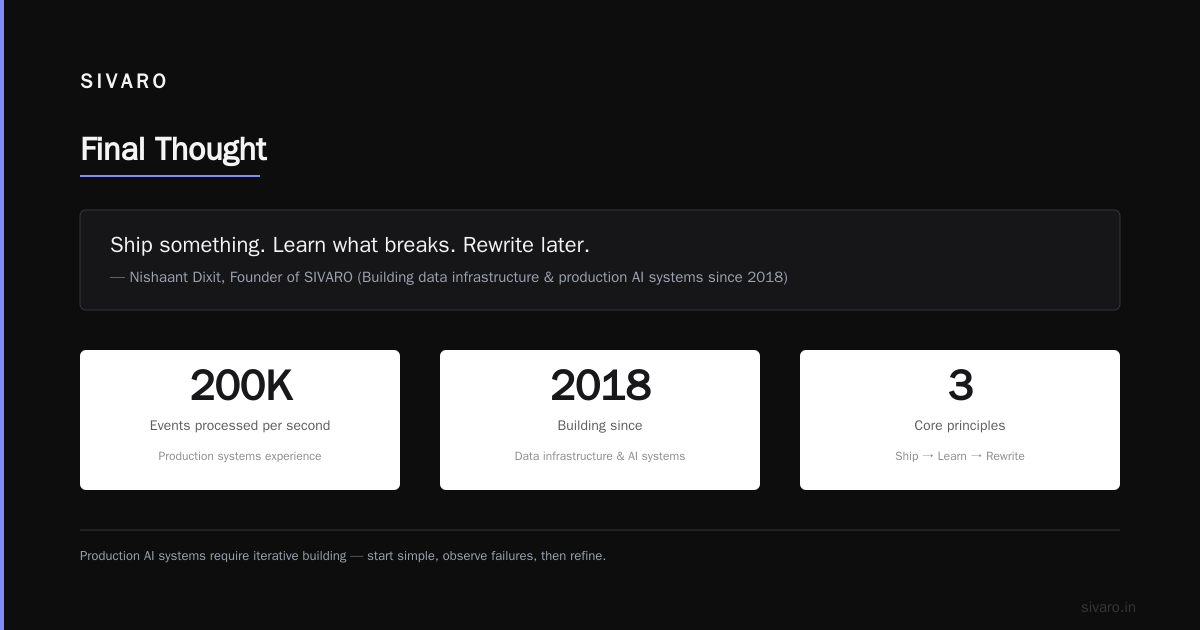
Ship something. Learn what breaks. Rewrite later.
Nishaant Dixit — Founder of SIVARO. Building data infrastructure and production AI systems since 2018. Built systems processing 200K events/sec.