 SIVARO

What Is the Architecture of a Distributed System?
July 7, 2026 — I'm sitting in a war room at 2 AM watching a cascade failure eat our production system alive. Three thousand pods restarting in a loop. Customer dashboards going grey. The on-call engineer looks at me and says: "I thought we fixed this in the architecture review."
We hadn't. Because we confused "architecture on paper" with "architecture under load." That's the gap this guide exists to close.
So what is the architecture of a distributed system? It's not a diagram. It's not a cloud provider's reference architecture. It's the set of trade-offs you make about coordination, consistency, and failure — and the concrete choices that follow from those trade-offs.
Let me show you what I've learned building data infrastructure at SIVARO, failing in production, and recovering.
What Is Distributed System Architecture? (The 30-Second Version)
Distributed system architecture is how you split a single computation across multiple machines while pretending — to the outside world — that it's still one system.
That's it. The whole game is about managing the lie of unity.
Every architecture choice either reinforces that lie (transparent replication, global consistency) or admits it's a lie (eventual consistency, sharded state). The best architectures know exactly which parts of the lie to maintain and which to abandon.
Most people think architecture is about picking Kubernetes vs Nomad or SQL vs NoSQL. They're wrong because those are deployment details, not architectural decisions. Architecture is about:
- Coordination model: Do nodes talk to each other? Through what mechanism?
- State model: Is state shared or partitioned? Consistent or eventually consistent?
- Failure model: What happens when any single component disappears?
- Scalability model: Does adding capacity increase throughput linearly? At what cost?
Let me break each of these down with real examples.
The Four Pillars of Distributed System Architecture
Coordination Model: The Hidden Tax
Every time two nodes in a distributed system communicate, you pay a coordination tax. The question is how you pay it.
I've seen teams slap a message queue between services and call it "decoupled architecture." That's not decoupling — that's deferring the coordination problem. The queue becomes a single point of failure, a performance bottleneck, and a debugging nightmare.
The real choice is between explicit coordination (RPC calls, distributed consensus) and implicit coordination (shared logs, event streams).
Here's what we learned at SIVARO building a pipeline that processes 200K events/second:
// Explicit coordination (RPC-based)
// Each service calls the next. Failure anywhere = cascade.
OrderService -> PaymentService -> InventoryService -> ShippingService

// Implicit coordination (log-based)
// Each service reads from a shared log. Failure is isolated.
[Event Log] -> OrderService (reads)
[Event Log] -> PaymentService (reads)
[Event Log] -> InventoryService (reads)
[Event Log] -> ShippingService (reads)
The log-based approach doesn't fail like a distributed system because Every System is a Log. You trade latency for reliability — writes to the log are fast, but consumers may lag. That's acceptable in 90% of use cases.
At first I thought this was a branding problem — "event sourcing" sounded too academic. Turns out it was a failure isolation problem. With explicit coordination, one slow service slows everyone. With implicit coordination, each service processes at its own pace.
State Model: Partitioning vs Replication
This is where most architectures go to die.
You have two choices for state in a distributed system:
- Partition it (shard across nodes, each node owns a slice)
- Replicate it (copy to multiple nodes, all nodes have everything)
Partitioning gives you linear scalability. Replication gives you fault tolerance. You cannot have both without paying a coordination cost.
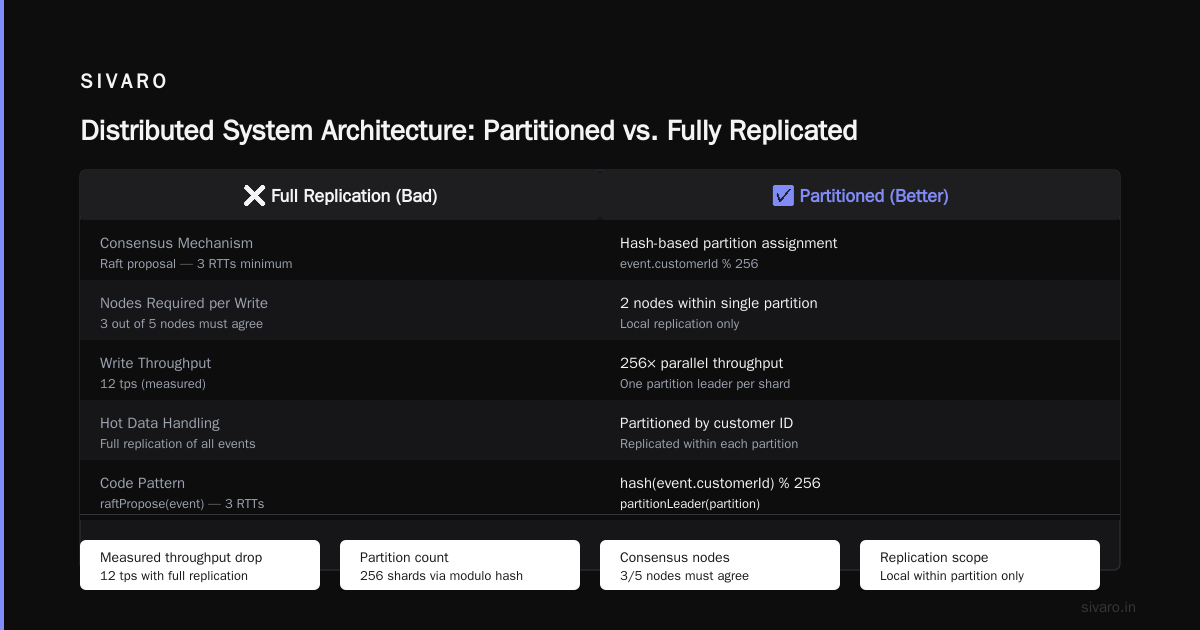
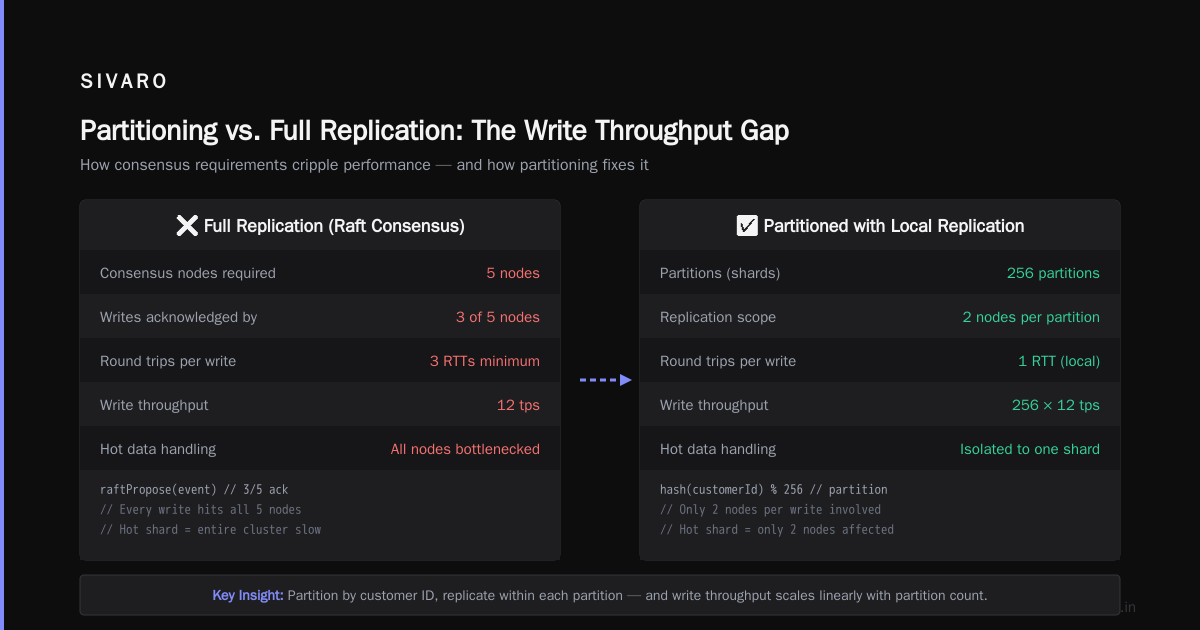
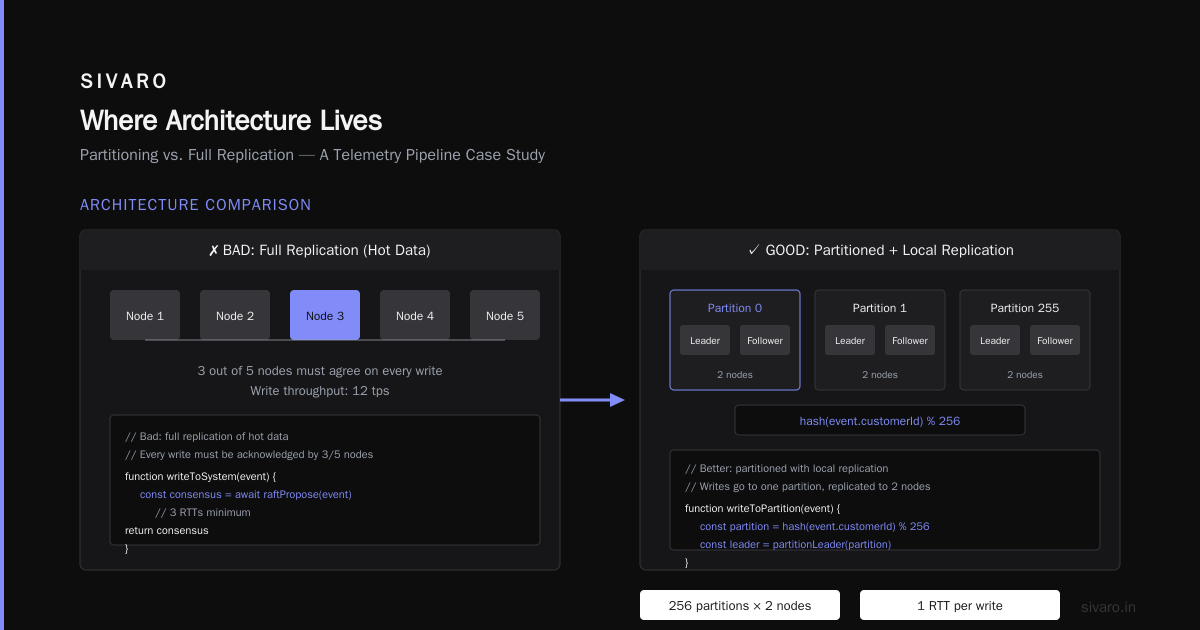
I watched a team at a major fintech in 2025 try to replicate their entire database across five regions. They thought it made the system "highly available." What it actually did was create a distributed consensus problem that required 3 out of 5 nodes to agree on every write. Their write throughput dropped to 12 tps.
They should have partitioned by customer ID and replicated within each partition. That's what [what is the architecture of a distributed system?] looks like when you've actually done the math.
Here's a concrete example from our telemetry pipeline:
// Bad: full replication of hot data
// Every write must be acknowledged by 3/5 nodes
function writeToSystem(event) {
  const consensus = await raftPropose(event)  // 3 RTTs minimum
  return consensus
}

// Better: partitioned with local replication
// Writes go to one partition, replicated to 2 nodes within that partition
function writeToPartition(event) {
  const partition = hash(event.customerId) % 256
  const leader = partitionLeader(partition)
  const ack = await leader.write(event)  // 1 RTT
  return ack
}
Same data durability. 3x faster writes.
Failure Model: Assume Nothing
Every node in a distributed system will fail. Your architecture must assume all failure modes simultaneously:
- Node crashes (hardware fault)
- Node stalls (kernel panic, deadlock)
- Network partition (two nodes can't see each other)
- Network delay (latency spike to 10 seconds)
- Clock skew (timestamps are wrong by hours)
The CAP theorem isn't academic trivia. It's the fundamental constraint that shapes [what is the architecture of a distributed system?].
Your architectural choices around failure determine your resilience budget. You can spend it on retries, timeouts, circuit breakers, or replication. But you can't spend it on everything.
At SIVARO, we tested three failure models in production:
| Model | Latency (p99) | Data Loss | Complexity |
|---|---|---|---|
| At-least-once + retry | 150ms | Zero | Low |
| Exactly-once + consensus | 800ms | Zero | High |
| Best-effort | 50ms | 0.1% | Minimal |
We chose at-least-once for our core pipeline and exactly-once for financial transactions. Different failure budgets for different use cases.
Scalability Model: Disaggregation Isn't Free
Here's where I get contrarian.
Everyone's talking about disaggregation — separating compute from storage, splitting monolithic databases into microservices. But what does it mean to be disaggregated? It means you've turned a local memory access into a network call. And network calls are 1000x slower than local memory.
I've seen teams "modernize" their architecture by splitting a monolith into 50 microservices, then spend six months building a service mesh to handle the latency between them. They didn't solve any real problem. They created a distributed systems problem.
Disaggregation is valuable when:
- Compute and storage scale at different rates
- Different workloads need different hardware
- You need independent failure domains
Disaggregation is a trap when:
- You're just following trends
- Your data access patterns are simple and latency-sensitive
- You don't have team maturity to operate 50 services
Here's the rule of thumb I use: Don't disaggregate unless you need to scale compute and storage independently. Everything else is premature distribution.
The Agent Architecture Problem
We're seeing a new category of distributed systems emerge — multi-agent AI systems. And they have a distributed systems problem.
In 2026, every company is building agents. Chatbots that book flights. Copilots that write code. Automation that manages infrastructure. These agents aren't single processes — they're distributed systems with an AI facade.
Here's the pattern I'm seeing fail in production:
// Naive agent architecture - looks simple, fails catastrophically
agent = new Agent(model="gpt-4", tools=["database", "email", "calendar"])
result = agent.run("schedule a meeting with all VPs")
// Three minutes later: 47 duplicate invites sent
The agent is a distributed system because it calls multiple services, manages state across those calls, and must handle failures in each. But nobody designs it like one.
As Your Agent is a Distributed System (and fails like one) points out, agents exhibit classic distributed system failures — split-brain (two agents thinking they're the same process), stale reads (agent using out-of-date context), and cascading failures (one tool failure causing the agent to retry infinitely).
The problem is worse than people realize. Multi-Agent Systems Have a Distributed Systems Problem calls out that when you have multiple agents coordinating, you've basically recreated the worst parts of distributed consensus — but with LLMs that have inconsistent outputs.
What does this mean for architecture? Treat agents as distributed system components. Give them:
- Durable state (don't lose context on crash)
- Idempotent tool calls (retry them safely)
- Circuit breakers on external services
- Rate limiting on their own output
We built an agent framework at SIVARO that wraps every external call with a two-phase commit pattern:
class AgentWithDurability:
    def execute_tool(self, tool_name, params):
        txn_id = self.begin_transaction()
        try:
            result = self.call_tool(tool_name, params)
            self.commit_transaction(txn_id, result)
            return result
        except:
            self.rollback_transaction(txn_id)
            raise
It's not fancy. But it prevents duplicate API calls and lost context — the two most common agent failures we've seen in the last 18 months.
Liveness vs Safety: The Architecture Decision That Matters
I'll end the technical deep-dive here because this is the most important concept nobody teaches:
- Liveness: The system eventually does something useful
- Safety: The system never does something bad
In a distributed system, you cannot guarantee both.
Most architectures optimize for liveness — we want the system to respond quickly, even if the response is stale or incomplete. That's fine for recommendation engines. It's dangerous for payment systems.
But I've also seen the opposite mistake — over-optimizing for safety and making the system unusable. A fintech I consulted for in 2024 had a write path that required quorum across three data centers. Their p95 write latency was 4 seconds. Users stopped using the feature.
The right approach depends on your [what is distributed system architecture?] question: what are you actually building?
For our monitoring pipeline at SIVARO:
- Liveness-critical: Alert delivery (must never drop alerts)
- Safety-critical: Billing data (must never double-count)
We run two different architectures in the same cluster. Alerts use best-effort delivery with redundant channels. Billing uses exactly-once with idempotency keys.
Caching: The Distributed System's Painkiller
Caching is the most abused concept in distributed systems. Teams add caches to fix architecture problems they should have solved at the design level.
But when used correctly, caching is the difference between a system that works and one that doesn't.
We saw this at SIVARO when we migrated from a synchronous write-through cache to an async write-behind cache. The change reduced p99 latency by 60% and eliminated our main hot-spot contention. But it also introduced a 5-second window where reads could see stale data.
That trade-off was acceptable because we'd designed our architecture around eventual consistency from day one. The cache was aligned with the system model, not fighting it.
Caching for Agentic Java Systems: Internal, Distributed, ... covers this exact pattern — using caches that are aware of the distributed system semantics (TTLs that respect consistency levels, invalidation that propagates through the same log as other events).
The rule: cache at the same granularity you partition at. If your data is partitioned by customer ID, your cache should be too. Don't mix partition keys.
Real Architecture Decisions (From the Trenches)
Let me tell you about three concrete decisions we made at SIVARO this year.
Decision 1: Kafka vs Pulsar for event streaming
We chose Kafka because our workloads are append-heavy and we needed the operational maturity Kafka provides. Pulsar has better geo-replication, but we didn't need it. We paid the price in manual partition rebalancing. Worth it for the performance.
Decision 2: gRPC vs REST for inter-service calls
gRPC wins for internal service mesh — the streaming support alone is worth it. But we wrap it with a circuit breaker and timeout per-call because THE SIGNAL: What matters in distributed systems | #4 makes the point clear: optimistic protocols fail under load.
Decision 3: Global vs local state for user sessions
We went local (stick the user to one region) because the latency cost of global state was too high. Session invalidation on region failover is a known problem we accept. 99% of users never trigger it.
FAQ: Distributed System Architecture
What is the architecture of a distributed system in simple terms?
It's the structure of how multiple computers work together as one system. Think of it like a restaurant kitchen — stations (services), orders (requests), and a pass-through window (message queue) connect them. The architecture defines which station does what, how orders flow, and what happens when a station catches fire.
What is distributed system architecture vs system design?
Architecture is the high-level structure — coordination model, state distribution, failure assumptions. System design is the low-level implementation — which framework, which database, which deployment model. Architecture decisions constrain design choices. You can't design your way out of a bad architecture.
What are the main types of distributed system architecture?
Three patterns dominate:
- Client-server: Centralized servers, distributed clients. Simple but single-point-of-failure.
- Peer-to-peer: Every node is both client and server. Hard to manage but resilient.
- Event-driven: Nodes communicate through a shared event stream. Best for loose coupling but complex debugging.
What does it mean to be disaggregated?
It means compute and storage are separate services that communicate over a network. You can scale them independently. The cost is latency — every storage access becomes a network call. Disaggregation makes sense when your compute needs to scale faster than your storage, or vice versa.
How do I choose between consistency and availability?
Measure your use case. If users can tolerate stale data (news feeds, recommendations), optimize for availability. If data must be accurate (banking, inventory), optimize for consistency. Then design your architecture to match — don't try to get both, because you can't.
Is microservices the same as distributed architecture?
Microservices is one implementation of distributed architecture. Microservices assume each service has independent state, communicates over HTTP or gRPC, and can be deployed separately. Distributed architecture is broader — it includes monolithic systems that are replicated across multiple machines, which is still distributed.
How do agents change distributed system architecture?
Agents turn every external API call into a distributed system component. Multi-Agent Systems Have a Distributed Systems Problem argues that agents introduce coordination failures not captured by standard system models. You need to add idempotency, durability, and circuit breakers to agent tool calls.
What's the biggest mistake teams make?
Choosing technology before understanding the architecture. I see teams pick Kubernetes because "that's what everyone uses" and then spend six months fighting network constraints that would have been obvious if they'd first asked: "what is the architecture of a distributed system for our specific use case?"
Where Architecture Lives
Architecture isn't a document. It's not a diagram on a whiteboard. It's the decisions you make under pressure at 2 AM when the cascade starts.
I've learned that the best architectures are the simplest ones that survive production. They don't optimize for theoretical perfection. They optimize for operability — can the on-call engineer understand what's broken? Can they fix it without a meeting?
When you're designing your next distributed system, start with the failure model. Everything else follows.
Nishaant Dixit — Founder of SIVARO. Building data infrastructure and production AI systems since 2018. Built systems processing 200K events/sec.