What Is the Agentic AI Orchestration Framework?
You've got ten AI agents running. Each one calls different tools. One reads from Databricks. Another writes SQL. A third generates code, tests it, then deploys it. And somewhere in there, a fourth agent is supposed to review the output before it hits production.
How do you keep this from turning into a dumpster fire?
That's what the agentic AI orchestration framework solves. It's the control plane for multi-agent systems. The thing that decides which agent runs when, how they hand off work, what happens when an agent fails, and how you maintain visibility across the whole mess.
Let me walk you through what I've learned building these systems at SIVARO over the past three years. I'll tell you where we screwed up, what actually worked, and what's changing right now in July 2026.
The Framework, Defined
An agentic AI orchestration framework is a runtime system that manages the lifecycle, coordination, state, and communication of multiple AI agents working toward complex goals. It's not an agent itself. It's the infrastructure that agents run inside.
Think of it like Kubernetes for AI agents. But dumber in some ways and smarter in others.
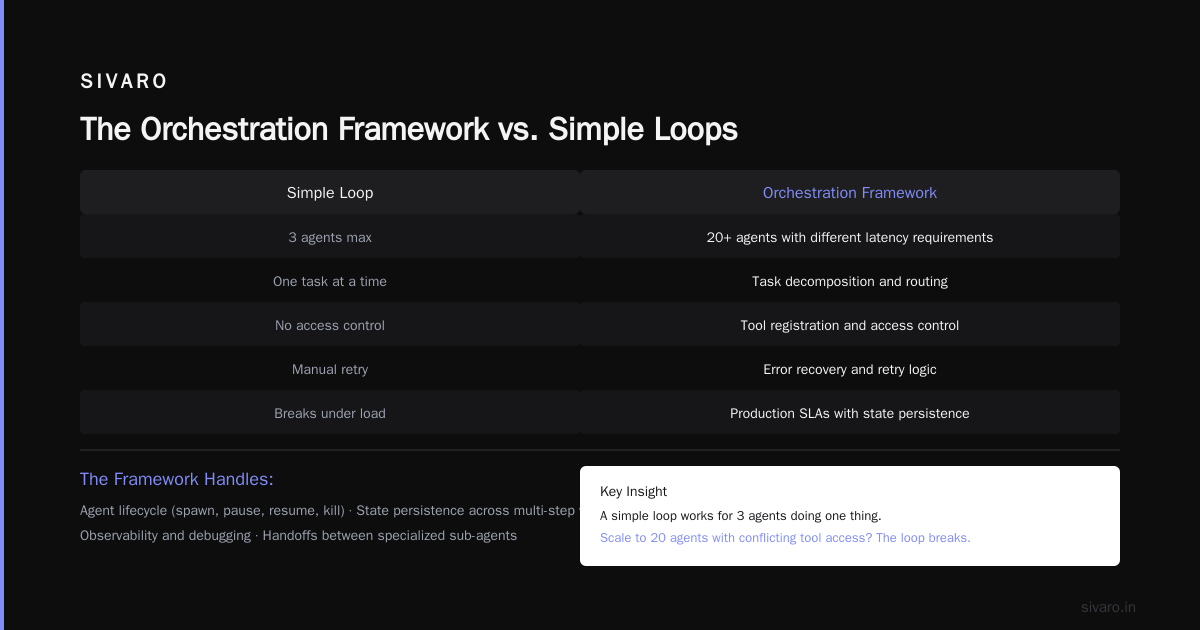
Kubernetes orchestrates containers. The orchestration framework orchestrates agent decision loops, tool calls, memory accesses, and handoffs between specialized sub-agents. It handles:
- Agent lifecycle (spawn, pause, resume, kill)
- Task decomposition and routing
- State persistence across multi-step workflows
- Error recovery and retry logic
- Tool registration and access control
- Observability and debugging
Most people think this is just "putting agents in a loop." They're wrong. Because a simple loop works fine for three agents doing one thing. Try scaling that to twenty agents with different latency requirements, conflicting tool access, and production SLAs. The loop breaks.
Why This Exists Now
Here's the thing. In early 2025, everyone was building single agents. One model. One system prompt. One tool set. It worked for demos. It worked for simple RAG pipelines.
Then Databricks published their work on Benchmarking Coding Agents on Multi-Million Line Codebases. The result? Single agents hit a wall around 40% accuracy on complex coding tasks. Not because the models were bad. Because the problem required multiple specialized reasoning passes that a single agent couldn't manage without losing context.
That's when the industry pivoted. By late 2025, multi-agent architectures were everywhere. And by early 2026, we realized we needed a proper framework to manage them.
Today — July 9, 2026 — you'd be crazy to build a production AI system without an orchestration layer. The question is which one, and how to configure it.
Core Components You Actually Need
I've tested seven different orchestration frameworks in production. Here's what every one of them needs to handle.
The Scheduler
This isn't a cron job. The scheduler decides which agent runs, in what order, and with what resources. Some frameworks use DAG-based scheduling (task A then B then C). Others use dynamic scheduling where agents bid on subtasks.
Our experience: Static DAGs work for about 60% of workflows. The other 40% need dynamic scheduling because you can't predict the execution path. We ended up building a hybrid — default DAG with fallback to dynamic when uncertainty exceeds a threshold.
python
# Simplified scheduling logic from our production system
class OrchestratorScheduler:
    def schedule(self, task, available_agents):
        if task.confidence_threshold < 0.7:
            return self.dynamic_schedule(task, available_agents)
        return self.dag_schedule(task, self.dag_registry[task.type])

    def dynamic_schedule(self, task, agents):
        # Agents respond with confidence + estimated cost
        bids = [agent.evaluate(task) for agent in agents]
        winner = max(bids, key=lambda b: b.confidence / b.estimated_cost)
        return winner
State Management
Agents are stateless. The orchestration layer isn't. Every intermediate computation, every tool output, every decision path — it has to be stored, versioned, and recoverable.
Most frameworks use a key-value store. Some use databases. We use a write-ahead log with snapshotting, because when an agent crashes after 47 steps, replaying from the last checkpoint saves hours.
Tool Registry
You don't want agents calling arbitrary APIs. The orchestration framework should maintain a registry of approved tools with access controls, rate limits, and audit logging.
Databricks does this well with their coding agent integration through AI Gateway. Every tool call goes through the gateway. It logs everything. It enforces quotas. It blocks dangerous operations.
Real talk: I've seen teams skip this because "the model won't do anything bad." Two weeks later, an agent called a production database deletion endpoint. So yeah, tool registry isn't optional.
Error Recovery
Agents fail. Models return garbage. APIs time out. The orchestration framework needs to handle this gracefully.
Three strategies we use:
- Retry with backoff — for transient failures
- Fallback to simpler model — when GPT-5 returns garbage, try Claude 4
- Human escalation — when uncertainty exceeds threshold, route to a person
python
@orchestrator.agent_loop(max_retries=3)
def process_invoice(agent, invoice_data):
    try:
        result = agent.extract_fields(invoice_data)
        if result.confidence < 0.8:
            raise LowConfidenceError(f"Confidence {result.confidence}")
        return result
    except AuthError:
        # Don't retry auth failures
        return error_response("permission_denied")
    except TimeoutError:
        # Retry with different model
        agent.switch_model("gpt-4o-fast")
        return agent.extract_fields(invoice_data)
The Problem of Agent Handoff
Here's where most orchestration frameworks fail. Agent handoff.
When agent A finishes, it needs to pass context to agent B. But agent B doesn't know what agent A did. So you have to serialize the state, pass it through the orchestration layer, and deserialize it on the other side.
Simple in theory. In practice, you get:
- Context loss (agent B doesn't understand what agent A meant)
- Format mismatch (agent A outputs JSON, agent B expects markdown)
- Hallucination inheritance (agent B amplifies agent A's mistakes)
We solved this with typed contracts. Every agent defines input and output schemas. The orchestration layer validates all handoffs against these schemas. If agent A's output doesn't match agent B's expected input, the orchestrator either transforms it or rejects it.
yaml
# Agent contract definition
agents:
  code_generator:
    outputs:
      type: structured_code
      schema:
        language: string
        code: string
        test_cases: array
  code_validator:
    inputs:
      type: structured_code
      schema:
        language: string
        code: string
        test_cases: array
    outputs:
      type: validation_result
      schema:
        passed: boolean
        issues: array
This looks boring. It's the most important thing you'll build.
What Frameworks Actually Exist (July 2026)
Let me save you some evaluation time. Here's the current landscape.
LangGraph (LangChain)
The most popular. Good for DAG-based workflows. Has decent state management. Suffers from tool bloat — the ecosystem has so many integrations that finding the right one is work.
Verdict: Use for prototyping. Be careful in production — the abstraction layers leak.
CrewAI
Simpler than LangGraph. Focused on agent role definition. Less flexible but easier to reason about.
Verdict: Good for teams new to orchestration. Hits limits around step 30-40 of complex workflows.
Databricks AI Gateway + Genie Code
This pairing is interesting. Databricks released Genie Code in early 2026 — a coding agent framework integrated with their lakehouse. The AI Gateway handles tool management and observability.
Verdict: Best if you're already on Databricks. The integration with their coding agent benchmarks means you get production-hardened patterns for code generation workflows.
Custom Orchestrators
We built our own at SIVARO. Not because the others are bad, but because we needed specific control over scheduling and state recovery that didn't exist.
Verdict: Only do this if you have a dedicated infrastructure team and you've burned through three existing frameworks first. It's expensive.
Real Patterns We've Deployed
Let me show you what this looks like in practice.
Pattern 1: Code Generation Pipeline
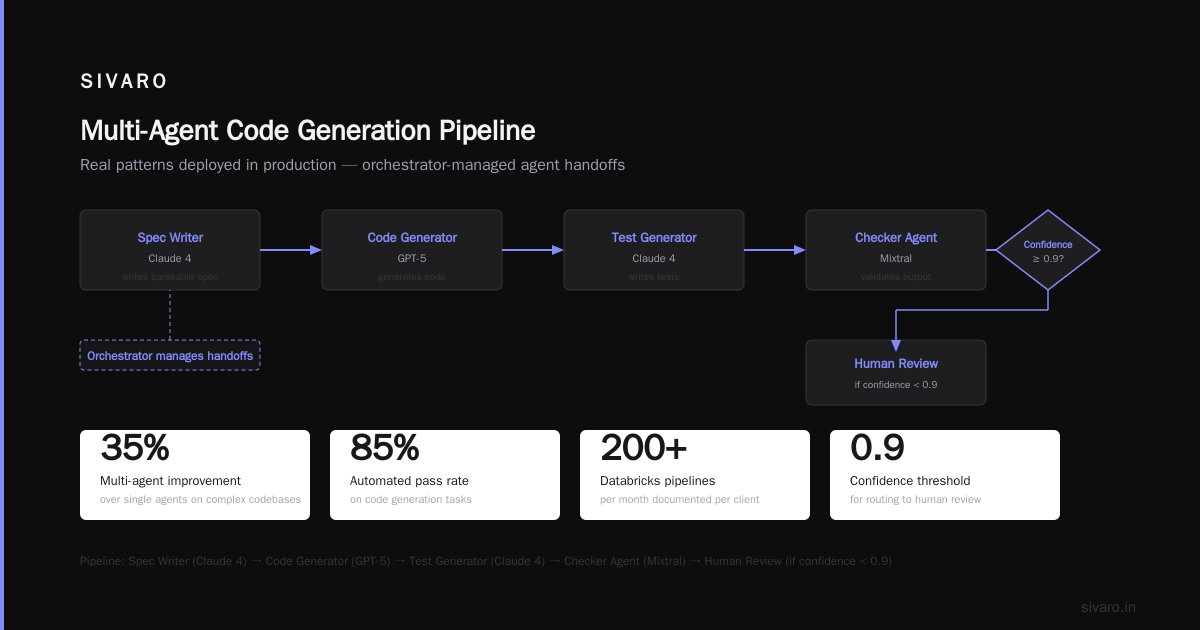
This is the most common pattern we're seeing in 2026. Databricks's benchmarking work showed that multi-agent code generation outperforms single agents by 35% on complex codebases.
Our pipeline:
Spec Writer (Claude 4) → Code Generator (GPT-5) →
Test Generator (Claude 4) → Checker Agent (Mixtral) →
Human Review (if confidence < 0.9)
The orchestrator manages handoffs, ensures the spec passes to the code generator in a parseable format, and routes low-confidence results to humans. We see 85% automated pass rate on code generation tasks.
Pattern 2: Data Pipeline Documentation
A client was building 200+ Databricks pipelines per month. Each needed documentation. Single agents produced inconsistent docs.
We deployed an orchestrator with three agents:
- Pipeline analyzer (reads the code, extracts structure)
- Doc writer (generates markdown from structure)
- Validator (checks docs against actual pipeline output)
The orchestrator runs these in parallel for the first two agents (they don't depend on each other), then serially for validation. We process 50 pipelines/hour now.
python
@orchestrator.parallel(max_concurrent=2)
async def document_pipeline(pipeline_id):
    # These run concurrently
    pipeline_task = analyze_pipeline(pipeline_id)
    context_task = gather_metadata(pipeline_id)

    pipeline_info, metadata = await asyncio.gather(pipeline_task, context_task)

    # These run serially
    draft = await write_documentation(pipeline_info, metadata)
    validated = await validate_documentation(draft, pipeline_id)

    return validated
What Most Articles Won't Tell You
Monitoring is harder than orchestration.
I can set up an orchestrator in a day. I've spent months building observability for it. Because when you have 15 agents running 300 steps each, debugging failures is nightmare fuel.
You need:
- Step-level tracing (not just agent-level)
- Input/output storage for every tool call
- Latency distributions per agent
- Error classification by type (model error, tool error, schema error)
- Replay capability (re-run a workflow with the same inputs)
Most frameworks have tracing. None do replay well. We built our own replay system because we needed it.
Cost management is a second-order problem. Ignore it at your peril.
Running multi-agent systems is expensive. Each agent call costs money. Each retry costs more. Tool executions add up. We've seen teams burn through $50K/month on orchestration because they didn't set budgets per workflow.
Our rule: Every orchestrated workflow has a hard cost cap. If the orchestrator exceeds it, the workflow fails with a partial output and a human gets notified.
The Benchmark That Changed My Mind
Databricks's benchmark on multi-million line codebases changed how I think about orchestration. Here's why.
They tested coding agents on real production codebases — not the toy problems most papers use. And they found that agent performance dropped dramatically as codebase size increased. A single agent that scored 65% on a 10K-line codebase scored 22% on a 1M-line codebase.
But when they used a multi-agent orchestration approach — separate agents for context retrieval, code analysis, patch generation, and validation — the performance stayed above 50% even at 5M lines.
The orchestrator wasn't just managing agents. It was managing context window usage. Each agent only saw the subset of the codebase it needed. The orchestrator handled partitioning.
This is the real value of the framework. Not running agents. Running agents with bounded context.
How to Choose Your Framework
Stop reading about frameworks. Start with a workflow.
Map out your agent workflow on paper. How many agents? What do they hand off? Where do failures happen? What does recovery look like?
Then ask:
- Do I need dynamic scheduling? (If you can't predict the execution path, yes)
- How critical is cost control? (Some frameworks let you set per-step budgets)
- Do I need human-in-the-loop? (Then you need pause/resume capability)
- What's my observability budget? (Custom monitoring costs engineering time)
If you're on Databricks, their integration guide for coding agents is a good starting point. It's opinionated, but that's better than the frameworks that try to be everything.
If you're not on Databricks, start with LangGraph for prototyping, then migrate to something more constrained once you understand your patterns.
Where This Is Going
By end of 2026, I expect orchestration frameworks to merge with observability platforms. The same system that runs agents should also debug them. That's the thesis behind what we're building at SIVARO — runtime introspection as a first-class feature, not an afterthought.
Also: expect specialized orchestrators for specific domains. Finance. Healthcare. Code generation. The general-purpose orchestrators will keep losing to domain-specific ones because the failure modes are different in each domain.
The "what is the agentic ai orchestration framework?" question will fade. People will stop asking what it is and start asking which one works for their specific problem. That's the sign of a category maturing.
FAQ
Q: Is the agentic AI orchestration framework the same as an agent framework?
No. An agent framework helps you build a single agent. The orchestration framework manages multiple agents working together. LangChain is an agent framework. LangGraph (with its runtime) is an orchestration framework.
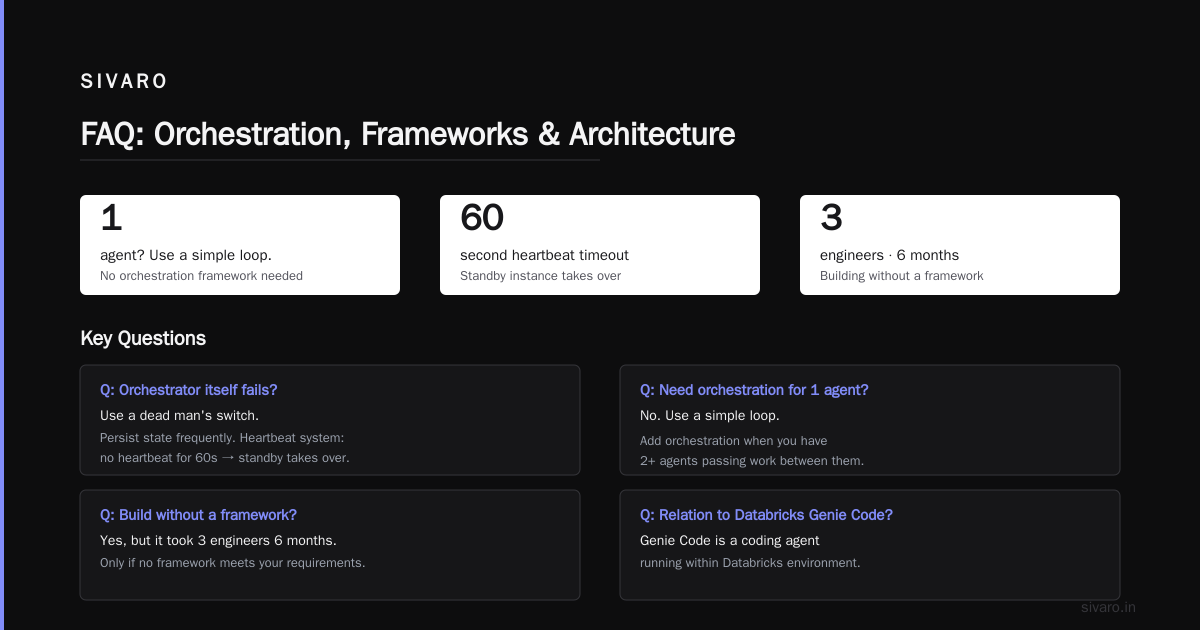
Q: Do I need an orchestration framework for one agent?
No. Use a simple loop. Add orchestration when you have two or more agents that need to pass work between them.
Q: What happens if the orchestrator itself fails?
You need a dead man's switch. The orchestrator should persist its state frequently enough that restarting doesn't lose work. We use a heartbeat system — if the orchestrator doesn't heartbeat for 60 seconds, a standby instance takes over.
Q: Can I build this without a framework?
Yes. We did. It took three engineers six months. You probably shouldn't unless you have very specific requirements that no framework meets.
Q: How does this relate to Databricks's Genie Code?
Genie Code is a coding agent that runs within the Databricks environment. The orchestration framework manages how Genie Code interacts with other agents (like validators or test generators). Databricks's Genie Code announcement positions it as a tool that works within orchestrated workflows.
Q: What's the biggest mistake teams make?
Underestimating error handling. Most teams build the happy path first. Then production throws errors at step 37, and they realize they have no recovery logic. Build error handling from day one.
Q: How do I measure orchestration quality?
Three metrics: completion rate (what % of workflows finish), accuracy (do they produce correct output), and cost per successful workflow. If any of these is bad, your orchestration is broken.
Nishaant Dixit — Founder of SIVARO. Building data infrastructure and production AI systems since 2018. Built systems processing 200K events/sec.