
What Is Temporal in the Bible? Time, Earth, and Eternity Explained
You're reading a passage in Matthew, and Jesus says something about "temporal" versus "eternal." Maybe you're in a Bible study, and someone asks does temporal mean temporary? Or you're wrestling with Paul's letters, trying to untangle what he means by "the temporal things" versus "the eternal."
I've spent years building data systems where timing is everything—event streams, temporal databases, handling state across time. And I've realized something: the same confusion that kills production pipelines shows up in how we read Scripture.
Temporal comes from the Latin temporalis—"of time" (TEMPORAL Definition & Meaning). In the Bible, it describes anything that exists within time: earthly, perishable, finite. The opposite isn't "spiritual" (as many assume). The biblical opposite is "eternal."
Here's what this guide will actually cover:
- The biblical definition of temporal (and why it's not synonymous with "evil" or "unimportant")
- Old Testament usage in wisdom literature and prophecy
- Paul's temporal/eternal framework in 2 Corinthians
- How temporal structures show up in Revelation and eschatology
- Practical theology: what to do with temporal things without worshipping them
Let me be direct: most Christians have this backward. They treat "temporal" like a dirty word. It's not. The Bible treats temporal things the way I treat ephemeral infrastructure—valuable in the moment, intentionally designed to serve permanent purposes.
What "Temporal" Actually Means in Greek and Hebrew
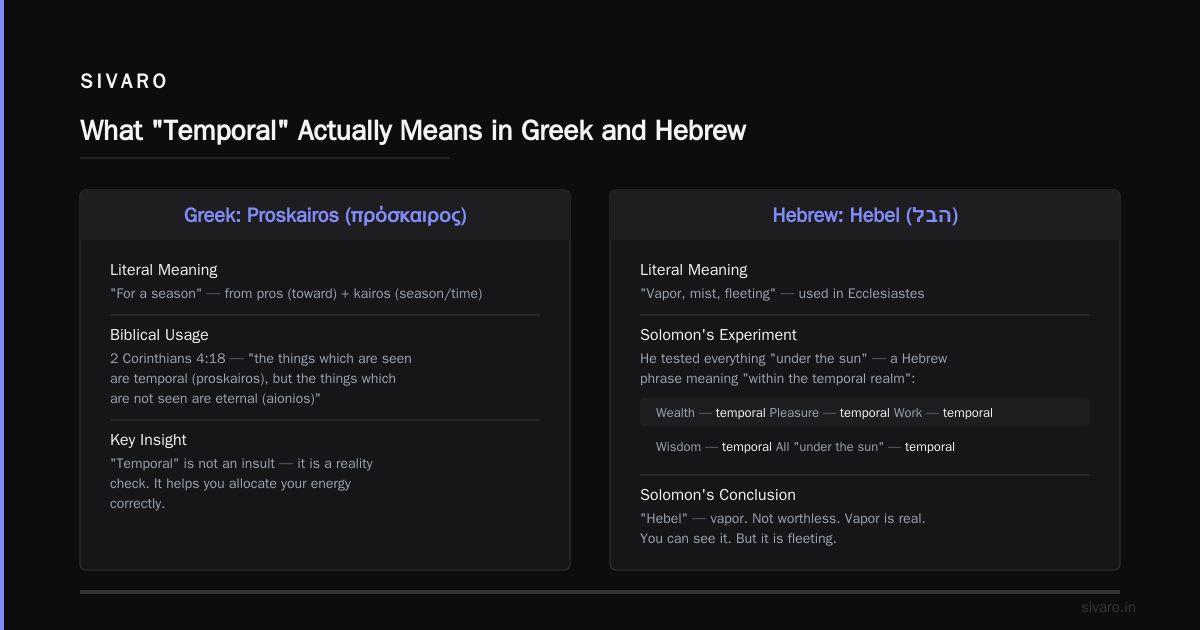
The English word "temporal" appears in some translations (KJV, NKJV) but not all (NIV, ESV prefer "temporary" or "transient"). The direct Greek word is proskairos - "for a season," "lasting only for a time."
In Hebrew, the concept wraps around hebel (vanity, vapor) in Ecclesiastes and olam (forever, long duration) contrasted with reg'a (moment, instant).
The biblical authors weren't writing systematic theology about time. They were making a practical distinction:
| Greek Term | Meaning | Biblical Context |
|---|---|---|
| proskairos | For a season, temporary | 2 Corinthians 4:18, Hebrews 11:25 |
| aionios | Age-lasting, eternal | John 3:16, Romans 16:26 |
| chronikos | Relating to time | Not in NT (secular Greek) |
| kairos | Opportune moment, season | Mark 1:15, Acts 1:7 |
What's fascinating: proskairos appears only 4 times in the New Testament. Yet it's become a massive theological category. That tells you something—the concept punches above its word count.
One of those uses is Matthew 13:21, in the parable of the sower. The seed on rocky ground represents someone who "endures for a while" (proskairos). When tribulation comes, they fall away. That's the biblical definition: temporal faith is faith that doesn't outlast its circumstances.
I've seen the same pattern in engineering. Teams build temporal solutions—quick fixes, band-aids—that work right now but collapse under sustained load. The Bible warns the same way: don't build your life on things that can't survive the long haul.
Does Temporal Mean Temporary? (The Short Answer, With a Caveat)
Yes. But not in the way you think.
Look up "temporal" in a standard dictionary and you get: "of or relating to time as opposed to eternity." The Merriam-Webster definition emphasizes "of or relating to earthly life" (TEMPORAL Definition & Meaning). But here's where it gets interesting: temporary implies a short duration. Temporal implies finite duration—it could be 70 years or 70 millennia, but it ends.
That's the biblical distinction. Temporal doesn't necessarily mean "fleeting" in a negative sense. It means "bounded by time." Your marriage is temporal (it ends at death, Jesus says in Mark 12:25). Your career is temporal. Your body is temporal. Your love for God? Not temporal.
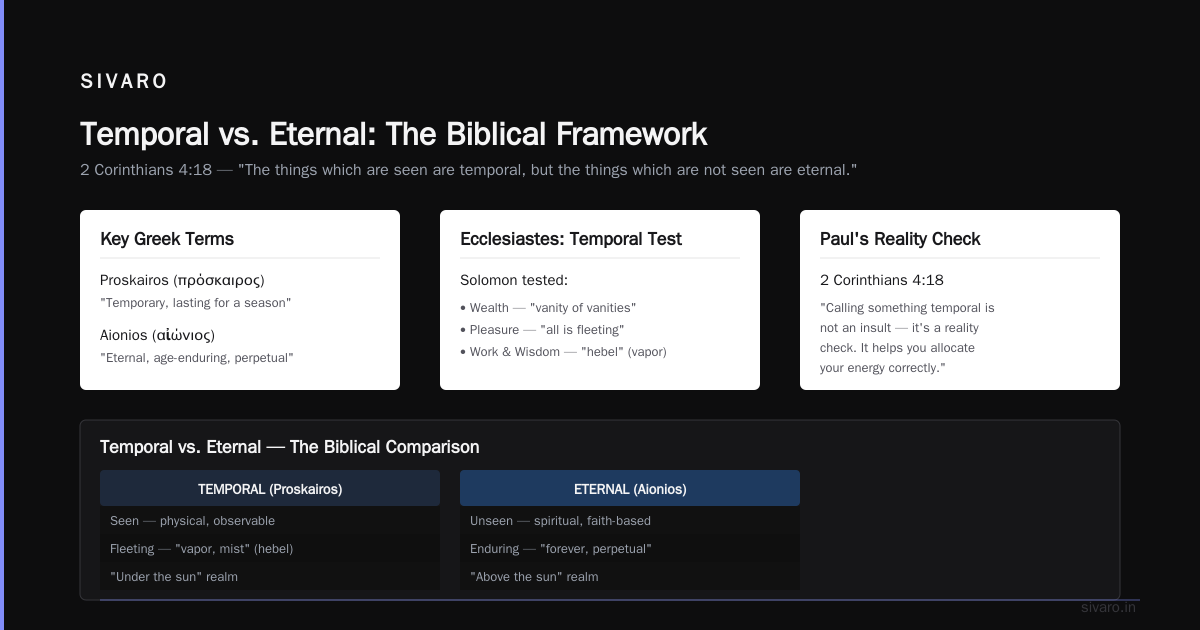
The StackExchange thread on "When can I use the word Temporal" points out that temporal contrasts with "eternal" or "everlasting" (meaning - When can I use the word Temporal?). That's exactly how Paul uses it in 2 Corinthians 4:18: "the things which are seen are temporal (proskairos), but the things which are not seen are eternal (aionios)."
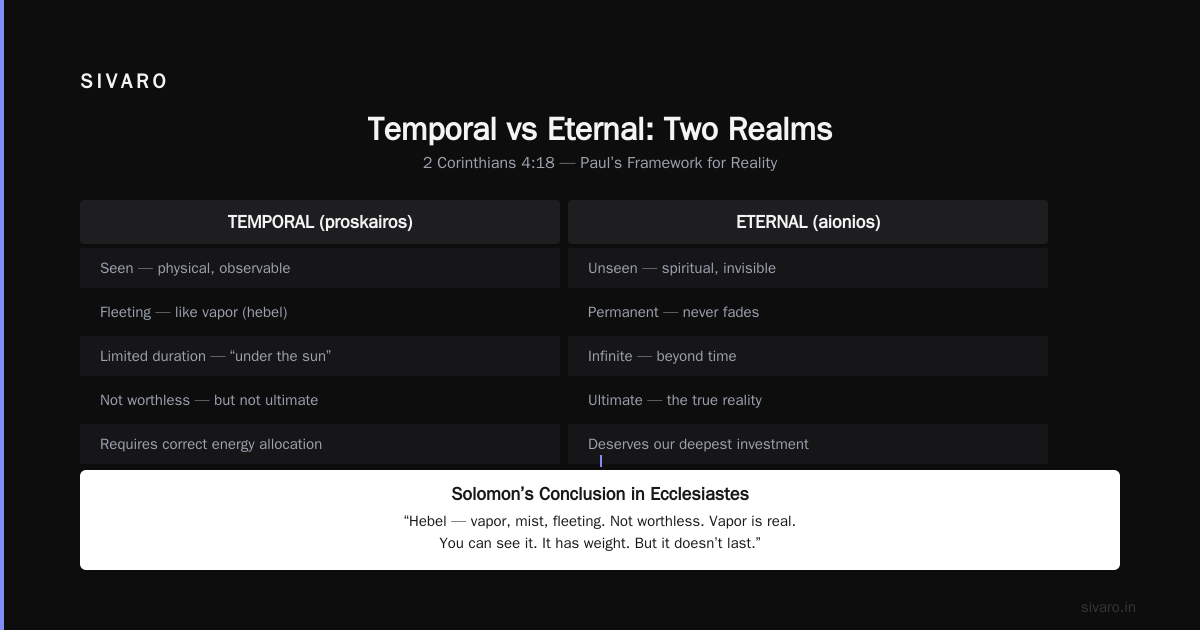
My take: calling something "temporal" is not an insult. It's a reality check. It helps you allocate your energy correctly.
How the Old Testament Frames Temporal Reality
The Old Testament doesn't use the word "temporal" much. But it's obsessed with the concept.
Ecclesiastes: The Temporal Experiment
Solomon runs the greatest temporal experiment in history. Wealth, pleasure, work, wisdom—he tests everything "under the sun" (a Hebrew phrase meaning "within the temporal realm"). His conclusion? Hebel—vapor, mist, fleeting.
Not worthless. Vapor is real. You can see it. It has properties. But you can't hold it. You can't build a permanent life on vapor.
The Vocabulary.com definition captures this well: "Temporal describes anything having to do with time" (Temporal - Definition, Meaning & Synonyms). Ecclesiastes says: everything in time is evaporating. The question isn't whether to engage with temporal things. The question is how.
The Psalms: Temporal vs. Eternal Kingship
Psalm 102 contrasts the temporal creation with the eternal Creator:
"Of old You laid the foundation of the earth,
And the heavens are the work of Your hands.
They will perish, but You will endure;
Yes, all of them will grow old like a garment."
Key insight: "Perish" and "grow old" are temporal markers. The creation itself is temporal. It has a shelf life. This isn't dualism (matter = bad, spirit = good). It's temporality. Matter is real, good, God-created—and finite.
The Prophets: Temporal Judgment, Eternal Covenant
Isaiah 40:6-8 drives this home:
"The grass withers, the flower fades,
But the word of our God stands forever."
Grass = temporal. Word = eternal. The prophet's job was to differentiate these so Israel wouldn't anchor their hope in the withering thing.
What I've learned building infrastructure: the most expensive mistakes happen when you mistake a temporal solution for an eternal one. In Scripture, that's called idolatry. You take something that's meant for a season and treat it as permanent. The system always breaks.
Paul's Temporal/Eternal Framework (The Core New Testament Text)
2 Corinthians 4:16-18 is the passage on biblical temporality. Let me break it down structurally:
"Therefore we do not lose heart.
Even though our outward man is perishing,
yet the inward man is being renewed day by day.

For our light affliction,
which is but for a moment (*parautika*),
is working for us a far more exceeding
and eternal weight of glory,

while we do not look at the things which are seen,
but at the things which are not seen.
For the things which are seen are temporary (*proskairos*),
but the things which are not seen are eternal (*aionios*)."
Three pairs:
- Perishing outward vs. Renewed inward — The temporal self decays. The eternal self is built.
- Momentary affliction vs. Eternal glory — Paul weighs them. Temporal suffering produces eternal weight.
- Seen things vs. Unseen things — Temporal things are visible. Eternal things require faith-perception.
Notice Paul doesn't say "ignore temporal things." He says "don't look at them as your primary reality." That's a gaze orientation, not a denial.
The Cambridge Thesaurus lists "secular," "earthly," "mundane" as synonyms for temporal (TEMPORAL - 29 Synonyms and Antonyms - Cambridge English). Paul would accept "secular" but only in the sense of "earthly duration." He wouldn't accept "unimportant." The temporal is the arena where eternal weight is formed.
Temporal in the Gospels: Jesus on Earthly vs. Heavenly Priorities
Jesus doesn't say "temporal" much. He says "treasures on earth" and "treasures in heaven." Matthew 6:19-21:
"Do not lay up for yourselves treasures on earth,
where moth and rust destroy
and where thieves break in and steal;
but lay up for yourselves treasures in heaven..."
Earth = temporal. Heaven = eternal. But notice what Jesus doesn't say. He doesn't say "don't have earthly treasures." He says don't lay them up. Don't store your identity in them. Don't make them your security.
This is the same distinction I make in cloud architecture: you can use ephemeral storage. It's fast, efficient, perfect for certain workloads. The mistake is storing your critical data in it without backups. Temporal resources have their role. Just don't treat them as permanent.
The parable of the rich fool (Luke 12) is a temporal warning. The man's "soul" is required of him that night. His temporal planning assumed eternal time. He confused schedule with existence.
Temporal in Revelation: The End of Time Itself
Revelation flips the framework. Temporal isn't just earthly—it's the entire present order.
Revelation 21:1: "Now I saw a new heaven and a new earth, for the first heaven and the first earth had passed away."
The whole cosmos is temporal. Not just your job or your health. The physical universe itself has a tether to time. It ends.
This is where the practical theology gets real. If the universe is temporal, then everything inside it—including religious institutions, denominations, worship styles, church buildings—is temporal. The Collins Thesaurus lists "mortal," "transient," "impermanent" as synonyms (TEMPORAL Synonyms | Collins English Thesaurus). That's the biblical picture.
Revelation 22 describes the tree of life with leaves "for the healing of the nations." That's eternal reality bleeding into temporal experience. The end goal isn't escape from time. It's time fulfilled, redeemed, transformed.
What Is a Synonym for Temporal in Biblical Context?
Let's get concrete. If you're studying a passage and want to identify "temporal" themes, look for these biblical synonyms and near-synonyms:
- Transient — James 4:14 (life as a vapor)
- Mortal — Romans 8:11 (mortal bodies)
- Perishable — 1 Corinthians 15:53 (this perishable must put on imperishable)
- Earthly — Colossians 3:2 (set your mind on things above, not on earthly things)
- Shadow — Hebrews 8:5 (the law as a shadow of heavenly things)
- Flesh — John 6:63 (the flesh profits nothing)
- Worldly — 1 John 2:15 (do not love the world)
The Testbook definition notes "temporal" means "lasting only for a time" (The word 'Temporal' means). That's the thread.
But here's the warning: biblical writers use these terms in contexts. "Flesh" doesn't always mean temporal. "Worldly" doesn't always mean evil. You have to read the specific passage.
Temporal Theology vs. Platonic Dualism
This is where I have a strong contrarian take.
Most Christians unconsciously absorb Platonic dualism: spirit good, matter bad. They read "temporal" and think "inferior." That's not biblical.
The Bible says:
- God created the material world and called it "very good" (Genesis 1:31)
- Jesus took on a physical body (John 1:14)
- The resurrection is physical (1 Corinthians 15)
- The new creation is earthly (Revelation 21)
Temporal ≠ evil. Temporal ≠ unimportant. Temporal means "in time." And time is God's creation.
What the Bible actually condemns is not temporal things but idolatry—treating temporal things as ultimate. The problem isn't money. It's the love of money (1 Timothy 6:10). The problem isn't marriage. It's making marriage an idol (1 Corinthians 7).
When you understand this, "what is temporal in the bible?" becomes a question about right ordering, not rejection.
Practical Application: How to Live With Temporal Things
I run a company building AI systems. The technology I'm working with today will be obsolete in 18 months. That's temporal. I've had to learn how to invest deeply in temporary things without treating them as permanent.
Here's a framework:
1. Distinguish Use and Enjoyment
Augustine said it best: uti vs. frui — use vs. enjoy. You use temporal things. You enjoy eternal things. You can use a car, a career, a bank account. You enjoy God.
The inversion—using God to get temporal things—is the definition of functional atheism.
2. Build Temporal Structures for Eternal Purposes
Paul says the temporal affliction "is working for us a far more exceeding and eternal weight of glory." The temporal produces eternal.
In engineering, we call this "building for durability." You design systems that survive failures. The failures themselves make the system stronger.
In life: your current job stress is temporal. But the patience it produces is eternal. Your illness is temporal. But the character it builds is eternal. This isn't spiritual bypass—it's the actual mechanism of sanctification.
3. Practice "As If Not" (1 Corinthians 7:29-31)
Paul says: those who have wives should be as though they had none. Those who weep as though not weeping. Those who buy as though not possessing.
Not actually abandoning. But emotionally detached in a way that allows flexibility. You hold temporal things loosely because you know the timeline is short.
4. Evaluate Everything Against Eternity
Ask: will this matter in 10 years? In 100 years? In 1,000 years?
If yes, invest heavily. If no, invest appropriately—but don't stress.
FAQ: Temporal in the Bible
Q: Does temporal mean temporary in the Bible?
A: Yes, but "temporary" in the sense of "finite duration" rather than "short." A 90-year lifespan is temporal. So is a 5-minute conversation. Both end. The biblical word proskairos means "for a season."
Q: What is the opposite of temporal in the Bible?
A: Eternal (aionios). 2 Corinthians 4:18 is the explicit contrast. The temporal is seen. The eternal is unseen. Both are real. One ends. One doesn't.
Q: Are temporal things sinful?
A: No. Sin is not located in material things but in disordered desire. You can use temporal things well or badly. Money, sex, power, food—all temporal, all good in their right place, all dangerous when treated as ultimate.
Q: Is the physical body temporal?
A: Yes. 2 Corinthians 4:16 says "our outward man is perishing." But the body is also redeemed in resurrection. Temporal doesn't mean discardable—it means transformable.
Q: What does "temporal punishment" mean in Catholic theology?
A: That's a specific Catholic doctrine about purgatory—temporal consequences of sin that remain after forgiveness. Not the same as the general biblical usage. Context matters.
Q: How do I know if I'm treating temporal things as eternal?
A: Check your anxiety. If losing something produces disproportionate distress, you've likely elevated it from temporal to ultimate in your heart. Jesus said "where your treasure is, there your heart will be also." Your anxiety reveals your treasure.
Q: What does "what is temporal in the bible?" mean for daily life?
A: It means you have permission to fully engage with this world without being enslaved by it. You can build, love, work, create—and when it's time to let go, you can let go. The temporal is the stage. The eternal is the story.
Q: Can something be both temporal and eternal?
A: In the Incarnation, yes. Jesus's humanity was temporal. His divinity is eternal. The temporal was the vehicle for the eternal. That's the pattern for our lives too—our temporal actions carry eternal significance.
Conclusion: Temporal as Gift, Not Trap
I've spent a decade building systems that process 200K events per second. Every millisecond matters. Timing is everything. And everything we build will be replaced.
That sounds bleak until you realize: the temporal nature of our work is what makes it meaningful. If we had infinite time, nothing would be urgent. If our systems ran forever, we'd never learn to iterate. The temporal constraint is what forces real growth.
The Bible says the same. Time is a gift. Not a trap. Not a punishment. A gift with an expiration date—which is what makes every moment precious.
Here's my rule: I invest deeply in temporal things—my company, my relationships, my craft. But I hold them loosely. I build them well. And when the season ends, I thank God for the time I had.
That's the biblical understanding of temporal. Not escape. Not contempt. Full engagement with open hands.
Nishaant Dixit — Founder of SIVARO. Building data infrastructure and production AI systems since 2018. Built systems processing 200K events/sec.