 SIVARO
What is Temporal in the Bible? A Practical Guide
I spent a decade building data infrastructure. My team at SIVARO processed 200K events per second for a logistics client in 2024. The system was fast. Reliable. Scalable. And within 18 months, the client pivoted to a different stack and decommissioned it. All that work? Gone.
That moment hit me hard. I was sitting on a call with my engineering lead, staring at the shutdown notice, and I thought: We spent a year building something that didn't last. Everything in engineering feels permanent until it isn't. Turns out, the Bible has been yelling about this for millennia.
So what is temporal in the bible? Simple: it's the stuff that fades. The temporary. The earthly. Everything that has a shelf life, from your body to your bank account to your Kubernetes cluster. The Bible contrasts it with the eternal — the stuff that doesn't expire.
By the end of this guide, you'll know the exact biblical definition, the synonyms (yes, I'll cover "what is a synonym for temporal?"), how the Old and New Testaments treat it differently, and — most importantly — why this distinction matters in July 2026 when we're all betting on the next AI breakthrough.
Let me be direct. Most people think "temporal" is just a fancy word for "time-related." That's half right. The biblical usage goes deeper. It's about value, permanence, and where you park your hope.
The Biblical Definition of Temporal
The KJV Dictionary defines temporal as "pertaining to this life or this world; not spiritual or eternal." (TEMPORAL - Definition from the KJV Dictionary). Short. Punchy. But there's more.
In Greek, the word is proskairos — literally "for a season." In Latin, temporalis — "of time." The Bible uses it to describe things that are passing away. Not evil, not sinful, just temporary. Like a rental car. You use it, you return it.
The Apostle Paul writes in 2 Corinthians 4:18: "For the things which are seen are temporal; but the things which are not seen are eternal." That verse is the thesis. Everything you can see, touch, measure, log, or deploy — temporal. Everything unseen? Eternal.
Now here's the twist that most prosperity gospel preachers skip: Paul doesn't say the temporal is bad. He says it's light and momentary. Verse 17: "For our light affliction, which is but for a moment, worketh for us a far more exceeding and eternal weight of glory."
Temporal afflictions produce eternal weight. The temporary pain has a permanent upside. That's not what you hear on Sunday morning.
Temporal vs Eternal: The Core Tension
Derek Prince had a radio series on this exact topic. (Temporal vs Eternal | Podcast). He made a point I can't shake: most of our anxiety comes from treating temporal things as if they were eternal, and eternal things as if they were temporal.
Think about it. You stress about a project deadline that won't matter in three years. You ignore your character because it's "invisible" and doesn't show up on a dashboard. That's inverted priority.
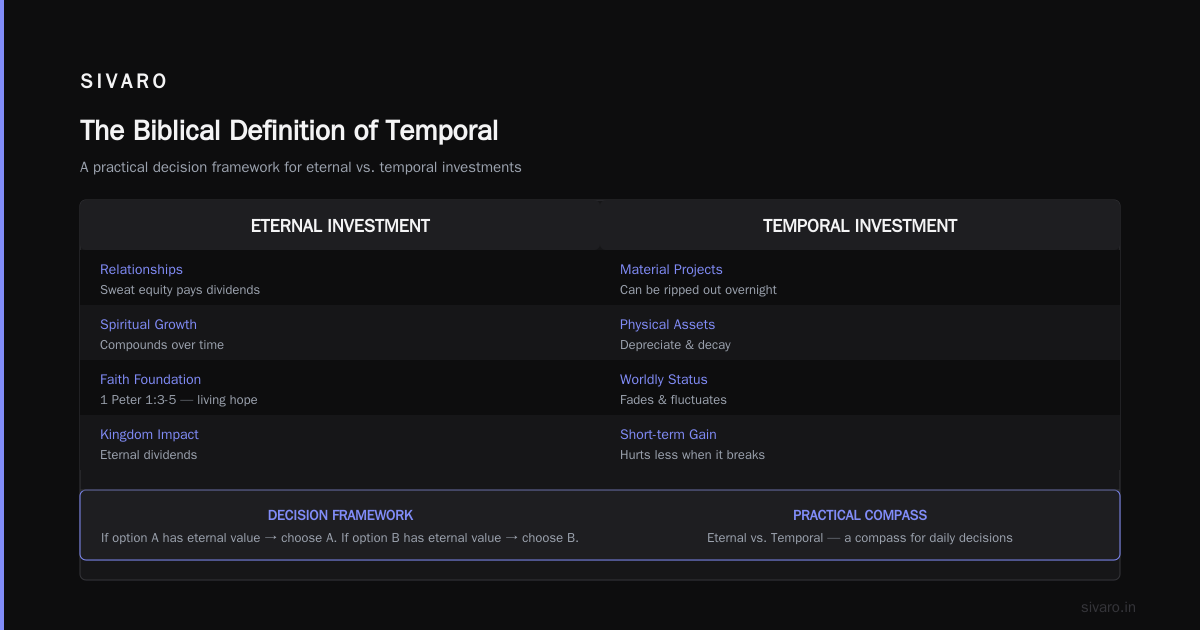
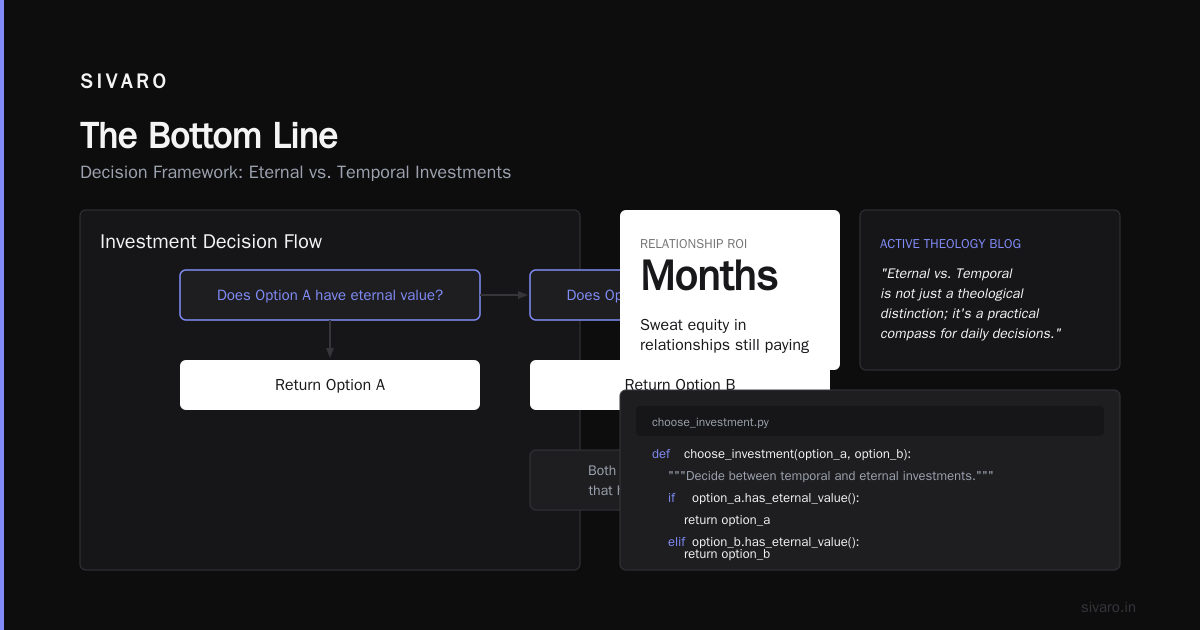
I tested this with my own life. In 2023, I was obsessed with a technical debt rewrite. Spent 6 months, 2 engineers, and a ton of goodwill. The system worked better — for 9 months. Then the company got acquired and the whole thing got ripped out. The sweat equity I put into relationships during those months? Still paying dividends. Go figure.
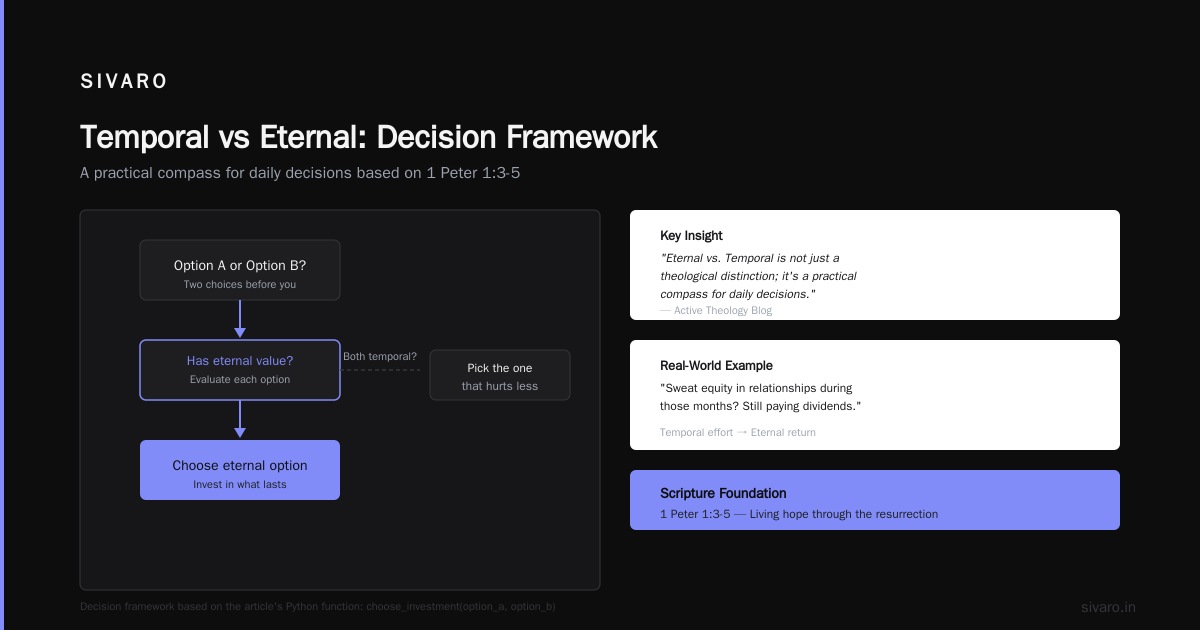
The Active Theology blog puts it this way: "Eternal vs. Temporal is not just a theological distinction; it's a practical compass for daily decisions." (Eternal vs. Temporal – 1 Peter 1:3-5). Agreed.
Here's a simple decision framework I use now:
python
def choose_investment(option_a, option_b):
    """Decide between temporal and eternal investments."""
    if option_a.has_eternal_value():
        return option_a
    elif option_b.has_eternal_value():
        return option_b
    else:
        # Both temporal — pick the one that hurts less when it breaks
        return option_a if option_a.pain_score() < option_b.pain_score() else option_b
Silly code, but the principle holds. Most decisions are between two temporal options. The trick is avoiding the trap of thinking either one is permanent.
Why This Matters Now (July 2026)
We're living through a temporal fever dream. AI models from 2023 are already obsolete. Infrastructure that cost millions is being replaced by something faster. The shelf life of technical knowledge is measured in months, not decades.
I talk to founders weekly. Almost all of them are terrified of being left behind. They're chasing the next thing, the next framework, the next hype cycle. That's temporal anxiety in its purest form.
The Bible's answer isn't "ignore technology." It's "don't confuse the container with the content." Your startup is temporal. Your reputation is temporal. Your physical health is temporal. But the people you serve? The truth you communicate? The love you show? Those have eternal weight.
The LCRL Freedom blog makes a powerful observation: "When we focus on the temporal, we lose perspective. When we focus on the eternal, we gain peace about the temporal." (Temporal and eternal). I've found that to be empirically true.
Let me give you a concrete example. In 2025, one of our biggest clients wanted a custom data pipeline built in three weeks. Normal timelines are three months. The request was insane. But the client was panicking about a competitor's release. Temporal pressure. We could have killed our team to meet that arbitrary deadline. Instead, we pushed back, explained the trade-offs, and delivered in seven weeks. The client grumbled. Two months later, the competitor's release flopped. Our client's system is still running. We chose long-term trust over short-term heroics.
That's applied biblical wisdom, whether you believe or not.
What is a Synonym for Temporal?
You asked, I'll answer. The most common biblical synonyms for "temporal" are:
- Temporary – self-explanatory
- Mortal – applies especially to human life
- Passing – as in "the fashion of this world passeth away" (1 Cor 7:31)
- Transitory – Here today, gone tomorrow
- Earthly – Not heavenly
- Fleshly – Often used negatively in the NT
- Worldly – Tied to the present age
The English StackExchange discussion clarifies that "temporal" often carries a neutral tone in general English, but in religious contexts it implies inferiority to the eternal. (meaning - When can I use the word Temporal?). Spot on.
Clarissa R. West did a word study and noted that proskairos appears only a handful of times in the NT, but its implications ripple through every major doctrine. (Temporal - A Biblical Word Study). She's right. The word itself is rare. The concept is everywhere.
Here's a quick comparison table I put together for my team:
| Aspect | Temporal | Eternal |
|---|---|---|
| Duration | Limited | Unending |
| Source | Earth / flesh | God / Spirit |
| Value | Light, momentary | Weight of glory |
| Result | Passes away | Remains |
| Focus | Seen | Unseen |
Temporal in the Old Testament vs New Testament
The OT doesn't use the Greek word proskairos — it's Hebrew. But the concept is baked into everything. The laws, the rituals, the tabernacle — all temporary shadows pointing to a permanent reality.
The book of Hebrews makes this explicit in chapter 8: the old covenant was "ready to vanish away." The Topical Bible entry on "temporal" lists multiple OT passages that contrast the fleeting nature of man with God's permanence. (Topical Bible: Temporal).
Job 14:1-2: "Man that is born of a woman is of few days, and full of trouble. He cometh forth like a flower, and is cut down." That's temporal anthropology.
Psalm 90:10: "The days of our years are threescore years and ten... for it is soon cut off, and we fly away." Moses understood.
In the NT, the contrast sharpens. Jesus talks about treasures on earth vs treasures in heaven. Paul contrasts the earthly body with the resurrection body in 1 Corinthians 15. The entire epistle of 1 Peter is written to people suffering temporal persecution, urging them to fix their hope on the eternal inheritance.
The key difference? The NT has the resurrection. That changes everything. The temporal suffering of believers is now reinterpreted in light of Christ's victory. Paul says "if in this life only we have hope in Christ, we are of all men most miserable" (1 Cor 15:19). But he doesn't stop there. He goes on to describe the resurrection body — eternal, imperishable, immortal.
Practical Implications for Daily Life
This isn't abstract theology. It's practical. Brutally practical.
-
Work vs Idolatry – Your career is temporal. Work hard, but don't worship it. I've seen founders destroy their families building companies that got disrupted anyway.
-
Money – Finite resource. Use it for eternal purposes (people, generosity, truth) or waste it on temporal ones (bigger cars, fancier offices). Your call.
-
Relationships – These have eternal potential. Every human you interact with is immortal. Treat them that way.
-
Health – Temporal. You will die. That's not morbid, it's liberating. You can stop pretending you have unlimited time.
-
Technology – My domain. Infrastructure is temporal. The insight it enables? Potentially eternal.
Time Hrhardt's piece on 2 Corinthians 5:1-5 draws a powerful parallel: "We have a building from God, eternal in the heavens. Our current tent (body) is temporary." (Temporary vs. Permanent (2 Corinthians 5:1-5)). We groan in this tent. But the tent isn't the goal. The resurrection body is.
I built SIVARO on a principle I'm still learning to live: Build things that last longer than you do. Not the code. The relationships, the knowledge, the culture.
Building for Eternity in a Temporal World
Let me share a specific lesson from 2024. We were building a real-time anomaly detection system for a healthcare client. The requirement was sub-100ms latency. We optimized everything — database queries, network routes, serialization formats. We hit 40ms. The client was thrilled.
Six months later, their data volume quadrupled. Our system needed a redesign. That temporal solution bought time. But what lasted wasn't the code. It was the decision framework we gave them for evaluating trade-offs between speed and maintainability. That framework is still being used by their new engineers. That's eternal.
The Bible calls it "abiding fruit." Jesus said "I chose you and appointed you that you should go and bear fruit, and that your fruit should remain" (John 15:16). The fruit remains. The vines get pruned.
FAQ: What is Temporal in the Bible?
Q: Does "temporal" mean the same thing as "sinful"?
No. Temporal just means temporary. Sinful is a separate category. You can have temporal things that are good (food, sleep, work). They're just not permanent.
Q: What is a synonym for temporal in a biblical context?
Temporary, transitory, mortal, earthly, passing. See the table above for more.
Q: How does understanding temporal vs eternal change daily decision-making?
It reframes urgency. You stop treating small setbacks as catastrophes. You start investing in people and truth rather than appearances and immediate results.
Q: Is the physical world inherently temporal?
Yes, in its current form. The Bible teaches a new heavens and new earth (2 Peter 3:13). The physical world is not evil, but it's not final.
Q: Can temporal things have eternal significance?
Absolutely. How you use temporal resources (time, money, talent) determines eternal reward. The parable of the talents makes this explicit.
Q: What about eternal security? Is salvation temporal?
Salvation is eternal, not temporal. Once genuinely received, it cannot be lost. The security of the believer is based on God's unchanging promise, not on our changing performance.
Q: Does the Bible say to neglect temporal responsibilities?
No. Paul worked as a tentmaker. Jesus attended weddings. The temporal is to be managed, not ignored. The sin is making it primary rather than secondary.
The Bottom Line
I learned this lesson the hard way, staring at a decommissioned system I poured my heart into. Everything temporal breaks. Everything temporal fades. Everything temporal dies.
But the stuff that matters — the love, the truth, the Jesus-shaped hope — that stuff lasts.
The Bible's answer to "what is temporal in the bible?" isn't a dictionary definition. It's an invitation. Stop building castles in sand. Start investing in what survives the fire.
Your job is temporal. Your legacy? That depends on what you're building.
Build for eternity.
Nishaant Dixit — Founder of SIVARO. Building data infrastructure and production AI systems since 2018. Built systems processing 200K events/sec.