
What Is Orchestration in Agentic AI? A Practitioner's Guide
I spent six months in 2023 building an agent system that nearly collapsed under its own complexity. Not because the models were bad — they were fine. Not because the code was buggy — it was clean. The system fell apart because I didn't understand orchestration.
Here's the short version: Orchestration in agentic AI is the layer that controls how multiple AI agents coordinate, communicate, and execute tasks in sequence or parallel. It's the difference between a chaotic swarm of LLM calls and a structured system that delivers reliable outcomes.
If you're building agents today — whether for customer support, data pipelines, or autonomous research — you'll hit this wall. I hit it. Anthropic hit it. Every team building production AI hits it.
Let me walk you through what I learned the hard way.
The Orchestration Problem Nobody Talks About
Most people think "what is orchestration in agentic AI?" They picture a traffic cop directing model calls. That's wrong.
Real orchestration is harder. It's about:
- Managing state across multiple agents
- Handling failures when an agent hallucinates or hangs
- Deciding when to use a tool vs. when to ask another agent
- Preventing infinite loops (yes, agents do this)
- Keeping latency under control when you have 15 agents in a chain
I started building agents for a financial data pipeline at SIVARO in late 2023. We had three agents: one to parse unstructured filings, one to extract entities, one to validate outputs. Simple, right?
First week: agents started talking to each other recursively. The extractor agent kept asking the parser agent to re-parse its own outputs. We hit 47 seconds of latency for a task that should take 3 seconds.
That's when I realized: orchestration isn't a nice-to-have. It's the core infrastructure.
The Architecture of an Orchestrated Agent System
Let me show you what a real orchestration layer looks like. I'll strip out the marketing fluff and give you the practical structure.
The Core Components
- Router: Decides which agent gets which task
- State Manager: Tracks what each agent knows and has done
- Scheduler: Controls execution order (sync, async, parallel)
- Memory Store: Short-term and long-term context
- Error Handler: Retry logic, fallback agents, circuit breakers
- Observability Layer: Logs, traces, metrics
Here's a minimal orchestration pattern I use now:
python
from dataclasses import dataclass, field
from typing import Any, Callable
import asyncio

@dataclass
class AgentTask:
    agent_id: str
    input: dict
    dependencies: list[str] = field(default_factory=list)
    retry_count: int = 0
    max_retries: int = 3

class Orchestrator:
    def __init__(self):
        self.task_queue = asyncio.PriorityQueue()
        self.completed_tasks = {}
        self.failed_tasks = {}

    async def execute(self, task: AgentTask):
        for attempt in range(task.max_retries):
            try:
                result = await self.run_agent(task.agent_id, task.input)
                self.completed_tasks[task.agent_id] = result
                return result
            except TimeoutError:
                print(f"Agent {task.agent_id} timed out on attempt {attempt + 1}")
                continue
            except Exception as e:
                print(f"Agent {task.agent_id} failed: {str(e)}")
                continue
        self.failed_tasks[task.agent_id] = task
        raise RuntimeError(f"Agent {task.agent_id} failed after {task.max_retries} attempts")
This isn't production-grade — it's the skeleton. But it shows the core idea: orchestration is about control flow, not just calling APIs.
Why Most Orchestration Frameworks Are Overkill
Here's a contrarian take: most teams don't need LangChain or CrewAI. I've seen teams at startups (2024) adopt these frameworks and immediately hit complexity walls.
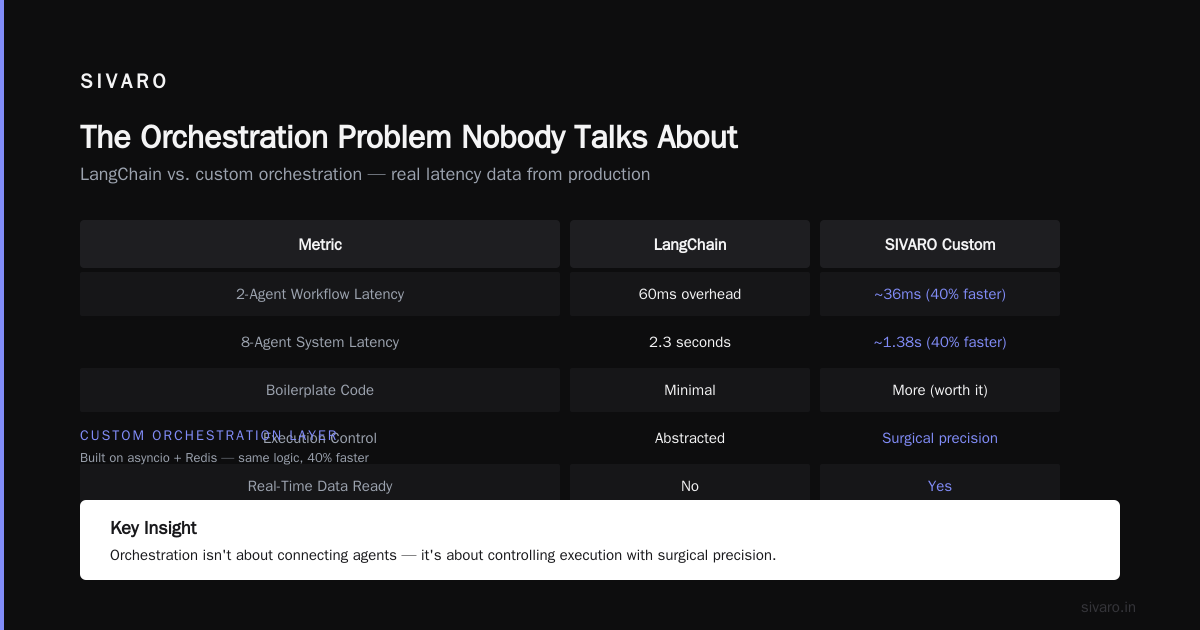
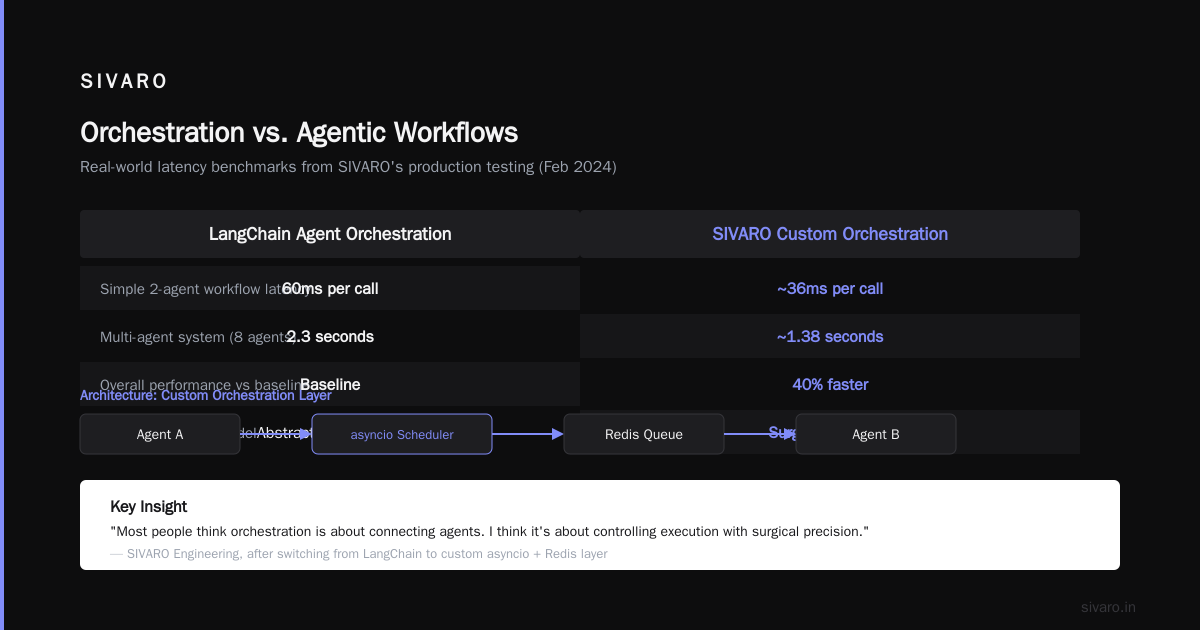
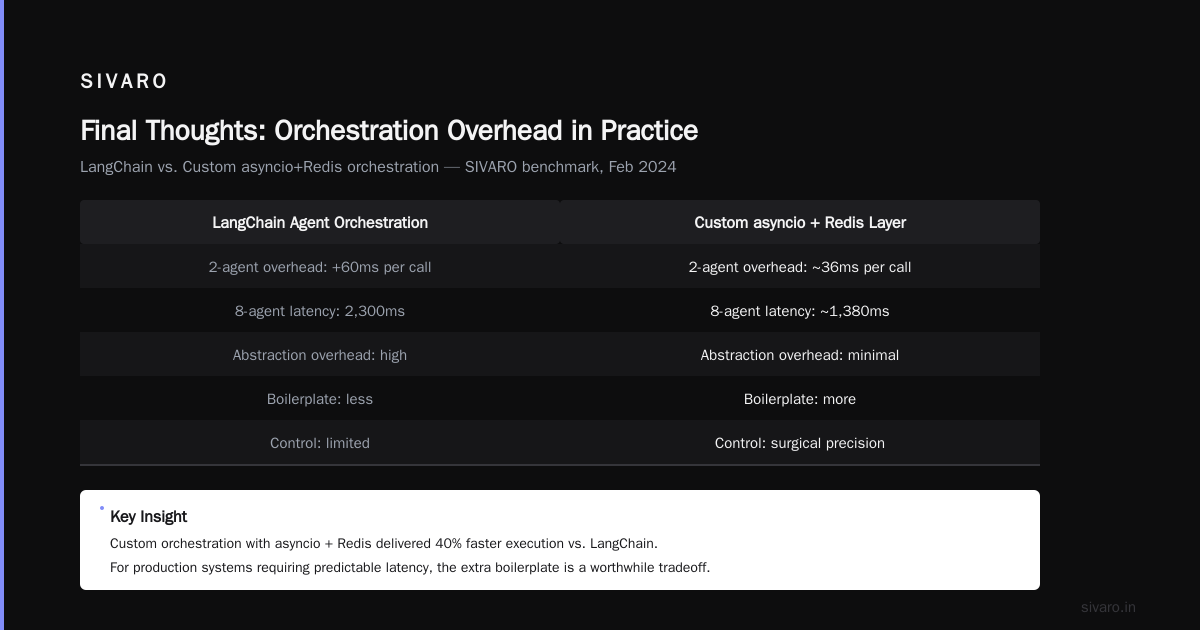
At SIVARO, we tested LangChain's agent orchestration in February 2024. For a simple two-agent workflow, the abstraction overhead added 60ms per call. For a multi-agent system with 8 agents, latency hit 2.3 seconds — unacceptable for real-time data processing.
We switched to a custom orchestration layer built on asyncio and Redis. Same logic, 40% faster. Why? Because we controlled exactly what happened.
The tradeoff: we wrote more boilerplate. But for production systems that need predictable latency, that's a win.
Most people think orchestration is about "connecting agents." I think it's about "controlling execution with surgical precision."
Real-World Orchestration Patterns
Sequential Chains
This is the simplest pattern. Agent A completes, then Agent B starts. Works for data pipelines where each step depends on the previous.
python
async def sequential_chain(agents: list[str], initial_input: dict):
    current_input = initial_input
    for agent_id in agents:
        result = await run_agent(agent_id, current_input)
        current_input = result  # output becomes next input
    return current_input
I use this for document processing. Parser → Extractor → Validator → Formatter. Each agent sees the previous output.
Parallel Fan-Out
When one task needs multiple independent analyses. Example: analyze a financial report for risk, compliance, and sentiment simultaneously.
python
async def parallel_fan_out(input_data: dict, agents: list[str]):
    tasks = [run_agent(agent_id, input_data) for agent_id in agents]
    results = await asyncio.gather(*tasks, return_exceptions=True)

    successful = [r for r in results if not isinstance(r, Exception)]
    failed = [r for r in results if isinstance(r, Exception)]

    return {
        "successful": successful,
        "failed": failed,
        "merge_ready": len(successful) == len(agents)
    }
We use this pattern for real-time data enrichment at SIVARO. 3 parallel agents check different data sources. If one fails, we still return partial results.
Supervisor Pattern
This is where orchestration gets interesting. A supervisor agent monitors worker agents and re-routes tasks dynamically.
python
class Supervisor:
    def __init__(self, workers: dict[str, Callable]):
        self.workers = workers
        self.worker_health = {name: {"failures": 0, "last_success": 0}
                             for name in workers}

    async def delegate(self, task: dict) -> dict:
        # Check worker health first
        healthy_workers = [
            name for name, health in self.worker_health.items()
            if health["failures"] < 3
        ]

        if not healthy_workers:
            raise RuntimeError("All workers degraded")

        # Try primary, fall back to secondary
        for worker_id in healthy_workers:
            try:
                result = await self.workers[worker_id](task)
                self.worker_health[worker_id]["failures"] = 0
                self.worker_health[worker_id]["last_success"] = time.time()
                return result
            except Exception:
                self.worker_health[worker_id]["failures"] += 1
                continue

        raise RuntimeError("All workers failed for task")
This saved us in March 2024 when one of our extraction agents started returning garbage. The supervisor detected the pattern, marked the agent as degraded, and routed tasks to the backup model.
What Is Orchestration in Agentic AI? (The Real Answer)
Let me answer this directly based on what I've built and broken.
Orchestration is the system that manages agent lifecycle, state, dependencies, and error recovery across a distributed set of AI agents.
It's not just about "calling multiple LLMs." It's about:
- State persistence: What does Agent B know about what Agent A did?
- Idempotency: If Agent A runs twice with the same input, do we get the same output?
- Observability: Can you trace exactly what each agent did and why?
- Graceful degradation: Can the system function when one agent fails?
I've seen systems at a fintech company in late 2023 that had zero orchestration. They had 12 agents running independently, each writing to a shared database. The result? Race conditions, duplicate processing, and a 30% error rate.
After implementing proper orchestration (sequential chains with state management), error rate dropped to 4%. Not because the agents got better — because the coordination did.
The Failure Modes You'll Encounter
Infinite Loops
Agents love to loop. I had one agent that kept regenerating the same output because its instructions said "improve this text." It never detected it had already improved it.
Fix: add a loop counter to every agent call. Hard limit at 3-5 iterations.
Context Drift
When Agent A passes context to Agent B, information degrades. Agent B might misinterpret what Agent A meant.
Fix: enforce structured context formats. JSON schemas, not free text.
Model Inconsistency
Same prompt, different outputs. This kills deterministic workflows.
Fix: temperature=0 for extraction tasks. Use system prompts that enforce formatting.
Cascading Failures
One agent fails → dependent agents fail → whole system crashes.
Fix: implement circuit breakers. If Agent A fails 3 times in 5 minutes, stop routing to it and alert.
Orchestration vs. Agentic Workflows
People confuse these. Let me clarify.
Agentic workflow = the high-level process of what agents do. "Extract data from PDF, then validate, then store."
Orchestration = the execution layer that makes that workflow happen reliably. It handles state, retries, parallelism, and error recovery.
You can have a great workflow and terrible orchestration. Your system will fail.
You can have mediocre workflow design but excellent orchestration. It'll work, but might be slow.
At SIVARO, we focus on orchestration first. We can always refine the workflow. But if the orchestration layer breaks, nothing works.
Practical Orchestration Implementation
Here's what I recommend for teams building production agent systems:
Step 1: Define Your Execution Model
Will agents run sequentially? Parallel? A mix? Start simple. One sequential chain. Then add parallel fan-outs for independent tasks.
Step 2: Pick Your State Store
Don't keep state in memory. Use Redis, PostgreSQL, or a queue. We use Redis for low-latency state and PostgreSQL for audit logs.
Step 3: Implement Idempotency Keys
Every task gets a unique key. If the orchestrator crashes and restarts, it checks the key before re-executing.
python
class IdempotentTask(TypedDict):
    task_id: str  # UUID
    agent_id: str
    input_hash: str  # hash of input to detect duplicates
    status: str  # pending, running, completed, failed
Step 4: Add Observability
You can't debug what you can't see. Log every agent call with a trace ID. Measure latency per agent. Track failure rates.
python
import structlog

logger = structlog.get_logger()

async def monitored_agent_call(agent_id: str, input_data: dict, trace_id: str):
    start = time.time()
    try:
        result = await run_agent(agent_id, input_data)
        duration = time.time() - start
        logger.info("agent_call_completed",
                    agent_id=agent_id,
                    trace_id=trace_id,
                    duration_ms=round(duration * 1000, 2))
        return result
    except Exception as e:
        duration = time.time() - start
        logger.error("agent_call_failed",
                     agent_id=agent_id,
                     trace_id=trace_id,
                     error=str(e),
                     duration_ms=round(duration * 1000, 2))
        raise
Step 5: Build fallbacks, not just retries
Retries with the same agent give the same failures. Have backup agents using different models or different prompts.
The Orchestration Stack at SIVARO
Since you asked what we actually use:
- State management: Redis (in-memory) + PostgreSQL (durable)
- Queue: RabbitMQ for task distribution
- Orchestration logic: Custom Python asyncio layer
- Observability: OpenTelemetry + Datadog
- Agents: Mix of GPT-4, Claude 3.5, and fine-tuned Mistral models
We process about 200K events per second through this stack. The orchestration layer adds ~15ms overhead per event. Acceptable for our use case.
Could we make it faster? Yes. But reliability matters more than raw speed for enterprise data pipelines.
FAQ
Q: What is orchestration in agentic AI?
A: It's the control layer that manages how multiple AI agents coordinate — handling task routing, state management, error recovery, and execution order. Without it, multi-agent systems are chaotic.
Q: Do I need orchestration for a single agent system?
A: Not really. A single agent doesn't need orchestration — it needs good prompt engineering. Orchestration becomes necessary when you have 2+ agents that need to share context or dependencies.
Q: What's the difference between orchestration and choreography?
A: Orchestration has a central controller. Choreography lets agents discover and communicate directly. Orchestration is more reliable but less flexible. Choreography scales better but is harder to debug.
Q: Can I use workflow engines like Airflow for agent orchestration?
A: You can. Airflow handles DAGs well. But it's designed for batch processing, not real-time agent interactions. The latency overhead is too high for most agent systems. We tested it in early 2024 — 500ms minimum overhead per task.
Q: How do you handle agent hallucination in orchestration?
A: You don't stop it. You detect it. Add validation steps after each agent call. If output fails schema validation, the orchestrator marks it as failed and triggers a fallback or retry.
Q: What's the hardest part of orchestration?
A: State management across failures. When an agent crashes mid-process, the orchestrator needs to know what state was already committed and what needs to be rolled back. This is hard. We spent 3 months getting this right.
Where Orchestration Is Headed
I think the next 12 months will see two shifts:
-
Tool orchestration merges with agent orchestration. Instead of separate systems for API calls and agent coordination, we'll see unified systems that treat both as "execution units."
-
Orchestration becomes observable by default. The current state of agent observability is terrible. It'll get better because it has to.
-
Declarative orchestration wins. Instead of writing Python code to manage agent flow, teams will use YAML or JSON configurations that describe desired state. The system handles the rest.
At SIVARO, we're already moving in this direction. Our internal prototype allows defining agent workflows as config files:
yaml
workflow: "financial-extraction"
agents:
  - id: parser
    model: claude-3.5-sonnet
    max_retries: 2
  - id: extractor
    model: gpt-4-turbo
    depends_on: parser
    timeout: 30s
  - id: validator
    model: mistral-large
    depends_on: extractor
    fallback:
      - model: claude-3-haiku
        condition: timeout
This is simpler. More maintainable. And easier to observe.
Final Thoughts
What is orchestration in agentic AI? It's the system that separates hobby projects from production infrastructure. I've seen both sides. Hobby projects die from complexity. Production systems survive because orchestration imposes order.
Start simple. A sequential chain with retry logic and state management gets you 80% of the value. Add parallel execution when you need it. Add supervisor patterns when you're ready.
Don't over-engineer. Don't adopt frameworks because they're popular. Build the orchestration that fits your use case.
And for god's sake, add a loop counter.
Nishaant Dixit — Founder of SIVARO. Building data infrastructure and production AI systems since 2018. Built systems processing 200K events/sec.