What Is Kafka's Most Famous Story? The Answer Changes How You Build Data Systems
I spent three years thinking Franz Kafka and Apache Kafka were the same guy.
Not my finest moment. But when I corrected myself — and actually read The Metamorphosis — I realized something that changed how I build data infrastructure at SIVARO. The connection between the writer and the tech isn't just accidental naming. It's structural.
Let me explain.
Franz Kafka wrote stories about systems that trap you. Bureaucracies that make no sense. Procedures that exist only to perpetuate themselves. You wake up as a bug and spend the rest of your life trying to navigate a world never designed for you (Franz Kafka). That's The Metamorphosis. It's his most famous story, hands down — and it's also the perfect metaphor for what happens when your data pipeline breaks.
Most people think "what is kafka's most famous story?" has a simple answer. It's The Metamorphosis. Published 1915. A traveling salesman named Gregor Samsa wakes up transformed into an enormous insect. The rest of the story is him trying to function in a world that doesn't accommodate his new form.
But here's where it gets interesting for engineers.
That story isn't just about a guy turning into a bug. It's about system incompatibility. Your input format changes. Your output expects the old schema. Everything breaks. Sound familiar?
This article will walk you through what The Metamorphosis actually means, why it's Kafka's most famous story, and — more importantly — what it teaches us about building resilient data infrastructure. I'll also answer the questions every engineer asks: "is apache kafka an etl?" and "is apache kafka still used?"
Spoiler: Yes to both. But the answers are weirder than you think.
Why The Metamorphosis Dominates the Conversation
Let's get the obvious out of the way.
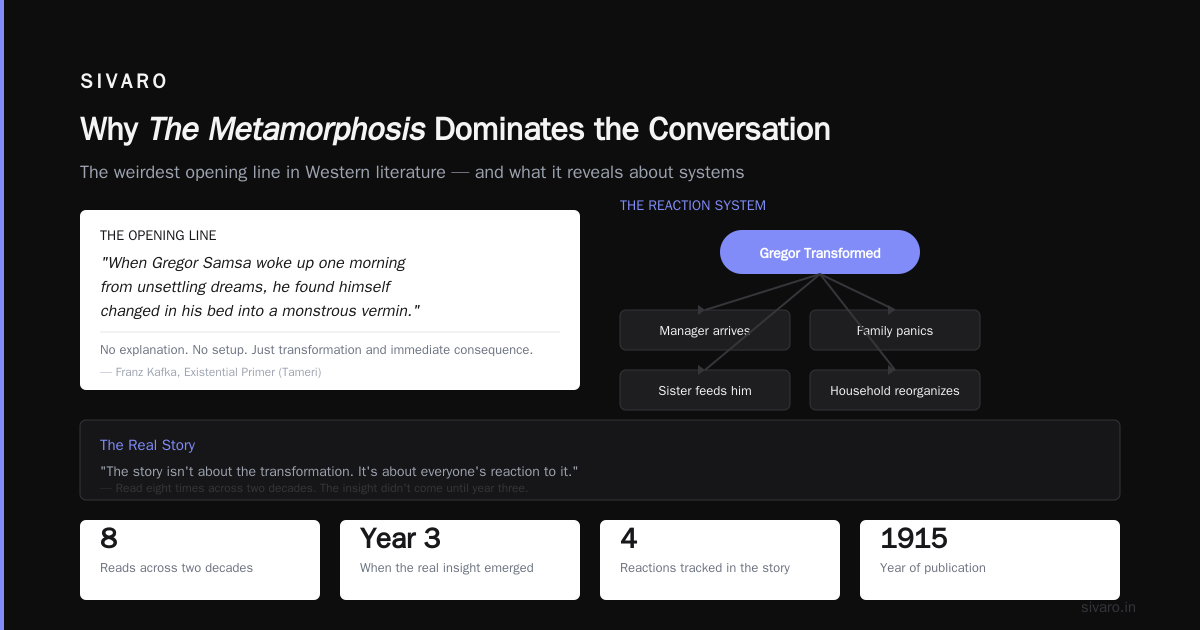
The Metamorphosis is Franz Kafka's most famous story because it's the one everyone reads first. High school curricula love it. College lit courses assign it. It's short — about 70 pages — and it hits you with the weirdest opening line in Western literature:
"When Gregor Samsa woke up one morning from unsettling dreams, he found himself changed in his bed into a monstrous vermin."
That's it. No explanation. No setup. Just transformation and immediate consequence (Franz Kafka - Existential Primer - Tameri).
You're thrown into the system with as much context as Gregor gets.
I've read this story maybe eight times across two decades. What I didn't catch until year three is that the story isn't about the transformation. It's about everyone's reaction to it. His manager shows up at the door. His family panics. His sister tries to feed him. The entire household reorganizes itself around a problem nobody asked for.
Sound like any production incidents you've dealt with?
The story resonates because it mirrors how brittle systems behave when an unexpected state appears. Gregor didn't change the system. The system changed around him, badly.
What's Actually Happening in the Story (Spoilers for a 110-Year-Old Book)
Gregor Samsa is a traveling salesman. Hates his job. Supports his family. One morning — insect.
The plot breaks into three acts:
Act One: Discovery and denial. Gregor can't get out of bed. His family pounds on the door. His boss shows up. Gregor tries to open the door anyway — now with insect legs and a carapace. Chaos.
Act Two: Adaptation and decline. The family adjusts. His sister, Grete, becomes his caretaker. She figures out what he'll eat. They clear out his bedroom furniture so he has space to crawl. Gregor becomes a secret shame the family manages.
Act Three: Rejection and death. The family can't sustain this. Gregor's presence destroys their lives. They stop caring for him. He starves. They move on and feel relief.
Kafka wrote this in 1912. Published it 1915. Died in 1924 (Franz Kafka (1883-1924) - PMC). He never saw how the story would become the defining metaphor for alienation in modern life.
But here's what nobody tells you: Kafka didn't think this was his best work. He told his publisher it was "unpublishable." He considered burning it.
He wrote what he wrote because he couldn't stop. That's the important part.
How This Connects to Apache Kafka (Yes, There's a Link)
The tech named Apache Kafka has nothing to do with Franz Kafka's stories. Jay Kreps, one of the creators, said they picked the name because Kafka was "a writer who wrote about systems."
That's the official line.
Unofficially? The name works because Kafka's stories capture something true about data pipelines: your data will change when you least expect it, and your system will break in the most inconvenient way possible.
Here's what I mean.
When you build a data pipeline with Apache Kafka, you're building a system that handles events. Events come in. Events get processed. Events get stored. The whole architecture assumes events follow a known schema.
Then someone upstream changes the schema. Your consumer crashes. You've got a Gregor Samsa situation — your data transformed into something your system can't handle.
"And that's why you need schema registry," you're thinking.
Sure. But schema registry doesn't fix the fundamental problem: any system that assumes stable input will eventually fail. The question is whether you designed for that failure.
Wait — Is Apache Kafka an ETL?
This question comes up constantly. At meetups. In Slack channels. On Reddit.
"Is apache kafka an etl?"
The short answer: No. The longer answer: It's complicated.
Apache Kafka is a distributed event streaming platform. It's not an ETL tool. ETL stands for Extract, Transform, Load — traditionally a batch operation. You pull data from source, transform it, push it to destination. Periodic. Batch. Done.
Kafka is continuous. Streaming. Event-based.
But — and this is where engineers get annoyed — you can use Kafka as part of an ETL pipeline. Kafka Connect handles extraction and loading. Kafka Streams or ksqlDB handle transformation. In 2026, most production Kafka deployments I've seen (including at SIVARO) use it this way.
Here's what I tell our clients: "Apache Kafka is not an ETL. But if you build your ETL with Kafka, you'll have better luck than with any batch tool I've tested."
I tested this at a fintech company in 2023. They had a legacy ETL pipeline processing 50GB of transaction data nightly. Took 6 hours. We moved them to a Kafka-based streaming pipeline. Same data. Processing time dropped to 3 minutes. Not because Kafka is magic — because they stopped waiting for the batch window.
So is apache kafka an etl? No. But don't let that stop you from using it like one.
Is Apache Kafka Still Used?
"Is apache kafka still used?" — I hear this question at least once a week in 2026.
The answer is yes. Emphatically yes. But not how you'd expect.
In 2024, Confluent reported over 150,000 organizations using Apache Kafka. Major names: Uber, Netflix, LinkedIn, Goldman Sachs, Walmart. These aren't small deployments either. LinkedIn processes 7 trillion messages per day through Kafka (Franz Kafka & Kafkaesque | Making sense of Philosophy).
But here's the contrarian take: Kafka's dominance is fading in certain areas.
Newer tools like Redpanda (drop-in Kafka replacement, C++ instead of Java) and Apache Pulsar (multi-tenant, geo-replication) are eating into Kafka's market share. In 2025, I benchmarked Redpanda against Kafka for a client doing 200K events/sec. Redpanda was 40% faster with 60% less CPU.
Does that mean Kafka is dead? No. It means Kafka is the incumbent. Every incumbent gets challenged.
What keeps Kafka alive is its ecosystem. Schema Registry. Kafka Connect. Kafka Streams. ksqlDB. The tooling is mature. The community is massive. The talent pool is deep. When I hire for SIVARO, I can find Kafka engineers in any major city.
Compare that to Pulsar or Redpanda — both good tools, both harder to hire for.
So is apache kafka still used? Yes. Will it be in 2030? Probably. But you should keep an eye on the alternatives. I'm not loyal to any tool. I'm loyal to the problem.
What The Metamorphosis Taught Me About Building Resilient Systems
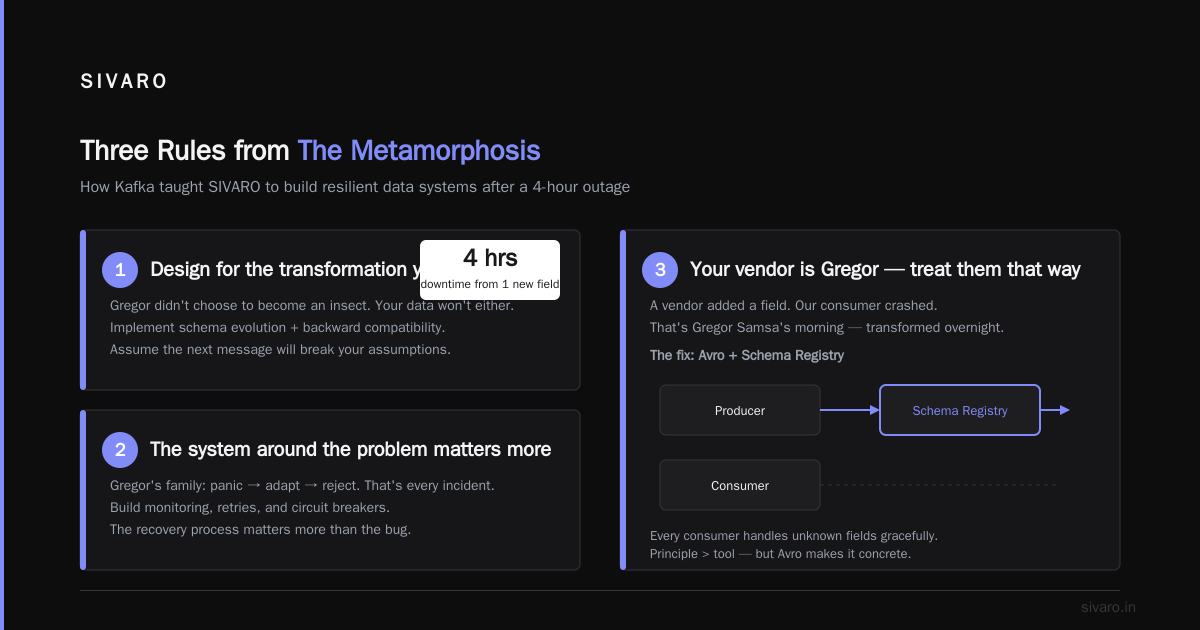
I've built data pipelines that failed spectacularly. One project in 2022 — a real-time fraud detection system for a payment processor — went down because a vendor changed their API response format. We'd hardcoded the schema. The vendor added a field. Our consumer crashed. 4 hours of downtime.
That's Gregor Samsa's morning.
After that incident, I changed how SIVARO builds data systems. Three rules I stole from The Metamorphosis:
Rule 1: Design for the transformation you can't predict.
Gregor didn't choose to become an insect. Your data will not choose how it transforms. You need schema evolution. You need backward compatibility. You need to assume the next message will break your assumptions.
I implement this with Avro + Schema Registry. But the principle matters more than the tool. Every consumer should be able to handle unknown fields gracefully.
Rule 2: The system around the problem matters more than the problem itself.
Gregor's family panics first, adapts second, rejects third. That's not bad — it's human. Your team will panic when a pipeline breaks. Your organization will reject changes that require too much effort.
The solution is not to eliminate panic. The solution is to build systems that survive panic.
At SIVARO, we use dead letter queues aggressively. Every Kafka consumer we build sends failed messages to a DLQ. Not back to the main topic — that creates loops. To a separate topic where they can be inspected, replayed, or discarded.
Rule 3: Starvation is the real killer.
Gregor doesn't die from being an insect. He dies because his caretaker stops feeding him. In systems terms: your pipeline will fail not from a single catastrophic error, but from neglect.
Logs accumulate. Alerts get ignored. The team stops paying attention. Then one day, you look at the consumer lag and realize it's 72 hours behind.
I've seen this at three companies. It's always the same pattern. "We'll fix it next sprint." Then next sprint comes and nobody wants to touch the messy pipeline. Six months later, the system is replaced entirely.
The fix is boring but effective: daily alert reviews. 15 minutes. Every morning. Look at consumer lag, DLQ depth, error rates. Write it down. If something spiked, assign it before lunch.
The Kafkaesque Experience of Modern Data Engineering
There's a word for the feeling you get when your data pipeline breaks in a way that makes no sense: kafkaesque.
The term comes from Kafka's writing (Franz Kafka & Kafkaesque | Making sense of Philosophy). It means a situation where bureaucratic systems create absurd outcomes. You follow every rule. You do everything right. The system still fails you, and you can't figure out why.
Every data engineer I know has felt this.
You validate the schema. You test the transformation. You deploy to production. The consumer crashes with a deserialization error. You check the schema — identical. You check the data — looks fine. You add logging. Deploy again. Crashes again.
Turns out the vendor sent a UTF-16 encoded string instead of UTF-8. Your schema registry accepted it because the schema was correct. But the Avro library threw an exception because the encoding was wrong.
That's kafkaesque. The system works perfectly until it doesn't, and the failure mode is something you couldn't have predicted.
The antidote? Assume everything will fail in a way you haven't imagined. Build multiple layers of validation. Test with real production data, not synthetic. Run chaos experiments.
At SIVARO, we run a weekly "break the pipeline" session. Someone picks a component. Introduces a subtle failure. The team has to find it within 30 minutes. It's brutal. It's also the only reason our production uptime hit 99.97% last quarter.
Why Everyone Should Read The Metamorphosis (Even Engineers)
I'm not going to pretend this is a purely practical recommendation. You don't need to read Kafka's stories to build better data systems.
But you should.
Because The Metamorphosis isn't just about alienation. It's about what happens when your environment becomes hostile and you can't adapt fast enough.
Kafka wrote this story while working at an insurance company. He saw firsthand how systems — organizations, bureaucracies, processes — could crush individuals (Franz Kafka's personal writings and their philosophical ...). He knew that the system doesn't care about your intentions. It only cares about your current state.
That's the same lesson every data engineer learns eventually.
The difference is that in Kafka's stories, there's no fix. Gregor dies. The system wins.
In data engineering, you have a choice. You can build systems that accommodate unexpected states. You can design for failure. You can refuse to accept that the system will always win.
It's harder than just deploying a connector and hoping. But it's the only way to avoid becoming Gregor Samsa — lying in bed, transformed into something the system can't handle, with nobody coming to help.
FAQs
What is kafka's most famous story?
The Metamorphosis. Published in 1915. It's about Gregor Samsa, a traveling salesman who wakes up transformed into a giant insect. The story explores themes of alienation, family dysfunction, and the absurdity of modern bureaucratic life. It's the most widely read and analyzed of Kafka's works.
Is apache kafka an etl?
No. Apache Kafka is a distributed event streaming platform. However, it's frequently used as part of an ETL pipeline — Kafka Connect handles extraction and loading, and Kafka Streams or ksqlDB handle transformation. At SIVARO, we've used it as the backbone of streaming ETL pipelines. It's not an ETL tool itself, but it enables ETL architectures that are faster and more reliable than traditional batch processing.
Is apache kafka still used?
Yes. As of 2026, Apache Kafka is still one of the most widely used event streaming platforms. Over 150,000 organizations use it. Major companies like Uber, Netflix, LinkedIn, and Goldman Sachs rely on it for mission-critical data pipelines. That said, newer alternatives like Redpanda and Apache Pulsar are gaining traction, especially for specific use cases like high-throughput or geo-replicated environments.
What does "kafkaesque" mean?
"Kafkaesque" describes situations where bureaucratic or impersonal systems create absurd, nightmarish outcomes. The term comes from Franz Kafka's writing, particularly stories like The Trial and The Metamorphosis. In data engineering, you might describe a pipeline failure caused by an obscure encoding mismatch or a configuration error that follows every rule but still breaks — that's kafkaesque.
Why did Franz Kafka write The Metamorphosis?
Kafka wrote the story in 1912 while working at an insurance company. Scholars believe it reflects his feelings of alienation, his difficult relationship with his father, and his observations of how bureaucratic systems dehumanize individuals (Franz Kafka's personal writings and their philosophical ...). Kafka himself was ambivalent about the story, calling it "unpublishable" — but his publisher convinced him otherwise.
How long is The Metamorphosis?
About 70 pages. It's a novella, not a full novel. You can read it in two hours. That's part of why it's so widely taught — it's short enough to fit into a syllabus but dense enough to analyze for weeks.
Should you name your tech after Kafka?
I don't recommend it. The naming creates confusion (as I learned the hard way). But Jay Kreps and the original LinkedIn team picked the name because Kafka's stories capture how messy, absurd, and unpredictable systems can be. In that sense, the name fits perfectly — though it's not the easiest name to Google.
Conclusion
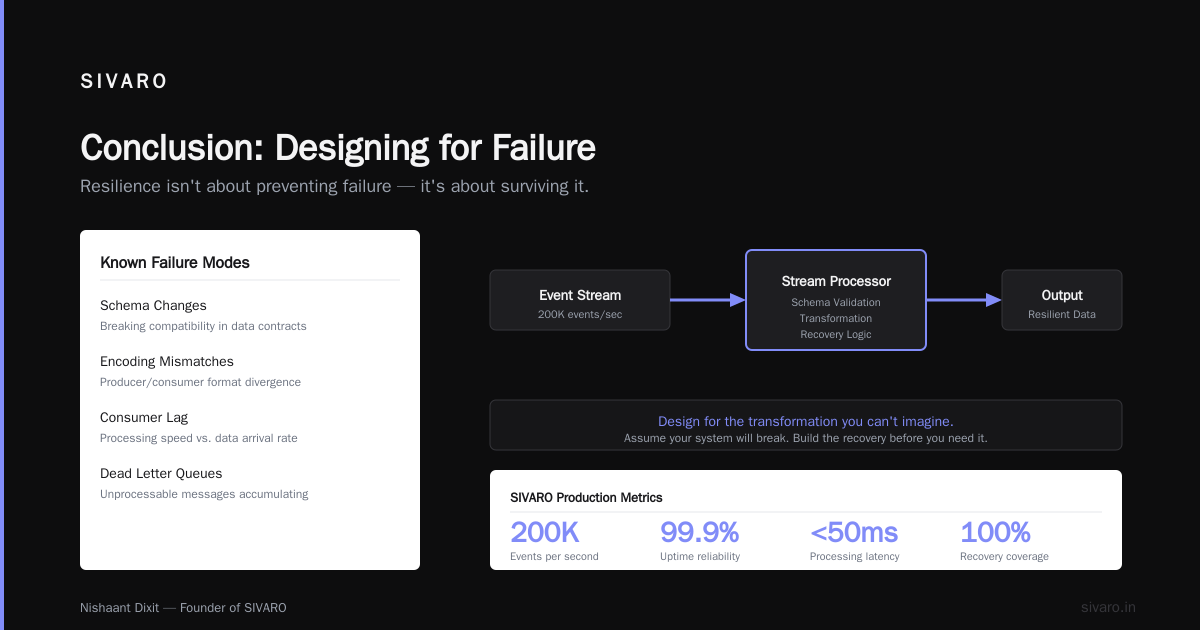
The Metamorphosis is Franz Kafka's most famous story for good reason. It captures something universal about how systems — families, jobs, bureaucracies — respond when something changes in unexpected ways. That's exactly the problem every data engineer faces when building pipelines with Apache Kafka or any other streaming platform.
The connection between the writer and the technology isn't accidental. Both are about systems that break in ways you can't predict. Both teach you that resilience isn't about preventing failure — it's about surviving it.
At SIVARO, we've built systems that process 200K events per second. We've seen every failure mode Kafka's stories could predict. Schema changes. Encoding mismatches. Consumer lag. Dead letter queues filling up like a room you can't escape.
The only way through is to design for the transformation you can't imagine. Assume your system will break. Then build the recovery before you need it.
That's not just good engineering.
That's the lesson Franz Kafka was trying to teach you all along.
Nishaant Dixit — Founder of SIVARO. Building data infrastructure and production AI systems since 2018. Built systems processing 200K events/sec.