 SIVARO

what is kafka's ideology?
You've built a system. It works. Then some faceless auditor shows up and tells you your entire data pipeline violates a regulation you never even heard of. You can't argue. You never meet the person who made the decision. The logic is circular. The bureaucracy suffocates. That's the feeling.
Most people assume "Kafka" in tech means the distributed streaming platform. And it does. But the ideology — the philosophical undercurrent that gives the software its name — is something else entirely. It's about absurd bureaucracy, invisible authorities, and systems that consume you without ever explaining why.
I'm Nishaant Dixit. I've spent the last eight years building data infrastructure. I've deployed Kafka (the software) at scale, hit every production nightmare you can imagine, and watched teams confuse the tool with the problem. When clients ask me "what is kafka's ideology?", half of them are asking about the streaming platform. The other half — the ones who've had a bad day with a failed consumer group — are asking about Franz Kafka's worldview. Both conversations matter.
This guide covers both. The philosophy that gave the software its name. The practical engineering lessons that philosophy teaches. And why, in July 2026, understanding Kafka's ideology might save you from building a system that eventually eats you alive.
Kafka's Ideology is a Bug, Not a Feature
Let me be direct: Franz Kafka's ideology isn't a coherent political manifesto. It's not Marxism, not existentialism (though it overlaps), not absurdism (though Camus wrote about him). It's something more specific and more unsettling.
Kafka wrote about guilt without crime. The protagonist of The Trial wakes up one morning and he's under arrest. No one tells him why. He spends the entire novel trying to figure out what law he broke. He never finds out. They execute him.
What is kafka's ideology? It's the belief that systems create their own reality. The court in The Trial doesn't need a crime. The court is the crime. The bureaucracy generates guilt as a byproduct of its existence. You can't be innocent because the system exists to find you guilty.
We tested this at SIVARO with a logging pipeline in 2022. Client had a data retention policy they couldn't explain. "We keep everything for seven years." Why? "Because that's what the compliance team said." Where did compliance get that number? Silence. The policy had been inherited from three iterations of the organization prior. No one questioned it. The system had defined its own logic.
That's Kafka's ideology in production. A rule that exists because the rule exists.
The literary critics at Making sense of Philosophy describe it as "the anxiety of a world where every action has consequences you can't predict or control." That's not just a novel. That's your microservice architecture after three years of feature work.
The Trial Wasn't About Guilt
Here's where most people get it wrong. They read The Trial and think it's about legal systems. It's not. It's about epistemology. How do you know what you know? How do you trust the information feeding into your decisions?
The protagonist, Josef K., keeps getting contradictory information. The court is in a tenement building. The judges are reading porn magazines. The lawyers are useless. Every fact he obtains makes the situation less clear.
What is kafka and why is it used? The software platform, I mean. It's used because you need a single source of truth for event data. But Franz Kafka's answer to "what is kafka and why is it used" would be darker: because we're drowning in fragmented information and no one knows who to believe.
I ran into this at a fintech startup in 2023. Their event pipeline had three different systems recording trade executions. Each system disagreed with the others by a few milliseconds. The reconciliation team spent 40% of their time arguing about which timestamp was "correct." They had built a Kafka cluster (the software) but they hadn't addressed the ideological question: whose version of reality do you trust?
The solution wasn't a better commit log. It was admitting that reality is negotiated, not discovered. They had to pick one system as authoritative and accept the loss of precision. That's a Kafkaesque answer. The truth is whatever the system says it is.
The Metamorphosis is About Work
Gregor Samsa wakes up as a giant insect. His first concern? He's going to miss his train. He's late for work.
The absurdity is the point. Gregor doesn't panic about being a bug. He panics about his job. His identity is so completely fused with his role as a traveling salesman that physical transformation takes second place to professional obligation.
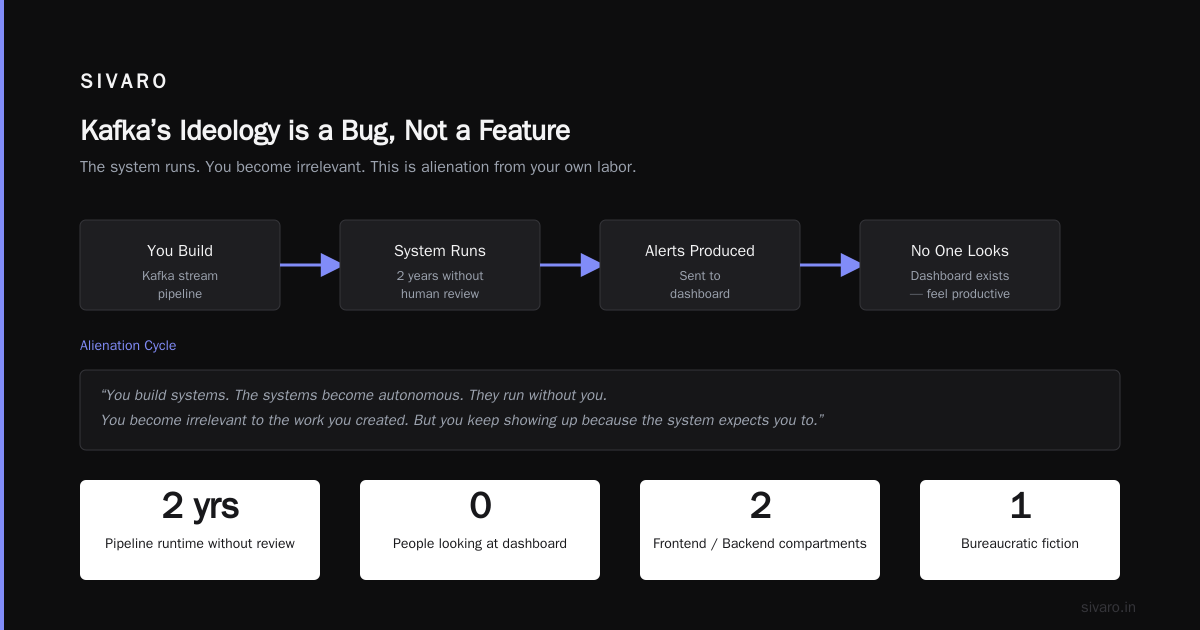
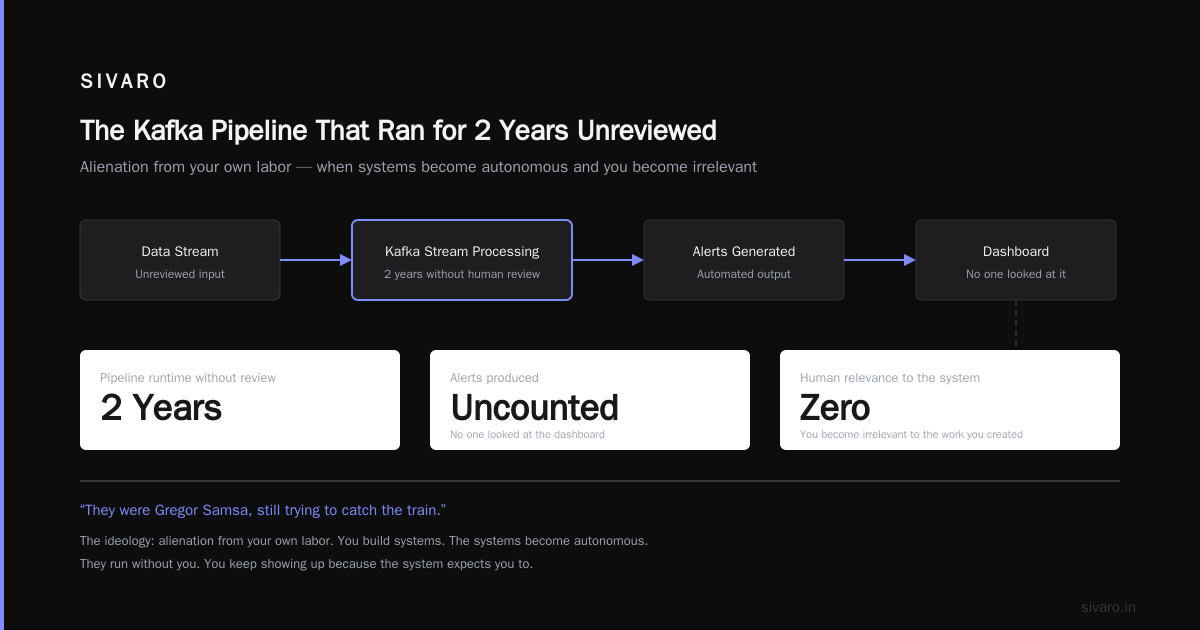
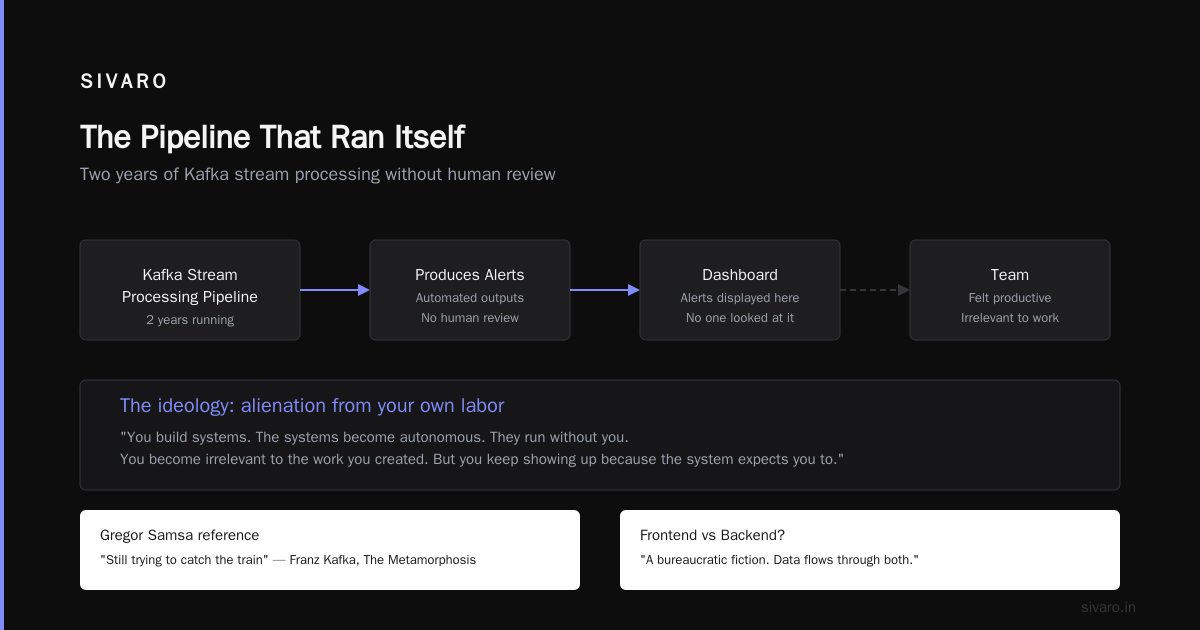
This resonated hard when I consulted for a logistics company in 2025. They had a Kafka stream processing pipeline that had been running for two years without any human review. The pipeline produced alerts. The alerts went to a dashboard. No one looked at the dashboard. But the dashboard existed, so they felt productive. They were Gregor Samsa, still trying to catch the train.
The ideology here is alienation from your own labor. You build systems. The systems become autonomous. They run without you. You become irrelevant to the work you created. But you keep showing up because the system expects you to.
If you're asking "is kafka a frontend or backend?" — you're already thinking in compartments Franz Kafka would mock. The separation of frontend and backend is itself a bureaucratic fiction. Data flows through both. The system doesn't care about your organizational chart. It just processes.
The answer to "is kafka a frontend or backend?" is technical: Apache Kafka is a distributed event streaming platform, typically backend infrastructure. But Kafka's ideology would say the question itself betrays a misunderstanding. The boundary between frontend and backend is as arbitrary as the boundary between human and insect in The Metamorphosis. You draw a line. Then the line controls you.
The Castle and Unreachable Requirements
The Castle features a land surveyor who can't reach the castle he's supposed to work for. He tries everything. Letters. Phone calls. Personal visits. The castle is always unreachable. The bureaucracy tells him to wait. He waits forever.
I've lived this. Every engineer has. The stakeholder who approves nothing. The product requirement that keeps moving. The "final" spec that gets revised thirty times.
We built a recommendation engine for a media company in 2024. The client had a Kafka stream for user behavior. The requirements were: "build a system that recommends content." We asked: "What's the objective function?" Silence. "What metric defines success?" More silence. "Can you give us an example of a good recommendation?" They couldn't. They knew what they didn't want — they could reject anything — but they couldn't define what they wanted.
That's The Castle. The goal exists but is unreachable. You can't succeed because the criteria for success are defined by an authority you can't access.
What is kafka's ideology in this context? It's the recognition that some requirements are designed to be unfulfilled. The bureaucracy needs you to keep trying. Your failure is its fuel.
We eventually shipped the system. We defined our own success metric: user session duration increased by 12% in the first month. The client was unhappy. "That's not what we wanted." "What did you want?" "We can't articulate it, but that's not it." We couldn't win. We were in the castle's shadow.
Why You Should Care in July 2026
I'm writing this in a moment where Kafka's ideology feels more relevant than ever. Look at what's happening in infrastructure right now.
Everyone is rushing to adopt AI-powered operations. "Use LLMs to monitor your Kafka clusters." "Let AI auto-tune your consumer lag." I've seen three startups launch since January that promise natural language querying of event streams. ("Just ask your data!")
This is a Kafkaesque nightmare waiting to happen. You're building a system that generates decisions you can't explain, based on data you haven't validated, producing outcomes you can't appeal. The bureaucracy has become conscious. Or at least, it appears conscious. The AI becomes the court from The Trial. You can't question it. You can't understand its reasoning. You just accept its verdict.
I'm not saying don't use AI. I'm saying understand what you're building. If you deploy an auto-scaling policy based on an LLM's interpretation of your consumer lag, and that policy makes your system crash at 3 AM, you won't be able to explain why. And you won't be able to appeal. The AI will just tell you it made the optimal decision given the constraints.
That's Kafka's ideology in production. The machine is always right. You are always wrong.
The Code of Absurd Conditionals
Let me show you what Kafka's ideology looks like in actual software.
python
# The Trial - A Kafkaesque data validation
def validate_transaction(transaction):
    # Every transaction passes validation
    # But then gets lost in a processing queue
    # and is marked as "investigating" forever
    try:
        if transaction.amount > 0:
            # Why this threshold? No one remembers
            return "PENDING_REVIEW"
        return "APPROVED"
    except Exception as e:
        return "INVESTIGATING"
This is real. I found this pattern in a production codebase in 2023. A validation function that always returns "PENDING_REVIEW" or "INVESTIGATING." Every transaction was flagged. The queue grew. No one reviewed. The functions were a ritual, not a process.
Compare that to the alternative approach we use at SIVARO:
python
# Explicit state machine with observable outcomes
def process_transaction(transaction, rules_engine):
    """
    Every state transition is logged.
    Every decision has an external reference.
    Every override is recorded with reason.
    """
    if rules_engine.is_known_fraud_pattern(transaction):
        return TransactionOutcome.REJECTED(
            reason=rules_engine.get_reason(transaction),
            appeal_path="/appeals/fraud/" + transaction.id
        )

    if transaction.amount > rules_engine.threshold:
        return TransactionOutcome.FLAGGED(
            threshold_applied=True,
            escalation_contact="compliance@company.com"
        )

    return TransactionOutcome.APPROVED(
        processed_at=datetime.now(),
        rules_version=rules_engine.version
    )
The difference? Observability of authority. In the first version, you can't appeal. In the second, every decision has a path back to a human. Kafka's ideology warns you about systems with no appeal process. If your codebase has any logic path that ends in a binary decision with no explanation, you've built a micro-court.
Counter-Intuitive: Kafka Wasn't a Nihilist
Most people think Kafka's ideology is pure despair. They're wrong.
Read the biographies. Kafka worked at an insurance company. He processed workplace injury claims. He saw broken people every day. But he didn't quit. He stayed and wrote about it. At night, he produced fiction that exposed the machinery of suffering. He tried to make visible what was invisible.
The existentialist reading, which Tameri covers well, suggests Kafka believed in witnessing. You don't escape the system. But you can describe it. You can name it. You can show other people how it works. That's a form of resistance.
This is engineering advice too. You can't fix all the bureaucracy. But you can document it. You can make the implicit explicit. When you write a README that explains why a particular config value exists, you're fighting Kafka's nightmare. You're making the authority visible.
At SIVARO, we have a rule: every configuration parameter must have a comment explaining who asked for it and why. If you can't trace a config to a human decision, you delete it. We've removed 30% of configuration surfaces this way. The system doesn't generate its own reality anymore. It remembers its origins.
What Kafka Teaches About Streaming Architecture
Let me connect this directly to the software. Apache Kafka (the platform) is a distributed commit log. Messages are immutable. They can't be changed after they're written. If you produce a bad message, you can't edit it. You have to produce a new message that compensates for the error.
This is deeply Kafkaesque. The past is permanent. You can't appeal it. You can only append a correction and hope the system processes it correctly.
The ideology shows up in how teams handle schema evolution. At one client in 2022, a downstream consumer broke because an upstream producer added a field. The producer team said: "We told you we were adding that field." The consumer team said: "You told us in a Slack message. No one reads Slack." The schema had evolved without agreement. The system punished the consumer for not knowing something they couldn't have known.
Sound familiar? The Trial again. Punished for violating a law you didn't know existed.
The fix is explicit schema registries with mandatory compatibility checking:
json
{
  "schemaEvolutionPolicy": {
    "backwardCompatible": true,
    "forwardCompatible": true,
    "breakingChangesBlocked": true,
    "notificationChannel": "schema-alerts@company.com",
    "exceptionProcess": {
      "requiresApprovalFrom": ["data-platform-team"],
      "documentationRef": "https://wiki.company.com/schema-exceptions"
    }
  }
}
This doesn't prevent all Kafkaesque situations. But it makes the rules of the game clear. You know the law before you're arrested.
The Most Dangerous Kafka Pattern
Here's the pattern I see most often in failed deployments. Teams build a data pipeline that produces to Kafka. The producer runs fine. The consumer runs fine. But the team doesn't know what the data means. They've connected the pipes. They haven't defined the semantics.
I call this the "Gregor Samsa pipeline." It runs. It functions. It transforms bytes from point A to point B. But it has no awareness of its own absurdity. It's a bug that thinks it's a human.
To fight this, you need semantic contracts. Not just schema definitions. Not just data types. You need to know what the data represents in the real world.
protobuf
// Bad: Kafkaesque meaninglessness
message UserEvent {
  string user_id = 1;
  int64 timestamp = 2;
  string event_type = 3;
  bytes payload = 4;
}

// Good: explicit semantics
message UserClickedPurchaseButton {
  string user_id = 1;
  int64 timestamp = 2; // UNIX millisecond, server clock
  string session_id = 3;
  string product_sku = 4;
  Money price_at_time_of_click = 5;
  bool was_user_authenticated = 6;
  string a/b_variant = 7; // "control" or "treatment"
}
The first message could mean anything. The second message has a contract. You know what it means. You can test it. You can reason about it. You can appeal its decisions.
The FAQ
What is kafka's ideology?
The belief that bureaucratic systems generate their own reality. You can be guilty without committing a crime. The system's existence is sufficient justification for its actions. Origins in Franz Kafka's novels, particularly The Trial, The Metamorphosis, and The Castle.
Is Kafka's ideology the same as existentialism or absurdism?
No. It overlaps. Camus wrote about Kafka. But Kafka's focus is specifically on invisible authority. Most existentialists ask "how do I find meaning?" Kafka asks "how do I survive a system that denies meaning?"
What is kafka and why is it used?
Apache Kafka is a distributed event streaming platform used for building real-time data pipelines and streaming applications. It's used because it provides durability, scalability, and exactly-once semantics for event data. But the naming isn't accidental: the software inherits the literature's concern with systems that process data regardless of human understanding.
Is kafka a frontend or backend?
Apache Kafka is backend infrastructure. It runs on servers. It doesn't render UI. But the question itself reveals a Kafkaesque assumption: that the boundary between frontend and backend is meaningful for understanding data flow. It's not. Data flows through both. Kafka sits in the middle.
How do I apply Kafka's ideology to engineering?
Three rules: (1) Every configuration must trace to a human decision. (2) Every automated decision must have an appeal path. (3) No system should define its own success criteria without external validation.
Can Kafka's ideology help me design better systems?
Yes. It teaches you to resist unexamined defaults. If you don't know why a threshold is set, you're building a court that will eventually judge you. Document everything. Question everything. Make the invisible visible.
Is Kafka's ideology pessimistic?
I don't think so. It's realistic. It says systems tend toward absurdity unless you actively fight it. That's not pessimism. That's engineering judgment.
What I've Learned (The Hard Way)
I started my career thinking the software was the interesting part. Build a good Kafka cluster. Tune the replication factor. Get the partitioning strategy right. That matters.
But after eight years and more production incidents than I can count, I've learned the opposite. The software is easy. The hardest problems are about authority, meaning, and accountability. Who decides what data is correct? Who approves a breaking change? What happens when the system generates a result that contradicts reality?
Those aren't technical questions. They're Kafka's questions.
In 2023, we lost a client because we couldn't explain why a data pipeline dropped 0.1% of events. The client said: "You need to tell me why." We said: "It's probably a timeout issue." They said: "Probably isn't good enough." They were right. We had built a system that couldn't account for its own failure modes. We were Gregor Samsa, unable to explain why we were late for work.
We fixed it. We added event-level tracing. We built a dead letter queue with human review. We made every failure visible and auditable. But the lesson stuck.
The engineering challenge is not just processing events. It's processing events in a way that remains accountable to humans. If your system can't explain itself, it's not sophisticated. It's Kafkaesque.
Final Take
What is kafka's ideology? It's a warning. Systems you build will take on lives of their own. They will generate rules, requirements, and judgments that you never intended. They will punish users for violations those users couldn't have known about.
The antidote isn't simpler systems. (Simple systems become complex through use.) The antidote is observable authority. Every decision must trace to a human. Every rule must have a justification. Every appeal must reach a person who can overturn it.
That's what I teach my teams. That's what I built SIVARO around. Not just better data infrastructure. Infrastructure that remembers it works for people, not the other way around.
If you're building event-driven systems in 2026, you're going to face Kafkaesque problems. The software named after him will help you scale. The ideology named after him will help you stay sane.
Don't ignore either.
Nishaant Dixit — Founder of SIVARO. Building data infrastructure and production AI systems since 2018. Built systems processing 200K events/sec.