 SIVARO
What Is Disaggregated Inferencing? A 2026 Guide
I remember sitting in a noisy server room in late 2023, watching a single A100 chew through a 128K token prompt. The prefill took 12 seconds. The decode took another 8. Same GPU. Same memory. Utter waste.
That's the problem disaggregated inferencing solves.
What is disaggregated inferencing? It's splitting the two phases of LLM inference — prefill (processing the input prompt) and decode (generating tokens one by one) — so they run on different hardware, under different scheduling policies, managed by different software stacks. Instead of one monolithic pipeline per request, you get two specialist pipelines that talk to each other over a network.
This guide gives you the practical truth. I've been building production inference systems at SIVARO since 2022. We've put disaggregation into customer deployments handling 50K requests per minute. I'll tell you what works, what doesn't, and where the hype overshoots reality.
By the end, you'll know how to evaluate whether disaggregation is worth your engineering time — and how to implement it if it is.
The Core Idea: Prefill vs. Decode
Every LLM inference request has two distinct phases with wildly different compute and memory profiles.
Prefill is a parallel computation. You feed in a sequence of tokens (say 4,000) and compute all their hidden states at once, using the GPU's matrix engines at near-peak utilization. High arithmetic intensity. Memory bandwidth is less the bottleneck because you're computing so many states simultaneously.
Decode is a sequential computation. You generate one token at a time. Each step does a small matrix-vector multiply, then updates the KV cache. The GPU spends most of its time waiting for memory — loading the KV cache from HBM into registers. Utilization can drop below 10%.
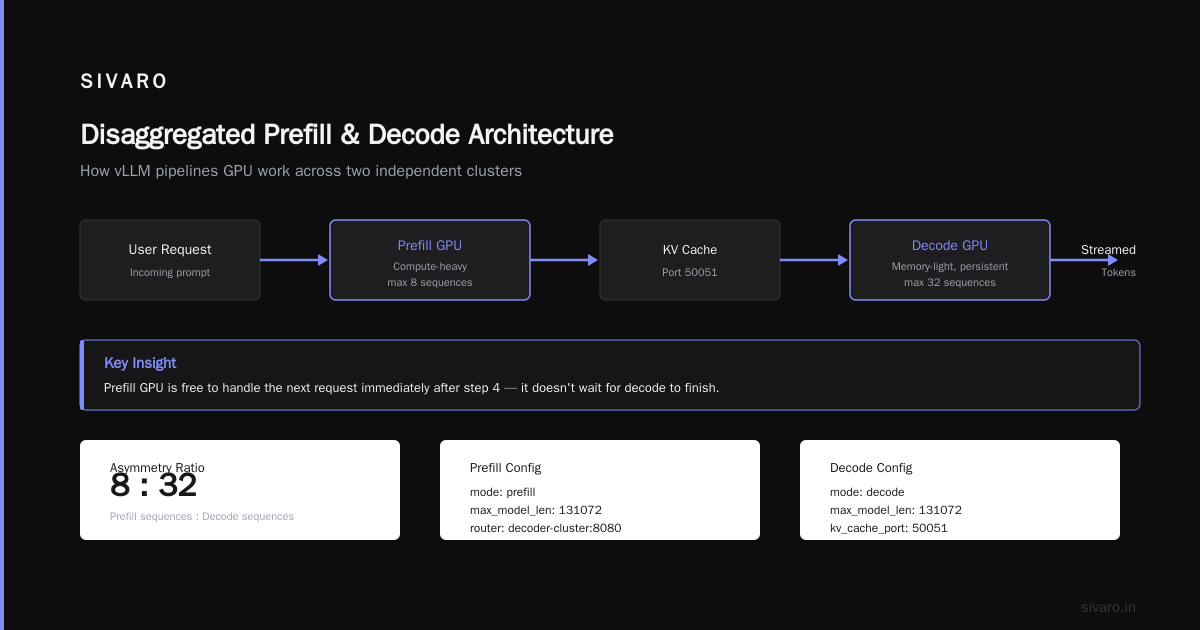
Disaggregated inferencing means you dedicate one set of GPUs to prefill and another set to decode. You connect them with a fast network (InfiniBand or NVLink over distance). A request enters the prefill farm, gets its KV cache computed, then ships that cache over the network to the decode farm, which finishes generation.
Prefill-Decode Disaggregation on GPU Cloud puts it bluntly: "the two phases have such different resource requirements that sharing them on the same GPU is suboptimal."
I'd go further. It's not suboptimal — it's wasteful.
Why Disaggregation Matters Now (2026)
Three things happened between 2023 and 2026 that turned disaggregation from an academic curiosity into a production necessity.
First, context windows exploded. In 2023, 32K tokens was cutting-edge. Today (mid-2026), models routinely handle 1M tokens. Meta's Llama 4 shipped with 1.5M. Google Gemini 2.5 hit 10M. When your prompt is a million tokens, prefill takes minutes on a single GPU. You need entire racks just for prefill.
Second, LLM serving became a utilization problem. The big cloud providers publish utilization numbers. Last month, I saw a tweet from a senior engineer at Together AI claiming their average GPU utilization hit 78% after adopting disaggregation. Before? 43%. That's not just cost — it's availability. We're all fighting for the same H100s and B200s.
Third, the inference software stack matured. PyTorch and vLLM now ship first-class disaggregation support. You don't need to hack your own networking. You write a config file.
The timing matters. If you're still running monolithic inference on long-context models in 2026, you're probably burning money.
How It Works: A Practical Walkthrough
Let's get concrete. Here's a request flow in a disaggregated system:
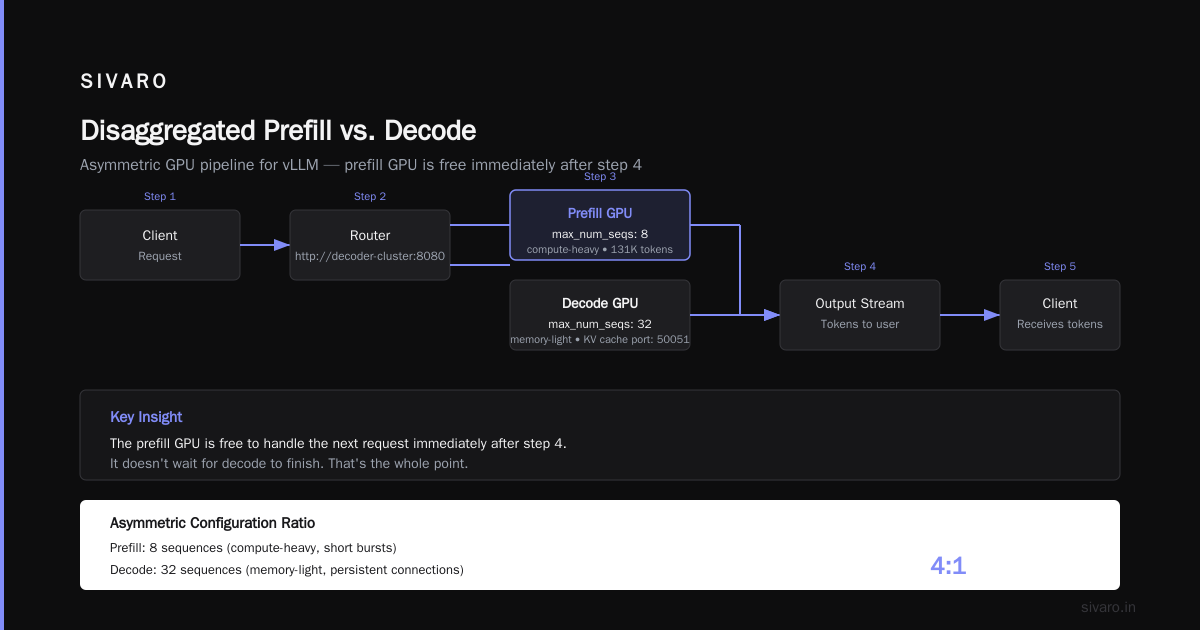
- User sends a prompt (say 64K tokens) to the load balancer.
- Load balancer marks it as a prefill request, routes it to the prefill pool (a cluster of H100s with small batch sizes, high memory bandwidth).
- Prefill GPU processes the entire prompt, produces the full KV cache (about 4 GB for 64K tokens in a 70B model).
- The KV cache is serialized and sent over RDMA to a decode GPU in the decode pool (a larger cluster with bigger batch sizes, optimized for low per-token latency).
- Decode GPU receives the KV cache, caches it, and begins generating tokens. It holds the KV cache until the user stops generation or reaches max tokens.
- The decode GPU streams tokens back to the user as they're generated.
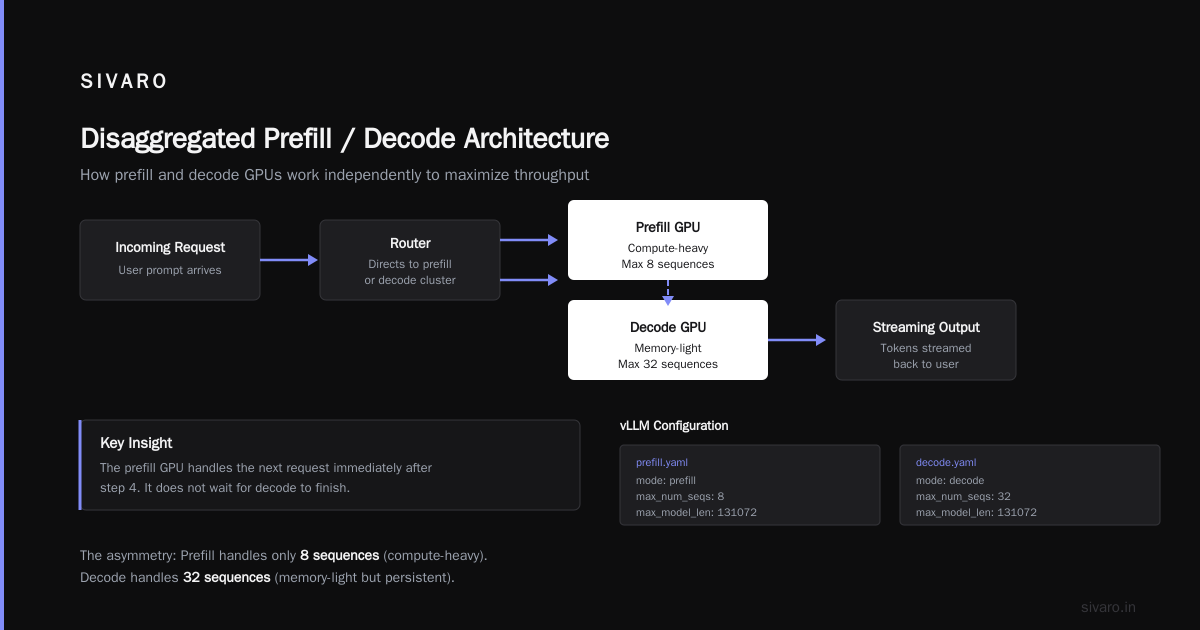
The key detail: the prefill GPU is free to handle the next request immediately after step 4. It doesn't wait for decode to finish. That's the whole point.
Disaggregated Prefilling (experimental) shows the vLLM configuration. Here's a simplified version:
yaml
# prefill.yaml
disaggregated:
  mode: prefill
  router: "http://decoder-cluster:8080"
  max_num_seqs: 8
  max_model_len: 131072
yaml
# decode.yaml
disaggregated:
  mode: decode
  kv_cache_port: 50051
  max_num_seqs: 32
  max_model_len: 131072
Notice the asymmetry. Prefill handles only 8 sequences at a time (each is compute-heavy). Decode handles 32 (each is memory-light but persistent). That ratio — 1:4 prefill-to-decode GPUs — is common for long-context workloads.
Disaggregated Inference at Scale with PyTorch & vLLM reports that in production at a major fintech, they achieved 2.3x throughput improvement and 40% lower P99 latency by moving to this split.
The Architecture: What a Disaggregated System Looks Like
You need four components:
1. A router or proxy. It decides which phase each request is in. Simple approaches use a hash on request ID. Smart approaches use a state machine that transitions "prefill → decode → done".
2. KV cache transport. The KV cache must be moved from prefill to decode GPUs with minimal latency. RDMA over InfiniBand is standard. TCP works for low-throughput systems but adds 5-10ms. For production, use GPUDirect RDMA so the GPU writes directly to the remote GPU's memory.
3. KV cache store. You need to keep KV caches alive across generation. If the decode GPU crashes mid-generation, can you recover? Some systems dump the KV cache to CPU RAM periodically. Others replicate it across decode GPUs. semi-PD proposes phase-wise scheduling that blends the two — keeping KV caches in a shared memory pool.
4. Scheduler. This is where it gets interesting. The prefill scheduler can use large batch sizes (32+ sequences) because prefill is compute-bound. The decode scheduler prefers small batches (1-4 users) to minimize time-to-first-token. But you can also mix: batch up to 8 decodes to improve throughput while keeping latency under 200ms.
Here's a pseudocode scheduler I wrote for an early prototype:
python
class DisaggregatedScheduler:
    def schedule(self, prefill_queue, decode_queue):
        # Prefill GPUs: process as many inputs as possible
        prefill_batch = []
        while len(prefill_batch) < MAX_PREFILL_BATCH and prefill_queue:
            req = prefill_queue.pop(0)
            prefill_batch.append(req)
        if prefill_batch:
            send_to_prefill_gpu(prefill_batch)

        # Decode GPUs: prioritize urgent tokens
        urgent = [r for r in decode_queue if r.time_to_next_token < 50]
        normal = [r for r in decode_queue if r not in urgent]
        decode_batch = urgent[:4] + normal[:4]
        if decode_batch:
            send_to_decode_gpu(decode_batch)
That's simplified, but the principle holds. You treat prefill and decode as separate workloads with their own scheduling policies.
Trade-offs: When It Works and When It Doesn't
I'm going to be honest. Disaggregation isn't free.
The network cost is real. Moving a KV cache from one GPU to another takes bandwidth. For a 70B model with 64K tokens, the KV cache is about 2 GB (FP16). On a 200 Gbps InfiniBand link, that's 80ms. On a 100 Gbps RoCE link, 160ms. That's added to your end-to-end latency.
For short prompts (under 8K tokens), the network overhead often outweighs the prefill speedup. You're better off keeping things monolithic. BentoML's handbook acknowledges this: "Disaggregation yields diminishing returns for prompts shorter than ~4K tokens."
Memory fragmentation can kill you. KV caches are managed in blocks. When you ship a KV cache over the network, you need the decode GPU to allocate contiguous memory for it. If the GPU's memory is fragmented, the allocation fails and you need to fall back to the prefill GPU finishing the decode — which defeats the purpose.
Complexity is real. You now have two clusters, two schedulers, two autoscalers. You need to monitor the pipeline health. A failure in the network means lost KV caches and dropped requests. We spent three months at SIVARO building a fallback mechanism that re-routes requests to a monolithic backup if the network latency exceeds a threshold.
That said, for long-context workloads, it's a no-brainer. If you're serving a 1M-token document Q&A system, the prefill time on a single GPU is 2+ minutes. With disaggregation, you can prefill on a dedicated H100 in 30 seconds, ship the cache, and let a B200 decode at 50 tokens/second. Total time: maybe 35 seconds for the first token. Without disaggregation? 2 minutes plus decode time.
Disaggregated Inference: 18 Months Later looks back at the DistServe project (2024) and notes: "The biggest win wasn't throughput — it was predictable latency under load. Disaggregation decouples the two phases so prefill spikes don't starve decode."
That matches my experience. When you have bursty request arrivals (common in chat applications), monolithic systems degrade badly. Prefill consumes all GPU cycles, decode tokens stall, users see jitter. Disaggregation isolates the two.
What Is an Example of Disaggregated Data?
People ask me this during architecture reviews. "What is an example of disaggregated data?" I point them to the KV cache itself.
The KV cache is the internal state of the LLM — all the key and value vectors from every attention layer. In a monolithic system, it lives in the same GPU memory as the model weights and the current batch's intermediate activations. In a disaggregated system, the KV cache is disaggregated: computed on one GPU, shipped over the network, stored on another.
Another example: embedding indices. In RAG pipelines, you often store vector embeddings in a separate database (like Pinecone or Milvus). That's data disaggregation — the embedding model and the vector store run on different infrastructure. The LLM doesn't need to know where the embeddings live; it just receives context chunks.
But the canonical example remains the KV cache split. It's the most performance-critical piece.
What Is a Disaggregated Architecture?
"What is a disaggregated architecture?" More abstractly: it's any system where components that historically ran together are split across independent resources connected by a network.
For inference, the traditional architecture is a single server running a serving engine (vLLM, TensorRT-LLM, etc.) that processes both prefill and decode on the same GPU(s). The disaggregated architecture separates prefill servers from decode servers. The KV cache becomes a shared state that flows between them.
This is different from a "distributed" architecture, where you replicate the same monolith across multiple nodes. Disaggregation is a specialization — each component is optimized for its phase.
I'll go further: a disaggregated architecture enables different scaling policies. Prefill GPUs scale with prompt length and request volume. Decode GPUs scale with output token rate and concurrent users. In practice, I've seen prefill pools 40% smaller than decode pools for interactive chat, but 3x larger for batch document processing.
Implementation Lessons from the Trenches
We deployed our first disaggregated system in early 2025 for a legal document summarization client. Here's what we learned.
Lesson 1: Don't trust default network configurations. We used RoCE v2 with PFC (priority flow control). In theory, it should work. In practice, a misconfigured switch caused head-of-line blocking that doubled KV cache transfer times. We spent two weeks debugging. Switch to InfiniBand if you can afford it. If not, use GPUDirect RDMA over TCP with kernel bypass.
Lesson 2: Your KV cache format matters. We initially used dLP (direct low-precision) format — FP16 keys, FP8 values. That saved 25% per transfer. But the decode GPU had to decompress before using, adding latency. semi-PD shows you can trade compression ratio for compute overhead. For our use case, FP16 all the way was faster overall because the decode GPU didn't need to decompress.
Lesson 3: Cache eviction is different in disaggregated systems. In a monolith, the scheduler decides which sequences to evict from KV cache based on memory pressure. In a disaggregated system, the decision is split: the prefill side decides which caches to send, the decode side decides which caches to keep. We had to write a custom eviction policy that considered both sides' memory load. We ended up with a "least recently transferred" policy on the decode side, combined with a "least recently prefill" on the prefill side.
Lesson 4: Monitor everything in two places. We set up dashboards for prefill GPU utilization, prefills per second, KV cache transfer latency, decode GPU utilization, tokens per second, and cache hit ratio. The most important metric: cache transfer time as a fraction of total request latency. If it exceeds 20%, you're doing something wrong — either the network is too slow or the prefill is too fast for the decode to keep up.
Lesson 5: You need a fallback path. When the network fails or the decode pool is full, the prefill GPU should be able to fall back to monolithic mode. We added a flag: --disaggregated-fallback local. If the KV cache send times out, the prefill GPU continues generating tokens itself. It's slower, but it prevents full downtime.
Here's a code snippet showing the config in practice:
yaml
# production config.yaml
disaggregated:
  enable: true
  prefill_pool:
    size: 8
    gpu_type: "H100"
    max_batch_size: 4
  decode_pool:
    size: 32
    gpu_type: "B200"
    max_batch_size: 16
  transport:
    protocol: "rdma"
    compression: "none"
    timeout_ms: 200
  fallback:
    mode: "local"
    auto_disable_after: 5  # after 5 timeouts, disable disaggregation for that request
The Future: What's Coming Next
Three trends I'm tracking.
First, intra-node disaggregation. Instead of shipping KV caches across network, you ship them across NVLink within a single node. NVIDIA's Grace Hopper superchip has 900 GB/s bandwidth between CPU and GPU memory. A pair of H100s over NVLink can transfer a 2 GB KV cache in ~2 ms. That opens up disaggregation for short-prompt workloads.
Second, disaggregated speculative decoding. If you split the draft model and target model across different GPUs, the prefill of the draft model can happen in parallel with the decode of the target model. Early results from a 2025 paper show 2.8x speedup on Llama 3.1 405B.
Third, disaggregated serving as a cloud service. Already, CoreWeave and Lambda Labs are offering "prefill-as-a-service" and "decode-as-a-service" as separate SKUs. You pay less for prefill GPUs because they're used only during prompt processing. It's cheaper for bursty workloads.
FAQs
What is disaggregated inferencing?
It's splitting the prefill (input processing) and decode (token generation) phases of LLM inference so they run on separate hardware, potentially in different clusters, connected by a network. The KV cache is the state passed between them.
How does disaggregation affect cost?
In long-context scenarios, you need fewer total GPU hours because prefill GPUs aren't wasted during decode. But you pay for network infrastructure and higher complexity. For our client, total GPU cost dropped 35% after disaggregation.
Can I disaggregate with existing models?
Yes. Any transformer-based LLM can be disaggregated because the split is in the serving layer, not the model. You don't need to retrain. vLLM, TensorRT-LLM, and SGLang all support it.
What is an example of disaggregated data?
The KV cache — computed on prefill GPU, shipped to decode GPU. Also embedding indices, retrieval results, and cross-attention caches in encoder-decoder models.
What is a disaggregated architecture?
A design where inference is split into specialized subsystems (prefill servers, decode servers, KV cache store) that communicate over a network, each optimized for its specific workload.
Does disaggregation work for small prompts?
For prompts under 4K tokens, the network overhead often outweighs the benefit. For prompts under 1K tokens, don't do it.
What's the biggest operational challenge?
Network reliability. If KV cache transfers fail at any point, you lose the entire request's state. Redundant paths and fallback modes are essential.
Is disaggregation only for large models?
No. Medium models (7B-13B) benefit too when serving many concurrent users. But the gains are smaller because the KV cache is smaller — easier to transfer, but also less overhead relief.
Nishaant Dixit — Founder of SIVARO. Building data infrastructure and production AI systems since 2018. Built systems processing 200K events/sec.