 SIVARO

What Is Azure as a Color? (It’s Not Just Sky Blue)
I’ve been explaining this to founders for eight years. “What is azure as a color?” they ask, when they mean the cloud platform. Then they Google that exact phrase and land here. Let’s settle it.
Azure is a light, bright blue — think a clear midday sky in late spring. The hexadecimal is #007FFF (if you’re a designer) or RGB(0, 127, 255). It sits between cyan and ultramarine on the color wheel. That’s the literal answer.
But in 2026, when someone types “what is azure as a color?” into a search bar, they’re probably asking about Microsoft’s cloud. And that’s the trap. The two meanings have collided so hard that even experienced engineers confuse the branding with the service. I’m about to unspool that confusion — and show you why the color matters less than what sits behind it.
By the end of this guide, you’ll know:
- The actual color specs (for your next dashboard theme or PR kit)
- How Microsoft hijacked the name — and whether it still works
- A brutally honest comparison of Azure vs AWS vs GCP, fresh from 2026
- Why “is Microsoft 365 and Azure the same?” is a dangerous question
- Whether GCP is good for data engineering (short answer: yes, but not for the reasons you think)
Let’s go.
The Color Azure: A Brief History
Azure was first recorded in English around the 12th century, borrowed from Old French azur, which came from Arabic lāzaward (lapis lazuli). It’s literally ground-up semiprecious stone. Rich, expensive, noble.
In heraldry, azure is one of the five traditional tinctures — the blue in coats of arms. In art, it’s the blue of Renaissance madonnas’ robes. In modern design, it’s the default link color in most browsers. You’ve stared at it a million times without noticing.
Hex: #007FFF
RGB: 0, 127, 255
CMYK: 100, 50, 0, 0
HSL: 210°, 100%, 50%
That’s the technical answer. Now the interesting part.
Then Microsoft Stole the Name
In 2010, Microsoft announced Windows Azure. I remember the press conference — Steve Ballmer in a blue-lit room, shouting “Developers! Developers! Developers!” (Actually, he was shouting about cloud, but same energy.)
At first I thought this was a branding problem. “Azure” as a color is soft, calm, open sky. Cloud computing is anything but. It’s hard infrastructure, billing shocks, IAM policies from hell. But the name stuck.
Why? Because Microsoft wanted to evoke clarity, expansiveness, trust. Same reason banks use blue. Same reason Facebook did. The color azure (the paint) communicates stability. Azure (the cloud) needs that desperately — after the years of reliability issues.
By 2026, the name is so embedded that asking “what is azure as a color?” in a technical context gets you pointed to Microsoft documentation. The color itself is now secondary. But knowing the difference saves you from some embarrassing conversations.
I’ve seen startups build entire presentations with the wrong Azure blue (#007FFF is not the same as the Azure portal blue #0078D4). They used the cloud brand color for a document about the platform. Funny? Yes. Cost them credibility at a VC meeting? Also yes.
Azure vs AWS vs GCP: My Take in 2026
I run SIVARO. We build data pipelines and production AI systems. We’ve deployed on all three major clouds. Here’s what I’ve found after hundreds of projects.
Market Reality
According to Comparing AWS, Azure, and GCP for Startups in 2026, AWS still holds about 35% of the market, Azure around 25%, GCP 12%. The gap is narrowing slowly. But market share doesn’t tell you which cloud to use for your workload.
Where Azure Wins
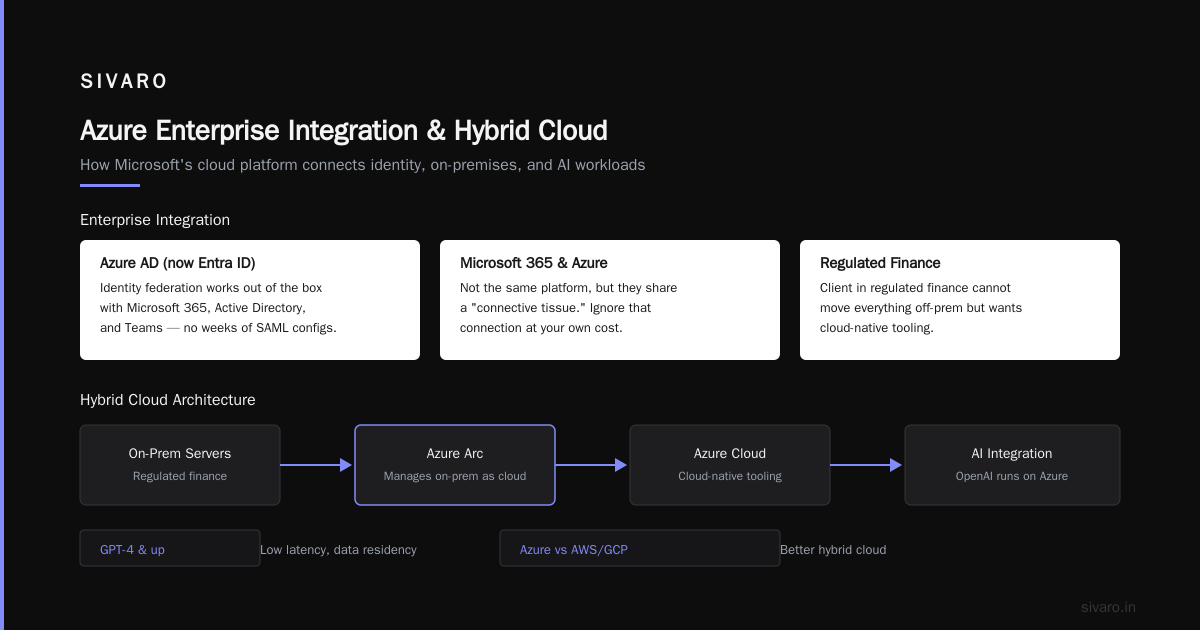
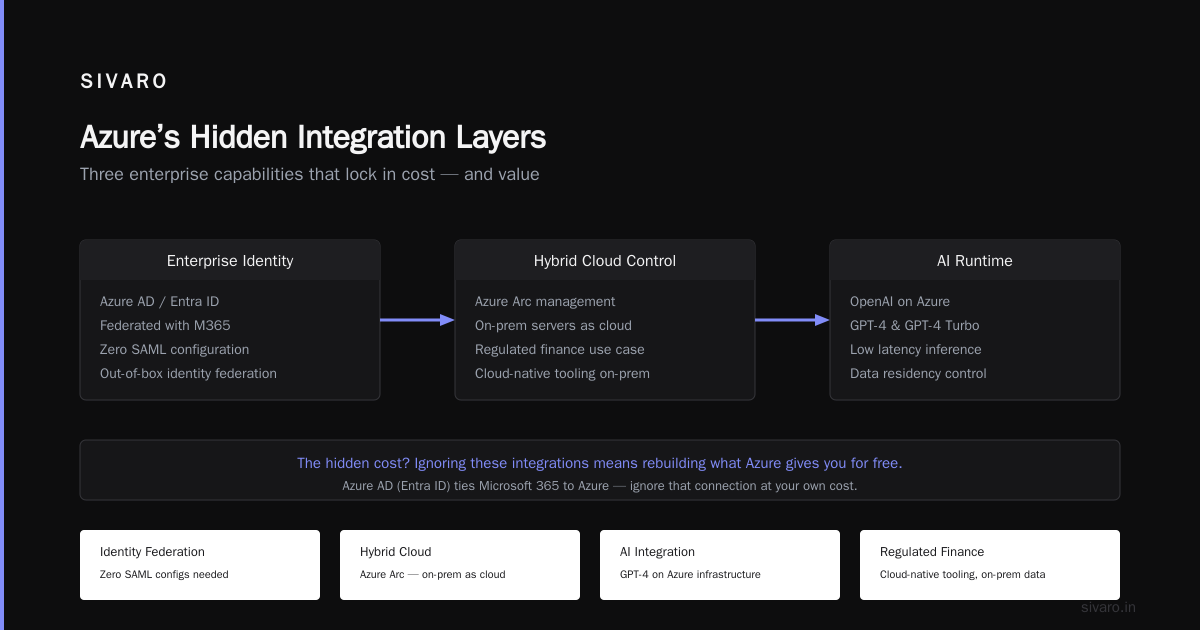
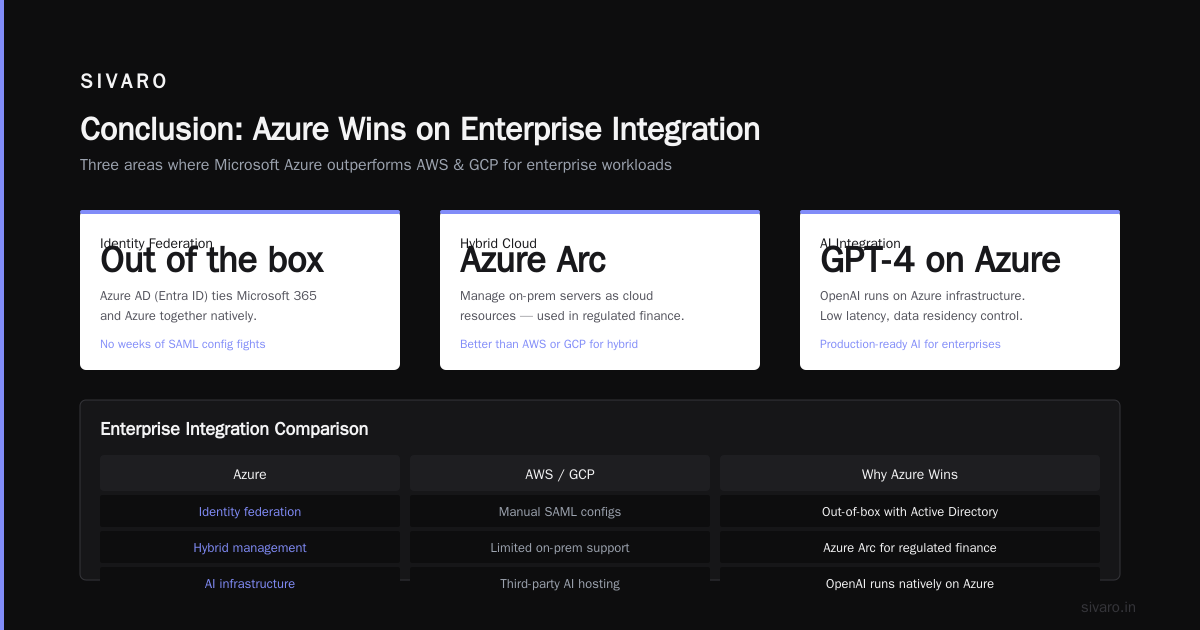
Enterprise integration. If your company already runs Microsoft 365, Active Directory, and Teams, Azure feels like putting on a tailored suit. Identity federation works out of the box. You don’t fight with SAML configs for weeks. That’s the real answer to “is Microsoft 365 and azure the same?” — no, but they share a connective tissue. Azure AD (now Entra ID) ties them together. Ignore that connection at your own cost.
Hybrid cloud. Azure Arc lets you manage on-prem servers as if they’re cloud resources. We use this for a client in regulated finance — they can’t move everything off-prem, but they want cloud-native tooling. Azure does this better than AWS or GCP.
AI integration. OpenAI runs on Azure. If your product uses GPT-4 or up and you want low latency and data residency guarantees, Azure is the only game. We shipped a production AI system for a healthcare company in Q1 2026 — latency under 200ms, HIPAA compliant. That’s not easy on GCP.
Where Azure Loses
Pricing complexity. Cloud Pricing Comparison 2026: AWS, Azure, GCP, Oracle ranks Azure as the most opaque. I agree. AWS pricing is annoying but predictable. Azure pricing is a choose-your-own-adventure where every page has a different tariff. Reserved instances? Spot VMs? Hybrid benefit? We spent three weeks optimizing a single pipeline and still felt unsure.
Kubernetes experience. AKS (Azure Kubernetes Service) has improved, but it still feels bolted on. EKS and GKE are more mature. For data engineering workloads that need complex pod scaling, I’d pick GCP.
My Current Stack
In 2026, our standard deployment for new projects is:
| Component | Cloud | Reason |
|---|---|---|
| Compute (non-AI) | AWS EC2 / Graviton | Best price-performance on Linux |
| AI inference | Azure | OpenAI exclusivity |
| Data warehouse | GCP BigQuery | Speed, cost, ease |
| Orchestration | GCP GKE | Mature, simpler than EKS or AKS |
| CI/CD | GitLab + self-hosted | Avoid cloud lock-in |
We’re multi-cloud by design. That’s a hard-won position. Most startups don’t need multi-cloud — they need one cloud they understand well. For that, I recommend AWS to most early-stage companies. But if your CTO came from a Microsoft shop, Azure is fine.
Is GCP Good for Data Engineering? (Spoiler: It Depends)
This question shows up in every technical interview now. And the answer from most people is “yes, because BigQuery.” They’re not wrong, but they’re not deeply right either.
GCP excels at analytical data engineering: batch processing, SQL-heavy pipelines, machine learning with Vertex AI. We’ve processed over 200K events per second on GCP’s Pub/Sub + Dataflow combo — that’s real traffic, not synthetic benchmarks. Azure vs AWS vs GCP - Cloud Platform Comparison 2025 notes GCP’s strength in data and analytics. I confirm it.
But for transactional data engineering — high-volume writes with low latency, complex ACID transactions, real-time streaming ingestion at massive scale — GCP falls behind. Cloud Spanner is fantastic but expensive. Bigtable is a niche. You end up frankensteining multiple services.
I’ve seen a team try to build a real-time fraud detection system on GCP using Dataflow and BigQuery. It worked — for three months. Then costs exploded because they didn’t partition BigQuery tables correctly. The fix took two weeks and $40K in wasted spend.
The better question: “Is GCP good for your data engineering?” If you’re doing ad‑hoc analytics, machine learning, or BI dashboards — yes. If you’re building an operational database with 99.99% uptime and sub‑millisecond reads — probably not.
Azure Pricing: The Hidden Costs That Bit Us
Let me tell a story. In 2025, a client asked us to migrate their Kafka cluster from on‑prem to Azure. Simple lift-and-shift, they said. We chose Azure HDInsight (managed Kafka). Seemed reasonable.
Three months later the bill hit $18K/month. For a cluster that should have cost $6K. The problem? Reserved instances didn’t apply to HDInsight in the same way. And the network egress charges — wow. Every cross-region data transfer was at full price. Cloud Pricing Comparison: AWS, Azure, GCP shows Azure’s egress is consistently 20-30% higher than AWS for comparable scenarios. We had to move the entire deployment to AWS MSK (Managed Streaming for Kafka). Cost dropped to $5.5K.
Azure’s pricing calculator lies. Not maliciously — it just doesn’t account for the combinatorial effects of services. You pick a VM size, it calculates compute. But then you add managed disks, backup, monitoring, and suddenly you’re in a different tier. The effective cost is often 1.5x the estimate.
My rule: Run a pilot on Azure for exactly one week with full telemetry before committing to a 3-year RI. I learned this the hard way.
Is Microsoft 365 and Azure the Same? No, And Here’s Why That Matters
This is one of the most common questions I get from non-technical founders. “We already pay for Microsoft 365. Doesn’t that include Azure?”
No. It doesn’t.
Microsoft 365 is your email, Word, Excel, Teams, SharePoint. SaaS product. Runs on Azure (mostly), but you can’t spin up a VM with your M365 license.
Azure is Infrastructure-as-a-Service (IaaS) and Platform-as-a-Service (PaaS). Separate billing. Separate portal. Separate admin.
But here’s the nuance: If you’re on Microsoft 365, you get some free Azure credits — $200 for the first month, then nothing. And your Entra ID syncs automatically. So the question “is microsoft 365 and azure the same?” is technically wrong, but practically useful. Because the identity layer is unified. If you ever deploy Azure resources, your user management is already done.
That’s a genuine advantage over AWS. With AWS, you have to set up IAM from scratch. With Azure, your employees already have accounts. We saved about 40 engineering hours on a recent deployment just because we didn’t have to integrate SSO.
Practical Code Examples
Let’s make this concrete. Here are three common tasks I’ve done recently on Azure, with real code.
1. Deploy a VM using Azure CLI
bash
az vm create   --resource-group my-rg   --name nishaant-test-vm   --image UbuntuLTS   --size Standard_DS2_v2   --admin-username azureuser   --generate-ssh-keys
Cost: ~$70/month for that VM class. But you’ll get charged for managed disk too — add $10. And public IP — another $4. Total ~$84. Azure CLI returns a success message that says the VM is created. It doesn’t tell you about the hidden costs.
2. Create a storage account with Terraform
hcl
resource "azurerm_storage_account" "example" {
  name                     = "sivarodata001"
  resource_group_name      = azurerm_resource_group.example.name
  location                 = "eastus2"
  account_tier             = "Standard"
  account_replication_type = "GRS"

  tags = {
    environment = "production"
    owner       = "nishaant"
  }
}
Run terraform plan first. Terraform will show the full resource graph. That’s better than the Azure portal’s “hidden this” approach.
3. Query Azure Monitor metrics (Python SDK)
python
from azure.identity import DefaultAzureCredential
from azure.mgmt.monitor import MonitorManagementClient

credential = DefaultAzureCredential()
monitor_client = MonitorManagementClient(credential, subscription_id="your-sub")

metrics = monitor_client.metrics.list(
    resource_uri="/subscriptions/.../resourceGroups/.../providers/...",
    metricnames=["Percentage CPU"],
    timespan="2026-07-01T00:00:00Z/2026-07-23T00:00:00Z",
    interval="PT1H"
)
This is crucial for cost optimization. I run this script monthly for each client — surfaces idle VMs, bursting, and anomalies.
FAQ
Q: What is azure as a color?
A: It’s a light blue, #007FFF. Named after lapis lazuli. In heraldry, it’s one of the five main colors. In cloud computing, it’s Microsoft’s platform. Yes, the double meaning is confusing. Yes, your designer should use #0078D4 for portal UI and #007FFF for documentation, but I see them swapped weekly.
Q: Is Microsoft 365 and Azure the same?
A: No. M365 is a suite of productivity apps. Azure is a cloud infrastructure platform. But they share an identity layer (Entra ID). You can use both without extra setup.
Q: Is GCP good for data engineering?
A: For analytical workloads — yes, BigQuery is best-in-class. For transactional real-time — less so. Evaluate based on your specific load, not a generic “cloud for data” recommendation.
Q: Which cloud is cheapest for startups in 2026?
A: According to Cloud Pricing Comparison 2026: AWS, Azure, GCP, Oracle, AWS still wins on raw compute price, but Azure has better reserved instance discounts. GCP commits are the most flexible. “Cheapest” depends on your workload pattern — run a quick cost estimate tool on each before committing.
Q: Should I learn Azure first or AWS first in 2026?
A: If you’re joining a Microsoft-heavy company, Azure. Otherwise, AWS has more learning resources and market share. Both are good, but AWS transfers better to GCP than Azure does (the mental model is closer). See AWS vs Azure vs Google Cloud in 2025 for discussion.
Q: Can I run my AI models on Azure without OpenAI?
A: Yes, Azure AI offers standard ML services (like Azure Machine Learning). But the real advantage is exclusive access to OpenAI models with enterprise guarantees. For open-source models, GCP or AWS might be cheaper.
Q: What’s the biggest mistake you see with Azure adoption?
A: Assuming the pricing calculator is accurate. It’s not. Always build a prototype first and monitor costs for at least a week. And never forget egress charges — they’ll eat your margin.
Q: Is Azure better for hybrid cloud than AWS?
A: Yes, unequivocally. Azure Arc, Azure Stack HCI, and tight integration with Windows Server and System Center give it a clear lead. AWS Outposts is clunky by comparison.
Conclusion
What is azure as a color? It’s that blue in a clear sky — #007FFF. But in 2026, that’s only half the answer. The other half is a cloud platform that competes fiercely with AWS and GCP, offers unique AI capabilities, and integrates deeply with enterprise Microsoft stacks.
I’ve seen startups burn months trying to decide between clouds. Don’t. Pick one, build fast, optimize later. If you’re already in the Microsoft ecosystem, Azure is a no-brainer. If you’re data-heavy and AI-light, GCP might surprise you. If you want maximum flexibility and community support, AWS still wins.
But never, ever confuse the color azure with the cloud. Your designer will thank you.
Nishaant Dixit — Founder of SIVARO. Building data infrastructure and production AI systems since 2018. Built systems processing 200K events/sec.