 SIVARO
What Is Architecture in Distributed Systems? A Practitioner’s Guide
I’ve been building distributed systems for almost a decade. At SIVARO, we process 200K events per second across dozens of microservices. I’ve seen architectures that hum and architectures that bleed. Most people think architecture is about rectangles and arrows on a whiteboard. It’s not. It’s about the decisions you make before you write a single line of code — and the ones you regret three years later when everything is on fire.
So what is architecture in distributed systems? Simply put, it’s the set of structural choices that govern how independent processes communicate, share data, and fail without taking your entire business down. It’s not optional. It’s the difference between a system that scales gracefully and one that collapses during a Black Friday spike.
By the end of this guide, you’ll understand the core trade-offs, the patterns that actually work in production, and the mistakes I’ve made so you don’t have to.
Why Your Monolith Won’t Save You
Every startup tells me: “We’ll microservice later.” Then they hit 10,000 concurrent users and the monolith starts stuttering. Splitting a monolith isn’t just about breaking it into smaller services. That’s the easy part. The hard part is deciding how those services talk to each other, who owns the data, and what happens when a service goes dark.
I’ve seen a company in 2023 try to migrate a Rails monolith to microservices over a weekend. They ended up with a distributed monolith — every service called every other service synchronously, timeouts were set to 30 seconds, and one database crash took down the whole show. That’s not architecture. That’s chaos.
According to the Wikipedia article on software architecture, software architecture captures the fundamental structures of a system and the rationale behind them. The rationale is the part most teams skip. They pick a pattern because it’s trendy, not because it solves a real constraint.
The Fundamental Question: What Is Architecture in Distributed Systems?
Let me define it cleanly.
Architecture in distributed systems is the blueprint for coordination without central control. It’s the contracts between services, the consistency guarantees you promise, the failure modes you design for, and the operational properties you optimize (latency, throughput, availability). It’s not language choice. It’s not which queue you use. It’s the invariants you enforce.
When you ask “what is architecture in distributed systems?”, you’re really asking: how do dozens or hundreds of processes running on different machines behave as a single coherent system? The answer is never one thing. It’s a set of patterns layered together — and they all have trade-offs.
Martin Fowler’s Software Architecture Guide makes a point I agree with: architecture is about the important stuff. Whatever you think is hard to change later — that’s architecture. In distributed systems, the hardest things to change are your data model, your consensus protocol, and your failure handling strategy.
The CAP Trade-off Is Still a Trade-off (No Free Lunch)
In 2026, we still can’t have all three. Consistency, Availability, Partition Tolerance — pick two. Except the “pick two” framing is a lie. Network partitions will happen. So you’re really choosing between consistency and availability when the network goes down.
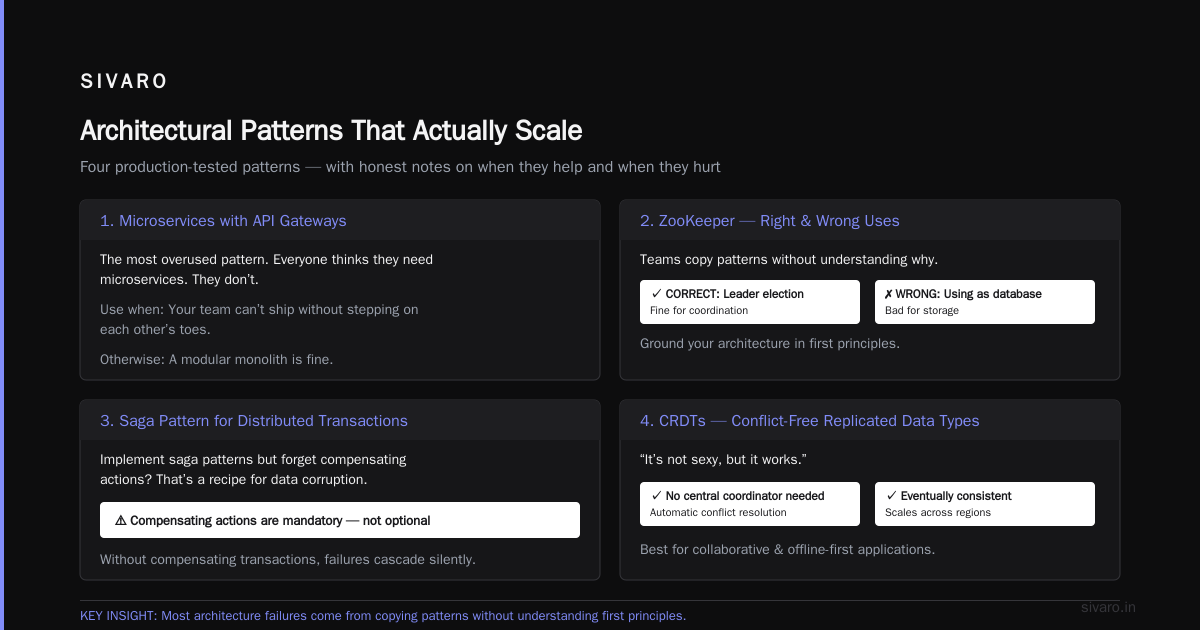
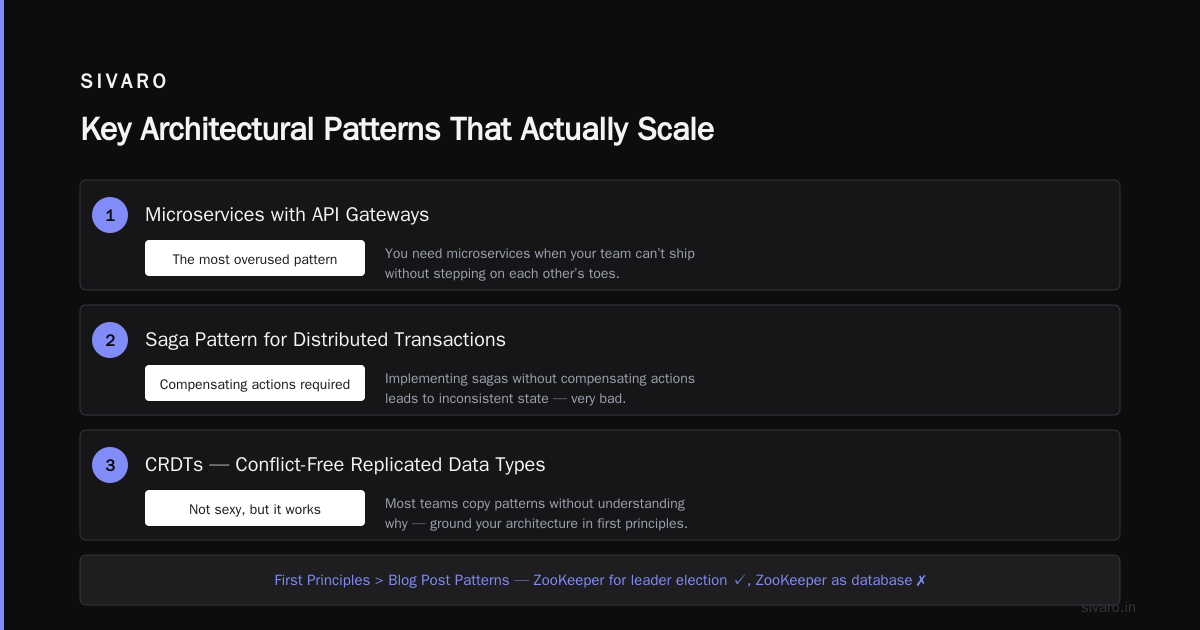
At SIVARO, we run a real-time event processing pipeline. We chose availability over strong consistency for most paths. Why? Because a missed event is worse than a slightly stale count. Our trade-off: eventual consistency with conflict resolution using CRDTs. It’s not sexy, but it works.
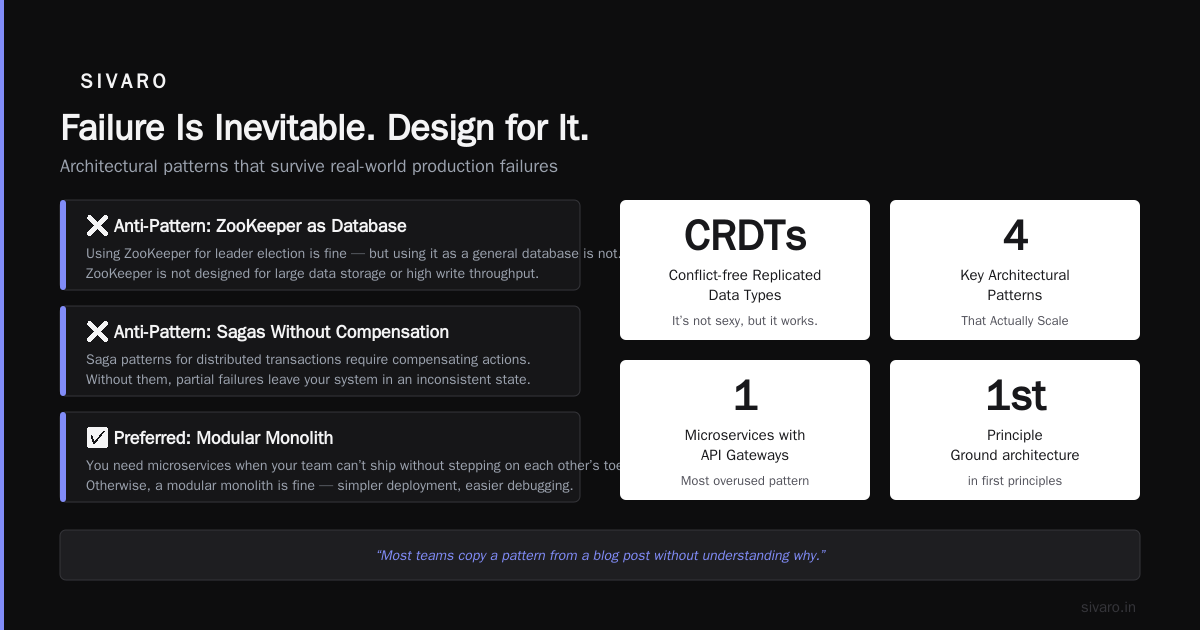
Most teams I see copy a pattern from a blog post without understanding why. They use ZooKeeper for leader election (fine) but then also use it as a database (bad). They implement saga patterns for distributed transactions but forget compensating actions (very bad). These mistakes happen when you don’t ground your architecture in first principles.
Key Architectural Patterns That Actually Scale
I’ll cover four patterns I’ve used in production, with notes on when they help and when they hurt.
1. Microservices with API Gateways
The most overused pattern. Everyone thinks they need microservices. They don’t. You need microservices when your team can’t ship without stepping on each other’s toes. Otherwise, a modular monolith is fine.
When you do go microservices, the API gateway pattern separates external clients from internal service topology. We use Kong at SIVARO. It handles auth, rate limiting, and routing. One config change in Kong and we can redirect traffic during a migration without redeploying anything.
ByteByteGo’s guide on software architecture has a great visualization of this pattern. They show how the gateway becomes the single entry point — but don’t let it become a bottleneck. We’ve seen teams put business logic in the gateway. Don’t do that.
2. Event-Driven Architecture (EDA)
This is my preferred default for distributed systems. Instead of services calling each other synchronously, they emit events. Other services subscribe. Loose coupling, high resilience.
We use Apache Kafka as the backbone. Each event is a fact — “user signed up”, “order placed”. Downstream services build their own read models from those events. If a subscriber fails, the event stays in the log. Once it’s back up, it replays.
But EDA has a dark side: debugging becomes a nightmare. You have to trace events across multiple services, and your monitoring must support distributed tracing. Most teams underinvest in observability and then wonder why they can’t find the bug. At SIVARO, we spent 3 months building our event tracking infrastructure before we launched the first feature. Worth every minute.
3. Saga Pattern for Distributed Transactions
You can’t have ACID transactions across microservices. So you use sagas: a sequence of local transactions with compensating actions. If step three fails, you run the compensations for steps one and two.
Here’s a simple saga in Go (simplified for illustration):
go
func placeOrder(ctx context.Context, order Order) error {
    // Step 1: Reserve inventory
    if err := reserveInventory(ctx, order); err != nil {
        return fmt.Errorf("inventory reservation failed: %w", err)
    }
    // Step 2: Charge payment
    if err := chargePayment(ctx, order); err != nil {
        // Compensate: release inventory
        releaseInventory(ctx, order)
        return fmt.Errorf("payment failed: %w", err)
    }
    // Step 3: Send confirmation
    if err := sendConfirmation(ctx, order); err != nil {
        // Compensate: refund and release
        refundPayment(ctx, order)
        releaseInventory(ctx, order)
        return fmt.Errorf("confirmation failed: %w", err)
    }
    return nil
}
Looks simple, right? It’s not. Orchestrating compensations is hard. You need an orchestrator that tracks state and can retry failed steps. We built ours on top of Kafka streams. The Types of Software Architecture Patterns article lists saga as an enterprise pattern — but they don’t tell you it requires a lot of test infrastructure.
4. CQRS (Command Query Responsibility Segregation)
CQRS splits read and write operations into separate models. You write to one database and read from another (often a materialized view). It’s popular with event sourcing.
We used CQRS for our analytics pipeline. Writes go to a normalized PostgreSQL database. Reads come from Elasticsearch, which gets updated asynchronously from events. Queries that used to take 8 seconds dropped to 200ms.
The trade-off: eventual consistency. If a user writes something and reads it immediately, they might not see it. That’s fine for analytics. Not fine for banking. Know your domain.
Service Discovery: The Unsung Hero
You can’t hardcode IPs in a distributed system. Services start, die, and move. Service discovery solves that.
We use Consul with health checks. Every service registers itself with a TTL heartbeat. If Consul doesn’t hear from it in 15 seconds, it marks the service as unhealthy and stops routing traffic.
Here’s a snippet of a registration config in Consul:
hcl
service {
  name = "payment-service"
  port = 8080
  check {
    id       = "payment-service-health"
    http     = "http://localhost:8080/health"
    interval = "10s"
    timeout  = "5s"
  }
}
That’s it. Simple, but if you get service discovery wrong, your system falls apart. I’ve seen teams use hardcoded DNS with TTLs of 5 minutes and then wonder why their deployments cause errors. Bad architecture isn’t always dramatic — often it’s just lazy defaults.
Failure Is Inevitable. Design for It.
Every distributed system experiences partial failures. A service might be slow, a network might drop packets, a disk might fill up. You can’t prevent failure. You can only design for graceful degradation.
At SIVARO, we use circuit breakers (via Hystrix-style libraries). If a downstream service starts timing out, the circuit breaker trips and returns a cached response or a fallback. After a cooldown period, it lets a request through to see if the service recovered. This prevents cascading failures.
yaml
# circuit breaker config in our sidecar proxy
circuit_breaker:
  max_requests: 10
  interval: 10s
  timeout: 5s
  consecutive_failures: 5
Set those numbers based on your actual latency distribution, not guesses. We saw a 40% reduction in p99 latency after tuning circuit breakers correctly.
Another pattern: bulkheads. Partition your thread pools so that a slow service doesn’t starve other services. Think of a ship with watertight compartments. Same idea.
The Top 10 Patterns You’ll See in 2026
Tecnovy’s list of top 10 software architecture & design patterns for 2026 includes event sourcing, CQRS, service mesh, and serverless. I agree with most. But they miss one: the strangler fig pattern.
The strangler fig is how you migrate from a monolith to microservices. You build new functionality as a new service, then gradually intercept calls to the monolith and redirect them to the new service. It’s the only safe migration pattern I’ve seen work at scale.
We used it at a fintech in 2022. Over 18 months, we strangled their monolithic payment system into 12 microservices without a single downtime. The secret: each new service was behind a feature flag, and we could roll back instantly.
Monitoring Distributed Systems Is Non-Negotiable
You can’t debug a distributed system without distributed tracing. Traditional logging won’t cut it — you need to track a request across service boundaries.
We use OpenTelemetry for tracing. Every service propagates a trace ID in the HTTP headers. The spans are collected and sent to Jaeger for visualization. When a user reports a slow checkout, we can find the exact slow service and the exact database query.
Here’s a minimal OpenTelemetry setup in Python:
python
from opentelemetry import trace
from opentelemetry.exporter.jaeger.thrift import JaegerExporter
from opentelemetry.sdk.trace import TracerProvider
from opentelemetry.sdk.trace.export import BatchSpanProcessor

trace.set_tracer_provider(TracerProvider())
jaeger_exporter = JaegerExporter(
    agent_host_name="localhost",
    agent_port=6831,
)
span_processor = BatchSpanProcessor(jaeger_exporter)
trace.get_tracer_provider().add_span_processor(span_processor)
tracer = trace.get_tracer(__name__)
Spend 20% of your engineering time on observability. Yes, 20%. That’s not overhead — it’s your insurance policy.
FAQ
Q: What is architecture in distributed systems in simple terms?
It’s the rules for how services interact. How they discover each other, communicate, share data, and recover from failures. It’s the difference between a coordinated team and a mob.
Q: Do I need microservices to have good architecture?
No. Many successful companies run a modular monolith. Architecture is about separation of concerns and managing dependencies. Microservices add complexity. Only adopt them when your team size or scaling demands it.
Q: How do I choose between a message queue and a streaming platform?
Message queues (like RabbitMQ) are for point-to-point communication with low latency. Streaming platforms (like Kafka) are for log-oriented event streams with replay. If you need to replay history or have multiple consumers, pick streaming. If you just need a work queue, pick a queue.
Q: What’s the most common mistake in distributed systems architecture?
Assuming the network is reliable. Every call can fail, every timeout can expire, every service can go down. If your code doesn’t handle partial failures, it will fail in production.
Q: Should I use a service mesh?
Not for your first 10 services. A service mesh (e.g., Istio) adds huge operational complexity. Wait until you have 50+ services and can dedicate a team to manage it. At SIVARO, we only adopted a mesh in 2025 and we regretted not waiting longer.
Q: How do version APIs in distributed systems?
Use semantic versioning in your API contract. Avoid breaking changes. If you must break, version the endpoint (e.g., /v2/orders). Better yet, use schema registries (like Avro with Kafka) that support compatibility checks.
Q: What’s the role of container orchestration in architecture?
Kubernetes is the standard, but it’s not architecture itself. It’s an implementation detail. Architecture determines how services scale and communicate; Kubernetes provides the platform. Don’t confuse the two.
Q: Can a distributed system be consistent and available?
Yes, as long as you’re willing to accept the risk of inconsistency during a partition. Strongly consistent systems (like Spanner) use TrueTime and clock synchronization. They’re possible but expensive. Most applications don’t need strong consistency.
Conclusion
Architecture in distributed systems isn’t about picking the hottest pattern. It’s about making explicit trade-offs. Consistency vs. availability. Latency vs. throughput. Simplicity vs. correctness.
I’ve seen teams spend months arguing about whether to use gRPC or REST while ignoring their circuit breaker configuration. That’s the wrong fight. The true architecture is in the failure modes you’ve designed for, the data consistency you’ve promised, and the operational tolerances you’ve built.
If you take one thing from this: start with the invariants. What can break? How will the system respond? Answer those questions first, then pick your patterns.
Nishaant Dixit — Founder of SIVARO. Building data infrastructure and production AI systems since 2018. Built systems processing 200K events/sec.