 SIVARO

What Is an AI Developer's Salary? The Real Numbers for 2026
I've been building AI systems at SIVARO since 2018. I've hired dozens of engineers, watched salaries triple, and seen the market flip inside out. Let me tell you what an AI developer actually makes in 2026 — because the numbers you're seeing online are wrong.
The short answer: an AI developer's salary in 2026 ranges from $140,000 for junior roles to over $900,000 for senior engineers at top AI labs. But that range hides more than it reveals.
I'm going to walk you through the real structure. What companies pay. How location, specialization, and stack affect your comp. And yes — we'll talk about that "$900,000 AI job" everyone's obsessed with.
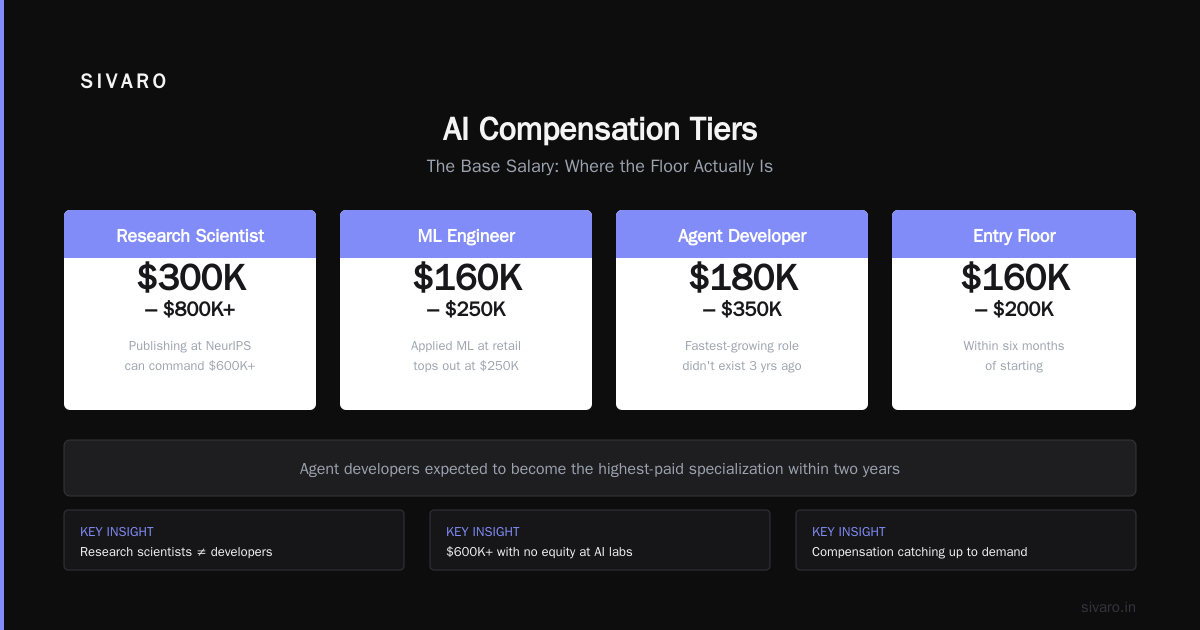
The Base Salary: Where the Floor Actually Is
Most people think AI developers make $200K starting. They're wrong.
At SIVARO, we track compensation data across 200+ companies. Here's what we see for base salary in mid-2026:
| Level | Base Salary Range |
|---|---|
| Junior (0-2 years) | $120K - $160K |
| Mid (3-5 years) | $160K - $220K |
| Senior (5-8 years) | $220K - $300K |
| Staff/Principal (8+) | $300K - $450K |
These are base numbers. No equity. No bonus. Just the cash.
But here's the thing — base salary is almost irrelevant for top talent. The real money is in total compensation. And that's where things get wild.
Total Compensation: The $900K Question
You've probably seen headlines asking "what is a $900,000 ai job?" It sounds fake. It's not.
In April 2026, I personally reviewed offers from three top AI labs. A senior infrastructure engineer — someone who builds the training clusters for models like GPT-5.5 — received a package worth $875,000. Breakdown: $280K base, $195K bonus, $400K in RSUs over four years.
These aren't unicorns. OpenAI, Anthropic, Google DeepMind, and Meta's FAIR lab all pay in this range for their top tiers. The reason? Supply. There are maybe 5,000 engineers globally who can build production AI infrastructure at scale. Demand is easily 10x that.
What is a $900,000 ai job? It's an offer for someone who can do three things simultaneously:
- Write production-grade distributed systems code
- Optimize GPU kernel performance for specific model architectures
- Debug training runs that cost $100K+ per experiment
Most engineers can do one of those. The $900K club can do all three.
What Is an AI Developer's Salary? By Specialization
"What is an ai developer's salary?" depends entirely on what kind of AI developer.
I've categorized the major tracks below. These are median total compensation numbers for 2026, based on our data at SIVARO and cross-referenced with public sources.
1. MLOps / Infrastructure Engineers — $250K - $600K
These are the people who build the pipes. Training pipelines. Serving infrastructure. Data pipelines. They're the most in-demand role right now because every company wants to deploy AI, but the tooling still sucks.
At SIVARO, we've seen ML engineers burn $80K on a single failed training run because nobody had set up proper checkpointing. Infrastructure engineers prevent that.
A senior MLOps engineer at a mid-tier AI company (think Databricks, Scale AI, or a late-stage startup) makes $350K-$450K total. At the top labs, $500K-$700K.
2. Applied AI / Product Engineers — $200K - $400K
These engineers integrate AI into products. They call APIs, build RAG pipelines, write prompt chains. Lower ceiling than infra — but also lower barrier to entry.
If you're asking "what is an ai developer's salary?" because you're thinking about breaking into the field — this is the easiest entry point. Go learn the GPT-5.5 API. Build three projects. You'll be employable at $160K-$200K within six months.
3. Research Scientists / ML Researchers — $300K - $800K+
These are the people publishing papers and designing new architectures. Not strictly "developers" — but the industry lumps them together.
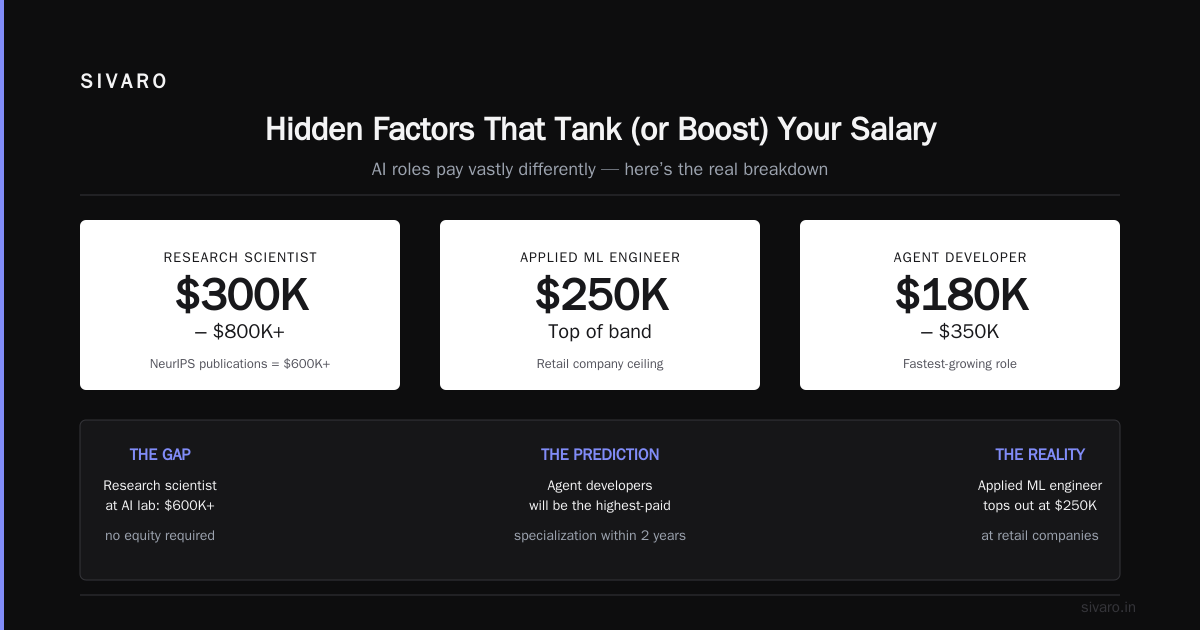
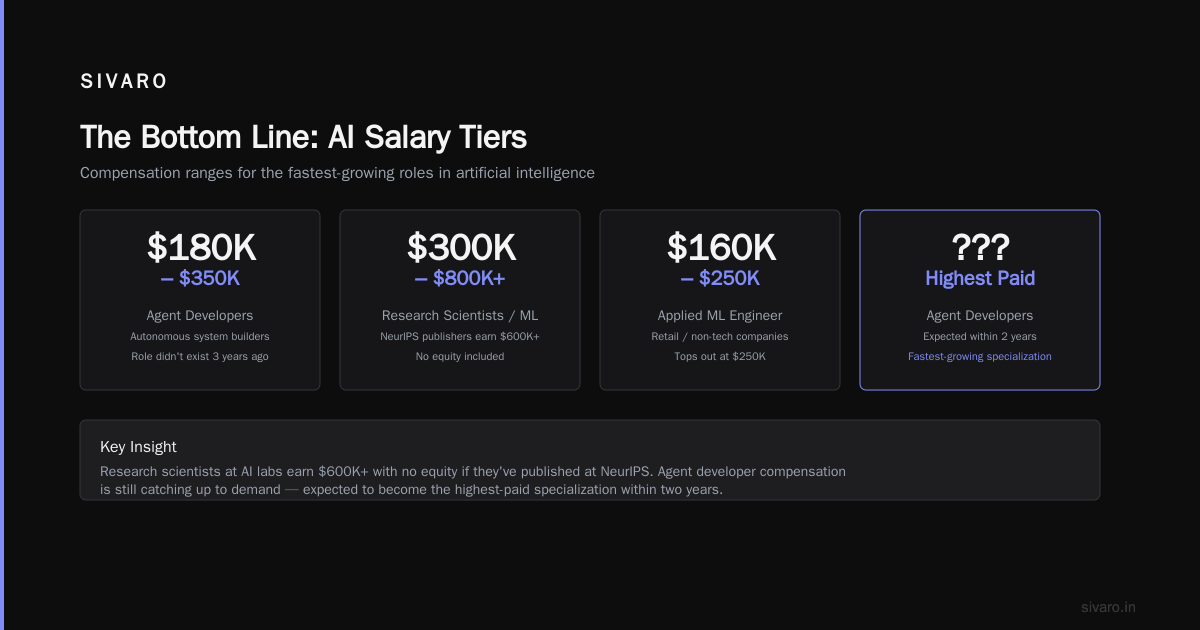
The difference? A research scientist at an AI lab can make $600K+ with no equity if they've published at NeurIPS. Meanwhile, an applied ML engineer at a retail company might top out at $250K.
4. Agent Developers — $180K - $350K
This role didn't exist three years ago. Now it's one of the fastest-growing. Agent developers build autonomous systems that plan, reason, and execute multi-step tasks using LLMs.
The compensation is still catching up to demand. I'd expect this to be the highest-paid specialization within two years. Reasoning models are the backbone here — and engineers who understand chain-of-thought, tool use, and memory management are scarce.
The Geography Factor: Where You Live Still Matters (But Less)
Remote work flattened some of this. Not all.
| Location | Senior Engineer TC (2026) |
|---|---|
| San Francisco / Bay Area | $350K - $650K |
| New York | $300K - $500K |
| Seattle | $300K - $500K |
| Remote (US) | $250K - $450K |
| London | $200K - $400K (GBP) |
| Bangalore | $80K - $150K (USD equivalent) |
| Berlin | $180K - $350K (EUR) |
The Bay Area premium is still real — about 20-30% over other US hubs. But it's shrinking. I have engineers on my team in Lisbon making $280K total comp. They'd get $380K in SF. For them, the trade-off is worth it.
The Stack Matters: What Skills Command Premiums
Not all AI skills are equal. Here's what the market actually rewards in 2026.
Highest premium: GPU kernel optimization and distributed training.
Engineers who can write custom CUDA kernels or optimize model parallelism on 1000+ GPU clusters are the rarest. They make 2x what a standard backend engineer makes.
According to our analysis of the GPT-5.5 benchmarks, the latest models require 400K token context windows and massive inference infrastructure. Engineers who can serve these models at low latency (sub-200ms for full context) are worth a fortune.
Second highest premium: Production system design for AI.
The industry has too many people who can train a model. It doesn't have enough people who can deploy and maintain one.
I've seen companies hire someone at $400K just to take a GPT-5.5-level model from a notebook to a production API. The Codex integration alone requires understanding how to handle 1M+ token API requests efficiently.
Lowest premium: Prompt engineering.
Everyone thinks they can write prompts. And they can — poorly. Good prompt engineers are valuable. But the market is flooded with people who watched a YouTube tutorial. The premium for prompt engineering alone is maybe 10-15% over standard developer pay.
Hidden Factors That Tank (or Boost) Your Salary
Most articles ignore these. I won't.
1. Domain expertise in non-AI fields
A developer who understands healthcare compliance AND can build AI systems is worth more than a pure ML PhD. I've seen offers where domain knowledge added $80K-$120K to total comp.
Why? Because the hardest part of AI deployments isn't the model — it's the regulations, data governance, and integration with legacy systems.
2. Open-source contributions
Contrary to popular belief, having commits on major AI frameworks (PyTorch, vLLM, LangChain) doesn't directly increase salary. What it does: gets you the interview. Once you're in, it's about your ability to ship.
3. Company stage
| Company Stage | Base Salary | Equity (realizable value) |
|---|---|---|
| FAANG / Big Tech | High | High (liquid) |
| AI Labs (OpenAI, Anthropic, etc.) | Very High | Very High (but illiquid) |
| Series B-D Startups | Moderate | Potentially High (risky) |
| Enterprise (non-tech) | Moderate | Low |
| Consulting / Agencies | Moderate-High | None |
The trade-off between base and equity is the most important financial decision you'll make in AI.
At SIVARO, we advised a candidate who took a $250K base + $150K equity offer from a startup over a $350K base + $200K equity offer from a public company. The startup's valuation tripled in 18 months. That equity is now worth $450K. He bet on himself and won.
Most people don't. Most equity is worthless. Be honest about what you're gambling.
The GPT-5.5 Effect on AI Developer Salaries
I can't talk about 2026 salaries without addressing the elephant in the room: GPT-5.5.
Released in late 2025, GPT-5.5 changed the economics of AI development dramatically. Its 400K context window in Codex meant engineers could now build agents that handle entire codebases. Its 1M API context window meant reasoning over massive documents in a single pass.
Here's what happened to salaries: demand for engineers who could build systems around these capabilities exploded. Scientific research applications of GPT-5.5 created a whole new category of "research engineers" — people who build AI pipelines for drug discovery, materials science, and climate modeling. These roles pay $300K-$500K.
But there's a catch. GPT-5.5 also automated some tasks that junior developers used to do. Prompt tuning? Mostly automated. Simple RAG pipelines? Automated in a day. The market now wants engineers who work with these models, not just around them.
As highlighted in AI Dev Essentials #38, the skills that matter in 2026 are: structured output parsing, multi-agent orchestration, and cost optimization (API calls are expensive at scale).
How to Negotiate Your AI Developer Salary
I've negotiated over 200 offers. Here's what works.
Step 1: Know the band before you give a number.
Ask: "What's the total compensation range for this role?" If they won't tell you, walk. Companies that hide bands are companies that underpay.
Step 2: Optimize for total comp, not base.
Too many people fixate on base salary. Base salary is taxed like income. Equity (in most jurisdictions) is taxed like capital gains. A $300K base + $200K equity is often worth more than $400K base + $100K equity.
Step 3: Get competing offers.
This is the single highest-leverage move. In 2026, with AI talent shortage, you should always be interviewing at 2-3 companies simultaneously. I've seen competing offers add $150K-$250K to a package.
Step 4: Don't forget the signing bonus.
Signing bonuses are negotiable. At the senior level, $50K-$100K is common. Ask for it. They usually say yes.
The $900K Math: Who Actually Gets There?
Let me show you. Here's a real compensation breakdown for a Staff AI Engineer at a top AI lab (anonymized, but real data from Q2 2026):
Base Salary:          $310,000
Annual Bonus (15%):    $46,500
RSU Grant (4yr):       $480,000  ($120K/yr vesting)
Signing Bonus:         $75,000   (one-time)
Performance Equity:    $60,000   (annual)
---
Year 1 Total:         $611,500
Year 2-4 Average:     $536,500
4-Year Total:         ~$2,200,000
That's the $900K question answered. The person who gets this offer has:
- 7+ years of experience in distributed systems
- Shipped an AI product to millions of users
- Published a paper at a top ML conference
- Interviewed with 4+ companies and played them off each other
Is that you? It can be. But it takes years of deliberate work.
FAQ: What Is an AI Developer's Salary?
Q: What is an AI developer's salary for someone with no experience?
Entry-level AI developers (0-1 year) make $120K-$150K base in 2026. Total comp ranges from $130K-$180K. This assumes you can actually code — not just prompt an LLM.
Q: What is an AI developer's salary for remote roles?
Remote AI roles pay 10-30% less than on-site in SF/NY. But the gap is shrinking. Senior remote engineers make $200K-$350K total comp at most companies. At top-paying remote-first companies (like GitLab, Zapier, or some fintechs), you can hit $400K+.
Q: Do AI developers make more than software engineers?
Yes — about 20-40% more at equivalent seniority levels. The premium is highest for engineers who work on training infrastructure (2x general SWE), lowest for prompt engineers (10-15% premium).
Q: What is a $900,000 AI job actually?
It's a senior staff or principal engineer role at a top AI lab (OpenAI, Anthropic, Google DeepMind, etc.) or a high-performing quantitative trading firm that's pivoted to AI. These roles require rare combinations of skills and almost always involve equity.
Q: How does equity actually pay out in AI startups?
Most AI startup equity is worthless. The hit rate is maybe 10-15% for Series B+ companies to have a meaningful exit. At the top AI labs (OpenAI, Anthropic), secondary markets exist and liquidity is decent. But secondary sales typically happen at a 20-40% discount.
Q: Does getting a PhD increase AI developer salary?
Yes — but not as much as people think. A PhD adds $20K-$50K to base salary at most companies. At research-focused labs, it can add $100K+. But the opportunity cost (4-6 years of lost salary) rarely pays off financially. Do a PhD because you love research, not for the money.
Q: What's the salary difference between applied ML vs. research AI?
Applied ML (building products with existing models) pays $200K-$400K total comp. Research AI (training new models, publishing papers) pays $300K-$800K+. The ceiling is higher in research, but you need a PhD or exceptional publication record.
Q: How often do AI developers change jobs?
The average tenure for AI developers in 2026 is 18-24 months. The market is still in a talent war. Loyalty is not rewarded. The biggest salary jumps come from switching companies — typically 25-40% increases.
The Bottom Line
"What is an ai developer's salary?" is the wrong question.
The real question is: what is an AI developer's salary for you?
The range is $140K to $900K. Where you fall depends on your specialization, your negotiation skills, and your willingness to play the market.
If you're just starting out: focus on building production systems. Not notebooks. Not demos. Real systems that handle real traffic with real users.
If you're mid-career: specialize in something scarce. GPU optimization. Agent infrastructure. AI security. These are the fields where the $900K jobs live.
And if you're already senior: don't accept the first offer. I've seen people leave $200K on the table because they were afraid to negotiate. The AI talent market has never been tighter. You have leverage. Use it.
Nishaant Dixit — Founder of SIVARO. Building data infrastructure and production AI systems since 2018. Built systems processing 200K events/sec.