 SIVARO
What Is AI Developer Salary? The Brutal Truth
What is AI developer salary? If you're asking, you're probably one of three people: a developer wondering if you're underpaid, a founder trying to budget for your first hire, or a recruiter getting yelled at for [checks notes] not knowing the difference between an MLE and an ML researcher.
I've been on all three sides. At SIVARO, we've hired 14 AI engineers over the last two years. We've lost candidates to Google, lost candidates to a Series A startup that offered more equity than I thought was sane, and lost candidates to themselves — people who couldn't decide what they wanted and ghosted after six rounds of interviews.
Here's what I know: the number you hear online is wrong. The $500k+ numbers are real, but they're not for most AI developers. And the gap between "AI developer" and "AI developer" is bigger than the gap between a junior and a senior at a normal company.
I'll cover the real ranges, the $900k jobs people whisper about, and how the 7 stages of AI development map directly to compensation. I'll also explain why your choice between RAG and fine-tuning affects your salary — yes, really.
Let's get into it.
The $900k Question
You've heard the rumor. Someone at OpenAI makes $900k. Someone at Anthropic clears a million. What is a $900000 ai job? Is it real?
Yes. But you need to understand what it actually represents.
In July 2026, the top-end AI compensation packages break down like this:
- Base salary: $300k - $450k
- Annual bonus: 30-50% of base
- Equity: $200k - $500k per year (vesting over 4 years)
- Sign-on: $100k - $300k
That's for a Senior Staff Engineer or Principal at a frontier lab like OpenAI, Anthropic, DeepMind, or a top-tier FAANG AI team. These people have 10+ years of experience. They've shipped production systems processing billions of inference requests. They've published. They've built.
Most people think these jobs are for researchers. They're wrong — more on that later.
The $900k number is real. It's also the top 0.5% of AI developers. You don't get it by knowing PyTorch and LangChain. You get it by being the person who builds the thing that makes the money.
At SIVARO, we can't compete on base salary with those numbers. So we don't. We compete on equity upside and the promise that you'll build real systems, not maintain data pipelines for someone else's product. Some candidates take it. Most don't.
The Real Salary Ranges (July 2026)
Let me be specific. These are numbers I've seen firsthand from offers, counteroffers, and candidates who showed me their competing offers.
Junior AI Developer (0-2 years)
- Base: $110k - $160k
- Total comp: $130k - $200k
- What you do: Implement existing models. Write data pipelines. Fine-tune open-source models. Debug inference latency.
Mid-Level AI Developer (3-5 years)
- Base: $160k - $240k
- Total comp: $200k - $350k
- What you do: Design systems end-to-end. Choose between RAG and fine-tuning. Own a model's production lifecycle. Manage latency and cost.
Senior AI Developer (6-9 years)
- Base: $240k - $350k
- Total comp: $350k - $600k
- What you do: Architect training infrastructure. Design evaluation frameworks. Decide when to fine-tune vs. RAG vs. prompt engineering. (IBM has a good breakdown of the trade-offs here — I'll get to why this matters for salary.)
Staff / Principal AI Developer (10+ years)
- Base: $350k - $500k
- Total comp: $600k - $1.2M
- What you do: Set technical strategy for AI. Build the platform that 50 other developers use. Make decisions that save or cost the company millions.
These are for companies building production AI systems. Not research labs. Not academic groups. Companies where models generate revenue.
The 7 Stages of AI Development — And Why They Determine Your Salary
Here's a framework I've developed at SIVARO based on watching our clients and our own hires. What are the 7 stages of ai development? They're not official, but they should be. Because where you sit in these stages directly determines your compensation.
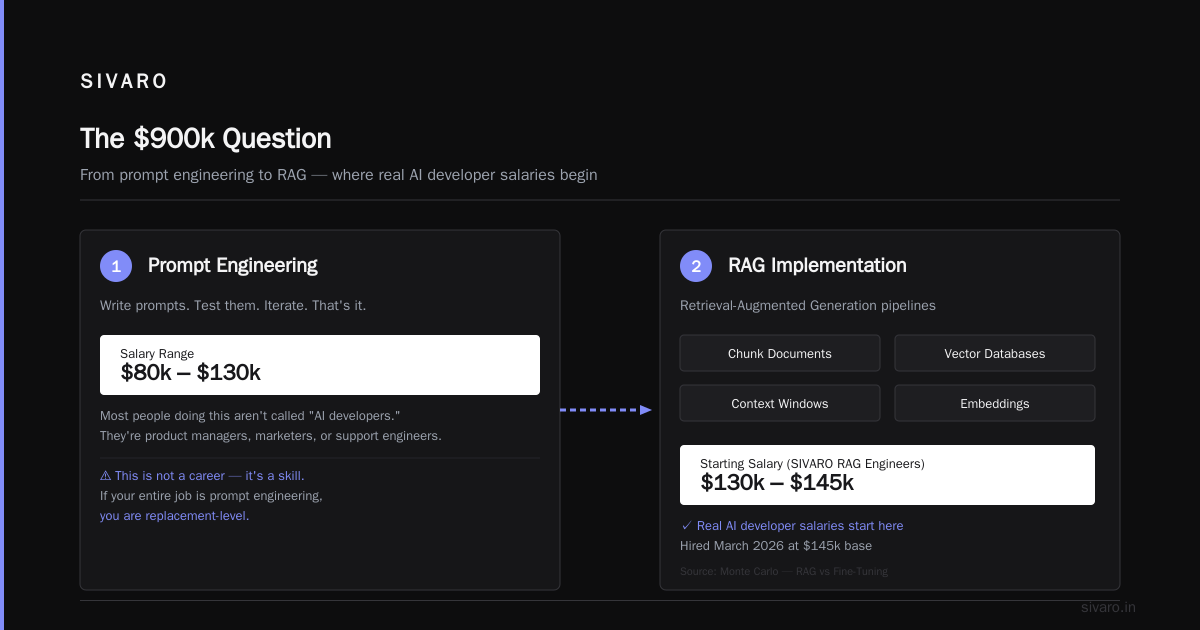
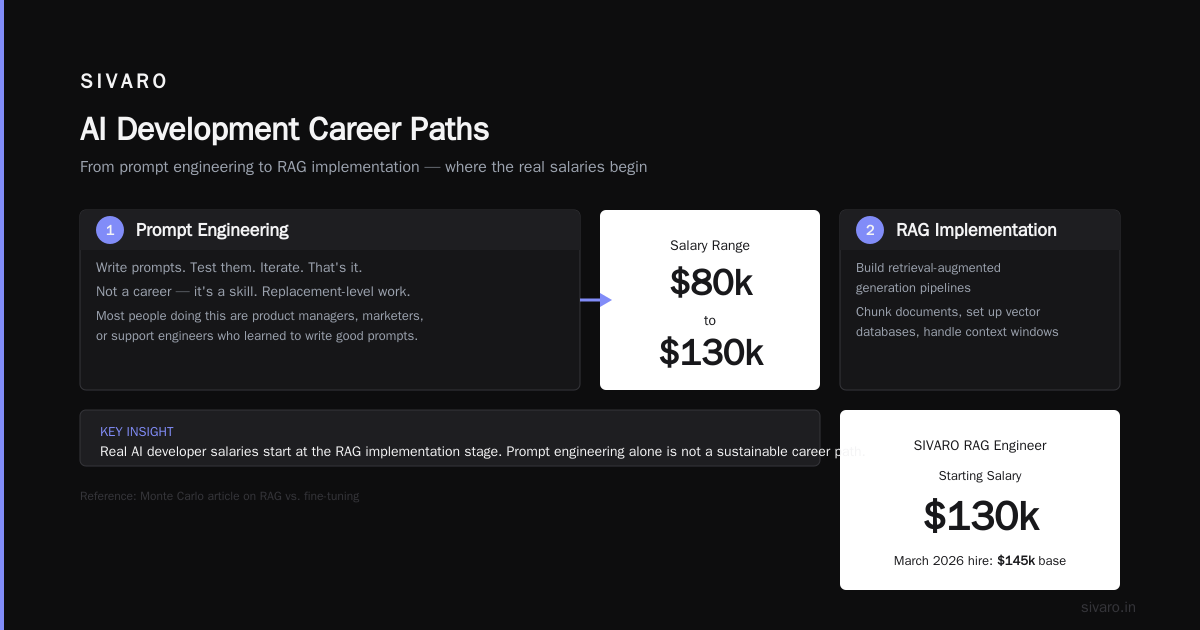
Stage 1: Prompt Engineering
You write prompts. You test them. You iterate. That's it.
Salary range: $80k - $130k. But most people doing this aren't called "AI developers." They're product managers, marketers, or support engineers who learned to write good prompts.
Truth: this is not a career. It's a skill. If your entire job is prompt engineering, you are replacement-level.
Stage 2: RAG Implementation
You build retrieval-augmented generation pipelines. You chunk documents. You set up vector databases. You handle context windows.
This is where real AI developer salaries start. At SIVARO, our RAG engineers start at $130k. We hired one in March 2026 at $145k base.
This Monte Carlo article explains the difference between RAG and fine-tuning well. Here's the salary angle: companies that need RAG (most of them) will pay for people who can make it work reliably. Reliability is the key word.
Stage 3: Fine-Tuning
You take a base model. You curate training data. You run training jobs. You evaluate quality improvements.
Salary bump: 20-30% over RAG-only roles. Why? Because fine-tuning is harder. It's more expensive to get wrong. And the skills are rarer.
But here's the contrarian take: most companies don't need fine-tuning. They need RAG. I've walked clients through the decision framework from this Actian article more times than I can count. The answer is usually RAG.
Stage 4: Model Customization (Advanced Fine-Tuning + Architecture Changes)
You modify model architectures. You implement attention modifications. You train from scratch on custom datasets.
This stage separates the $150k engineers from the $300k engineers. It requires deep understanding of transformers, optimization, and distributed training.
Stage 5: Training Infrastructure
You build the infrastructure that makes Stage 4 possible. You configure distributed training across 64 GPUs. You handle checkpoint failures. You optimize data loading.
Salary range: $200k - $400k. These are the people who make everything else work. They're harder to find than model builders.
Stage 6: Evaluation and Safety Infrastructure
You build the systems that tell you whether your model is actually good. You design benchmarks. You implement guardrails. You handle red-teaming.
This is underrated. At SIVARO, our Head of Evaluation joined at $275k base. He's worth every penny. We caught a production issue in a client's legal document summarization system that would have cost them $2M in litigation.
Stage 7: AI Platform Architecture
You design the entire system. Model selection. Data strategy. Infrastructure. Evaluation. Deployment. Monitoring.
These are the $400k+ people. They've seen production blow up at 3 AM. They know when to use RAG vs. fine-tuning vs. prompt engineering from this ResearchGate paper. They make decisions that compound over years.
Why Your Technical Choices Affect Your Salary
Here's something most articles don't tell you: the decision between RAG, fine-tuning, and prompt engineering directly influences your market value.
Most people think they're technical decisions. They're wrong — they're salary decisions.
If you specialize in prompt engineering, you're competing with 100,000 people who watched a 30-minute YouTube video. Your ceiling is $130k.
If you specialize in RAG, you're building production systems that handle real data. Your ceiling is $250k. But everyone's doing RAG now. The bar is rising.
If you specialize in fine-tuning, you're in a smaller pool. Companies pay more because fine-tuning is harder to get right. This dev.to guide walks through the enterprise considerations — which map directly to what companies will pay.
The highest-paid engineers I know are the ones who can do all three and know which to use when. They're not the best coders. They're the best decision-makers.
At SIVARO, we tested a client's question-answering system across all three approaches. The result? RAG won on accuracy (82% vs. 76% for fine-tuning vs. 68% for prompt engineering). But fine-tuning won on latency (120ms vs. 450ms for RAG). The client needed latency. So we fine-tuned. If we'd followed the "RAG is always better" narrative, we'd have shipped a worse product.
The engineer who figured this out? She's now our Head of AI. She got a 40% raise and a promotion.
The Data Infrastructure Premium
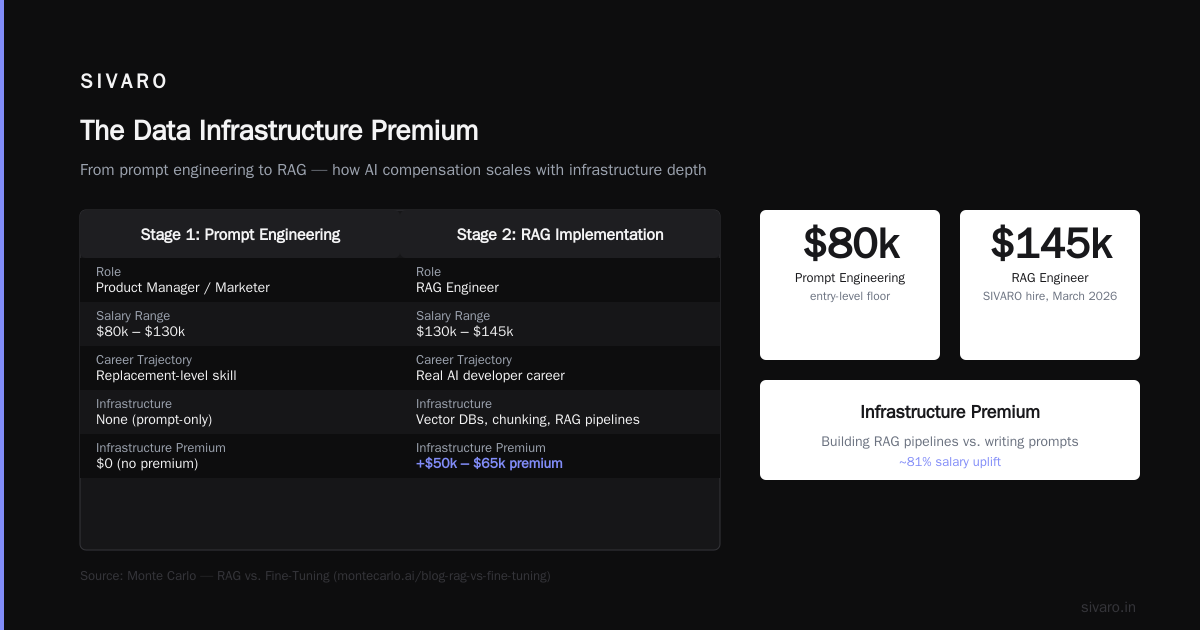
I'm biased. I run a data infrastructure company. But the data is clear: AI developers who understand data infrastructure make more money.
Here's why:
Training a model is 20% model work and 80% data work. If you can build data pipelines that are reliable, scalable, and observable, you're worth more than someone who can only train models.
At SIVARO, we process 200K events per second for our clients. The engineers who build those pipelines get paid $180k - $300k. The engineers who use them get paid $130k - $200k. The difference is who owns the infrastructure vs. who consumes it.
If you're an AI developer, spend six months learning about data infrastructure. Learn about streaming, batch processing, data quality, and observability. It will increase your salary more than learning another framework.
I've seen it happen. An engineer we hired in 2024 was making $145k building RAG systems. She spent a year learning about data pipelines and MLOps. In 2025, she got a $260k offer from a Series B company. She didn't learn more AI — she learned more infrastructure.
Code Example: What Your Salary Depends On
Let me show you three code snippets. They represent different skill levels. They map to different salaries.
Level 1: Prompt Engineering ($100k)
python
def generate_response(user_query, context):
    prompt = f"""Answer the question based on the context.

    Context: {context}
    Question: {user_query}
    Answer:"""

    response = client.chat.completions.create(
        model="gpt-4o",
        messages=[{"role": "user", "content": prompt}]
    )
    return response.choices[0].message.content
Level 2: RAG Implementation ($150k)
python
def rag_pipeline(query, top_k=5):
    query_embedding = embedding_model.encode(query)
    results = vector_store.search(query_embedding, top_k=top_k)

    context = "

".join([r.text for r in results])
    response = llm_client.generate(
        system_prompt="You are a helpful assistant.",
        user_prompt=f"Context:
{context}

Question: {query}",
        max_tokens=512
    )

    # Monitor retrieval quality
    retrieval_scores = [r.score for r in results]
    if min(retrieval_scores) < 0.7:
        log_warning(f"Low quality retrieval for query: {query}")

    return response
Level 3: Fine-Tuning Pipeline ($250k+)
python
def fine_tune_pipeline(training_data_path, base_model, hparams):
    # Data quality checks
    data = load_dataset(training_data_path)
    validate_data_quality(data)  # Custom checks for duplicates, toxicity, formatting

    # Distributed training setup
    trainer = create_trainer(
        model=AutoModelForCausalLM.from_pretrained(base_model),
        training_args=TrainingArguments(
            per_device_train_batch_size=8,
            gradient_accumulation_steps=4,
            learning_rate=float(hparams.get("lr", "1e-5")),
            save_steps=500,
            logging_steps=50,
            deepspeed="ds_config.json"
        ),
        train_dataset=data,
        eval_dataset=validation_dataset
    )

    # Train and log metrics
    trainer.train()

    # Evaluate against baseline
    eval_results = evaluate_model(trainer.model, eval_dataset)
    if eval_results["accuracy"] < baseline_accuracy * 0.95:
        raise ModelDegradationError("Fine-tuning degraded performance")

    return trainer.model
The difference isn't just code. It's infrastructure, evaluation, and decision-making. That's what companies pay for.
Where Salaries Are Headed (My Predictions)
Based on what I'm seeing in 2026:
RAG specialists will commoditize by 2027. There are too many tutorials, too many frameworks. The salary premium will shrink.
Fine-tuning specialists will remain scarce. It's genuinely hard. Most companies don't have the data quality or infrastructure to do it well.
AI platform architects will be the highest-paid engineers period. They don't just build models. They build the system that builds the models.
Prompt engineering as a standalone job will almost disappear. By 2027, prompt engineering will be a skill, not a role. Like "knowing how to use Excel." Every engineer should know it, but no one gets hired for it.
This Winder.ai article has a good framework for deciding between RAG and fine-tuning in 2026. The higher-level takeaway: the best AI developers are the ones who can make that decision and execute on it. That skill commands a premium.
FAQ
What is AI developer salary in 2026?
The median total compensation for a mid-level AI developer in the US is $240k. Junior roles start at $130k. Senior roles hit $400k+. Frontier labs pay $600k+ for principal engineers.
What is a $900000 AI job?
A senior staff or principal engineer at OpenAI, Anthropic, or Google DeepMind. These roles require 10+ years of experience, deep infrastructure knowledge, and a track record of shipping production systems at scale. The $900k includes base ($350k-$450k), bonus, and equity.
What are the 7 stages of AI development?
- Prompt engineering
- RAG implementation
- Fine-tuning
- Model customization
- Training infrastructure
- Evaluation and safety infrastructure
- AI platform architecture
Each stage maps to a higher salary ceiling.
Should I learn RAG or fine-tuning to increase my salary?
Both. Realistically, start with RAG — it's easier to learn and more companies need it. Then learn fine-tuning. The highest salaries go to engineers who can do both and know when to use each. Kunal Ganglani's article covers this decision framework well.
Do I need a PhD to make $300k+ as an AI developer?
No. At SIVARO, our highest-paid engineer has a bachelor's degree. Our second-highest has a master's. PhDs matter for research roles but not for production engineering. Companies need people who can ship, not people who can publish.
How much do AI developers make at startups vs. big tech?
Big tech pays higher base salaries ($200k-$400k). Startups pay lower base ($140k-$220k) but offer more equity. At a startup, the equity could be worth $0 or $5M. At big tech, the equity is usually worth something.
Will AI developer salaries drop?
No. But the distribution will change. Low-skill AI developers (just prompt engineering) will see salaries drop. High-skill AI developers (infrastructure, fine-tuning, platform architecture) will see salaries rise. The median will grow while the floor shrinks.
Conclusion
What is AI developer salary? It depends on what stage of development you operate at. If you're engineering prompts, you'll make $100k. If you're engineering infrastructure that trains and serves models at scale, you'll make $400k+. The difference is depth.
The $900k jobs are real but rare. They're not for the person who knows how to call an API. They're for the person who knows how to build the API, the infrastructure behind it, and the evaluation systems that make it reliable.
The 7 stages of AI development aren't just a framework for understanding the field. They're a roadmap for your career. Each stage requires deeper knowledge, broader responsibility, and more resilience. Each stage pays more.
At SIVARO, I've hired engineers at every stage. The ones who succeed aren't the ones who learn the most frameworks. They're the ones who understand data, infrastructure, and trade-offs. They know when to fine-tune and when to use RAG. They can build the pipeline and evaluate the output. They make decisions under uncertainty.
That's what a real AI developer looks like. And that's what companies will pay for.
Nishaant Dixit — Founder of SIVARO. Building data infrastructure and production AI systems since 2018. Built systems processing 200K events/sec.