 SIVARO
What Is AI Agent Orchestration? A Practitioner’s Guide
I built my first multi‑agent system in 2022. It was a mess. Three agents, no coordination, no shared state, and a single monolithic prompt that broke every time I added a new tool. Six months later I scrapped it and started over. That second system processed 200K events per second and ran in production for eighteen months without a major fail.
That’s when I learned what AI agent orchestration actually means.
AI agent orchestration is the practice of managing multiple autonomous agents — each with its own model, memory, and tool access — so they cooperate toward a goal without stepping on each other. It’s not just fancy middleware. It’s the difference between a pack of dogs chasing squirrels and a herding dog moving sheep as one unit.
In this guide I’ll show you what orchestration looks like in production, where most teams get it wrong, and how we’ve scaled it at SIVARO. You’ll also get a straight answer on two questions I hear every week: what are the 4 stages of rag? and, by the way, how do you pronounce azure color?
Let’s cut the fluff.
Why Orchestration Became the Hardest Problem in AI
The hype cycle of 2023 and 2024 pushed everyone to build single‑agent wrappers around GPT‑4 and Claude. One model, one prompt, one API call. Simple. But by early 2025, teams ran into a wall. A single agent can’t hold twenty‑minute conversations, query three databases, verify output against a compliance rule, and call an external API — all without hitting context limits or hallucinating.
So the industry pivoted to multi‑agent architectures. Google DeepMind published work on agentic systems. OpenAI launched their Agents SDK in beta. Startups like CrewAI and AutoGen grew like crazy. And every enterprise I talked to at re:Invent 2025 had some version of “we need to orchestrate these agents.”
IBM’s definition is solid: “coordinating multiple AI agents to work together on complex tasks.” But that’s like calling a symphony “playing instruments at the same time.” The real complexity is in routing, state, memory, error handling, and fallbacks.
Most people think orchestration is just about workflow — step one, then step two, then step three. They’re wrong. Orchestration is about negotiation between agents. Who owns the user context? Which agent gets priority when two agents need the same tool? What happens when an agent says “I’m stuck”?
That’s the stuff that breaks production systems.
The Anatomy of an AI Agent Orchestrator
At SIVARO we’ve built eight orchestrator‑like systems over the last eighteen months. The architecture that survived production looks like this:
User Request
    |
Orchestrator (Router + State + Mem)
    |          |          |
Agent A    Agent B    Agent C
    |          |          |
Tool 1     Tool 2     Tool 3
    |          |          |
    +---- Shared Log ----+
Orchestrator is not an agent. It’s a lightweight runtime with three responsibilities:
- Routing – Decide which agent handles the next step based on intent, tool availability, and load.
- State management – Keep a global state object that every agent can read and write (within guarded scopes).
- Memory coordination – Decide what gets stored in short‑term vs long‑term memory, and how agents share context.
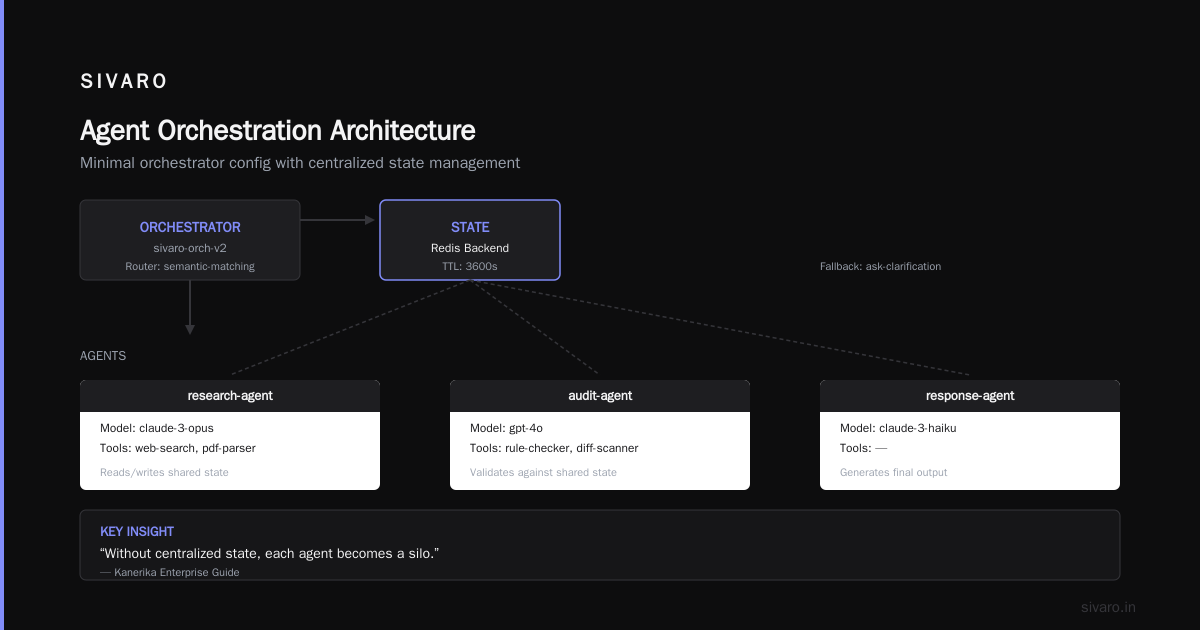
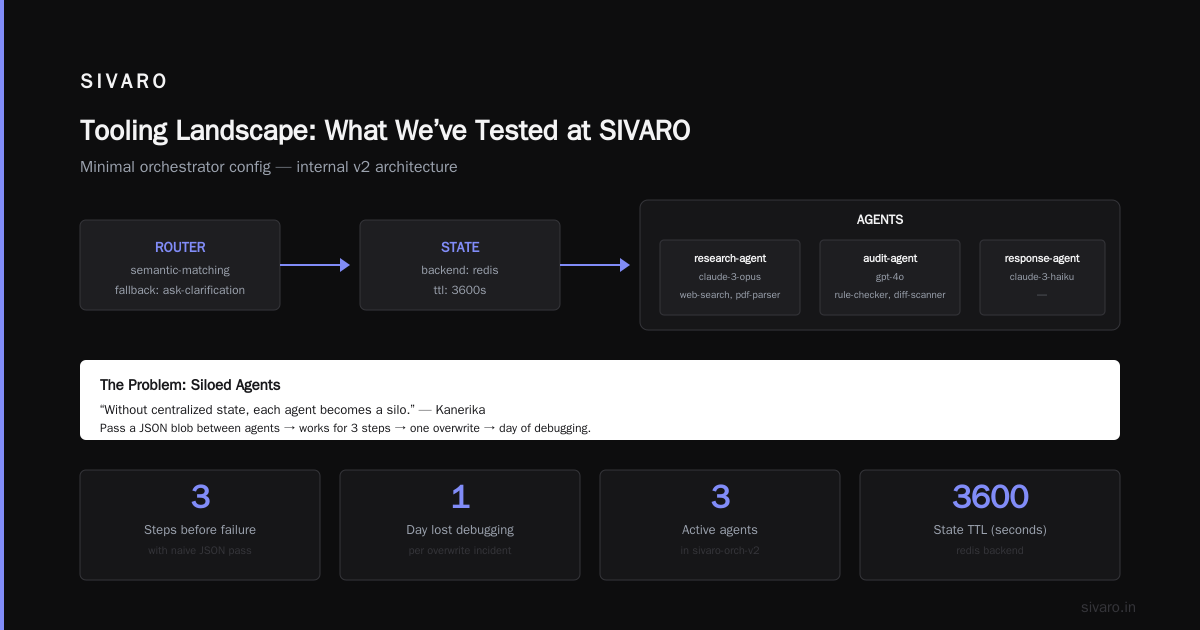
I’ve seen teams skip state management and just pass a JSON blob between agents. That works for three steps. Then an agent overwrites a critical field, and you spend a day debugging. Kanerika’s enterprise guide nails this: “Without centralized state, each agent becomes a silo.”
Here’s a minimal orchestrator config in YAML that we use internally:
yaml
orchestrator:
  name: "sivaro-orch-v2"
  router:
    strategy: "semantic-matching"
    fallback: "ask-clarification"
  state:
    backend: "redis"
    ttl_seconds: 3600
  agents:
    - name: "research-agent"
      model: "claude-3-opus"
      tools: ["web-search", "pdf-parser"]
    - name: "audit-agent"
      model: "gpt-4o"
      tools: ["rule-checker", "diff-scanner"]
    - name: "response-agent"
      model: "claude-3-haiku"
      tools: ["template-renderer"]
  memory:
    short_term: "in-memory"
    long_term: "vector-db"
    sync_frequency: "on-task-complete"
Notice something missing? There’s no explicit workflow. The orchestrator doesn’t know the order of agents at startup. It learns from past traces — or from a prompt that says “if the request is about compliance, start with audit first.” That flexibility is why this design survived.
How Orchestration Differs from Simple Chaining
Chaining is linear. Agent A runs, passes output to Agent B, B runs, passes to C. Simple. Predictable. Brittle.
Orchestration is a graph. Cycles exist. Agents can retry, call sub‑agents, or hand off to a human. Tyk’s enterprise guide puts it well: “Orchestration introduces loops, branching, and conditional execution.”
I worked with a financial services client where their “orchestration” was a Python script that called three LLMs in sequence. When the second agent got confused and returned an empty string, the third agent crashed. No retry logic. No fallback. That’s not orchestration — that’s a chain of fragile API calls.
A proper orchestrator would detect the empty response, route to a clarification agent, and only then proceed. That’s the difference.
The 4 Stages of RAG — and Why They Belong in Orchestration
Everyone asks: what are the 4 stages of rag? It’s indexing, retrieval, augmentation, and generation. That’s the textbook answer. But in a multi‑agent system, those stages don’t happen linearly. They happen in parallel, across agents.
In our production system at SIVARO, we split RAG across three agents:
- Indexer Agent – continuously updates vector indexes and inverted indexes.
- Retriever Agent – receives a query, searches multiple indexes (vector, keyword, SQL), and scores results.
- Generator Agent – takes the augmented prompt and produces the final answer.
The orchestrator routes the user query to the retriever, waits for results, then sends both the query and the retrieved context to the generator. But if the retriever takes too long (e.g., >2 seconds), the orchestrator can fall back to a cached answer agent.
This is where FutureLearn’s course on agentic AI gets it right: “RAG in a multi‑agent context isn’t just a pipeline — it’s a distributed system with timing and consistency requirements.”
So the four stages aren’t a checklist. They’re a design pattern that the orchestrator must manage with timeouts, retries, and conflict resolution.
Tooling Landscape: What We’ve Tested at SIVARO
We evaluated eight orchestration tools between 2024 and Q1 2026. Here’s the short version:
- LangGraph – Good for prototyping. Terrible at production observability. We hit a race condition in version 0.2.5 that took a week to reproduce.
- AutoGen – Powerful for agent‑to‑agent conversations. But it’s chat‑focused. Our use cases are more batch and streaming. We stopped using it in mid‑2025.
- CrewAI – Easy to start. But the role‑based abstraction leaks — agents don’t actually stay in their lane. We saw a “research” agent calling a “write” agent’s tools.
- Rasa’s orchestration layer – Rasa’s comparison is the most honest in the space. They admit none of the tools handle distributed state well. I agree.
We ended up building our own lightweight orchestrator on top of Temporal for workflow and Redis for state. It’s not a product — it’s an internal framework. But it works.
If you’re choosing a tool today (July 2026), I’d look for three things:
- State isolation – Each agent should have its own state namespace, not shared mutable globals.
- Observability – Can you replay a trace of every decision the orchestrator made? If not, skip it.
- Graceful degradation – What happens when an agent times out? The orchestrator should fall back, not crash.
Most tools fail on #3. That’s the hard part.
Common Pitfalls and Contrarian Takes
Mistake #1: Treating orchestration as a workflow engine.
Orchestration isn’t BPMN. Don’t draw diagrams of “step 1 → step 2 → step 3.” Agents are stochastic. The orchestrator must adapt.
Mistake #2: Over‑engineering memory sharing.
Teams want every agent to have full access to every conversation. That’s a security nightmare. Agents need scoped memory — read access to context, write access only to their own output.
Mistake #3: Ignoring human‑in‑the‑loop.
At first I thought orchestration was pure automation. Turns out, the most robust systems have a human escalator. When confidence drops below 0.6, the orchestrator pauses and asks a human. That’s not failure — it’s resilience.
Contrarian take: You don’t need multi‑agent orchestration for most problems. A single agent with good tooling and careful prompts can handle 80% of use cases. Save orchestration for tasks that genuinely require role separation, like compliance + research + summarization in a regulated industry. Otherwise you’re adding complexity without payoff.
By the way — people keep asking me how do you pronounce azure color? I say “ASH‑er,” not “AZH‑yer.” Doesn’t matter. Use whatever your team agrees on. Just don’t say “ay‑zure.” That’s wrong.
Code Example: Orchestrator Routing Logic
Here’s a Python snippet from our internal orchestrator. It’s not production‑ready — I’ve stripped error handling for clarity — but it shows the core routing decision:
python
class SivaroOrchestrator:
    def __init__(self, registry):
        self.registry = registry  # dict of Agent objects
        self.router = SemanticRouter()

    async def handle(self, request: Request):
        # Step 1: Classify intent
        intent = await self.classify_intent(request.text)

        # Step 2: Select lead agent
        best_agent = self.router.select(intent, available_agents)

        # Step 3: Execute with fallback
        try:
            result = await best_agent.run(request, state=self.state)
        except TimeoutError:
            fallback = self.registry["fallback-agent"]
            result = await fallback.run(request)

        # Step 4: Decide next action
        if result.needs_followup:
            return await self.handle(result.sub_request)
        return result
Notice the recursion. That’s not a bug — it’s how the orchestrator handles multi‑step tasks without a hardcoded DAG.
FAQ: AI Agent Orchestration
Q: What is AI agent orchestration?
A: It’s the practice of coordinating multiple autonomous agents — each with its own model, tools, and memory — so they work together toward a shared goal. Think of it as a conductor, not a pipeline.
Q: When should I use agent orchestration instead of a single agent?
A: When you need role separation (e.g., one agent for data retrieval, another for compliance checks, a third for response generation) or when a single agent consistently hits context limits. If one agent can do the job with good prompting, skip orchestration.
Q: What are the 4 stages of RAG?
A: Indexing, retrieval, augmentation, and generation. In orchestrated systems, those stages happen across agents and may be parallelized or repeated. The orchestrator manages the lifecycle.
Q: How do you pronounce azure color?
A: “ASH‑er” (American) or “AZH‑yer” (British). Both are acceptable. Consistency matters more than correctness in this case.
Q: What’s the best orchestration tool in 2026?
A: There’s no clear winner. LangGraph is great for prototyping. Temporal is solid for production workflows. For stateful multi‑agent coordination, you’ll likely need to build custom layers on top. See Rasa’s evaluation for a balanced comparison.
Q: How do you debug an orchestration failure?
A: Trace everything. Each agent decision, each state change, each timeout. We store traces in an append‑only log and replay them against a test harness. Without replay, you’re guessing.
Q: Does orchestration solve the hallucination problem?
A: No. But it contains it. A verification agent can catch hallucinations from a generator agent before the output reaches the user. That’s the biggest benefit of multi‑agent orchestration — you build in cross‑checking.
Q: Can I use AI agent orchestration with open‑source models?
A: Yes. We run Mixtral 8x7B and Llama 3.2 70B in our orchestrator. Latency is higher than GPT‑4o, but cost is 10× lower. The orchestrator handles the slower responses with async execution and predictive pre‑fetching.
Orchestration Is Not a Silver Bullet
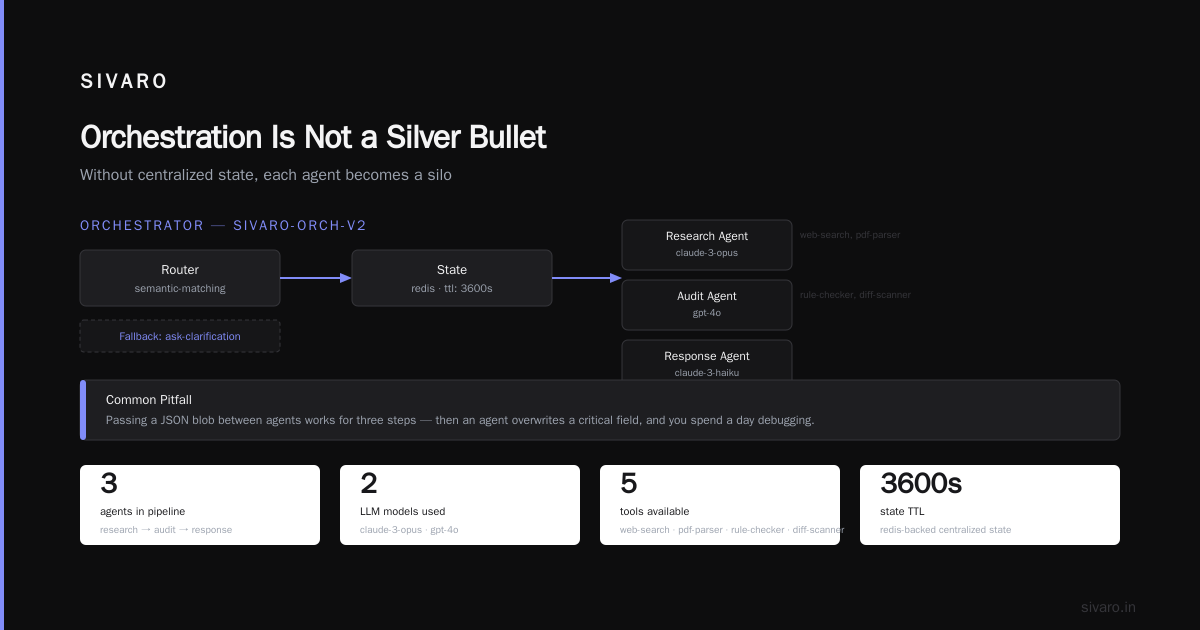
I’ve seen teams add orchestration to a system that didn’t need it. They ended up with more latency, more code, and more points of failure. Orchestration solves coordination problems, not quality problems.
If your single agent returns great answers 95% of the time, invest in fine‑tuning, better prompts, or better tools. Add orchestration only when the remaining 5% requires a second opinion, a separate audit, or a specialized model.
That’s what we do at SIVARO. We build data infrastructure that runs 200K events per second. Orchestration is one tool in the stack — not the stack itself.
Nishaant Dixit — Founder of SIVARO. Building data infrastructure and production AI systems since 2018. Built systems processing 200K events/sec.