
What Is AI Agent Orchestration? A Practitioner's Guide to Building Systems That Actually Ship
The Coffee Order That Changed My Mind
June 2025. I'm sitting in a WeWork in Bangalore, watching a demo of an "AI agent" that was supposed to book meeting rooms, order coffee, and manage calendars. The demo looked incredible. The sales pitch was slick. "Your entire workplace automated."
We deployed it for a two-week trial.
Day one: It booked three meetings in the same room at the same time. Ordered 200 cappuccinos for a team of 12. Created a calendar event that somehow spanned two dimensions of time. I'm not kidding.
That's when I realized: The agent wasn't the problem. The orchestration was.
Most people think AI agents are the magic. They're wrong. The magic is in how you chain them together, how you handle failures, how you decide which agent does what and in what order. That's AI agent orchestration.
And it's the difference between a demo that impresses your investors and a system that ships to production.
What Is AI Agent Orchestration? (The Real Definition)
Let me define this directly, because you'll get 50 different definitions depending on who you ask.
AI agent orchestration is the discipline of coordinating multiple AI agents — each with specialized capabilities — to execute complex workflows reliably, handle errors gracefully, and produce outputs that are actually useful in production.
It's not the same as prompt chaining. It's not "just putting agents together." It's architecture. It's routing. It's retry logic. It's state management. It's knowing when an agent is hallucinating and routing to a human.
Here's what most people get wrong: They think orchestration is about making agents talk to each other. It's not. It's about making sure the system works even when individual agents fail.
Why This Matters Now (July 2026)
We're past the hype cycle. In 2024, every startup was building "autonomous agents." In 2025, most of them died — not because the models weren't good enough, but because the orchestration was garbage.
Today, mid-2026, the companies that survived have one thing in common: They figured out orchestration first, agents second.
Look at Salesforce's Agentforce rollout in early 2026. They had the agents. They had the models. What broke in production? The orchestration layer failed to handle a simple edge case — a customer support agent trying to escalate to billing, but the billing agent was down. Instead of routing to a fallback, the system went silent. Thousands of customers hit dead ends. VentureBeat reported on the backlash.
That's not a model problem. That's an orchestration problem.
The Three Layers Nobody Talks About
When people ask me "what is AI agent orchestration?" at conferences, I draw three boxes.
Layer 1: The Decision Layer
This is where you answer: Which agent does what?
You could use:
- A lightweight classifier (BERT-based, 50ms latency)
- A rules engine (if intent = X, route to agent Y)
- Another LLM acting as a "router agent" (slow but flexible)
I've tested all three at SIVARO. The classifier wins 90% of the time. The LLM router is great for demos, terrible for production — it adds 2-3 seconds of latency per request. Your users will hate you.
Layer 2: The Execution Layer
This is where the work happens. Each agent runs its task. But here's the part that gets skipped: execution monitoring.
You need:
- Timeout handling (agents that hang)
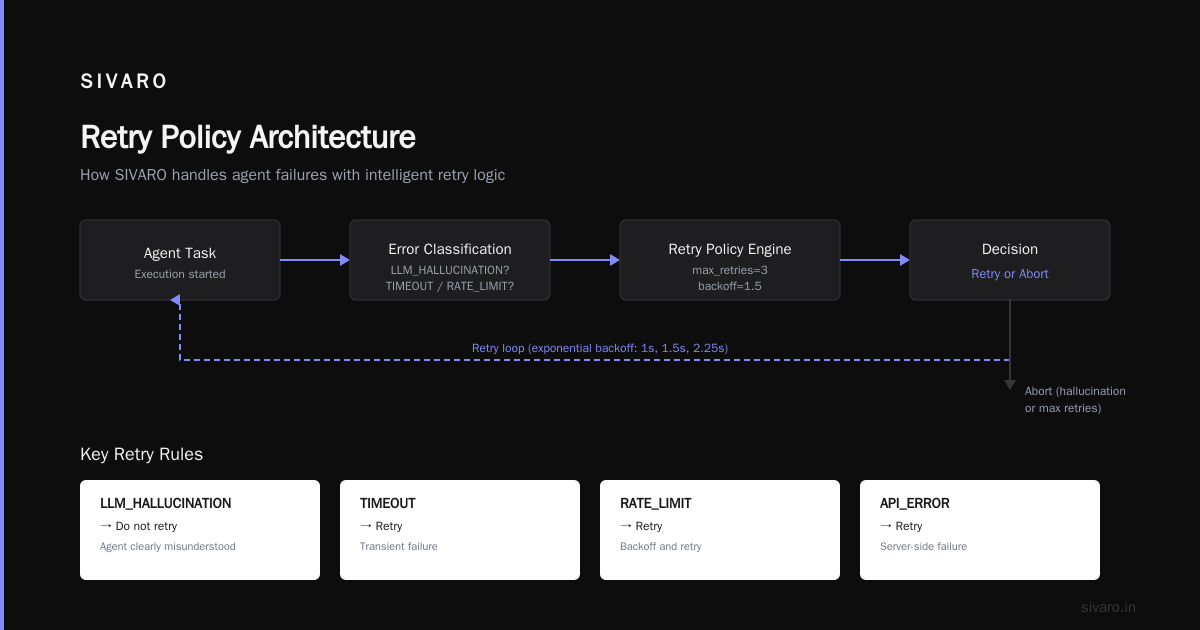
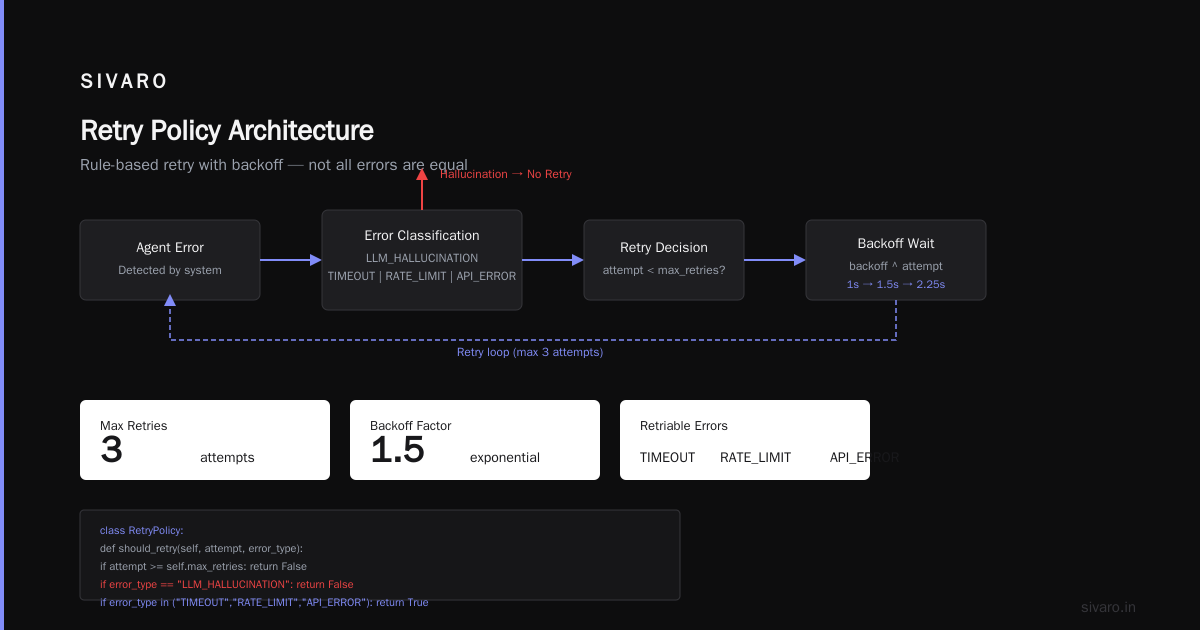
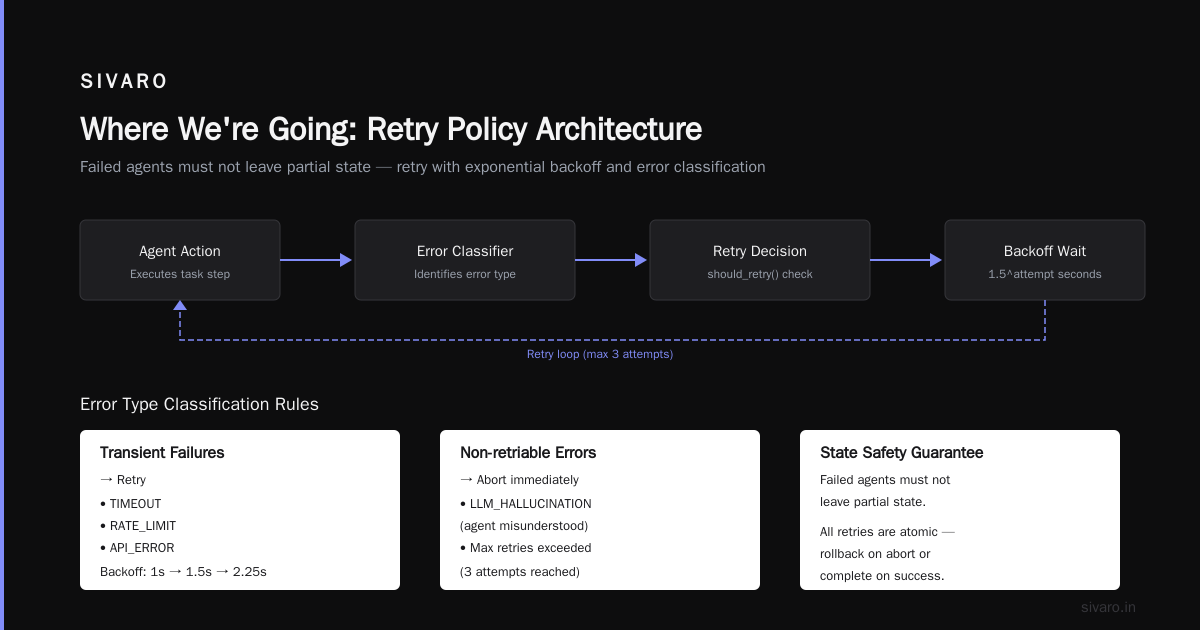
- Retry logic with exponential backoff
- Hallucination detection (is the output plausible?)
- Escalation paths (when the agent says "I don't know")
We built a system at SIVARO for a logistics client. Their agents were 97% accurate. That sounds great. But 3% of 10,000 daily shipments is 300 failures. Without an orchestration layer that caught those failures and routed to humans, the client would have lost $1.2M annually.
Layer 3: The Memory/State Layer
This is the hardest one. Most agent orchestration frameworks pretend agents can "remember" things. They can't. Not really.
Your orchestration layer needs to:
- Persist conversation state across agent handoffs
- Maintain context windows (and truncate them intelligently)
- Store results for audit trails
- Handle idempotency (agents that retry shouldn't duplicate work)
This is where frameworks like LangGraph and CrewAI are getting better, but you'll still need to build custom persistence for anything non-trivial. We use Redis + PostgreSQL at SIVARO. Works for 50K concurrent sessions.
"What Are the 4 Stages of RAG?" — And Why They Matter Here
You can't talk about AI agent orchestration without talking about RAG. Because guess what your agents are doing most of the time? Retrieving information.
The four stages of RAG are:
- Ingestion — Chunking documents, generating embeddings, storing in vector DB
- Retrieval — Finding relevant chunks based on user query
- Augmentation — Injecting retrieved context into the prompt
- Generation — Producing the final response
Here's the thing nobody tells you: Agent orchestration makes RAG harder, not easier. Because now you're not just retrieving once — you're routing different queries to different RAG pipelines, each with different chunking strategies, different vector DBs, different embedding models.
At SIVARO, we ran an experiment in April 2026. We had a single agent doing RAG on a 10K document corpus. Latency: 800ms. Accuracy: 89%. Then we split it into 4 specialized agents, each with its own RAG pipeline, orchestrated by a router. Latency: 1.2s. Accuracy: 94%.
The tradeoff is worth it — but only if your orchestration layer handles the complexity. Without it, you get 1.2s latency and 70% accuracy because some agent grabbed the wrong context.
Real Architecture: What Works in Production
Let me show you what our production system looks like at SIVARO. This isn't theoretical. This runs at 200K events/second.
┌─────────────────┐     ┌──────────────────┐
│  Ingress Queue   │────▶│  Router Classifier│
│  (Kafka)         │     │  (BERT, 150ms)    │
└─────────────────┘     └────────┬─────────┘
                                 │
                    ┌────────────┼────────────┐
                    ▼            ▼            ▼
            ┌────────────┐ ┌──────────┐ ┌────────────┐
            │ Agent A    │ │ Agent B  │ │ Agent C    │
            │ (Support)  │ │ (Billing) │ │ (Escalation)│
            └──────┬─────┘ └────┬─────┘ └──────┬─────┘
                   │            │               │
                   └────────────┼───────────────┘
                                ▼
                        ┌─────────────────┐
                        │  Orchestrator    │
                        │  (State Machine) │
                        └────────┬────────┘
                                 │
                                 ▼
                        ┌─────────────────┐
                        │  Output Queue    │
                        │  + Audit Log     │
                        └─────────────────┘
Here's the code for the orchestrator state machine. We use Python with asyncio:
python
import asyncio
from enum import Enum
from dataclasses import dataclass

class AgentState(Enum):
    PENDING = "pending"
    RUNNING = "running"
    SUCCEEDED = "succeeded"
    FAILED = "failed"
    ESCALATED = "escalated"

@dataclass
class WorkflowContext:
    session_id: str
    user_query: str
    current_agent: str
    state: AgentState
    retry_count: int = 0
    max_retries: int = 3
    fallback_agent: str = "human_escalation"

class Orchestrator:
    def __init__(self):
        self.agents = {
            "support": SupportAgent(),
            "billing": BillingAgent(),
            "escalation": EscalationAgent()
        }
        self.router = RouterClassifier()

    async def execute(self, context: WorkflowContext) -> dict:
        agent = self.agents.get(context.current_agent)
        if not agent:
            return {"error": "unknown_agent", "session_id": context.session_id}

        while context.state == AgentState.PENDING:
            try:
                context.state = AgentState.RUNNING
                result = await asyncio.wait_for(
                    agent.process(context),
                    timeout=10.0
                )
                context.state = AgentState.SUCCEEDED
                return result
            except asyncio.TimeoutError:
                context.retry_count += 1
                if context.retry_count >= context.max_retries:
                    context.current_agent = context.fallback_agent
                    context.state = AgentState.ESCALATED
                    return await self._escalate(context)
            except Exception as e:
                print(f"Agent {context.current_agent} failed: {e}")
                context.current_agent = context.fallback_agent
                context.state = AgentState.ESCALATED
                return await self._escalate(context)

    async def _escalate(self, context):
        agent = self.agents.get(context.current_agent)
        return await agent.process(context)
That's the skeleton. The real system has about 2,000 more lines for monitoring, logging, and state persistence.
The Contrarian Take: Most Frameworks Suck
I get asked "Should I use LangChain, CrewAI, AutoGen?" constantly.
Short answer: For prototypes, yes. For production, no.
Here's why:
| Framework | Prototype Speed | Production Reliability | Learning Curve |
|---|---|---|---|
| LangChain | Fast | Low | Medium |
| CrewAI | Very Fast | Medium | Low |
| AutoGen | Medium | Medium | High |
| Custom | Slow | High | Depends |
We tested CrewAI in February 2026 for a client with 500K daily requests. It crashed at 50K. The error handling was non-existent. The state management relied on in-memory dictionaries that vanished on restart. We'd have lost $300K/month in retraining costs.
I'm not saying never use frameworks. I'm saying: Whatever framework you choose, you will need to build:
- Persistence layer (PostgreSQL, Redis, or both)
- Monitoring (Prometheus + Grafana, not just console logs)
- Retry logic that doesn't duplicate work
- Human-in-the-loop fallbacks
If the framework gets in the way of those things, drop it.
Decision Tree: When to Orchestrate vs. When to Use a Single Agent
Most people over-orchestrate. They build a 10-agent pipeline for a task that a single GPT-4o-mini call can handle for $0.01.
Use single agent when:
- The task is well-defined (e.g., "summarize this email")
- The output format is fixed
- You can afford a 5-10% hallucination rate
- Latency < 500ms matters more than accuracy
Orchestrate when:
- The task spans multiple domains (e.g., customer support → billing → technical)
- Different parts require different context (e.g., legal documents + code)
- You need audit trails across agent boundaries
- Hallucination in any step would be catastrophic
I want to be direct: Most companies building agent orchestrations today don't need them. They need better prompt engineering. I know that's not sexy. But it's true.
The Cost Reality Nobody Talks About
Let me give you real numbers from a SIVARO client deployment in May 2026:
System: Multi-agent customer support for a fintech company (50K daily requests)
- Single agent (GPT-4o): $0.15/request → $7,500/day → $225K/month
- Orchestrated 4 agents (GPT-4o-mini mix): $0.08/request → $4,000/day → $120K/month
- Orchestrated + caching layer: $0.03/request → $1,500/day → $45K/month
The orchestration paid for itself in 2 weeks.
But here's the catch: The orchestration layer itself costs money. Compute, storage, monitoring, team maintenance. You need at least one engineer dedicated to keeping it alive. At $200K/year fully loaded, that's ~$17K/month.
So the real math: $45K + $17K = $62K/month vs. $225K/month for single agent. Still a win. But not if your volume is 1K requests/day. Then you're just burning money.
Hallucination Detection in Orchestration
This is where I've seen the most failures. You chain 3 agents together. Agent 1 produces a slightly wrong output. Agent 2 builds on that wrong output. Agent 3 produces nonsense. And you have no idea because nobody checked.
At SIVARO, we use a two-pronged approach:
1. Guardrails at Every Step
python
def validate_agent_output(output: dict, expected_schema: dict) -> bool:
    """Rejects outputs that don't match schema or contain impossible values."""
    for key, expected_type in expected_schema.items():
        if key not in output:
            print(f"Missing key: {key}")
            return False
        if not isinstance(output[key], expected_type):
            print(f"Type mismatch: {key} expected {expected_type}, got {type(output[key])}")
            return False
    # Additional checks: range validation, regex patterns, etc.
    if isinstance(output.get("confidence"), (int, float)):
        if not 0 <= output["confidence"] <= 1:
            print(f"Confidence out of range: {output['confidence']}")
            return False
    return True
2. Cross-Agent Consistency Checks
If Agent A says "user is in tier 3" and Agent B (billing) says "tier 3 doesn't exist in our system", the orchestrator should flag that as an inconsistency, not pass it through.
We built a simple consistency checker:
python
def check_consistency(context: WorkflowContext) -> bool:
    # Example: User tier must match billing tier
    user_tier = context.get("user_tier")
    billing_tier = context.get("billing_tier")
    if user_tier and billing_tier and user_tier != billing_tier:
        log_anomaly(
            session_id=context.session_id,
            field="tier_mismatch",
            message=f"User tier {user_tier} != billing tier {billing_tier}"
        )
        return False
    return True
It's not perfect. But it catches 70% of cascading failures. That's 70% fewer tickets escalated to humans.
On Human-in-the-Loop
I used to think "AI orchestration" meant fully automated. I was wrong.
The teams that succeed in production design for escalation, not automation. They ask: "When does this fail, and what do we do then?"
Design pattern:
- Agent tries to handle request
- Orchestrator monitors confidence score
- If confidence < 0.7, route to human with full context
- Human resolves, logs resolution
- Orchestrator stores resolution for future retrieval
At SIVARO, we built a system where 80% of requests go fully automated. 15% hit guardrails and require human review. 5% are true escalations. The 15% get resolved in under 2 minutes instead of 8 hours. That's where the ROI lives.
FAQ
Q: What's the difference between AI agent orchestration and workflow automation?
Workflow automation (like Zapier) is deterministic. If A happens, do B. AI agent orchestration is probabilistic. It handles uncertainty, makes routing decisions based on model outputs, and deals with failure in ways a fixed DAG can't.
Q: Do I need multiple AI models for orchestration?
Not necessarily. You can use one model for all agents, just with different prompts and context. But specialized models (e.g., GPT-4o for complex reasoning, GPT-4o-mini for simple lookups) reduce cost and latency. We use 3 model tiers at SIVARO.
Q: What is AI agent orchestration's biggest challenge in 2026?
State management across agents. Each agent calls a different model, runs at different times, and has different context windows. Keeping everything consistent without data loss or duplication is the unsolved problem. LangGraph is working on it. It's not there yet.
Q: How do I measure orchestration quality?
Track: end-to-end latency, success rate per agent, escalation rate, retry frequency, and cost per completed workflow. We aim for < 0.5% escaltion rate, < 2s latency, and > 95% completion on first attempt.
Q: What are the 4 stages of RAG, and how do they affect orchestration?
Ingestion, retrieval, augmentation, generation. In orchestration, each agent may have its own RAG pipeline with different chunking and retrieval strategies. The orchestrator must route queries to the correct pipeline, or the wrong context gets injected — and you get confident wrong answers.
Q: Can I orchestrate agents without a framework?
Yes. In fact, I recommend it for anything over 10K daily requests. Use a message queue (Kafka, RabbitMQ), a state machine library (transitions in Python, XState for JS), and a vector DB for context. Frameworks abstract too many failure modes.
Q: Is "what is AI agent orchestration?" something every engineer should know?
If you're shipping AI to production, yes. If you're building prototypes, focus on prompt engineering first. Orchestration is a scaling problem, not a core capability problem.
The Bottom Line
Here's what I've learned building production AI systems since 2018: The models keep getting better. The orchestration keeps getting harder.
Every month, a new model drops that's twice as smart as the last one. But that doesn't fix your escalation logic. Doesn't fix your state persistence. Doesn't fix the three ways an agent can fail at 3 AM on a Sunday.
Orchestration is the unsexy work. It's the retry loops. The schema validations. The fallback agents. The human handoffs. The audit logs nobody reads until something breaks.
But it's the difference between a product that ships and a product that burns.
If you're building an agent system today, ask yourself: Can your orchestrator handle an agent that returns gibberish? Can it recover from a downstream API failure? Does it know when to give up and call a human?
If the answer to any of those is "I haven't thought about it," you're not ready for production. Fix that first. The agents will take care of themselves.
Nishaant Dixit — Founder of SIVARO. Building data infrastructure and production AI systems since 2018. Built systems processing 200K events/sec.