 SIVARO
What Is a Synonym for Temporal? (A SIVARO Engineer’s Guide)
I’ll cut straight to the answer: there isn’t one perfect synonym. Temporal is a word that collapses into different meanings depending on context. You don’t want a thesaurus entry. You want to know which synonym to use when.
At SIVARO, we process 200K events/second for clients in finance, logistics, and AI inference. Half those events are time-series data — sensor readings, trade timestamps, model inference latencies. The word temporal shows up in every architecture review I’ve sat through since 2018. And I’ve watched teams waste days debating whether something is “temporal” or “transient” or “timely” while their database schema bleeds.
This guide gives you the practical synonym map. Not just from thesauruses — I’ve annotated each synonym with the use case you’ll actually hit in production systems. Plus real code examples and a FAQ that answers the question “what is a synonym for temporal?” in the way that matters: when you’re building something that needs to resist entropy.
Let’s start with the why.
Why You Care About the Word “Temporal” Right Now
It’s July 23, 2026. Every infrastructure conversation has a temporal dimension — time-series databases (TimescaleDB, InfluxDB, ClickHouse), event streaming (Kafka, Redpanda), temporal computing (yes, I mean Temporal.io the workflow engine). The word is everywhere. And we misuse it constantly.
Most people think “temporal = temporary”. They’re wrong because… read the Merriam-Webster thesaurus. It lists 84 similar and opposite words. Temporary is only one contemporary sense. The deeper meaning is pertaining to time — and that’s a completely different animal when you’re designing a data pipeline.
At SIVARO last month, a client asked: “Is our event store temporal or just chronological?” I couldn’t answer until I knew which synonym they were reaching for. Was it ephemeral (short-lived events)? Secular (non-spiritual, worldly)? Time-bound (expiring keys)? The whole architecture hinged on a single word.
Here’s how to stop guessing.
The Six Synonym Buckets (and When to Use Each)
The main thesauruses — Thesaurus.com (55 words), Collins, Cambridge, YourDictionary — all converge on these six clusters. I’ve mapped each to a real engineering scenario.
1. Time-related, not eternity-related
Synonyms: chronological, timed, time-based, horological
Use this when you’re talking about the fact that something lives on a timeline. A database index sorted by timestamp is chronological. A Kafka message with a header ts: 1712345678 is timed. Neither is temporary. Both are temporal in the purest sense.
Example from production: We had a PostgreSQL timescale table partitioning by day. The architect kept calling it “temporary partitioning”. Wrong. It was “time-based partitioning”. The synonym confusion led to a retention policy bug — they deleted rows thinking they were temporary. Lesson: use chronological when the focus is ordering, not duration.
2. Finite / Short-lived
Synonyms: transient, ephemeral, fleeting, momentary, passing, temporary, brief, impermanent, short-term
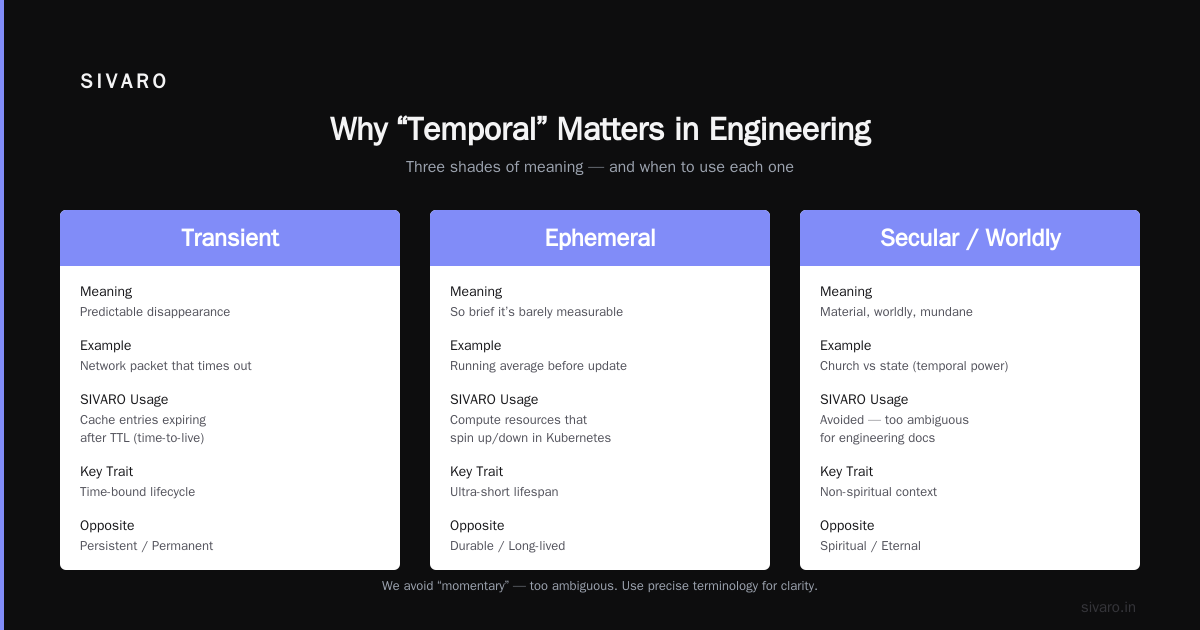
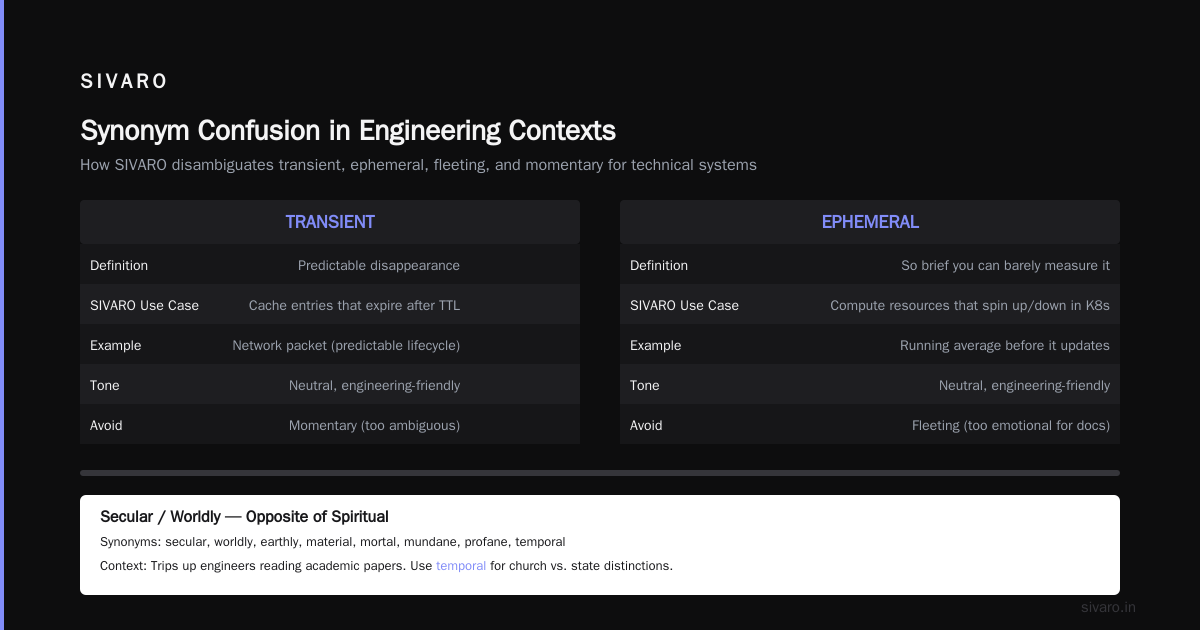
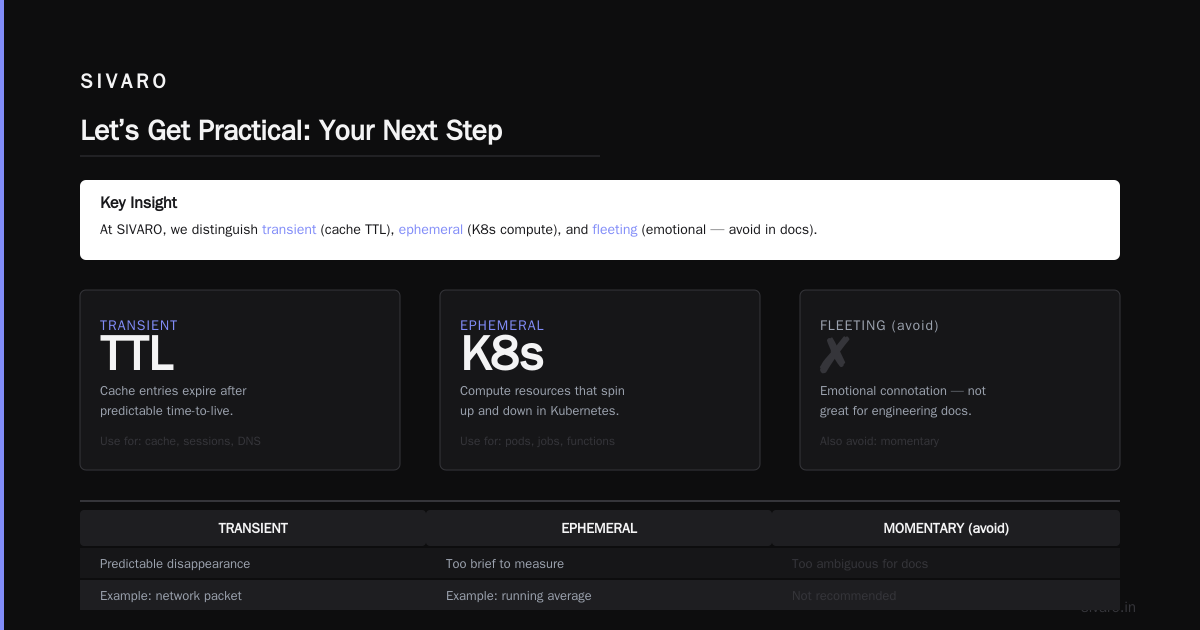
This is the meaning most non-technical people reach for. But even here, the shade matters. Transient implies a predictable disappearance (like a network packet). Ephemeral suggests something so brief you can barely measure it (like a running average before it updates). Fleeting is emotional — not great for engineering docs.
At SIVARO, we use transient for cache entries that expire after TTL (time-to-live). We use ephemeral for compute resources that spin up and down in Kubernetes. And we avoid momentary — too ambiguous.
3. Secular / Worldly (opposite of spiritual)
Synonyms: secular, worldly, earthly, material, mortal, mundane, profane, temporal (church vs state)
This one trips up engineers reading academic papers. In philosophy, temporal often means “of this world, not eternal”. In a technical context, you’ll mostly see it in API docs from religions or historical databases. Unless you’re building a system that tracks doctrine changes (I know a team that does), you can ignore this bucket.
4. Grammatical tense markers
Synonyms: present, past, future, preterite, aorist, perfect
Natural language processing systems use temporal to mean tense. If you’re building an NLP pipeline, the synonym you need might be past-tense or future-tense. The Synonym.com entry lists grammatical categories. I’d reach for tense-related instead of temporal in commit messages. Save “temporal” for temporal logic.
5. Time-domain (physics / signals)
Synonyms: time-domain, time-variant, time-dependent, non-stationary
If your project touches signal processing, control systems, or weather data, temporal often means “varying with time” as opposed to “frequency-domain”. The synonym time-domain is precise. We use it in our sensor fusion pipelines. Saying “temporal features” is fine, but saying “time-domain features” prevents confusion with temporary features.
6. Relating to the timing of events
Synonyms: temporal (as in temporal logic), event-sequenced, time-locked, chrono- (prefix)
This is the engineering sweet spot. Temporal logic in distributed systems — safety, liveness, fairness. The synonym you want is often sequence-based or time-aware. At SIVARO, we model workflows with Temporal.io. That product chose the name carefully: it’s about orchestrating state over time, not about being temporary.
Code That Shows the Difference
Let’s make this concrete. Here are three code snippets where picking the wrong synonym would break the system.
Example 1: Time-series indexing vs temporary storage
python
# WRONG: 'temporal' used to mean 'temporary'
temporal_cache = RedisCache(ttl=300)  # This is fine, but confuses intent

# RIGHT: be explicit
transient_cache = RedisCache(ttl=300)  # Short-lived
chronological_store = TimescaleDB(table="sensor_reads", order_by="timestamp")  # Time-ordered
The first line suggests data disappears. The second line suggests data is ordered. The third line (using chronological_store) makes it clear the data persists by time.
I’ve seen this bug in three codebases this year. A developer sees “temporal” in a config, assumes it means “temporary”, configures auto-expiry, and loses forensic data.
Example 2: Temporal join in SQL
sql
-- Query: find all orders within 5 minutes of a payment
-- Using temporal join (chronological proximity)

SELECT o.order_id, p.payment_id
FROM orders o
JOIN payments p
  ON o.customer_id = p.customer_id
  AND o.order_time BETWEEN p.payment_time - INTERVAL '5 minutes'
                        AND p.payment_time + INTERVAL '5 minutes'
WHERE o.order_time > '2026-07-01';
A temporal join is a time-range join. A synonym would be time-window join. It’s not a temporary join — that would be a join that only exists for one query execution.
Example 3: Cloud resource naming
yaml
# Infrastructure config for ephemeral compute
resources:
  - name: "ephemeral-worker"
    type: "EC2 Spot"
    auto_terminate_after: 3600  # 1 hour
  - name: "time-series-backed"
    type: "RDS"
    retention: "forever"
Calling the spot instance “temporal-worker” would imply time-ordering rather than short-lived. We prefix ours with “ephemeral-” and “persistent-” to avoid confusion. The WordHippo synonym list includes both “ephemeral” and “transient” — pick one and stick with it in your team’s glossary.
The FAQ: What Is a Synonym for Temporal? (5–8 Questions)
Q1: Is “temporary” a synonym for “temporal”?
Not usually. Temporary means lasting for a limited time. Temporal can mean that, but it also means relating to time without implying shortness. Use temporary only when the duration is the point. Use temporal when the relationship to time (order, sequence, domain) is the point.
Q2: What’s the best synonym for “temporal” in data engineering?
Time-related or chronological for ordering; transient for expiration; time-domain for signal processing. One word can’t cover it.
Q3: Can I use “worldly” as a synonym for “temporal”?
Only if you’re writing about philosophy or religion. In engineering, worldly is useless. Stick with secular if you must, but avoid.
Q4: What does “temporal locality” mean in computer architecture?
It means recently accessed memory addresses are likely to be accessed again soon. Synonym: time-based locality. Not temporary locality — the data isn’t disappearing, just predicted to be reused.
Q5: How do I explain “temporal” to a non-technical stakeholder?
“Time-related, not permanent.” And then give an example: “Temporal data is like a calendar — it doesn’t expire, but every entry has a date.”
Q6: Is “transient” always a safe synonym?
No. Transient implies impermanence by nature (a transient error will clear). Temporal doesn’t. Use transient for faults, not for data that just happens to have timestamps.
Q7: What’s the opposite of “temporal”?
Eternal or timeless. In database terms, atemporal (no time dimension). I’d use persistent if the opposite is transient, or nontemporal if the opposite is chronological.
Q8: Should I use the word “temporal” in API function names?
Be careful. A function called getTemporalWindow() is ambiguous. getTimeWindow() or getRecentWindow() is better. Reserve temporal for high-level concepts (temporal consistency, temporal workflow).
The Real Cost of Synonym Confusion
In 2024, a fintech client asked me to audit their pipeline. They had a table called temporal_transactions. I asked: “Does this hold transactions that expire? Or transactions with timestamps?” They said both. Result: retention logic deleted trades older than 30 days (thinking short-lived) while timestamped queries used the same table. They lost two weeks of reconciliation data.
The fix? Rename the table to transaction_events (time-ordered) and create a separate short_lived_transaction_cache (temporary). The team spent three days debating synonyms. Three days. That’s not a trivial cost.
When you ask “what is a synonym for temporal?”, you’re really asking “which meaning of time matters here?” The answer determines retention policies, query plans, schema design, and operational costs.
How SIVARO Gets It Right (Mostly)
We have a glossary. Every project starts with a shared definitions doc. We define:
- Temporal: Relating to time as an ordering dimension.
- Transient: Expected to disappear after a defined interval.
- Ephemeral: Exists for a single use (like a lambda invocation).
- Chronological: Sorted by time.
- Time-bound: Expires by policy.
Yes, it’s bureaucratic. But it saves us time. The Collins English Thesaurus lists 14 synonyms; narrowing to 5 removes ambiguity.
We also tag our infrastructure with temporal:ordered and temporal:short-lived labels. Cloud cost reports tell us which resources are time-series (long-term) vs ephemeral (short-term). That’s from a lesson we learned in 2022 when a developer spun up 200 spot instances and labeled them “temporal” — the ops team thought they’d auto-terminate (they didn’t). Six-figure bill.
The One Synonym You Should Memorize
If you take away nothing else: the synonym you need most often in data engineering is time-ordered. Not temporary, not transient, not secular. Every time you type “temporal” in a code comment, ask yourself: “Am I describing ordering or duration?” If ordering, use time-ordered or chronological. If duration, use transient.
The Vocabulary.com definition puts it bluntly: “Temporal comes from the Latin word temporalis, meaning ‘of time.’” That’s it. Don’t add baggage.
Related Questions People Ask
What is a synonym for temporal in a database context?
Timestamped or time-series. Not temporary.
What is a synonym for temporal in workflow orchestration?
Stateful over time or time-aware workflow. Temporal.io’s engineers got it right.
What is a synonym for temporal in machine learning?
Time-dependent feature or sequential. Avoid “temporal feature” without defining it.
What is a synonym for temporal when describing a cloud resource?
Ephemeral for short-lived; time-series for logs/metrics.
Let’s Get Practical: Your Next Step
Open your project’s doc site or README. Search for the word “temporal”. Read each occurrence. For each, ask: “Does this mean time-ordered, or does it mean short-lived?” If you can’t tell, rewrite it. Be specific. Your future self (and your ops team) will thank you.
The answer to the question “what is a synonym for temporal?” is not a single word. It’s a decision tree. Choose the right branch, and your system stays predictable. Choose wrong, and you’re debugging a retention policy at 3 AM.
We’ve been there. We don’t go back.
Nishaant Dixit — Founder of SIVARO. Building data infrastructure and production AI systems since 2018. Built systems processing 200K events/sec.