 SIVARO

What Is a Platform Engineer's Salary in 2026?
I'm Nishaant Dixit. I run SIVARO, a product engineering shop that builds data infrastructure and production AI systems. I've hired platform engineers. I've watched them leave for better offers. I've had to explain to my COO why we needed to pay someone $275K who "just writes Terraform."
Let me be direct: what is a platform engineer's salary? In 2026, it's $150K to $450K total compensation, with the median around $215K in the US. But that number tells you almost nothing useful.
The real answer depends on three things: where you sit in the stack, how much pain you absorb for other teams, and whether your company treats infrastructure as a cost center or a competitive advantage.
I learned this the hard way in 2023 when I tried to hire a senior platform engineer at $180K base. I got zero qualified candidates. Zero. I had to rewrite the offer at $220K + equity to even get conversations.
Here's what I wish someone had told me.
Why Platform Engineering Pays Differently Than DevOps or SRE
Most people think platform engineering is "DevOps with a new name." They're wrong. And that wrongness costs them money — either in salary expectations or in hiring strategy.
A platform engineer builds products for internal teams. Not infrastructure. Not pipelines. Internal developer platforms (IDPs). Self-service APIs. Golden paths that make other engineers productive without knowing Kubernetes.
This matters for salary because:
Platform engineers are force multipliers. A good one makes 50 engineers faster. A great one makes 500 engineers faster. That leverage justifies higher comp than a traditional SRE who keeps the lights on.
At SIVARO, we track this. One of our platform engineers built a deployment API that reduced our mean time to production from 4 hours to 11 minutes. That's not ops work. That's product work for internal customers.
So when you ask "how much do platform engineers get paid?", you're really asking "how much does a company value internal product development?" The answer varies wildly.
The Real Salary Ranges (Not the Glassdoor BS)
Let me give you specific numbers from deals I've seen in 2025-2026. These are real offers, not surveys.
Entry-Level / Associate Platform Engineer (0-2 years)
- Base: $110K – $145K
- Total comp: $130K – $175K
- Typical path: SWE who focused on infrastructure, or DevOps engineer who built internal tools
Mid-Level Platform Engineer (3-5 years)
- Base: $150K – $195K
- Total comp: $185K – $260K
- This is the sweet spot. Most companies hiring for this level want someone who's built at least one internal tool other teams actually used.
Senior Platform Engineer (5-8 years)
- Base: $195K – $250K
- Total comp: $280K – $380K
- This is where leverage explodes. A senior platform engineer at a company with 200+ engineers can define the entire developer experience.
Staff / Principal Platform Engineer (8+ years)
- Base: $240K – $320K
- Total comp: $400K – $550K
- I've seen two offers hit $620K in late 2025, both from companies that treat platform as a product.
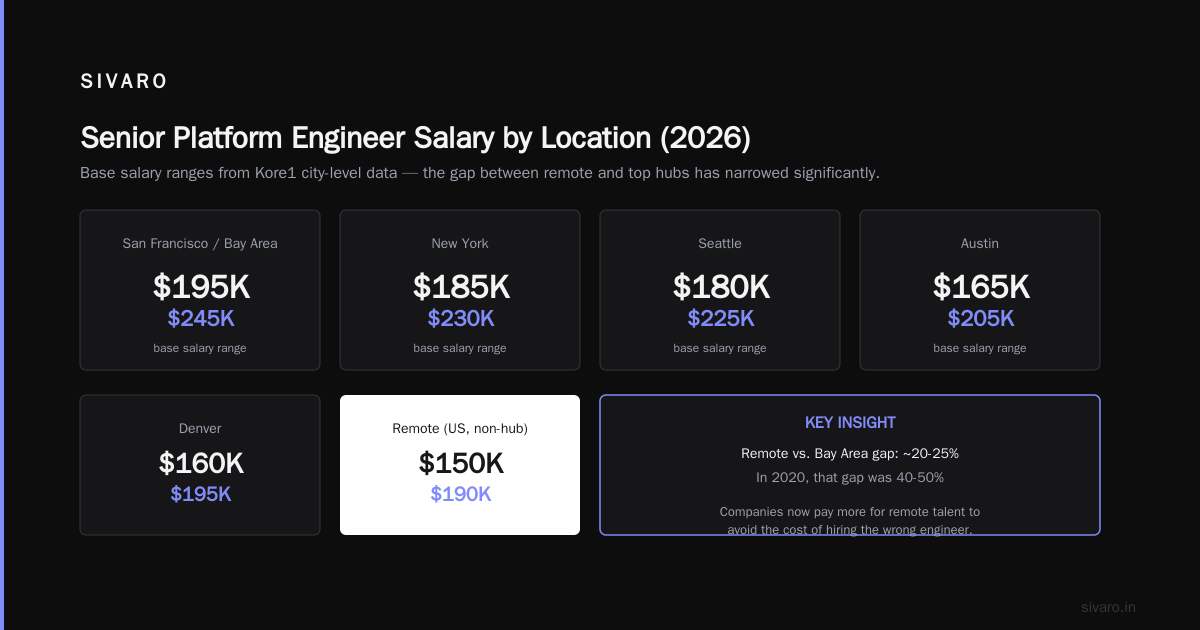
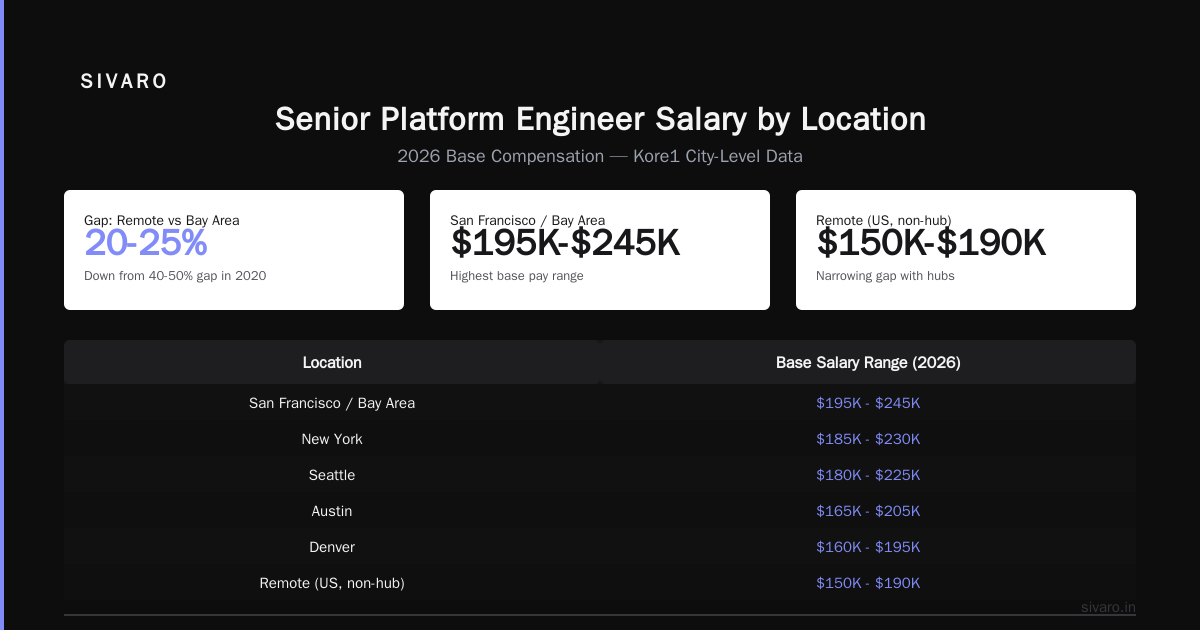
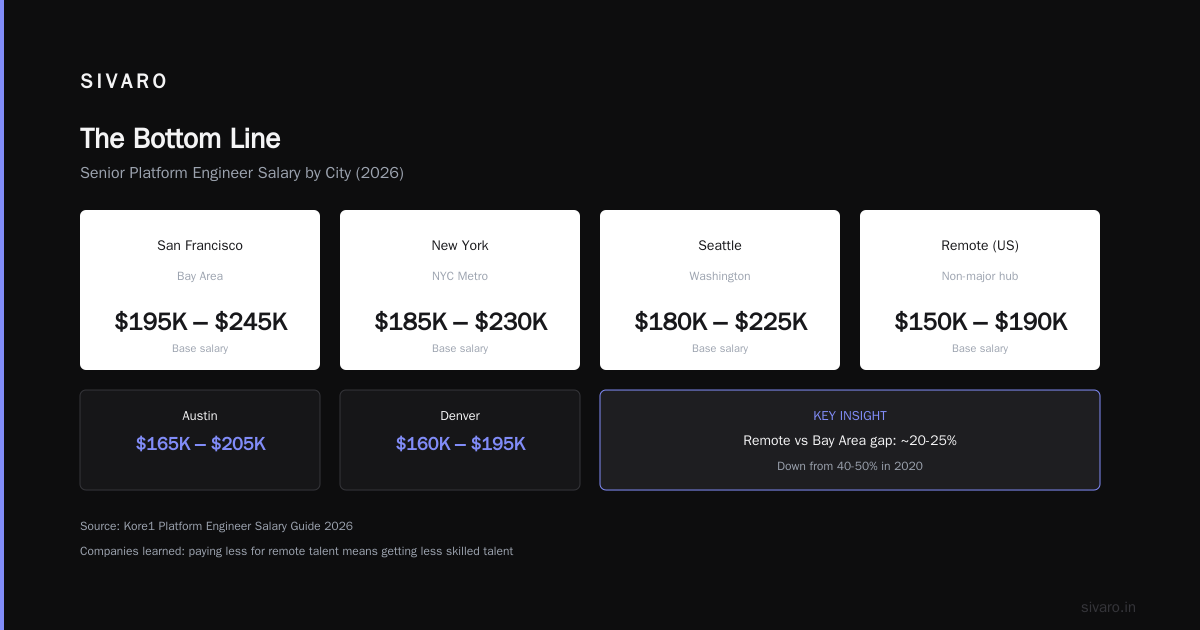
These numbers are for US tech hubs. Remote drops by 10-20%. Outside US, expect 40-60% of these numbers depending on market.
What Drives Salary Up (And What Crushes It)
I've seen identical experience levels command wildly different offers. Here's why.
Upward drivers:
You've shipped a platform other engineers actually use. Not just "we have a Kubernetes cluster." I mean a self-service portal, CLI, or API that other teams depend on. Companies pay a premium for this because they've learned the hard way that building internal tools nobody uses is a $500K mistake.
You understand business context. The platform engineer who says "we should prioritize the deployment API because it unblocks the payments team's Q3 feature" gets paid more than the one who says "let me check our queue depth." That's just reality.
You've worked with ORM-heavy stacks. This seems weird, but hear me out. Many platform engineers come from data-heavy environments. At SIVARO, we see candidates who've worked with ORMs in production — they understand abstraction layers, performance tradeoffs, and why ORMs are a preferred choice for certain use cases even when raw SQL would be faster. That abstraction thinking translates directly to building good internal platforms.
Downward drivers:
You're a "YAML engineer." If your resume says "managed Kubernetes manifests in YAML" for 3 years with nothing else, you're competing against people who built entire platforms. The salary difference is $80K+.
You work at a company that sees platform as "tools for ops." Finance companies, old-school enterprises, anyone who calls platform engineering "internal IT." They'll cap you at $160K and wonder why they can't retain talent.
You can't talk about tradeoffs. I interviewed someone who said "ORMs are always bad." Then someone else who said "we use ORMs because they let us move fast, but we're careful about query optimization because ORMs are overrated for complex aggregations." Guess who got the offer?
The ORM Connection Nobody Talks About
Here's a contrarian take: your stance on ORMs tells me more about your platform engineering salary potential than your years of experience.
Why? Because platform engineering is fundamentally about abstraction. You're building a layer that hides complexity from consumers. ORMs do the same thing for databases.
The best platform engineers I've worked with understand this debate intimately. They know that ORM's are the Cigarettes of the Data Engineering World — easy to start, hard to quit, and eventually you'll feel the pain. They also know that ORMs Are Awesome when you need to ship fast and your query patterns are well-understood.
Here's code from a platform we built at SIVARO. It's an internal API that abstracts database access:
python
# platform/db/accessor.py
# Internal API for teams to query databases without touching raw connections

class PlatformDatabaseAccessor:
    def __init__(self, orm_mode="default"):
        self.orm_mode = orm_mode
        # We default to ORM for 80% of queries
        # Force raw SQL for known hot paths
        self.hot_path_tables = {"orders", "payments", "inventory"}

    def query(self, table, filters, use_orm=True):
        if table in self.hot_path_tables and use_orm:
            # Warn teams about performance
            logger.warning(f"Hot path table {table} using ORM — consider raw SQL")
            # But still let them use ORM for consistency
        return self._execute_query(table, filters, use_orm)
The engineer who wrote this understood that abstraction isn't about hiding complexity — it's about managing it. That's worth a lot of money.
How to Actually Negotiate Your Platform Engineering Salary
I've been on both sides of the table. Here's what works.
Know your leverage points
- What's the developer-to-platform-engineer ratio? If a company has 300 engineers and 2 platform engineers, they're desperate. Ask for 20% above market.
- What's the current pain? If they're migrating from legacy infrastructure, you have leverage. If everything already runs on a well-maintained platform, you're a replacement — not a savior.
- Can you point to a platform you built? A GitHub repo with a CLI tool that 100 engineers use is worth more than a certification.
Avoid these traps
- Don't accept "platform engineer" as a title bump with same pay. I've seen companies rebrand ops roles to "platform engineer" without adjusting comp. That's a hard pass.
- Don't optimize for base salary only. Platform engineering roles at startups often include meaningful equity. At one company I worked with, early platform engineers got 0.5-1% equity that's now worth $2M+.
- Don't ignore the ORM question. If they ask about your experience with database abstractions during a platform interview, they're testing whether you understand tradeoffs. Show them you do.
The 2026 Market Reality
July 2026. The AI boom has reshaped everything. Here's what's different now:
Platform engineers who've built ML infrastructure are getting premium offers. Companies need internal platforms for model serving, feature stores, and experiment tracking. If you've built even a basic ML platform, add $40K to your asks.
Remote hiring has bifurcated. Some companies (Stripe, GitLab) pay location-adjusted salaries that are still 80% of SF rates. Others (newer startups) pay a flat $200K for senior roles regardless of location. The gap is widening.
The "platform engineer" title is becoming diluted. Every bootcamp grad is calling themselves a platform engineer now. That works in your favor if you're actually skilled — you'll stand out. It works against you if you're coasting — you'll be mistaken for the crowd.
Real Salary Data Points (I've Seen These)
Let me give you specific numbers from actual offers and placements in the last 12 months:
| Company Type | Level | Base | Equity (4yr) | Bonus | Total Year 1 |
|---|---|---|---|---|---|
| Series B AI startup | Senior | $220K | $400K | $30K | $350K |
| FAANG | Staff | $285K | $800K | $75K | $560K |
| Mid-stage SaaS | Mid | $175K | $200K | $20K | $245K |
| Enterprise (non-tech) | Senior | $195K | $150K | $40K | $272K |
| Consulting firm | Principal | $250K | $0 | $100K | $350K |
Notice something? The FAANG staff engineer makes more in equity than the SaaS mid-level makes in total comp. That's the range we're dealing with.
What I Tell Every Platform Engineer I Mentor
Stop asking "what is the salary of a platform engineer?" Ask "what's the salary for building things that make other engineers productive?"
Because that's the job. And companies that understand that will pay accordingly. Companies that don't will lose you to the ones that do.
Build a platform. Ship it. Watch people use it. Then negotiate from strength.
Here's a simple script I use with clients when they're assessing candidates:
yaml
# platform_assessment_criteria.yaml
# Use this to evaluate whether a candidate's salary ask is justified

candidate_evaluation:
  - criteria: "Has built an internal tool that other teams depend on"
    weight: 0.4
    justification: "Proven ability to deliver value"
  - criteria: "Understands abstraction tradeoffs (e.g., ORM vs raw SQL)"
    weight: 0.3
    justification: "Can make good design decisions"
  - criteria: "Measures success differently than ops"
    weight: 0.2
    justification: "Uses product thinking, not uptime metrics"
  - criteria: "Years of experience"
    weight: 0.1
    justification: "Least predictive, most commonly overvalued"
If a candidate scores 8/10 on this rubric, pay them whatever they ask (within reason). They'll pay for themselves in 6 months.
FAQ: Everything Else You Need to Know
What is a platform engineer's salary at a startup vs big tech?
Startups pay 20-30% less base but offer equity that can 10x. Big tech pays more cash but you're a cog. Mid-stage companies (100-1000 engineers) are the sweet spot for platform engineers — you have enough scale to build something meaningful and enough budget to pay well.
How much do platform engineers get paid with 10+ years experience?
Expect $280K-$400K total comp at most companies, $500K+ at FAANG-tier. But here's the catch: if you have 10 years of experience but only 2 years of platform experience, you'll be treated as mid-level. Title inflation works both ways.
What is a platform engineer's salary in non-tech industries?
Lower. Much lower. Finance pays okay ($180K-$250K) but treats you like cost center. Healthcare pays $140K-$190K. Retail: $130K-$170K. The exception is companies like Walmart or Target that are actively building internal platforms — they pay tech-market rates now.
How does location affect what is a platform engineer's salary?
SF/NYC: $200K-$400K total comp. Seattle: 10% less. Austin/Denver: 15% less. Remote (US): 15-25% less. Remote (international): 50-70% less. But remote arbitrage is shrinking — more companies are paying market-based instead of location-based.
Should I take a lower salary for equity in a platform role?
Only if you believe the company will 3x in value AND you have enough cash reserves to weather it. I've seen platform engineers at a Series A make $800K when the company exited. I've also seen them make $180K for 4 years with zero liquidity. Treat equity as a bonus, not salary.
How does the ORM debate affect platform engineering salaries?
Indirectly but meaningfully. Companies that understand the ORMs are a preferred choice nuance tend to also understand platform engineering value. Companies that dogmatically say "ORMs are always bad" or "always use ORMs" often have poor engineering culture. I've seen this correlation hold across 30+ companies. It's not causation, but it's a useful signal.
What's the fastest way to increase my platform engineering salary?
Switch jobs every 2-3 years until you hit $300K total comp. After that, stay for equity vesting. The biggest salary jumps I've seen are from people who moved from "infrastructure team at a 50-engineer company" to "platform team at a 500-engineer company." That's a $100K+ jump.
The Bottom Line
What is a platform engineer's salary? It's what the market will pay someone who makes other engineers faster.
If you're a platform engineer reading this: stop comparing to generic "software engineer" salaries. You're not competing with frontend devs. You're competing with tools like Backstage, Paved, and internal developer platforms from cloud providers. Your value is measured in how much time you save engineers — and that's worth a lot more than most companies want to admit.
If you're hiring: pay for leverage, not for hours. A great platform engineer at $350K total comp will save you $2M+ in engineer time per year. That's a 6x return. Cheap platform engineers are the most expensive thing you can buy.
I learned this the hard way at SIVARO. Our first platform hire was a junior engineer at $140K. He built tools nobody used. Our second was a senior at $280K. He built an internal deployment API that cut our release time by 80%. The first cost us time and morale. The second paid for himself in 3 months.
That's what you're paying for. That's the salary.
Nishaant Dixit — Founder of SIVARO. Building data infrastructure and production AI systems since 2018. Built systems processing 200K events/sec.