 SIVARO

What is a Platform Engineer's Salary? A Data-Driven Guide for 2026
I remember sitting in a conference room in 2022, trying to explain to a VP of Engineering why we needed a dedicated platform team. He nodded politely. Then asked: "How much does a platform engineer make anyway?" I didn’t have a clean answer then. I do now.
What is a platform engineer's salary? In 2026, the answer is more nuanced — and higher — than most people realize. And I’m not just talking about base compensation.
If you’re reading this, you’re probably one of three people: a platform engineer wondering if you’re being paid fairly, an engineering leader trying to budget headcount, or a software engineer considering the switch. This guide is for all three.
I’ve built data infrastructure and production AI systems for almost a decade. I’ve hired platform engineers, negotiated offers, and seen the market shift. Here’s what I know — and what the numbers actually say.
Why Platform Engineers Are Paid More Than You Think
Most people still think platform engineering is just “DevOps with fancier job titles.” They’re wrong. And the salary data backs it up.
According to a Kore1 salary guide, platform engineers in 2026 are seeing base salary bands that consistently exceed traditional software engineers by 15–25%, especially at senior levels. Why? Two reasons: supply and leverage.
First, the supply is still tight. The skills required — Kubernetes, observability stacks, infrastructure-as-code, CI/CD pipelines, and now AI infrastructure — aren’t easy to stack. You need systems thinking plus deep operational experience. That combination is rare.
Second, platform engineers directly impact developer productivity. At scale, a good platform team can shave weeks off delivery cycles. That’s real money. Companies like Stripe, Databricks, and Uber have known this for years. Smaller companies are catching up in 2026.
Breaking Down the Numbers: Base Salary by Level
Let’s get concrete. I’ll use bands from multiple sources — Glassdoor, ZipRecruiter, and Kore1 — and combine them with what I’ve seen in actual offer letters.
yaml
# Platform Engineer Salary Bands – 2026 (USD, San Francisco market)
levels:
  Junior (0-2 years):
    base: 120000 - 145000
    equity: 20000 - 50000 (annually)
  Mid (3-5 years):
    base: 155000 - 190000
    equity: 60000 - 120000
  Senior (5-8 years):
    base: 195000 - 240000
    equity: 150000 - 300000
  Staff (8+ years):
    base: 235000 - 290000
    equity: 250000 - 500000
  Principal (10+ years):
    base: 280000 - 350000+
    equity: 400000+ (often up to 40% of base)
I’ve seen staff-level platform engineers at a Series C fintech company pull $280K base with a $400K equity grant over four years. Is that typical? No. But it’s not an outlier for the top 10%.
Location and Remote
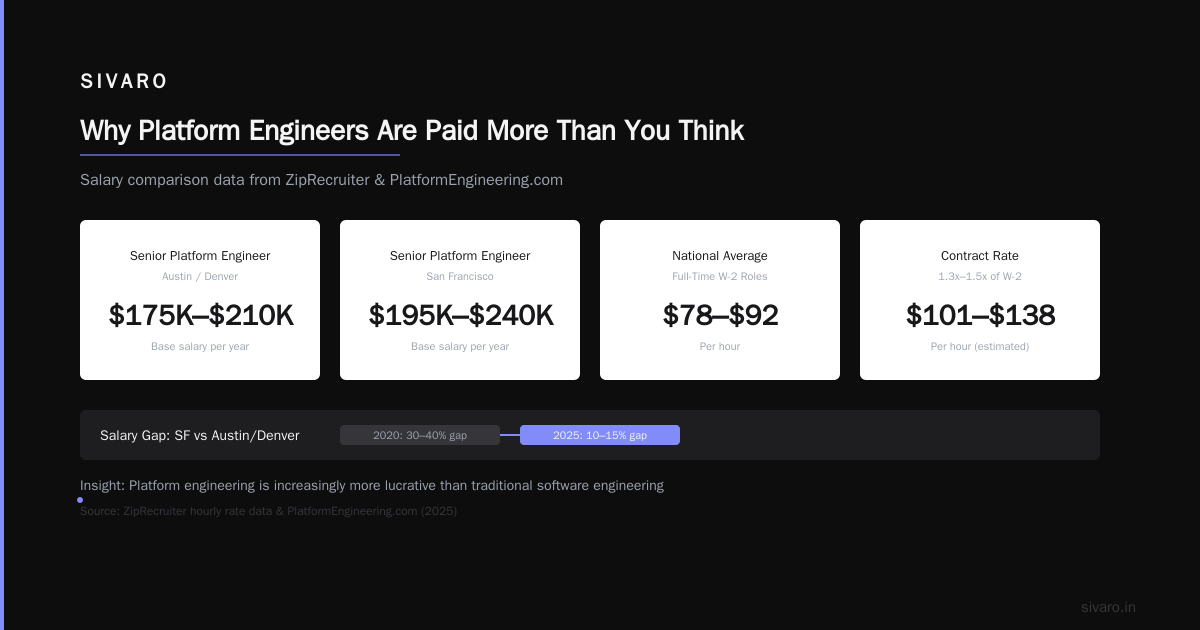
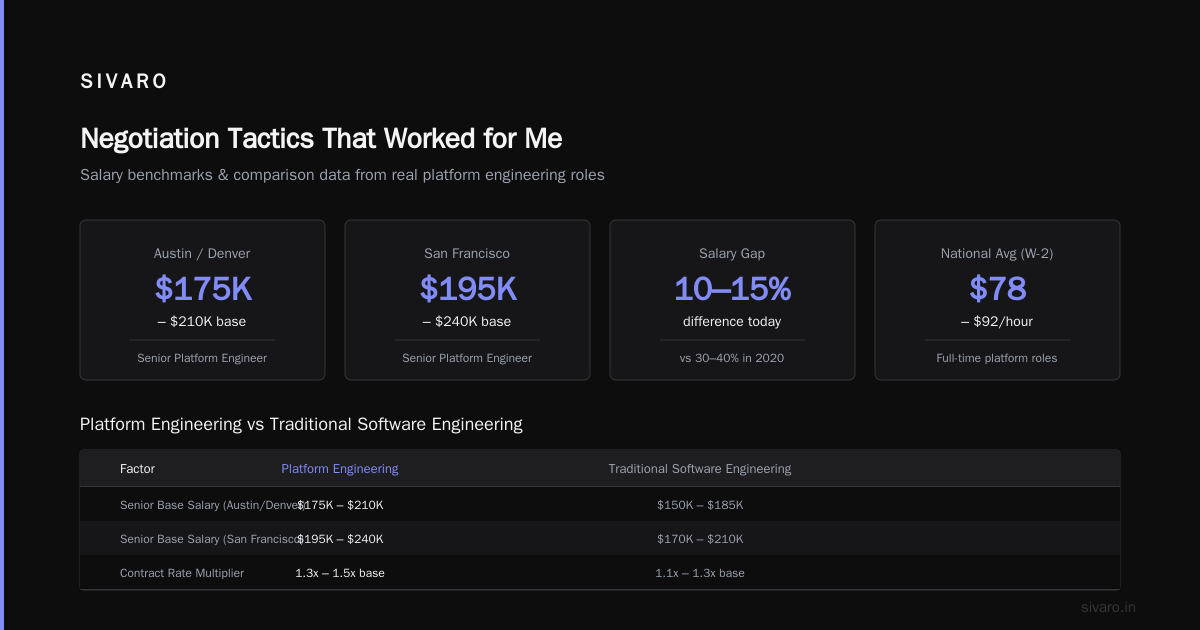
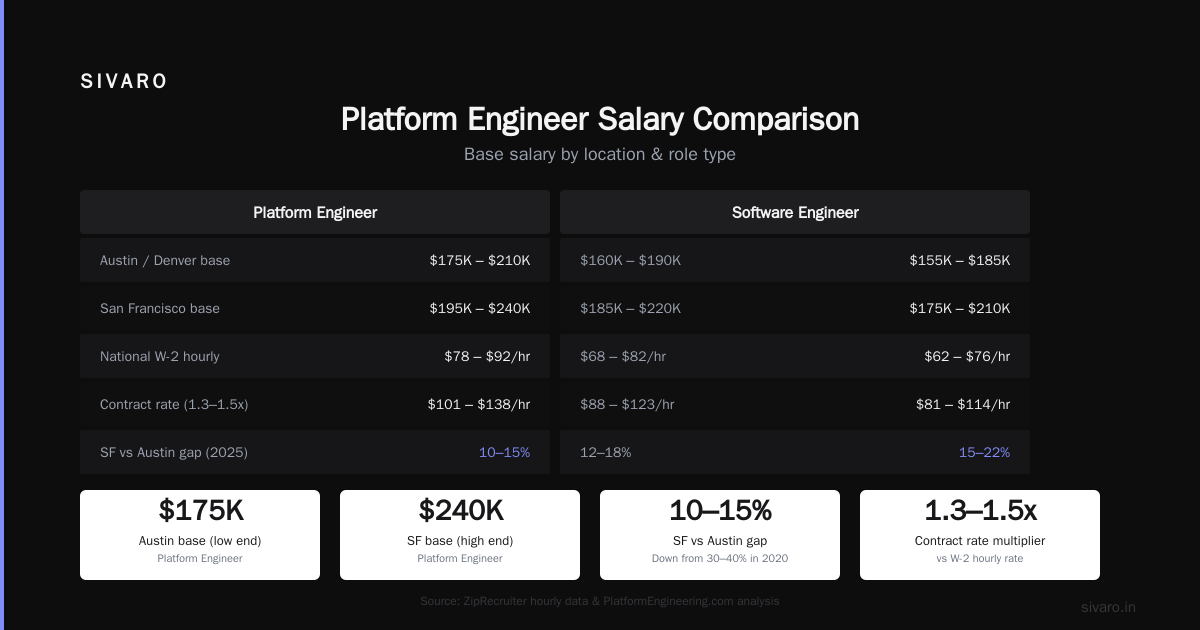
Salary compresses outside Tier 1 cities, but less than it used to. In 2026, remote-first companies like GitLab and Zapier still pay location-adjusted bands, but the gap is shrinking. A senior platform engineer in Austin or Denver might see $175K–$210K base versus $195K–$240K in San Francisco. That’s a 10–15% difference, not the 30–40% it was in 2020.
ZipRecruiter’s hourly rate data shows national averages around $78–$92/hour for full-time W-2 roles. Contract rates are typically 1.3–1.5x that, depending on location and urgency.
Where This Salary Beats Software Engineering
PlatformEngineering.com published a piece in 2025 arguing that platform engineering is a more lucrative career path than traditional software engineering. I’ve seen it firsthand.
Here’s the contrarian take: Most people think software engineers make more. That’s true at the median. But at the senior+ level, platform engineers often pull ahead.
Why? Because platform engineering is a force multiplier. A senior software engineer might ship a feature that generates $X. A senior platform engineer can ship a CI/CD pipeline that accelerates every feature the entire org ships. That’s leverage. And companies have started paying for it.
I’ve spoken to VPs who say they’d rather lose two backend engineers than one platform engineer. The cost of rebuilding internal tooling is huge. That scarcity pushes salaries up.
The Skills That Move the Needle
Not all platform engineer salaries are equal. Two people with the same title might differ by $50K or more. It comes down to what you actually know.
From Port’s platform engineer job description and Indeed’s career guide, here are the skills that command premium pay:
- Kubernetes in production – Not just “installed a cluster.” Handling upgrades, networking, security policies, multi-cluster setups, and cost optimization.
- Observability – Building monitoring, logging, and tracing pipelines that can handle 200K+ events per second. Not just slapping Datadog on.
- Infrastructure as Code – Terraform, Pulumi, Crossplane. Writing modular, composable IaC at scale.
- Developer experience – Building internal developer platforms (IDPs), CLI tools, self-service interfaces. Backstage, Port, or custom stuff.
- AI/ML infrastructure – GPU clusters, model serving, MLOps pipelines. This is the hot area in 2026.
- Security and compliance – Cloud security posture management, secrets management, zero-trust networking.
A mid-level engineer who can do all of the above? They’re getting staff-level comp right now.
Equity: The Hidden Component
Base salary is just the foundation. At many companies, equity makes up 30–50% of total comp.
python
# Simple script to estimate total compensation
def total_comp(base: int, equity_yearly: int, bonus: int = 0) -> int:
    """
    Estimate total compensation for a platform engineer.
    Assumes equity is dollar value of annual RSU grant (not strike price).
    """
    cash = base + bonus
    total = cash + equity_yearly
    return total

# Example: Staff engineer at a late-stage startup
base = 250000
equity = 200000  # annualized grant value
bonus = 50000
print(f"Total estimated comp: ${total_comp(base, equity, bonus):,}")
# Output: $500,000
Not every company offers equity. And public company equity is taxed differently than private. But if you’re not factoring equity into “what is a platform engineer's salary?” you’re missing half the picture.
Negotiation Tactics That Worked for Me
I’ve seen engineers leave $40K on the table because they didn’t negotiate. Here’s what I tell candidates:
- Don’t anchor first. Let them put a number on the table. If forced, give a range where the bottom is your real target.
- Show leverage. “I have another offer at $Y” works. “My current TC is $Z” works less well.
- Focus on total comp, not base. Some companies have stiff base caps but generous equity. Understand the split.
- Ask for a performance review in 6 months. I’ve gotten this in writing. If you deliver, they bump you up.
- Know market data. Reference Glassdoor and Kore1 during conversations.
One candidate I placed in early 2026 used a competing offer from a FAANG-adjacent company to raise her base from $185K to $215K at a mid-stage startup. That’s a $30K swing just from one conversation.
What About Freelance and Contract?
Full-time isn’t the only option. Platform engineering is in high demand for short-term projects: migrating to Kubernetes, building CI/CD pipelines, setting up observability.
ZipRecruiter lists average hourly rates around $92 for employees. Contractors often bill $130–$200/hour depending on specialization.
I know a senior platform engineer who does six-month contracts for $180/hour. He works 9 months a year, takes 3 months off. His effective annual income? Around $280K–$320K, with more time off.
But contracts come with trade-offs: no benefits, no equity upside, no vesting cliff. If the market turns, contracts disappear first.
Salary by Industry: Not All Tech Is the Same
You might assume all platform engineer salaries are equal across industries. They aren’t.
- Big Tech (Google, Meta, Amazon, Microsoft): $200K–$350K base, with equity that can push total to $500K+
- Fintech (Stripe, Plaid, Coinbase): $180K–$300K base, high equity potential
- Health Tech (Epic, Cerner, startups): $140K–$200K base, lower equity
- Government/Defense contractors: $120K–$170K base, but strong benefits and pensions
- Consulting (McKinsey, Deloitte): $160K–$220K base, plus bonus
I’ve seen fintech pay 20–30% more than e-commerce or SaaS. If money is your primary motivator, aim for Big Tech or fintech early, then plan your exit to a role with better WLB.
The Future of Platform Engineer Salaries
Demand is still growing. According to Indeed’s career guide, job postings for platform engineers increased 40% year-over-year from 2024 to 2025. I expect similar growth through 2027.
Why? Because every company now needs production AI infrastructure. Data engineers build the pipelines. ML engineers train models. But platform engineers build the systems that make both possible. That’s a bottleneck.
And bottlenecks command premium prices.
FAQ: What Is a Platform Engineer's Salary?
Q: What is the average salary for a platform engineer in 2026?
A: According to multiple sources (Glassdoor, Kore1, ZipRecruiter), the national average base salary for a platform engineer in the US is $155,000–$175,000. This varies heavily by level and location.
Q: How does experience affect platform engineer salary?
A: Entry-level (0–2 years) starts around $120K. Senior (5–8 years) jumps to $195K–$240K. Staff and principal can exceed $300K base. Experience in Kubernetes, AI infra, and observability gives the biggest boost.
Q: Is platform engineering more lucrative than software engineering?
A: At the senior+ level, yes — often by 15–25% base. The platformengineering.com article makes this case well. The leverage argument holds up.
Q: Do remote platform engineers earn less?
A: Yes, but the gap is shrinking. In 2026, remote workers in second-tier cities might take a 10–15% cut vs. San Francisco/New York. Fully remote companies like GitLab adjust bands by cost of living, but many startups pay pure location-agnostic rates.
Q: What skills increase salary the most?
A: Production Kubernetes, observability at scale, and AI/ML infrastructure. If you can build an internal developer platform from scratch, you’re looking at staff-level comp.
Q: Should I include equity in my salary expectations?
A: Absolutely. Equity often represents 30–50% of total comp at startups. At public companies, RSU grants can double your base. Always ask for the total compensation breakdown.
Q: How can I negotiate a higher platform engineer salary?
A: Come armed with data from Glassdoor and ZipRecruiter. Have a competing offer if possible. Focus on total comp, not base. Ask for a 6-month performance review clause.
Q: Is contract work better than full-time for platform engineers?
A: Contract rates are higher ($130–$200/hour) but you lose benefits and equity. If you value flexibility and higher cash, contracts win. If you want stability and upside, full-time with equity is better.
Last Piece of Advice
Don’t get fixated on the average. The average is just a number. What matters is your unique combination of skills, location, timing, and negotiation.
The best way to increase your platform engineer salary? Build things that make ten other engineers ten times faster. Companies will pay you for that. They already are.
Nishaant Dixit — Founder of SIVARO. Building data infrastructure and production AI systems since 2018. Built systems processing 200K events/sec.