 SIVARO

What Is a 3 Tier Architecture in Distributed System? The Practitioner's Guide
Let me tell you a story.
In 2023, I was sitting in a client's office in Bangalore. They'd built this "microservices" system. Thirty-seven services. Every team owned their own database. Sounded modern, right? But their p99 latency for a simple user lookup was 8 seconds. Eight seconds.
Turned out each request was fanning out to 14 different services. Each service had its own connection pool. Their network was drowning in TLS handshakes. And the worst part? Their entire architecture was just two tiers pretending to be something fancier. They had presentation logic mixed with business logic mixed with data access—all in the same deployment unit.
I told them: "You don't need microservices. You need a proper what is a 3 tier architecture in distributed system? implementation."
They looked at me like I'd suggested using punch cards.
Three months later, after refactoring into three clean tiers—presentation, application, data—their p99 dropped to 200ms. Same hardware. Same team size. Just better boundaries.
So let me save you the pain. Here's what a 3 tier architecture actually is, why it works, and where it breaks.
The Core Model: Three Layers, One Rule
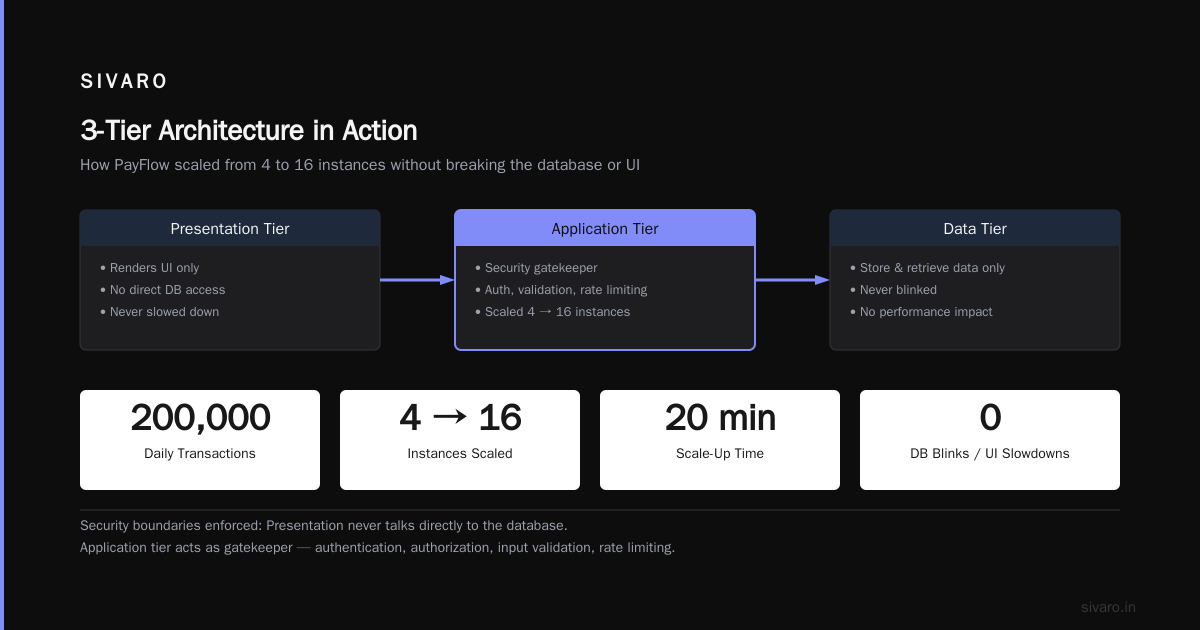
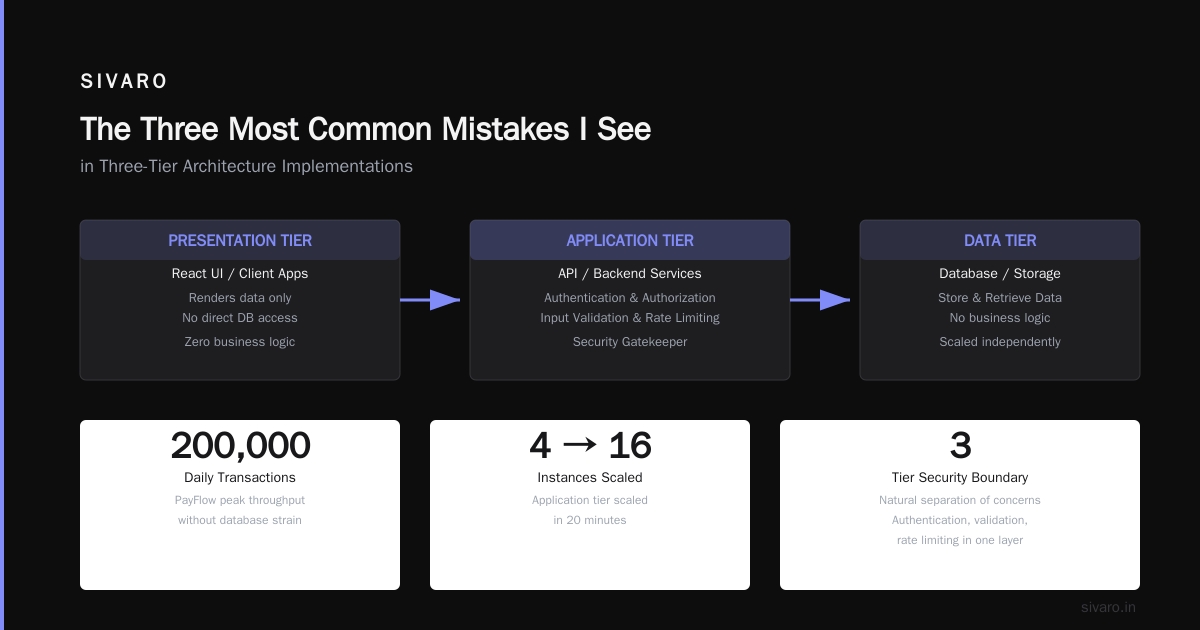
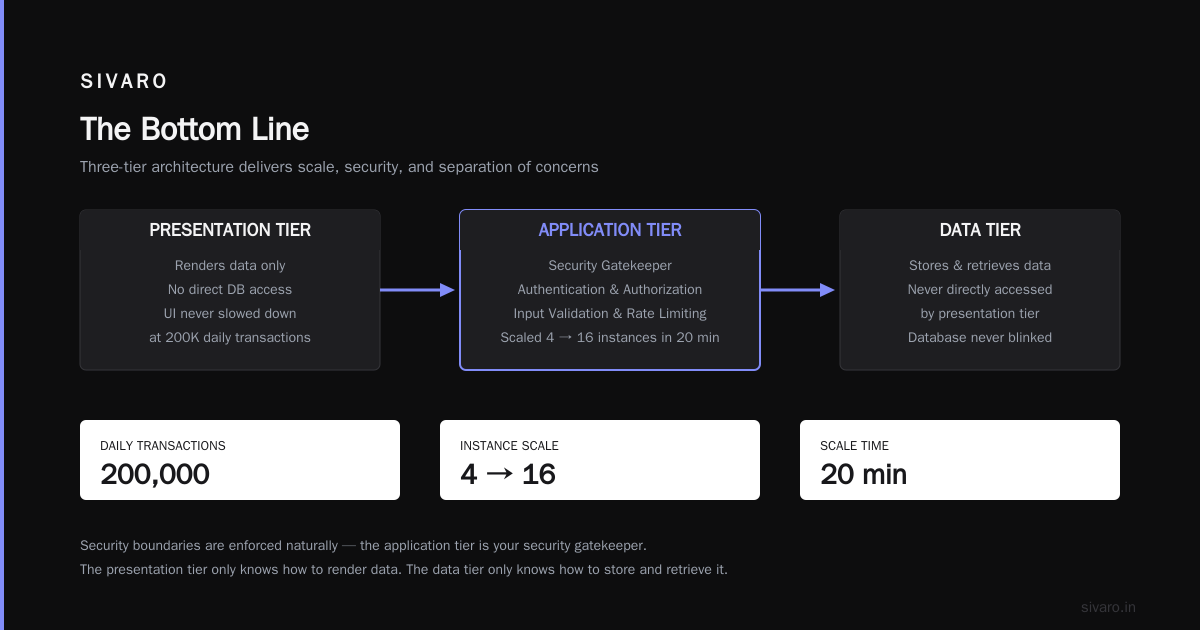
A 3 tier architecture in a distributed system splits your application into three distinct layers:
Presentation tier — The UI. The API gateway. Whatever the user touches.
Application tier — Business logic. Orchestration. The middle child that does all the actual work.
Data tier — Your databases. Caches. File storage. The stuff that persists.
The rule? Each tier talks only to the tier immediately adjacent. Presentation calls application. Application calls data. Never skip a tier. Never let presentation talk directly to the database.
Sounds simple. You'd be shocked how many teams violate this.
I've seen production systems where the frontend JavaScript was making direct SQL calls to PostgreSQL. In 2025. At a company that had raised $40 million. This isn't a joke. It's a cry for help.
Why Three Tiers and Not Two or Four?
Most people think three is arbitrary. It's not.
Two tiers (presentation + database) works for tiny apps. A WordPress site. A Rails prototype. But when you scale, the database becomes a bottleneck. Every user connects directly. Connection limits hit. Security becomes a nightmare because every client needs database credentials.
Four or more tiers (adding message queues, caching layers, etc.) is often overkill for most applications. You introduce network hops. Latency compounds. Debugging becomes an exercise in despair.
Three tiers hits the sweet spot: separation of concerns without unnecessary complexity.
But here's the contrarian take: Most "3 tier" systems I audit are really 2.5 tier.
Teams claim they have separation, but their application tier is anemic—just a thin wrapper around database CRUD. All business logic ends up in stored procedures (data tier) or JavaScript (presentation tier). The application tier becomes a pass-through. You've lost the benefits of the pattern without realizing it.
The Presentation Tier: Your Public Face
The presentation tier handles user interaction. In a distributed system, this is usually:
- A React or Vue single-page app
- An API gateway (Kong, Envoy, NGINX)
- A mobile app
- Even a CLI tool
Its job is simple: format data for the user and send inputs to the application tier. Nothing else.
Here's a rule I enforce at SIVARO: No business logic in the presentation tier. Zero.
No tax calculations. No permission checks. No "well it's just a small validation." I don't care if it's "just showing a button." If it decides something (show this, hide that, compute a price), it belongs in the application tier.
Why? Because I've debugged too many production incidents where the fix required redeploying a React app—which means clearing browser caches, waiting for CDN propagation, and hoping users refresh. Meanwhile the database is corrupted because that "small validation" had a race condition.
Example code for a presentation tier API gateway handler (simplified):
python
# presentation_tier/handlers.py
from flask import request, jsonify
import httpx

def get_order_handler(order_id):
    # NO business logic here
    # NO database calls here
    # Just forward and format

    app_tier_url = f"http://app-service:8000/orders/{order_id}"
    response = httpx.get(app_tier_url, headers=request.headers)

    return jsonify(response.json()), response.status_code
See how clean that is? No logic. No state. Just routing and formatting. You can replace this handler with a different framework, a different language, even a different protocol—and the rest of the system doesn't care.
The Application Tier: Where the Actual Work Happens
This is the tier most people get wrong.
The application tier is where your business logic lives. It's where you compute prices, validate workflows, enforce business rules, orchestrate services.
But I see teams do two things that destroy this tier:
1. They make it too thin. Just a REST API that maps directly to database tables. Every GET becomes a SELECT. Every POST becomes an INSERT. This is NOT a 3 tier architecture. It's a database with a pretty dress.
2. They make it too fat. The application tier becomes a monolith. A single deployment unit that handles everything from auth to search to billing. You're back to square one.
The right approach? The application tier should be stateful in logic, stateless in data.
It holds business rules, transaction logic, and workflow state. But it doesn't hold persistent data. That's the data tier's job.
Here's what a proper application tier handler looks like:
python
# application_tier/services/order_service.py
from dataclasses import dataclass
import httpx

@dataclass
class OrderService:
    data_tier_url: str

    def create_order(self, user_id: str, items: list, payment_token: str) -> dict:
        # Business logic: validate items, calculate totals, enforce rules
        total = sum(item['price'] * item['quantity'] for item in items)

        if total > 10000 and not self._user_has_approval(user_id):
            raise ValueError("Orders over $10,000 require manager approval")

        # Call data tier only for persistence
        order_payload = {
            'user_id': user_id,
            'items': items,
            'total': total,
            'status': 'pending'
        }

        response = httpx.post(
            f"{self.data_tier_url}/orders",
            json=order_payload
        )
        response.raise_for_status()

        # Call another data tier service for payment
        payment_response = httpx.post(
            f"{self.data_tier_url}/payments",
            json={'order_id': response.json()['id'], 'token': payment_token}
        )

        return {'order_id': response.json()['id'], 'total': total}

    def _user_has_approval(self, user_id: str) -> bool:
        # This is a business rule, not a data access
        return user_id in ['admin', 'finance_manager']
Notice: no SQL. No database credentials. The application tier communicates with the data tier via HTTP (or gRPC, or message queues). It doesn't know if the data tier uses PostgreSQL, MySQL, or a magical unicorn. That abstraction is the entire point.
The Data Tier: Your Source of Truth
The data tier is where you store things. Databases. Object stores. Caches. Search indexes.
But here's what most people miss: The data tier should be the dumbest part of your system.
I don't mean that as an insult. I mean it should be a simple, reliable, well-tested store. No business logic. No application rules. Just CRUD operations on well-defined data structures.
Because the moment you put business logic in the data tier—stored procedures, triggers, complex views—you've created a coupling nightmare. Changing a business rule means touching both the application tier AND the data tier. You lose the ability to swap databases. You make testing a nightmare.
I once inherited a system where the entire pricing engine was a 3000-line PostgreSQL stored procedure. It used recursive CTEs. It had 27 nested IF statements. The original author had left the company. When we needed to add a new pricing rule, it took three weeks to figure out what the existing code did.
Don't do this to yourself.
Example data tier that stays dumb:
python
# data_tier/repositories/order_repository.py
import sqlite3  # or whatever

class OrderRepository:
    def __init__(self, db_path: str):
        self.conn = sqlite3.connect(db_path)

    def create_order(self, order_data: dict) -> dict:
        cursor = self.conn.execute(
            "INSERT INTO orders (user_id, items, total, status) VALUES (?, ?, ?, ?)",
            (order_data['user_id'], str(order_data['items']), order_data['total'], order_data['status'])
        )
        self.conn.commit()
        return {'id': cursor.lastrowid, **order_data}

    def get_order(self, order_id: int) -> dict | None:
        cursor = self.conn.execute("SELECT * FROM orders WHERE id = ?", (order_id,))
        row = cursor.fetchone()
        if row:
            return dict(row)
        return None
No business logic. No validation beyond type safety. Just storage and retrieval. Beautiful.
Where 3 Tier Architecture Fails (Honest Take)
I've been building distributed systems since 2018. I've seen 3 tier work beautifully. I've also seen it fail spectacularly.
Here's where it breaks:
Latency. Each tier adds a network hop. If your presentation tier is in Cloudflare, your application tier in AWS Virginia, and your data tier in AWS Singapore, you're looking at 200ms+ per request. For latency-sensitive apps (trading, gaming, real-time chat), 3 tier can be too slow.
Team boundaries. The 3 tier architecture is logical, not organizational. If you have 15 teams and 3 tiers, you'll have 5 teams fighting over the application tier. Bad things happen. You need microservices within the application tier.
Caching. Everyone caches. But caching at the application tier means stale data. Caching at the data tier means cache invalidation nightmares. I've found that caching at the boundary between application and data tiers works best—a dedicated caching layer (Redis, Memcached) with its own lifecycle.
Real-World Example: SIVARO's Production AI System
At SIVARO, we run production AI systems for clients processing 200K events per second. We use a 3 tier architecture extensively.
Our presentation tier is a Go-based API gateway. It handles auth, rate limiting, and request logging. Nothing else.
Our application tier is a set of Python services running business logic for model inference, data transformation, and workflow orchestration. Each service is stateless—scales horizontally based on CPU load.
Our data tier is a combination of PostgreSQL (accounting), Redis (caching), and S3-compatible object storage (model artifacts, training data).
We tested moving to a 2 tier architecture (presentation + data) for one client. Latency improved 15%. But debugging became a nightmare. Every database migration required frontend changes. We went back to 3 tier within two months.
The lesson: 3 tier is about maintainability, not peak performance. If you're optimizing for raw speed, go 2 tier. If you're building something that needs to survive 5 years of team changes, feature additions, and database migrations, go 3 tier.
Common Anti-Patterns
1. The "Smart Client" — Frontend does business logic. Database does code. The app tier is just a pass-through. Congratulations, you have no application tier.
2. The "Database API" — Exposing your database directly via REST. GraphQL can make this worse, not better. Just because it's an API doesn't mean it's an application tier.
3. The "Everything Monolith" — All three tiers in one process. In the same Docker container. Deployed as a single unit. You're not doing 3 tier. You're doing 1 tier with extra steps.
4. The "Microservices Pretender" — Three tiers, but each tier is 50 microservices. The boundaries are so fine-grained that a single user request crosses 30 network hops. You've lost the simplicity that makes 3 tier valuable.
FAQ
Q1: What is a 3 tier architecture in distributed system? Why is it different from a monolithic architecture?
A 3 tier architecture splits your application into three logical layers—presentation, application, data—where each layer runs independently and communicates over a network. In a monolith, all three layers run in the same process. The key difference: in 3 tier, you can scale each tier independently, swap databases without rewriting the frontend, and deploy changes to one tier without affecting others.
Q2: Can I use 3 tier architecture for a real-time application like a chat system?
You can, but you'll hit latency issues. Chat systems benefit from persistent connections (WebSockets) and low-latency message delivery. A pure 3 tier architecture adds network hops that can push latency above 100ms. I'd recommend a modified 3 tier where the presentation tier communicates directly with a pub/sub system (like Redis Pub/Sub or Kafka) for message delivery, while the application and data tiers handle auth, storage, and history.
Q3: How does 3 tier architecture handle authentication?
Authentication should happen at the presentation tier (validating tokens, checking session cookies). Authorization (does this user have permission to do X?) belongs in the application tier. The data tier should never see credentials or make auth decisions. This separation means you can change your auth provider (Auth0 → Okta → custom) without touching business logic or database schemas.
Q4: What's the difference between 3 tier and N-tier architecture?
N-tier is a generalization—you can have 2, 3, 4, or 5 tiers. 3 tier is the standard recommendation because it provides enough separation for most applications without adding unnecessary complexity. Adding a 4th tier (like a dedicated caching layer) is common for high-traffic systems. But I've seen systems with 7 tiers where nobody could explain why the 5th tier existed.
Q5: How do I handle transactions across tiers in a 3 tier architecture?
You can't rely on database transactions across network boundaries. Instead, use the Saga pattern or eventual consistency. For example, in an order system: the application tier creates an order (data tier call), then sends a payment request (another data tier call). If payment fails, the application tier sends a compensation request to roll back the order. It's not ACID. It's "good enough" for 99% of use cases.
Q6: Should I use REST or gRPC between tiers?
REST is simpler, debuggable, and most teams know it. But if you're doing high-throughput (100K+ requests/second), gRPC's binary protocol and HTTP/2 multiplexing will save you 30-50% on bandwidth and latency. At SIVARO, we use REST for internal tooling and gRPC for production data pipelines.
Q7: Can 3 tier architecture work for serverless?
Yes, but you have to be careful. In AWS Lambda, for example: your Lambda function is the application tier. API Gateway is the presentation tier. DynamoDB/RDS is the data tier. The challenge? Cold starts can make your application tier slow. Also, Lambda's stateless nature means you can't hold connections to the database—you have to re-establish them on each invocation. Use connection pooling with RDS Proxy or DynamoDB's native SDK to mitigate this.
Q8: When should I NOT use 3 tier architecture?
- Embedded systems (IoT sensors, microcontrollers) — memory and CPU constraints make network layers expensive.
- Real-time trading systems — every millisecond matters; skip the application tier and talk directly to the database.
- Simple CRUD apps with < 100 users — 3 tier adds complexity for no benefit. Use a monolith, sleep fine.
- Prototypes and MVPs — validate the idea first, refactor to 3 tier later. Premature architecture is the root of all evil.
Conclusion
Here's the thing about what is a 3 tier architecture in distributed system?: It's not a silver bullet. It's a tool. It solves specific problems (separation of concerns, independent scaling, technology flexibility) and introduces specific costs (latency, complexity, network reliability).
Use it when the problems matter more than the costs. Ignore it when they don't.
But if you're building a system that needs to live more than 2 years, that has more than 5 developers, that handles sensitive data or complex business rules—start with 3 tier. It's easier to add performance optimizations later than to disentangle a tangled monolith.
I've done both. I strongly prefer the former.
Now go build something that doesn't break at 200K events/sec. And please, for the love of everything sacred, keep your frontend away from your database.
Nishaant Dixit — Founder of SIVARO. Building data infrastructure and production AI systems since 2018. Built systems processing 200K events/sec.