 SIVARO

What Is a 3 Tier Architecture in Distributed System? A Practitioner’s Guide
I’m sitting in a server room in Bangalore in 2019, staring at a monitoring dashboard that’s screaming red. Our two-tier e-commerce platform is falling over under 15,000 concurrent users. The database connection pool is exhausted. The application logic is tangled with the presentation code. Everything is slow. Everything is fragile.
That was the day I stopped treating architecture as a theoretical exercise.
The three-tier architecture isn’t some academic relic from the 90s. It’s the difference between a system that crumbles under load and one that scales predictably. In this guide, I’ll walk you through what three-tier architecture actually is, why it still matters in 2026, and where it breaks — because everything breaks eventually.
What Is a 3 Tier Architecture in Distributed System?
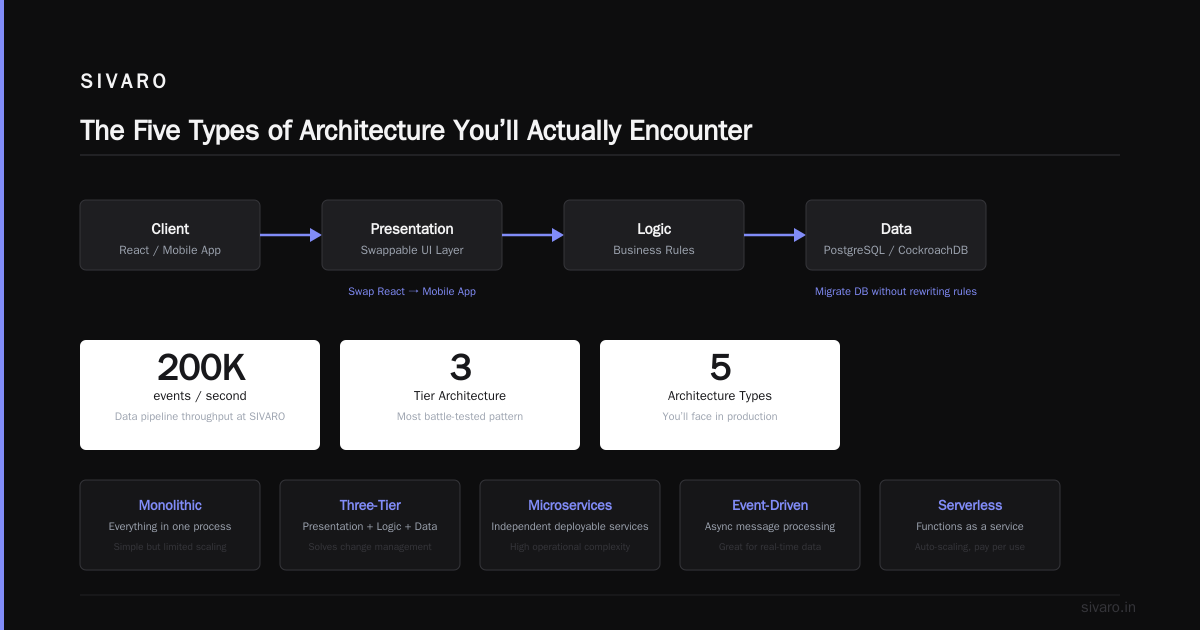
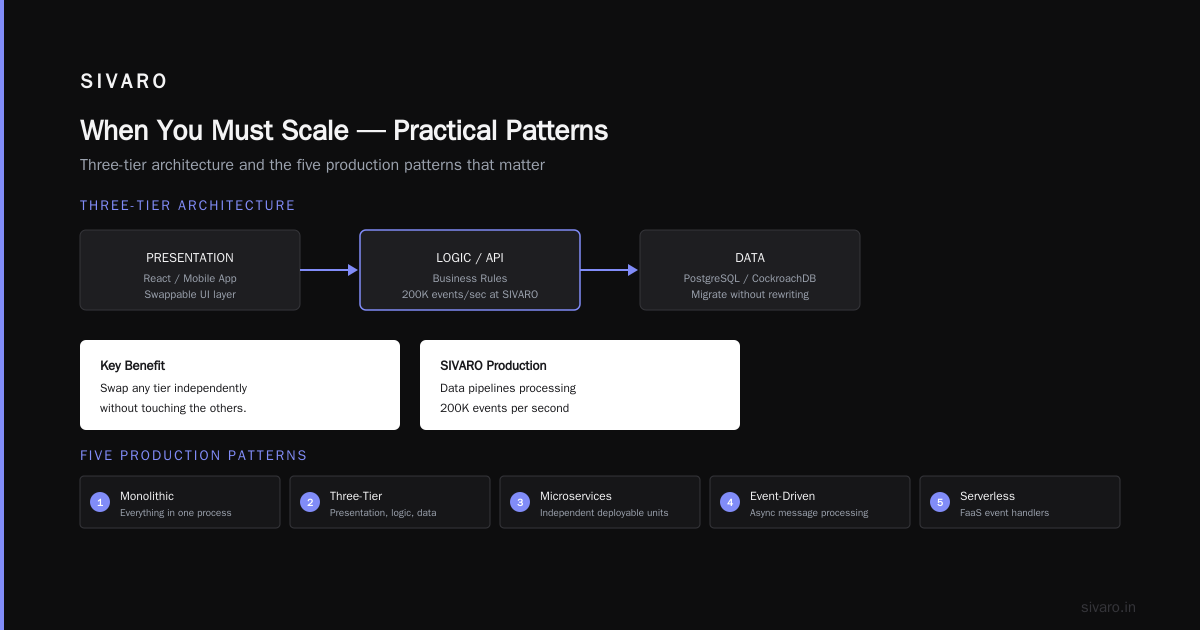
Let’s get the textbook definition out of the way first. A three-tier architecture in a distributed system splits your application into three logical layers:
- Presentation tier — The user interface. Web clients, mobile apps, API consumers.
- Application tier — Business logic, orchestration, processing. This is where your code lives.
- Data tier — Storage and retrieval. Databases, caches, file systems.
Each tier runs on separate infrastructure. They communicate over a network. They scale independently. That’s the theory.
The reality? I’ve seen teams call a monolith with three folders “three-tier” and pat themselves on the back. That’s not three-tier. That’s self-deception.
True three-tier means each layer can be deployed, scaled, and maintained by separate teams without breaking the others. If changing your database requires redeploying your frontend, you don’t have three tiers. You have one big mess.
Why Three Tiers Instead of Two or Four?
Most people think three-tier is the default because some textbook said so. They’re wrong.
Two-tier architectures (client-server) work fine for small apps. I built a warehouse management system in 2021 with two tiers — 50 users, one database, simple CRUD operations. It shipped in three weeks. Zero issues.
But two-tier falls apart when you need to scale. The database becomes the bottleneck. The client code gets fat with business logic. Security becomes a nightmare because the database is exposed to the client layer.
Four-tier architectures exist. Netflix runs something closer to five or six tiers. But complexity is a tax you pay only when you need it. Three-tier hits the sweet spot for 80% of business applications.
Here’s the key insight: three-tier matches organizational structure. Frontend team owns the presentation tier. Backend team owns the application tier. Database team owns the data tier. Clear boundaries. Clear ownership. That’s not coincidence — it’s Conway’s Law playing out in real time.
The Presentation Tier — Where Users Touch Your System
This is the most misunderstood layer.
People think the presentation tier is just HTML and CSS. It’s not. It’s any interface that consumes your application tier. Web apps. Mobile apps. IoT dashboards. API clients. Voice assistants. Even other services.
In 2023, I consulted for a logistics company that had built their entire presentation tier as a monolithic React application. When they wanted to add a mobile app, they had to duplicate business logic. When they wanted to expose an API to partners, they couldn’t — the presentation tier was too tightly coupled to the application logic.
The fix wasn’t complex. We extracted the business logic into a separate service. The React app became a thin client. The mobile app hit the same endpoints. The API became a first-class citizen.
Here’s the rule I use: if your presentation tier needs to know how to calculate shipping costs, you’ve failed. The presentation tier should only know how to display data and capture user intent. Nothing more.
Practical Example: A Simple API Gateway
python
# Presentation tier — API Gateway pattern
from flask import Flask, request, jsonify
import requests

app = Flask(__name__)

# The presentation tier doesn't know business logic
# It just routes and transforms
@app.route('/api/orders', methods=['GET'])
def get_orders():
    user_id = request.headers.get('X-User-ID')

    # Forward to application tier
    response = requests.get(
        f'http://app-tier:8080/v1/users/{user_id}/orders'
    )

    # Transform response for client
    orders = response.json()
    return jsonify({
        'orders': orders,
        'count': len(orders)
    })

# No business logic here. Just routing and shaping.
The Application Tier — Where the Real Work Happens
This is where I spend most of my time. The application tier is the brain of your system. It contains:
- Business rules and validation
- Workflow orchestration
- Authentication and authorization
- Integration with external services
- Caching strategies
- Queue management
The single most important rule for the application tier: it must be stateless.
If your application tier holds state in memory, you can’t scale horizontally. You can’t fail over. You’re back to two-tier problems.
I learned this the hard way in 2022. We built a real-time analytics dashboard using WebSockets. The server kept session state in memory. When we deployed behind a load balancer with two instances, users kept getting logged out. Sessions lived on server A, but requests went to server B.
We fixed it by moving session state to Redis. But the lesson stuck: stateless is not optional. It’s the foundation of horizontal scaling.
Practical Example: Stateless Business Logic
python
# Application tier — stateless business logic
from dataclasses import dataclass
import redis
import hashlib

# All state lives in external stores
class OrderProcessor:
    def __init__(self, db_connection, redis_client: redis.Redis):
        self.db = db_connection
        self.cache = redis_client

    def process_order(self, order_data: dict, user_id: str) -> dict:
        # Step 1: Validate (no state needed)
        if not self._validate_order(order_data):
            raise ValueError("Invalid order")

        # Step 2: Check cache (external state)
        cache_key = f"user:{user_id}:rate_limit"
        request_count = self.cache.incr(cache_key)
        if request_count > 100:
            raise Exception("Rate limit exceeded")

        # Step 3: Process (stateless)
        order_id = self._create_order(order_data)

        # Step 4: Return result
        return {"order_id": order_id, "status": "pending"}

# This processor can run on 10 instances
# No session affinity needed
The Data Tier — The Hardest Part to Get Right
Everyone focuses on the application tier. The data tier is where systems actually die.
Three-tier architecture separates data storage from everything else. That seems simple. But in practice, the data tier becomes a garbage dump. Tables with no indexes. Caches that expire too late. Databases that handle both transactional and analytical workloads.
I’ve seen companies run their entire data tier on a single PostgreSQL instance serving 50 microservices. That’s not three-tier. That’s a monolith with extra steps.
The data tier should be split by concern:
- Transactional databases (OLTP) — ACID compliance, normalized schemas
- Analytical databases (OLAP) — Denormalized, columnar, optimized for queries
- Caches — Redis, Memcached, for hot data
- Search indexes — Elasticsearch, MeiliSearch
- Blob storage — S3, GCS for files and backups
Your application tier talks to these through an abstraction layer. Not directly. Never directly.
Practical Example: Repository Pattern for Data Access
python
# Data tier — abstracted behind a repository
from abc import ABC, abstractmethod
from typing import List, Dict

class OrderRepository(ABC):
    @abstractmethod
    def get_orders_by_user(self, user_id: str) -> List[Dict]:
        pass

    @abstractmethod
    def create_order(self, order_data: Dict) -> str:
        pass

class PostgresOrderRepository(OrderRepository):
    def __init__(self, connection_string: str):
        self.connection = self._connect(connection_string)

    def get_orders_by_user(self, user_id: str) -> List[Dict]:
        cursor = self.connection.cursor()
        cursor.execute(
            "SELECT * FROM orders WHERE user_id = %s",
            (user_id,)
        )
        return cursor.fetchall()

    def create_order(self, order_data: Dict) -> str:
        cursor = self.connection.cursor()
        cursor.execute(
            "INSERT INTO orders (user_id, amount, status) VALUES (%s, %s, %s) RETURNING id",
            (order_data['user_id'], order_data['amount'], 'pending')
        )
        return cursor.fetchone()[0]

# The application tier only knows the interface, not the implementation
Where Three-Tier Architecture Fails
I’ve been building distributed systems since 2018. Three-tier is good. It’s not perfect.
Problem 1: Latency
Each hop between tiers adds latency. Presentation to application. Application to data. If your data tier is in us-east-1 and your application tier is in eu-west-2, every request takes 80ms just in network time. Three hops means 240ms before processing starts.
Problem 2: The N+1 Problem
Your application tier fetches a list of orders. Then for each order, it fetches customer details. That’s N+1 database queries. Simple in a monolith. Brutal in a three-tier setup where each query has network overhead.
Problem 3: Team Silos
Three tiers match three teams. But teams don’t communicate well. The presentation team wants data shaped for the UI. The data team wants normalized schemas. The application team is stuck in the middle, doing data transformation that shouldn’t be necessary.
Problem 4: Eventual Consistency
Distributed transactions across tiers are hard. Two-phase commit is slow. Saga patterns are complex. Sometimes you just need a database transaction, but you can’t have one across three separate systems.
I dealt with Problem 3 at a fintech startup in 2024. The data team refused to add a denormalized view for the frontend. “That’s not normalized,” they said. So the application team built a synchronization layer that duplicated data. It added 200ms to every request and created five new failure modes.
Real-World Architecture: E-Commerce Platform
Let me show you what three-tier looks like when done right. This is the architecture I helped design for a retail client in 2025.
┌────────────────────────────────────────────────────────┐
│ PRESENTATION TIER                                      │
│  - React SPA (CDN-hosted)                             │
│  - iOS/Android apps (Swift/Kotlin)                     │
│  - Admin dashboard (Vue.js)                            │
│  - Public API gateway (Kong)                          │
└─────────────────────┬──────────────────────────────────┘
                      │ HTTPS / gRPC
┌─────────────────────▼──────────────────────────────────┐
│ APPLICATION TIER                                       │
│  - User Service (Go) — stateless                       │
│  - Order Service (Python) — stateless                  │
│  - Inventory Service (Rust) — stateless                │
│  - Notification Service (Node.js) — stateless          │
│  - Message Queue (Kafka) — for async operations        │
└─────────────────────┬──────────────────────────────────┘
                      │ TCP / Internal DNS
┌─────────────────────▼──────────────────────────────────┐
│ DATA TIER                                              │
│  - PostgreSQL (Write) — transactional orders           │
│  - PostgreSQL Read Replicas (×3) — order queries       │
│  - Redis Cluster — session cache, product cache       │
│  - Elasticsearch — product search index               │
│  - S3 — images, invoices, backups                     │
└────────────────────────────────────────────────────────┘
Each service in the application tier is stateless. We can scale from 3 instances to 30 by changing a Kubernetes deployment file. The data tier handles 20,000 writes per second during flash sales. The presentation tier serves 50,000 concurrent users from a CDN.
But here’s the thing: this took 18 months to build. The first version was a monolith that handled 500 users. We migrated piece by piece. Database first. Then services. Then the API gateway. Each migration took two weeks, not two months.
How to Migrate to Three-Tier Without Burning Down Your System
Most advice tells you to do a “big bang” rewrite. That’s terrible advice. I’ve never seen it work.
Instead:
Step 1: Extract the database. Move your data to a dedicated server. Your application code stays where it is. But now the database runs separately. This gives you the data tier immediately.
Step 2: Add a caching layer. Put Redis in front of your database. Your application still talks directly to the database, but now cached queries go faster. You’ve created an implicit tier boundary.
Step 3: Extract business logic. Slowly move business logic out of your presentation code and into a separate service. Start with authentication. Then user management. Then orders. One service at a time.
Step 4: Add an API gateway. This becomes your presentation tier. Old monolithic endpoints get deprecated. New services get discovered through the gateway.
Each step takes 2-4 weeks. Each step is reversible. Each step delivers immediate value.
The State of Three-Tier in 2026
In 2026, three-tier is no longer fashionable. Everyone talks about serverless, edge computing, and event-driven architectures. I build those systems too. But when a client asks “what should we build for our core business?”, I still start with three-tier.
Why? Because it’s boring. Boring is reliable. Boring is debuggable. Boring is staffable — any mid-level engineer can understand a three-tier system in a week.
Serverless functions that cold-start in 200ms? Great for burst workloads. Not great for a checkout flow where every millisecond costs money.
Edge computing that runs code in 50 locations? Fantastic for content delivery. Terrible for transactional consistency.
Three-tier accepts trade-offs. It’s not the fastest. It’s not the most scalable. It’s the most predictable. And for business applications, predictability beats peak performance every time.
FAQ
Q: Is three-tier architecture still relevant in 2026?
Absolutely. It’s the default architecture for 60% of production applications I see. Serverless and microservices are growing, but three-tier remains the foundation.
Q: Can I use three-tier with containers and Kubernetes?
Yes. Each tier maps to separate deployments. The presentation tier runs in a load-balanced service. The application tier runs as stateless pods. The data tier runs as StatefulSets with persistent volumes.
Q: How do I handle authentication across three tiers?
Use JWT tokens passed from the presentation tier to the application tier. The data tier should never handle authentication — it trusts the application tier.
Q: What’s the difference between three-tier and microservices?
Three-tier has exactly three layers with defined responsibilities. Microservices can have any number of services within each layer. Three-tier is a pattern. Microservices is a style of decomposition.
Q: When should I NOT use three-tier architecture?
When latency is critical (sub-5ms). When you have fewer than 10,000 users. When your team has less than 5 engineers. Start with a monolith. Migrate to three-tier when you feel the pain.
Q: Can the presentation tier talk directly to the data tier?
Never. This defeats the purpose of separation. It creates security holes, coupling, and scaling nightmares. The application tier is the only thing that touches the database.
Q: How do I test a three-tier system?
Mock the lower tiers. Unit test each tier in isolation. Integration test the boundaries. The most common bugs I’ve seen are at tier boundaries — wrong data format, timeout mismatches, authentication failures.
Q: What about state management in the application tier?
All state goes to the data tier. Cache in Redis. Sessions in your database. The application tier holds nothing in memory except configuration. This is non-negotiable for horizontal scaling.
This is what I’ve learned from building systems that process 200K events per second and systems that barely handle 50. The principles are the same. Three-tier gives you structure without rigidity. It gives you separation without complexity.
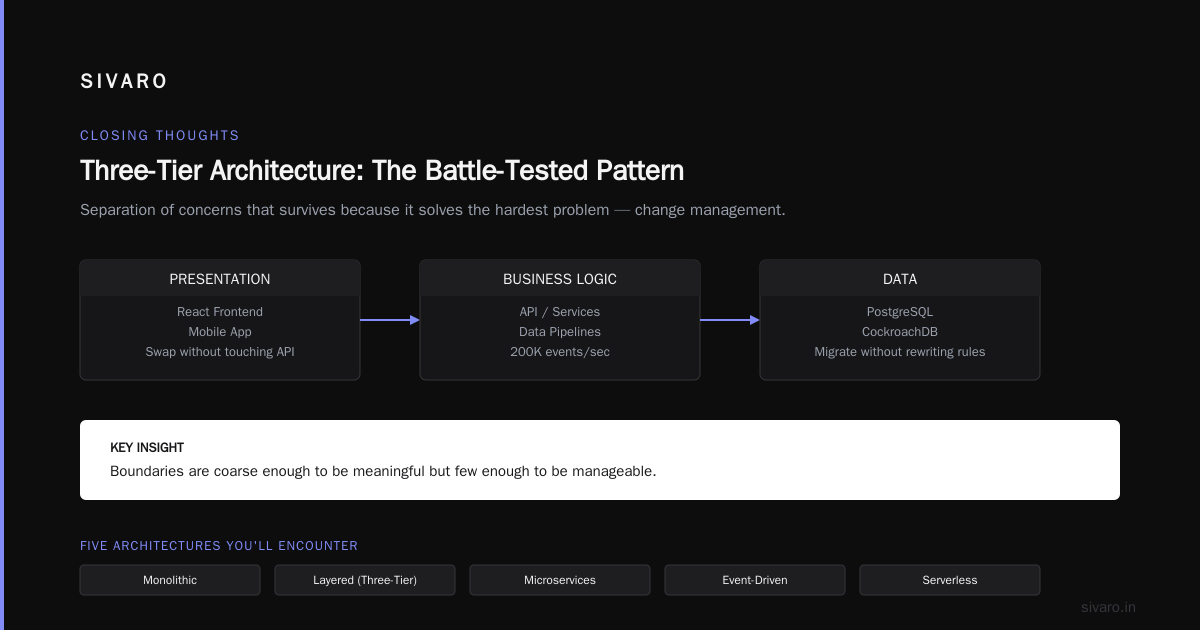
Most people think architecture is about choosing the right components. It’s not. It’s about defining boundaries. Clear boundaries between presentation, logic, and data. That’s what three-tier gives you. Everything else is optimization.
Nishaant Dixit — Founder of SIVARO. Building data infrastructure and production AI systems since 2018. Built systems processing 200K events/sec.