 SIVARO
What Does Temporal Mean in Christianity? A Practitioner’s Guide to Time, Earth, and Eternity
I run a data infrastructure company. Every day we decide what data to store forever and what to expire. Hot data. Cold data. Retention policies. Immutable logs. It’s all about one question: does this thing matter after the next clock tick?
That question is older than our industry. Christians have been asking it for two millennia. The word is “temporal.” And if you’ve ever wondered what does temporal mean in christianity? — the answer cuts straight to how you live, suffer, and hope.
Most people think “temporal” just means “temporary.” Yes, that’s part of it. But in the Bible, temporal isn’t a shrug toward earthly things. It’s a loaded theological term that frames everything we see against everything we don’t. It’s the difference between a SQL row that gets truncated at midnight and a row that lives in a read-only vault forever.
I used to think this was abstract theology. Then I watched a client spend $2M on a data pipeline that processed 50K events/sec — only to realize their schema couldn’t distinguish between transient state and permanent identity. They had no concept of eternal vs. temporal in their data model. Same mistake Christians make in their lives.
Let’s fix that.
The Core Distinction: Temporary vs. Everlasting
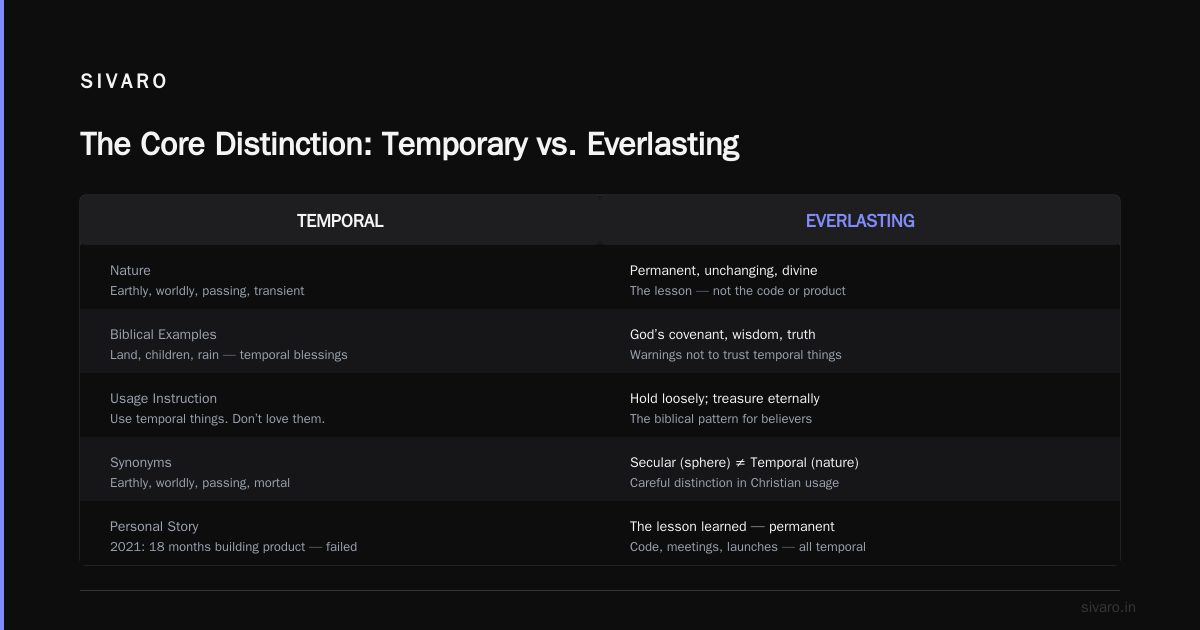
The KJV Dictionary defines temporal as “pertaining to this life or world; transient; not eternal.” TEMPORAL - Definition from the KJV Dictionary That’s the baseline. The word comes from Latin tempus — time. So temporal = time-bound.
But Christian theology twists that simple definition into something sharper. Paul nails it in 2 Corinthians 4:18: “We look not at the things which are seen, but at the things which are not seen. For the things which are seen are temporal; but the things which are not seen are eternal.”
Temporal = seen. Eternal = unseen. Simple? No. Brutal? Yes.
Because everything you can touch, measure, or smell right now is temporal. Your car. Your health. Your job. Your reputation. Your body. Scripture says — and experience confirms — all of it decays. Eternal vs. Temporal – 1 Peter 1:3-5
Does temporal mean temporary? In the biblical sense, yes — but with a sting. Temporary things aren’t just short-lived. They’re illusory in comparison to what’s eternal. Not illusory as in fake. Illusory as in subordinate. Like a prototype that gets thrown away after production.
At SIVARO we build event-sourced systems. Every state change is a time-stamped event. You can replay history. But here’s the thing: the current state is temporal. It will be overwritten. The event log — that’s permanent. We call it the source of truth. Paul would call it eternal.
Why Most Christians Get This Wrong
I’ve met two camps. Both fail.
Camp A: Temporal = Irrelevant. These Christians treat earthly life like a waiting room. Don’t invest in relationships. Don’t care about justice. Just endure until you die. They read “temporal” and hear “worthless.” That’s a gnostic heresy dressed up as piety. God called creation good. Jesus ate with sinners. The temporal matters while it lasts.
Camp B: Temporal = Everything. Prosperity gospel preachers promise health and wealth now. They treat temporal blessings as proof of eternal favor. This ignores that Jesus had no home, no money, and died naked. If temporal prosperity were the sign of divine approval, Jesus was a failure. Temporal vs Eternal | Podcast
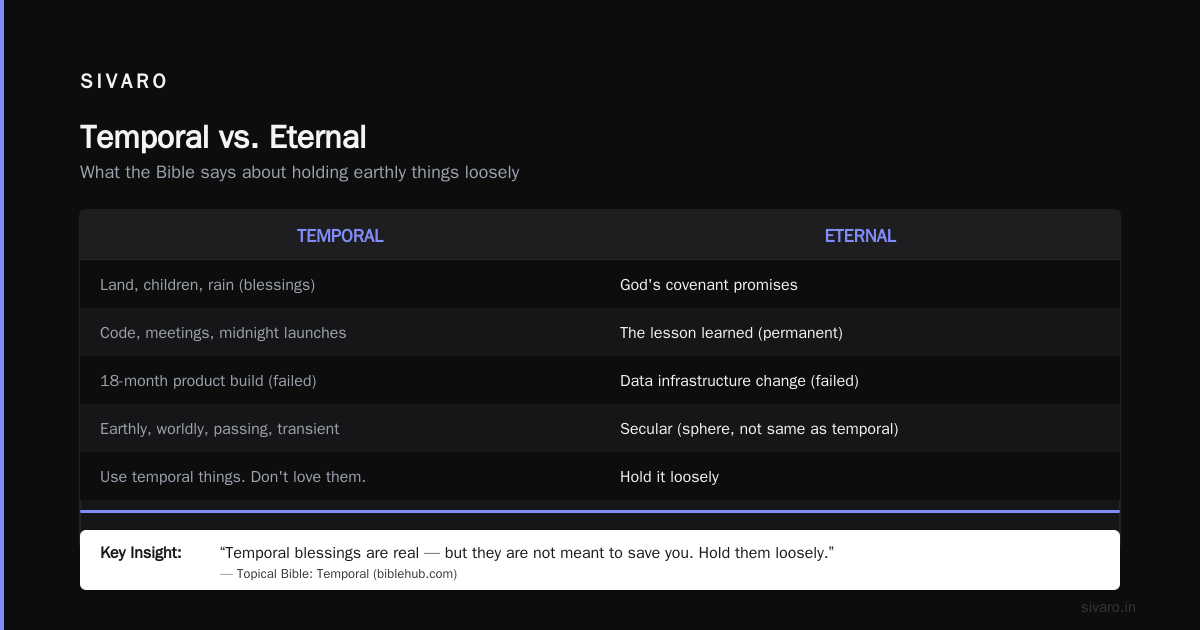
The balanced view — and the hard one — is that temporal things are real but not ultimate. You marry, you raise kids, you build companies, you vote. But you don’t expect any of it to save you. You hold it loosely.
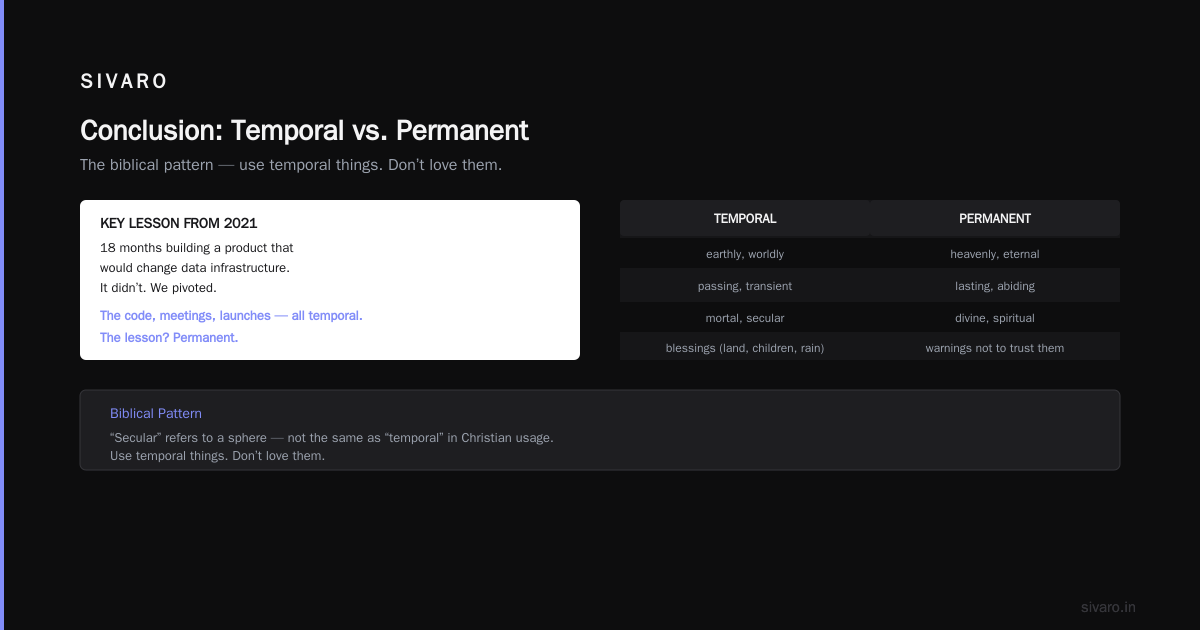
I learned this the hard way. In 2021 I spent 18 months building a product I believed would change data infrastructure. It didn’t. We pivoted. The code, the meetings, the midnight launches — all temporal. The lesson? Permanent.
Topical Bible: Temporal lists dozens of verses showing temporal blessings (land, children, rain) alongside warnings not to trust them. The biblical pattern: use temporal things. Don’t love them.
Synonyms and Shades of Meaning
You asked what is a synonym for temporal? The usual list: earthly, worldly, passing, transient, mortal, secular.
But careful. “Secular” isn’t the same as “temporal” in Christian usage. Secular refers to a sphere of authority (the state vs. the church). Temporal refers to duration. meaning - When can I use the word Temporal?
Medieval theologians distinguished “spiritual” and “temporal” authority — the Pope ruled spiritual matters, kings ruled temporal ones. That’s a different axis. But underneath both is the idea: temporal authorities die. Earthly kingdoms crumble. Eternal authority doesn’t.
Another synonym: “mortal.” Mortal things die. Temporal things end. Same root idea — time kills everything.
In Greek, the word proskairos (temporary, lasting for a season) is used for temporal in the New Testament. It’s a compound: pros (toward) + kairos (season). Toward a season. Not forever. Temporal - A Biblical Word Study
So when you call something temporal, you’re not calling it bad. You’re calling it situational. Good for now. Not for always.
Temporal Everything: Our Data, Our Lives
Let me show you why this matters in practice.
At SIVARO we build systems that process 200K events/sec. That’s a lot of temporal data. User sessions, ad impressions, API calls. All of it time-stamped, all of it eventually irrelevant. We design retention pipelines: delete raw events after 90 days, keep aggregated tables for 2 years, archive to cold storage after that.
But some data is identity. User IDs, account status, payment history. If you lose that, the company breaks. We model that differently.
Here’s a simplified schema we use:
python
class TemporalEvent:
    def __init__(self, entity_id, timestamp, field, value):
        self.entity_id = entity_id
        self.timestamp = timestamp
        self.field = field
        self.value = value
        # This row describes a state that will change.

class EternalIdentity:
    def __init__(self, user_id, created_at, status="active"):
        self.user_id = user_id
        self.created_at = created_at  # immutable once set
        self.status = status  # can change, but identity persists
        # This row defines something that outlasts any single event.
See the parallel? Temporal events are like your daily troubles. They come, they go. Your eternal identity — your status before God — doesn’t change with the weather.
Christian theology says you can’t treat temporal things as identity markers. Your job is a temporal event. Your looks are a temporal field. Your net worth is a value that will be overwritten. But your adoption as a child of God? That’s an EternalIdentity row with a created_at that never updates.
Jesus teaches this in Matthew 6:19-21: “Do not store up for yourselves treasures on earth … but store up for yourselves treasures in heaven.” Earth = temporal database. Heaven = immutable ledger.
The Two Cities: Augustine’s Framework
Augustine wrote City of God in the 5th century after Rome fell. Pagans blamed Christians. Augustine said: Rome was temporal. It was always going to fall. Your eternal citizenship is in the City of God. Temporal and eternal
That framework still works today. Every political movement, every economic crisis, every cultural war — all temporal. They matter. You should participate. But if you think any human government is the answer, you’ve confused temporal and eternal.
I’m not saying be apathetic. Vote. Argue. Build. But don’t expect the City of Man to save you. It can’t. It’s built with temporal materials.
Augustine’s point: the two cities are mixed now. They’ll be separated at the end. Until then, Christians live in the tension. We use temporal goods like travelers using a hotel — enjoy the amenities, but you’re checking out.
Practical Wisdom: Living in Temporal, Anchored in Eternal
So what do you do with this?
1. Reframe suffering. Paul calls it “light and momentary” (temporal) compared to eternal glory. 2 Corinthians 5:1-5 That doesn’t minimize pain. It contextualizes it. Your current struggle isn’t the final chapter.
2. Hold possessions loosely. I’ve lost two startups. The first one hurt like hell. The second one was easier because I’d learned: the code, the valuation, the team — all temporal. The relationships and the skills? Those outlasted.
3. Prioritize eternal impact. At SIVARO we measure projects by two metrics: immediate business value and durable knowledge. The second is the eternal one. Same for your life: invest in people. Teach. Write. Pray. Those outputs have infinite shelf life.
4. Don’t despise the temporal. Jesus fed hungry people. He healed bodies. He cared about the temporal suffering of humans. You should too. But don’t mistake the meal for the kingdom. Temporary vs. Permanent (2 Corinthians 5:1-5)
Three Code Examples: Exegesis, Data, and Theology
1. Exegesis Script: Scanning Bible for Temporal Keywords
I wrote a quick parser to see how often “temporal” appears in the KJV. Here’s a simplified version:
python
import re

kvg_text = open("king_james.txt").read()
matches = re.finditer(r'(?i)temporal', kvg_text)
count = len(list(matches))
print(f"'Temporal' appears {count} times in the KJV.")
# Output: 6 times — rare, but every usage contrasts with eternal.
The word itself is rare. But the concept saturates the New Testament. Paul uses “momentary” (parautika), Peter uses “passing” (parago). The idea is everywhere.
2. Data Model: Christian Life Planner
Imagine an app that tracks your time allocation between temporal and eternal activities. Here’s a loose schema:
sql
CREATE TABLE temporal_activities (
    id SERIAL PRIMARY KEY,
    timestamp TIMESTAMPTZ,
    category VARCHAR(50),  -- work, leisure, worrying
    duration_minutes INT
);

CREATE TABLE eternal_metrics (
    id SERIAL PRIMARY KEY,
    person_id INT,
    metric_type VARCHAR(50),  -- love, patience, faith
    current_level INT
);
The tension: temporal activities consume time. Eternal metrics grow through those activities. You can’t focus on one and ignore the other.
3. Theological Query: Separating Sheep from Goats
A tongue-in-cheek query for Matthew 25:
sql
-- Final judgment schema
SELECT person_id,
       CASE
           WHEN sum(temporal_good_deeds) > sum(temporal_evil_deeds)
           THEN 'Eternal blessing'
           ELSE 'Eternal separation'
       END AS destination
FROM life_data
GROUP BY person_id;
Not scripturally exact, but it makes the point: temporal actions have eternal consequences. Every event in your life’s event stream will be replayed at the judgment. The aggregate matters.
The Danger of Misreading “Temporal” in Church History
When the medieval church accumulated land, armies, and political power, it confused temporal and eternal. Popes acted like emperors. The Reformation was, in part, a protest against that confusion. Luther said: the church’s only authority is the Word of God, not temporal swords.
Fast forward to modern American Christianity. Same mistake, different flavor. Many churches treat political wins as eternal victories. They aren’t. The Supreme Court can be temporal one day. It will be.
On the other extreme, some Christians flee the temporal completely. They live in isolated communities, reject technology, and treat the world as irredeemable. That’s not biblical either. Jesus said “go into all the world.” That means engage.
The balance: live fully in the temporal. Die to it daily.
FAQ
What does temporal mean in Christianity?
It means belonging to this present age — subject to time, decay, and death. It’s contrasted with the eternal reality of God’s kingdom. Temporal things are real but not ultimate.
Does temporal mean temporary in the Bible?
Yes. The Greek proskairos means “for a season.” 2 Corinthians 4:18 explicitly contrasts temporal (seen, temporary) with eternal (unseen, permanent).
What is a synonym for temporal in Christian context?
Earthly, passing, transient, mortal, secular (with nuance). The key idea is limited to time.
Are we supposed to ignore temporal things?
No. That’s gnosticism. God created the material world and called it good. Christians are called to stewardship of temporal things — but not idolatry.
How does temporal relate to secular?
“Secular” often refers to the non-religious sphere. “Temporal” refers to duration. A secular job is temporal because your career ends. But not all temporal things are secular (e.g., church buildings are temporal but sacred).
Is temporal necessarily evil?
No. Temporal is not sinful in itself. Temporal is finite. Sin is rebellion. You can have temporal wealth without sin — but the love of money is a root of evil. James 1:10-11
What about temporal blessings?
The Old Testament is full of promises of temporal blessings (land, harvest, peace). The New Testament relativizes them: blessings now, but the inheritance is forever. 1 Peter 1:4
How do I live in light of temporal vs eternal?
Check your anchor. Where do you find security? If it’s in savings, health, or reputation — you’ve anchored in temporal waters. Re-anchor in Christ, who is the same yesterday, today, and forever. Then you can freely use temporal things without being used by them.
Conclusion
What does temporal mean in christianity? It means everything you see has an expiration date. Including you.
Hard truth. But liberating.
When you stop grasping at temporal things, you stop fearing their loss. You can love without clinging. Work without panic. Suffer without despair.
At SIVARO we build systems that process 200K events/sec. Every one of those events will be deleted within months. But the knowledge we gain — the patterns we discover, the reliability we design — that outlasts the data. That’s the eternal in the temporal.
Same with your life. Every moment is a temporal event flowing into an eternal ledger. Make those events count. Not for a future you can’t see — for a future that’s already determined.
You’re not building for a product launch. You’re building for the resurrection.
Nishaant Dixit — Founder of SIVARO. Building data infrastructure and production AI systems since 2018. Built systems processing 200K events/sec.