
What Does Kafka Stand For? The Untold Story Behind Tech's Most Misunderstood Name
Every time I tell someone I work with Kafka, I get the same two reactions. Either they think I'm talking about the writer — the guy who wrote The Metamorphosis, the one who turned alienation into an art form. Or they assume I'm talking about a tool they've been told to learn but can't quite explain.
What does Kafka stand for?
The short answer: nothing. It's not an acronym. The longer answer — the one that matters — is that Apache Kafka was named after Franz Kafka, the early 20th century Czech writer who died in 1924. And that naming choice tells you more about what Kafka the technology actually is than any documentation page ever could.
Let me explain why that matters, and why the confusion around "what does Kafka stand for?" is actually the key to understanding distributed systems in 2026.
The Name and the Nightmare
Jay Kreps, one of Kafka's original creators at LinkedIn, said they picked the name because "Kafka was a writer who wrote about systems that are opaque and hard to reason about." He was being half-funny. But here's the thing that most people miss: the joke is actually the thesis.
Franz Kafka built worlds where characters couldn't see the machinery running their lives. They'd file forms, wait in corridors, and never get answers. Sound familiar? That's exactly what distributed data feels like when you don't have the right infrastructure. Messages vanish. State gets lost. You're begging an opaque system to tell you what happened.
Kafka (the technology) was designed to make that nightmare visible. You can replay logs. You can trace exactly what happened. You can audit every decision. It's the anti-Kafkaesque experience — a system where transparency is the whole point.
So when someone asks "what does Kafka stand for?", the real answer is: clarity through logs. It stands for telling you exactly what happened, not hiding it behind bureaucracy.
So is Apache Kafka a Language?
I've had junior engineers ask me this point-blank: is Apache Kafka a language?
No. It's not. But I get why they ask.
Kafka has its own vocabulary. Topics. Partitions. Offsets. Consumer groups. It feels like learning a new syntax. But Kafka is a distributed event streaming platform. It's written in Java and Scala at the core. You interact with it through client libraries — Java, Python, Go, Node, Rust, you name it.
Here's the distinction that matters: a language is how you express logic. Kafka is how you move data between systems. You don't write "in" Kafka. You write against Kafka's APIs. You produce records. You consume records. The tool itself doesn't care what those records contain — JSON, Avro, Protobuf, plain text, serialized Python objects — it just preserves order and guarantees delivery.
Think of it like this: TCP/IP isn't a language either. But you can't build the internet without it.
Is Kafka a Frontend or Backend?
Let me kill this one dead: is Kafka a frontend or backend?
Neither. And "full stack" isn't right either.
Kafka sits in the infrastructure layer. It's middleware. It's plumbing. It doesn't have a UI you ship to users (though tools like Kafka UI exist for admin). It doesn't run business logic directly. It's the nervous system — not the brain or the limbs.
Most people think X. They're wrong because Kafka feels like a backend component when you're writing consumers and producers. But it's deeper than that. Kafka is the substrate on which backend services communicate. It's the message bus, the event store, the change data capture pipeline, the metrics backbone.
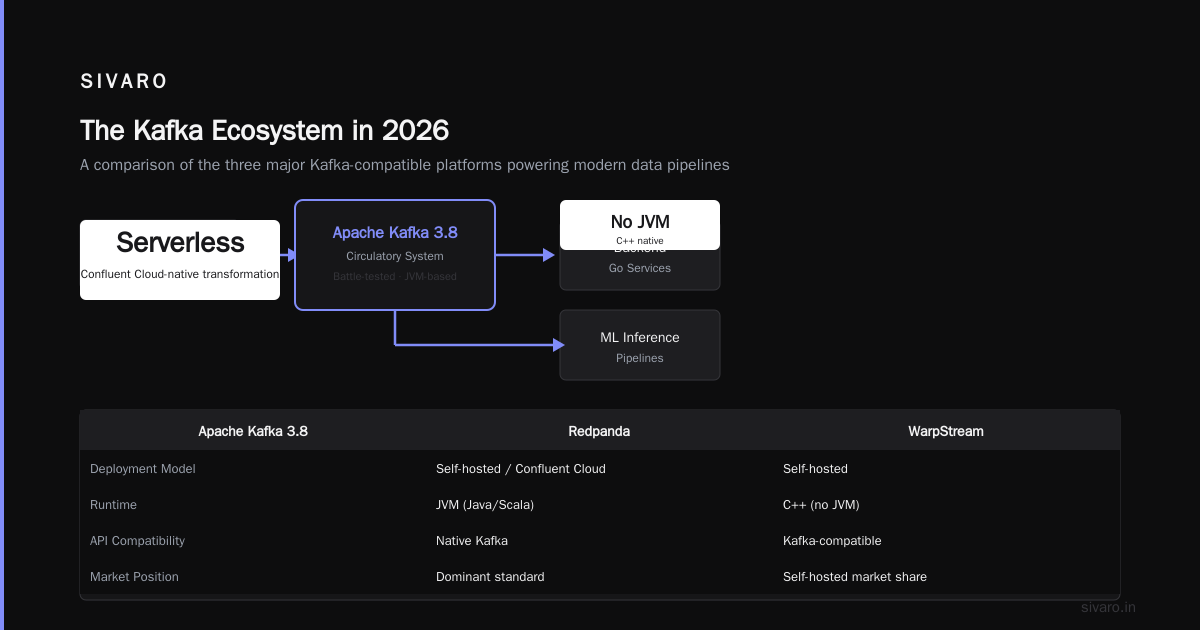
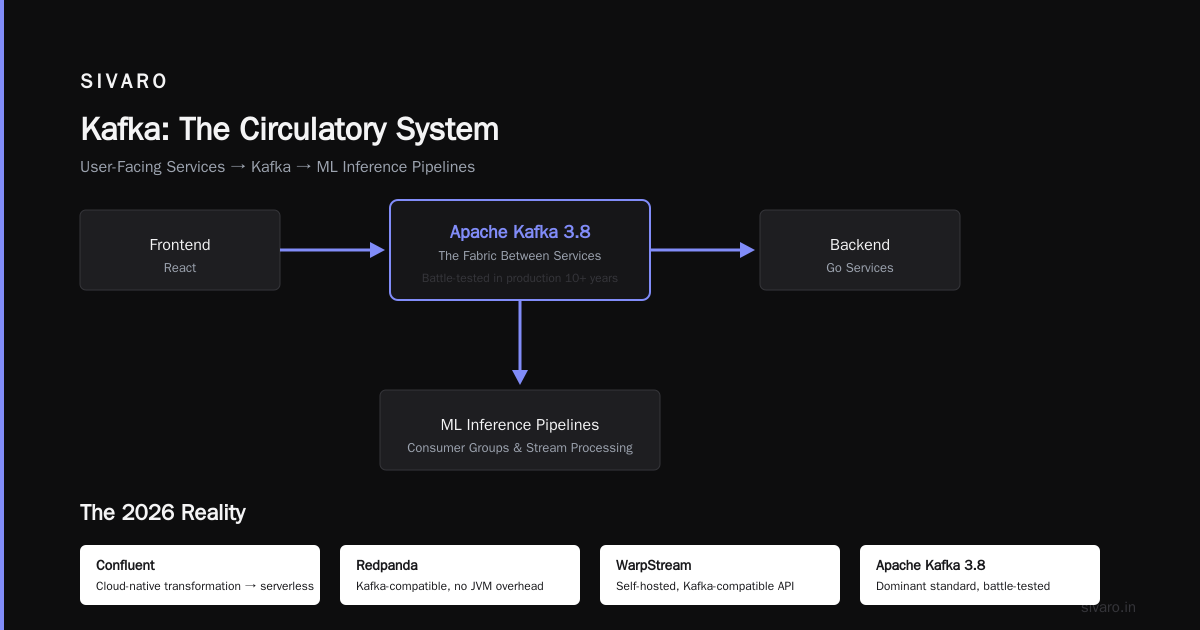
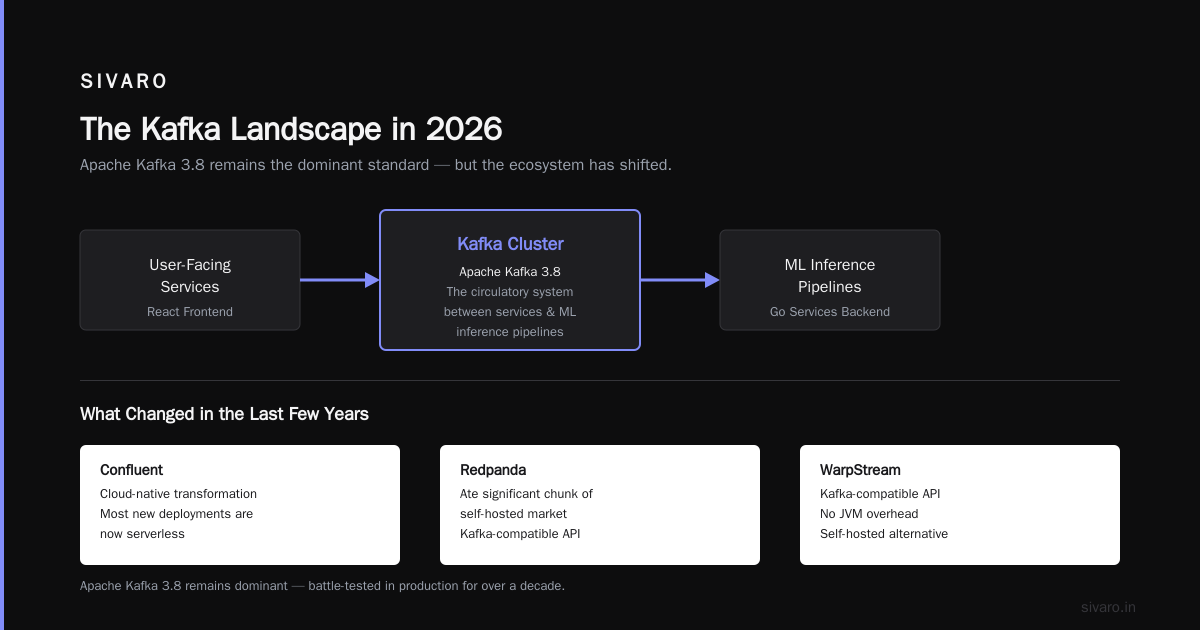
At SIVARO, we run Kafka clusters that sit between user-facing services and our ML inference pipelines. The frontend sits in React. The backend runs Go services. Kafka is the fabric between them. It's not frontend. It's not backend. It's the circulatory system.
What Kafka Actually Is (The 2026 Reality)
Today is July 7, 2026. The Kafka landscape has shifted hard in the last few years.
Two things happened. First, Confluent went through its "cloud-native" transformation and now most new deployments are serverless. Second, Redpanda and WarpStream ate a significant chunk of the self-hosted market by offering Kafka-compatible APIs without the JVM overhead.
But Kafka itself — Apache Kafka 3.8 as of this writing — is still the dominant standard. Why? Because it's been battle-tested in production for over a decade. Because the ecosystem around it (Kafka Connect, Kafka Streams, ksqlDB) is unmatched. Because every cloud provider offers it as a service.
What does Kafka stand for in practice? Four things:
- Durability — records written to Kafka survive broker failures. Period.
- Ordering — within a partition, messages arrive in the order they were produced.
- Replayability — consumers can rewind and re-process historical data.
- Decoupling — producers don't know about consumers. They just publish.
That last point is the killer feature. In 2026, microservices are still the dominant architecture (despite the "modular monolith" backlash of 2024-25). And microservices need an async communication backbone. Kafka is that backbone.
The Architecture Nobody Teaches You
Here's what I wish someone had told me when I first started with Kafka.
Most tutorials show you this:
python
from kafka import KafkaProducer

producer = KafkaProducer(bootstrap_servers='localhost:9092')
producer.send('my-topic', b'hello')
producer.flush()
That's fine for a demo. It's useless in production.
Here's what production Kafka looks like:
python
from kafka import KafkaProducer
import json
import uuid
from datetime import datetime

producer = KafkaProducer(
    bootstrap_servers=['kafka-1:9092', 'kafka-2:9092', 'kafka-3:9092'],
    value_serializer=lambda v: json.dumps(v).encode('utf-8'),
    acks='all',  # Wait for all replicas to acknowledge
    retries=5,
    retry_backoff_ms=1000,
    linger_ms=10,  # Batch for efficiency
    batch_size=16384,
    compression_type='gzip'
)

event = {
    'event_id': str(uuid.uuid4()),
    'timestamp': datetime.utcnow().isoformat(),
    'user_id': 'u_9f3k2a',
    'action': 'checkout',
    'value': 249.99
}

future = producer.send('orders', key=b'u_9f3k2a', value=event)
result = future.get(timeout=10)
print(f"Published to partition {result.partition}")
See the difference? acks='all' means you don't lose data. retries means transient failures don't kill you. linger_ms means you batch for throughput. key means ordering is guaranteed per user ID.
This is the stuff that matters. Not "what does Kafka stand for?" as a trivia question. But what it stands for in terms of reliability guarantees.
The Dark Side (Honesty)
I've been running Kafka in production since 2018. I've seen it break in ways that made me question my career choices.
ZooKeeper was the original pain point. If you've ever had a ZooKeeper cluster lose quorum during a network partition, you know the specific flavor of terror that produces. Kafka 2.8 (2021) introduced KRaft mode to replace ZooKeeper. By 2026, KRaft is stable, but migrating an existing cluster is still surgery.
Rebalancing is the other nightmare. When a consumer joins or leaves a group, Kafka reassigns partitions. During that rebalance, no messages are processed. For large consumer groups (50+ consumers), this can take minutes. You need to design for it. Static group membership helps. Cooperative rebalancing helps more. But it's still a sharp edge.
Schema management is mandatory but painful. Avro, Protobuf, or JSON Schema — pick one. Schema Registry is the standard, but it adds operational complexity. One wrong schema evolution and you corrupt your data pipeline.
I say all this not to scare you. I say it because the "Kafka is perfect" narrative is dangerous. It's a tool with sharp edges. Respect them.
When to Use Kafka (And When Not To)
Most people use Kafka when they should use something simpler.
Use Kafka when:
- You need replayability (re-process last 7 days of events)
- You have multiple consumers reading the same stream
- You need strict ordering within a partition
- You're building event sourcing or CQRS
- Your throughput exceeds what a traditional message queue can handle (hundreds of thousands of messages per second)
Don't use Kafka when:
- You need exactly-once delivery to a single consumer (use RabbitMQ or Redis)
- Your total throughput is < 1000 messages per minute (too much overhead)
- You need low latency (< 5ms) (use Pulsar or NATS)
- You're prototyping a new service (use a database first, add Kafka later)
I learned this the hard way. In 2019, we put Kafka in front of a simple notification service that sent maybe 200 emails an hour. We spent more time tuning the cluster than building the product. Overengineering is a tax you pay upfront. Underengineering is a tax you pay later. Neither is fun.
The 2026 State of Stream Processing
ksqlDB in 2026 is mature enough that I'd use it in production. Kafka Streams is still the gold standard for JVM shops. But the interesting shift is toward Python-native streaming.
Projects like Bytewax and Quix have matured. We're using a custom Kafka consumer with async Python and Ray for real-time ML inference at SIVARO. Here's what that looks like:
python
import asyncio
from aiokafka import AIOKafkaConsumer
from ray import serve

@serve.deployment
class InferencePipeline:
    async def __init__(self):
        self.consumer = AIOKafkaConsumer(
            'sensor-readings',
            bootstrap_servers='kafka-cluster:9092',
            group_id='ml-inference-group',
            value_deserializer=lambda m: json.loads(m.decode('utf-8')),
            auto_offset_reset='earliest',
            enable_auto_commit=False
        )
        await self.consumer.start()

    async def process_batch(self):
        batch = await self.consumer.getmany(timeout_ms=5000, max_records=100)
        for topic_partition, messages in batch.items():
            for msg in messages:
                prediction = await self.run_model(msg.value)
                await prediction_sink.write(prediction)
        await self.consumer.commit()
Notice enable_auto_commit=False. Always manage offsets manually in production. Auto-commit will lose data when your consumer crashes between commits.
What Does Kafka Stand For? The Philosophical Answer
Let me circle back to the original question.
Franz Kafka lived from 1883 to 1924. He worked at an insurance company. He wrote at night. He published barely anything during his lifetime. His friend Max Brod ignored Kafka's instruction to burn his manuscripts and published them posthumously. We nearly lost The Trial, The Castle, Amerika.
Franz Kafka - Existential Primer - Tameri describes him as someone who "saw the absurdity of bureaucracy and the loneliness of modern existence." His characters are trapped in systems they can't understand.
Kafka (the technology) was built to prevent that exact feeling. It gives you:
- Observation — you can see every message, every offset, every lag
- Audit — you can replay history and verify what happened
- Control — you decide retention, replication, partitioning
Franz Kafka's personal writings and their philosophical... explore how Kafka's personal diaries show a man obsessed with clarity amid chaos. The technology named after him serves the same purpose — imposing order on distributed chaos.
So when you ask what does Kafka stand for?, the real answer is: it stands for making systems legible.
It's a tool that says "you don't have to wonder what happened. Here's the log. Read it."
The FAQ
Q: What does Kafka stand for in Apache Kafka?
A: Nothing. It's not an acronym. It's named after Franz Kafka, the writer. The name was chosen because Kafka's work deals with opaque systems — and the technology was designed to make distributed systems transparent.
Q: Is Apache Kafka a language?
A: No. It's a distributed event streaming platform written in Java/Scala. You interact with it using client libraries in various languages (Java, Python, Go, etc.). You don't write programs "in" Kafka — you produce and consume messages to and from it.
Q: Is Kafka a frontend or backend?
A: Neither. It's infrastructure middleware. It sits between frontend and backend components, decoupling them. It's the plumbing, not the fixtures or the water.
Q: Is Kafka still relevant in 2026?
A: Yes, but the ecosystem has shifted. Confluent Cloud dominates for managed Kafka. Redpanda and WarpStream challenge self-hosted deployments. The core Kafka protocol remains the industry standard for event streaming.
Q: When should I not use Kafka?
A: When you need sub-5ms latency, when your throughput is under 1000 msg/min, when you need simple point-to-point messaging, or when you're prototyping. Use simpler tools for simpler problems.
Q: What's the hardest thing about running Kafka?
A: Operations. Managing partitioning, rebalancing, schema evolution, and cluster health takes dedicated expertise. The technology is solid. Running it at scale is where the pain lives.
Q: Can I use Kafka for real-time machine learning?
A: Yes, and it's increasingly common. Kafka handles the data pipeline. You attach ML inference as consumers. The replayability is critical for model retraining and A/B testing.
Q: What's the difference between Kafka and RabbitMQ?
A: Kafka persists messages for replay. RabbitMQ is designed for transient messaging. Kafka scales to higher throughput. RabbitMQ has lower latency and simpler routing. Different tools for different jobs.
The Bottom Line
I've been building data infrastructure since 2018. I've watched Kafka become the default choice for event streaming at every company I've worked with. I've also watched teams struggle because they treated it like a magic black box instead of understanding what it actually is.
What does Kafka stand for? It stands for durable, ordered, replayable event streams. It stands for decoupling producers from consumers. It stands for making your system's behavior visible and auditable. It stands for the promise that you can know what happened, even after things break.
And yes — it stands for Franz Kafka, who wrote about the horror of not knowing.
Build systems differently.
Nishaant Dixit — Founder of SIVARO. Building data infrastructure and production AI systems since 2018. Built systems processing 200K events/sec.