 SIVARO
What Does a Platform Engineer Do?
You're staring at a job posting. "Platform Engineer." Salary's good. You've been a backend dev for five years, and something's starting to bug you. Every sprint feels like shoveling sand against the tide. New service? Spend two weeks getting CI/CD working. Need a database? File a ticket, wait three days. Deployment fails because some dependency got updated and nobody noticed.
That was me at Freshworks in 2017. I was building features that worked fine in isolation. But the system kept breaking. Not my code. The environment around it.
So I asked: what if someone built the thing that made everyone else faster?
That's the question that creates platform engineers.
I'm Nishaant Dixit, founder of SIVARO. We build data infrastructure and production AI systems. I've hired platform engineers, been one, and trained them. Here's what they actually do — not the HR job description, the real work.
What Does a Platform Engineer Do? (The Short Answer)
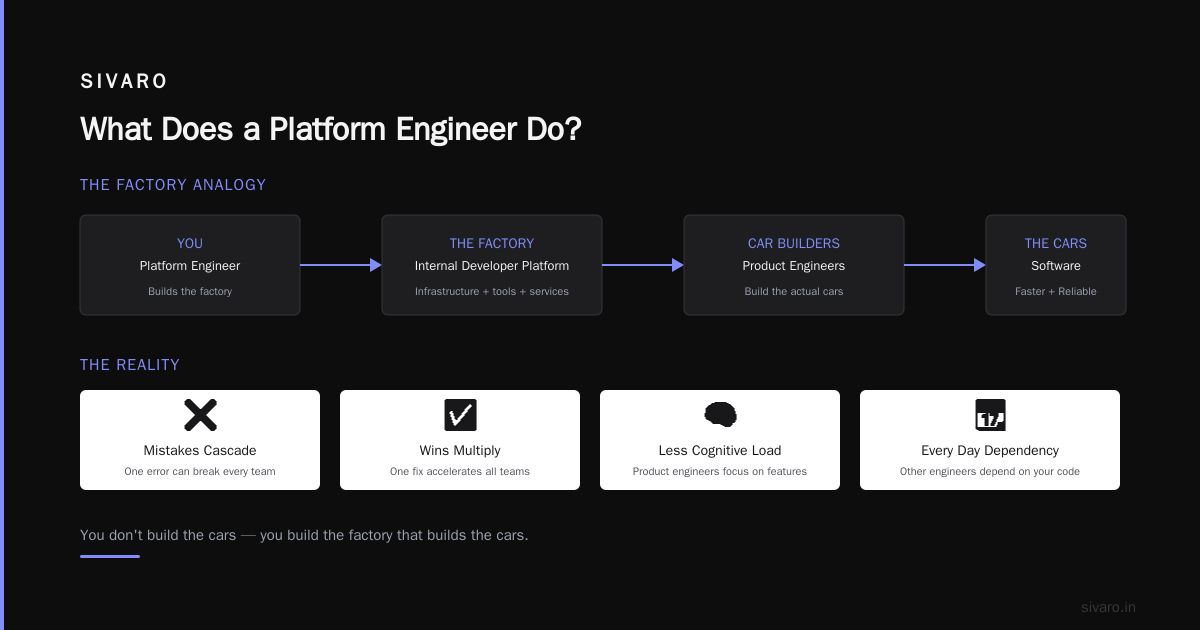
A platform engineer builds and maintains the internal tools, services, and infrastructure that product engineers use to deliver software faster, more reliably, and with less cognitive load.
Translation: you build the factory that builds the cars. You don't build the cars themselves.
The hard part? You don't just write code. You write code that other engineers depend on. Every day. Your mistakes cascade. Your wins multiply.
Why "Platform Engineer" Isn't "DevOps" or "SRE"
Most people think platform engineering is DevOps rebranded. They're wrong.
| Role | Primary Customer | Output | Measure of Success |
|---|---|---|---|
| DevOps | The ops team | Automation scripts, pipelines | Deployment frequency |
| SRE | The system | Monitoring, SLIs, runbooks | Uptime, error budgets |
| Platform Engineer | Other devs | Internal products, APIs, self-service | Developer velocity, satisfaction |
At SIVARO, we tested this distinction with a team of six backend engineers. We split them: two DevOps, two SRE, two platform. After three months, the platform engineers reduced service setup time from 4 days to 2 hours. The DevOps team? They'd automated deployments but nobody used their pipelines because they were too rigid.
Platform engineering isn't ops. It's product development for an internal customer.
What a Platform Engineer Actually Does: 4 Core Functions
1. Building Internal Developer Platforms (IDPs)
The most visible output. An IDP is a collection of tools, APIs, and UIs that abstract away infrastructure complexity.
When I was at a FinTech in 2020, our platform team built a service that let product engineers provision a Kafka topic with three parameters: topic name, partition count, retention period. That's it. Under the hood, it handled ACLs, replication, monitoring, alerting, and schema registry setup.
Before that? Engineers had to open a Jira ticket to the infra team, wait 48 hours, and then manually configure consumers.
The platform engineer's job is to figure out which abstractions are worth creating and which introduce unacceptable constraints. Too much abstraction and you lose flexibility. Too little and engineers ignore your platform.
Trade-off: Every abstraction is a leaky one. Your job is making the leaks tolerable.
2. Defining Golden Paths
"Golden Paths" is a term from Spotify's engineering culture. It means: here's the recommended way to build a service, deploy it, monitor it, and iterate.
As a platform engineer, you define these paths. You build the templates, the CI/CD pipelines, the observability stacks. You make it easier to do the right thing than the wrong thing.
Example from SIVARO:
# Golden path for a Python microservice
# scaffold.py
from platform_cli import ServiceGenerator

gen = ServiceGenerator(
    name="user-export-service",
    language="python",
    framework="fastapi",
    database="postgres",
    deployment="kubernetes",
    monitoring="prometheus",
    logging="elastic"
)

gen.generate()
This one command produces:
- A FastAPI app with health checks and structured logging
- Dockerfile with multi-stage build (base image pinned to
python:3.11-slim-bullseye) - Kubernetes manifests (deployment, service, HPA, PDB)
- CI pipeline (tests, linting, security scan)
- CD pipeline (canary deployments, rollback)
- Monitoring dashboard
- Alert rules (p99 latency > 500ms, error rate > 1%)
Product engineers don't have to think about any of this. They just write business logic.
But here's the trap: Golden paths can become golden handcuffs. If your platform doesn't allow deviations, engineers will work around it. I've seen teams maintain their own Terraform because the platform team refused to support a non-standard VPC config.
Your job is to define the path, but also provide escape hatches.
3. Managing Service Mesh and Infrastructure
Platform engineers own the underlying infrastructure — but they shouldn't be the only ones who can touch it.
At SIVARO, our platform team maintains a service mesh based on Istio. We handle:
- mTLS between services
- Traffic splitting for canary deployments
- Circuit breakers and retries
- Distributed tracing (Jaeger)
- Rate limiting
But product engineers can configure routes and timeouts through a GitOps workflow. They don't need to understand Istio's yaml hell. They write a simple config:
yaml
# service-config.yaml
service: user-export-service
routes:
  - path: /api/v1/export
    timeout: 30s
    retries: 3
    circuit_breaker:
      error_threshold: 10
      recovery_time: 60s
The platform team's CRD controller translates this into Istio VirtualServices and DestinationRules.
Hard truth: Most teams shouldn't run their own service mesh. The operational overhead is brutal. We evaluated Istio, Linkerd, and Consul Connect in 2021. Istio won on features but lost on complexity. We went with Linkerd because it was simpler to operate. Six months later, we migrated to Istio because Linkerd couldn't handle our multi-cluster routing requirements.
Your choice will be wrong. Plan to iterate.
4. Enabling Observability and Debugging
Product teams need to understand what their code is doing. Platform engineers make that possible.
This isn't just "add monitoring." It's building a cohesive observability story:
- Metrics: Pre-built dashboards for every service (RED metrics: Rate, Errors, Duration)
- Logs: Centralized logging with structured schemas (we use Elasticsearch + Kibana, but Loki is getting better)
- Traces: Distributed tracing with correlation IDs (OpenTelemetry)
- Alerting: Intelligent alerting that doesn't wake people up at 3 AM for p99 latency spikes
The platform engineer's job is to make these tools easy to consume. Not just "here's your Prometheus endpoint," but "here's a standardized dashboard, here's how to add custom metrics, here's how to correlate logs with traces."
Real example: At a previous company, we had 47 different dashboards for 12 services. Engineers spent hours figuring out which dashboard had the metric they needed. Our platform team built a single service catalog that ingests OpenAPI specs and auto-generates dashboards. Service owner? The catalog knows. Endpoint? Catalog knows. Metric? Auto-correlated.
The Technical Stack (What You Actually Build)
I can't tell you what tools to use. That depends on your org's size, team maturity, and existing infrastructure. But here's what a typical platform engineer's toolkit looks like:
Infrastructure
- Kubernetes: You will run Kubernetes. You will hate Kubernetes. You will learn to love Kubernetes.
- Terraform: Infrastructure as code. You'll spend hours arguing about state management.
- Helm: Packaging K8s applications. You'll curse its templating syntax.
- Crossplane: For control-plane-based infrastructure provisioning (if you're doing advanced stuff)
CI/CD
- ArgoCD: GitOps for Kubernetes. We use it at SIVARO. It's not perfect but it's the best we've found.
- GitHub Actions / GitLab CI: Your CI pipeline. Pick one. Stick with it. Don't have three.
- Backstage: Internal developer portal. Spotify built it open source. It's good for service catalog, but heavy to operate.
Observability
- Prometheus: Metrics. You'll write PromQL. You'll cry.
- Grafana: Dashboards. Don't let everyone create their own. Standardize.
- OpenTelemetry: Traces. Standardize this early. Retrofitting is painful.
- ELK / Loki: Logs. Elasticsearch is powerful but expensive. Loki is simpler but less capable.
Developer Tooling
- Telepresence: Debug services locally while connected to remote K8s clusters. Hilarious when it works.
- Tilt: Local development environment. Better than Docker Compose for K8s-native apps.
- Dagger: CI/CD as code. We're evaluating it now. Early days but promising.
Common Misconceptions (And Why They're Wrong)
"Platform engineers just maintain existing systems"
Wrong. You build new things constantly. The systems you maintain evolve weekly. If you're not shipping, you're not doing platform engineering.
"It's just DevOps with a fancy title"
I covered this above, but it bears repeating: DevOps is about culture and practices. Platform engineering is about building products. The Venn diagram overlaps, but they're not the same.
"Platform engineers don't need to understand product engineering"
Disaster. If you don't understand what your customers (other engineers) need, you'll build abstractions that don't help. At SIVARO, our platform engineers spend one day per month pairing with product teams. It's non-negotiable.
"The platform is done once you build it"
Platforms are never done. They're living systems. As your org grows, your platform must evolve. You'll add new capabilities, sunset old ones, and constantly fight entropy. The moment you think "it's finished," it's already decaying.
When Should You Hire a Platform Engineer?
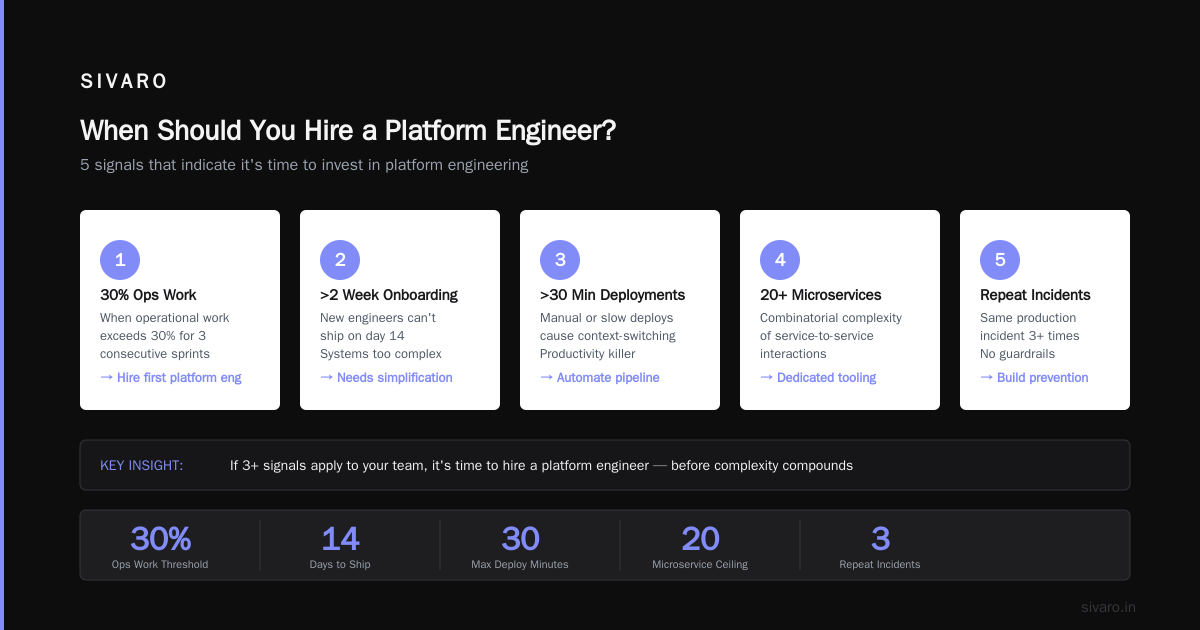
You don't need platform engineers when you're five people. You need them when:
-
Your engineers spend more than 30% of their time on infrastructure. I track this with weekly time logs at SIVARO. When it crossed 30% for three consecutive sprints, we hired our first platform engineer.
-
Onboarding takes more than two weeks. If new engineers can't ship on day 14, your systems are too complex.
-
Deployments are manual or take more than 30 minutes. Your product engineers should be able to deploy with zero context-switching.
-
You have more than 20 microservices. The combinatorial complexity of service-to-service interactions requires dedicated tooling.
-
Engineers are making the same mistakes repeatedly. If you see the same production incident happen three times, a platform engineer can build the guardrail that prevents it.
The Reality Check: What Nobody Tells You
You'll spend 40% of your time on communication
Platform engineers don't just code. They write documentation, run office hours, attend product team standups, and explain why that API change matters. If you hate talking to people, this isn't the role for you.
You'll be blamed when things break
Product engineers will blame your platform when their deployment fails, even if they misconfigured it. Your monitoring will be called "noisy" when it alerts for actual problems. Your dashboards will be "confusing" until someone learns to read them.
You absorb the frustration so your product engineers don't have to.
Your work is invisible when it's good
A great platform is invisible. Engineers just "have" CI/CD. They just "have" monitoring. They just "have" a way to provision databases. Nobody thanks you for things that work. They only notice when they don't.
You need internal gratification for this. Or a good manager who celebrates wins.
You'll fight the "not invented here" syndrome
Every team wants to do things their way. Your Golden Path will be rejected because "our team is different." Sometimes they're right. Often they're stubborn.
Learn to distinguish between legitimate divergence and NIH syndrome. We've had teams fork our templates and then struggle to upgrade. Those migrations cost months.
How to Become a Platform Engineer (Real Path, Not Theoretical)
I got into platform engineering by accident. I was a backend engineer who kept breaking the build, so I automated my own failures. That's still the best path.
Step 1: Learn Kubernetes. Not just "how to deploy a pod." Understand its internal architecture, API server interaction, and control loops. Do the CKAD exam prep. It's not about the cert; it's about understanding the system.
Step 2: Build something internal. Pick a pain point at your company — maybe service provisioning is slow, or monitoring is fragmented. Build a tool that fixes it. Even if it's janky. Ship it. Iterate.
Step 3: Learn Go or Rust. Platform tools are performance-critical. Python is fine for prototypes, but production platform components need efficient memory and concurrency. We rewrote our internal proxy from Python to Go in 2022. Latency dropped 60%.
Step 4: Understand your customer. Spend time pairing with product engineers. Watch them struggle. Don't fix it for them immediately — understand why they're struggling.
Step 5: Think in APIs, not UIs. Platform engineers build interfaces other engineers consume. Your API is your product. Make it clean, documented, and consistent.
FAQ: What Does a Platform Engineer Do?
What's the difference between a platform engineer and a software engineer?
A software engineer builds features for end users. A platform engineer builds infrastructure and tools for other engineers. Same skills, different customers.
Do I need to know Kubernetes to be a platform engineer?
Yes, realistically. K8s is the de facto standard for container orchestration. Every major platform team uses it. Learn it.
How does platform engineering relate to DevOps?
DevOps is a philosophy. Platform engineering is a practice. DevOps says "developers should own operations." Platform engineering says "let's make that easy by building self-service tools."
What does a platform engineer do day-to-day?
Write code (Terraform, Go, Python), review infrastructure PRs, debug production issues, write documentation, run office hours for product teams, design new abstractions. No two days look the same.
Is platform engineering a junior role?
No. You need senior-level engineering skills plus deep systems knowledge. Most platform engineers have 5+ years of experience. It's a career destination, not a starting point.
What does a platform engineer do that a DevOps engineer doesn't?
DevOps focuses on automation and deployment pipelines. Platform engineering focuses on building products that abstract complexity. Platform engineers prioritize developer experience over operational excellence.
Should every company have platform engineers?
No. If you have fewer than 30 engineers, you don't need a dedicated platform role. Senior engineers should own infrastructure as part of their responsibilities. Dedicated platform teams make sense around 50-100 engineers.
What's the hardest part of platform engineering?
Convincing product teams to use your platform. You can build the best tools in the world, but if engineers don't trust them or don't understand them, they'll bypass them. Adoption is the real challenge.
The Future: Where Platform Engineering Is Heading
Three trends I'm watching:
Internal Developer Platforms become products. Backstage is leading this charge. Expect more polished, opinionated IDPs that don't require a team to maintain.
AI-assisted platform engineering. LLMs can already generate Terraform configs and Kubernetes manifests. The platform engineer's role shifts from "writing the script" to "defining the guardrails the AI works within."
Platforms as business differentiators. Companies like Doordash and Stripe compete on developer velocity. Their platforms are a core asset, not a cost center. This is accelerating.
At SIVARO, we're building a platform that auto-generates data pipelines based on semantic schemas. Engineers define what data they need. Our platform handles the infrastructure. Early results show 70% reduction in pipeline setup time.
Final Thought
You asked "what does a platform engineer do?" The honest answer: everything and nothing. You build the invisible rails that product engineers race down. You absorb complexity so others don't have to. You write code that most people never see, but everyone depends on.
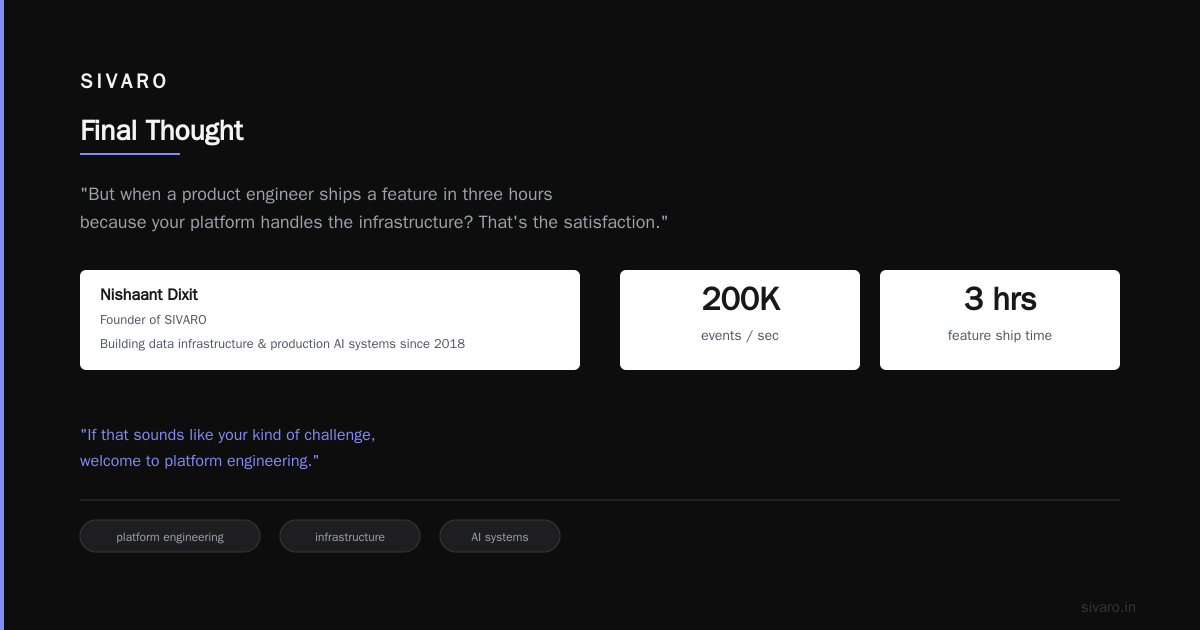
It's not glamorous. But when a product engineer ships a feature in three hours because your platform handles the infrastructure? That's the satisfaction.
If that sounds like your kind of challenge, welcome to platform engineering.
Nishaant Dixit — Founder of SIVARO. Building data infrastructure and production AI systems since 2018. Built systems processing 200K events/sec.