 SIVARO

What Does a Platform Engineer Do? The Real Answer
I spent 2018-2020 building data pipelines at a fintech startup that shall remain nameless. We had eight microservices, three databases, two queues, and one Kubernetes cluster that I swear had a vendetta against me.
Our team was drowning.
Every deploy broke something. Every new service took weeks to set up. Developers spent more time configuring CI/CD than writing actual business logic. The CTO kept asking why we couldn't "just move faster."
I couldn't answer that question then. But I knew the problem. We had no platform.
So in 2021, I founded SIVARO. And I've spent the last four years figuring out exactly what does a platform engineer do? — not from theory, but from building systems processing 200K events per second for production AI workloads.
Here's the answer I wish someone gave me in 2019.
The One-Sentence Definition
A platform engineer builds infrastructure that lets product engineers ship software without thinking about infrastructure.
That's it. Nothing more glamorous than that.
But let me tell you what it's not. It's not just DevOps with a fancier title. It's not "SRE but you sit in more meetings." And it's definitely not a junior role where you "learn the stack before moving to product."
If you're asking what does a platform engineer do? — you're really asking: "What's the difference between someone who keeps servers running and someone who builds an internal product?"
The answer: a platform engineer treats their colleagues as customers. Not users. Customers.
The Three Buckets of Platform Engineering
I've seen platform teams fail in three distinct ways. Each failure maps to one thing they forgot to do.
Internal Product Development
Here's the part most people miss. Platform engineers build products. Just not for external customers.
At SIVARO, we built an internal platform we call "The Dock" (creative, I know). Before The Dock, spinning up a new data pipeline took our team 3-5 days. After? About 45 minutes.
The product features were:
- A CLI tool (
dock init) that scaffolded everything - A web dashboard showing pipeline health
- Templates for common data patterns (Kafka to Postgres, API to S3, etc.)
Was this sexy? No. Did it make our product engineers 10x faster? Yes.
That's the job. You build tools. You build abstractions. You build the thing between the raw cloud and the product code.
Infrastructure as a Service
Not "infrastructure as code" — that's a different thing. Infrastructure as a service means you don't hand your product team a Terraform module and say "good luck."
You hand them a button that says "deploy my service" and it works.
When a product engineer at your company needs a new database, they shouldn't write a CloudFormation template. They should file a ticket or — even better — just declare database: postgres in their service config and it happens.
At first I thought this was about tooling. Turns out it's about trust. Product engineers don't want to learn your infrastructure. They want to trust that you've handled it.
Developer Experience Engineering
This is the part that sounds soft but costs real money.
Every minute a product engineer spends debugging a CI failure is a minute they're not building features. At a company with 50 engineers, if each loses 30 minutes per day to infrastructure bullshit, you've lost 25 engineering hours daily.
That's $1.5M a year in wasted salary at $150/hr fully loaded cost. Even more if you're at a tech company paying market rates.
Platform engineers fix that. They build the golden path — the one way to do things that just works. They eliminate choices. They enforce patterns.
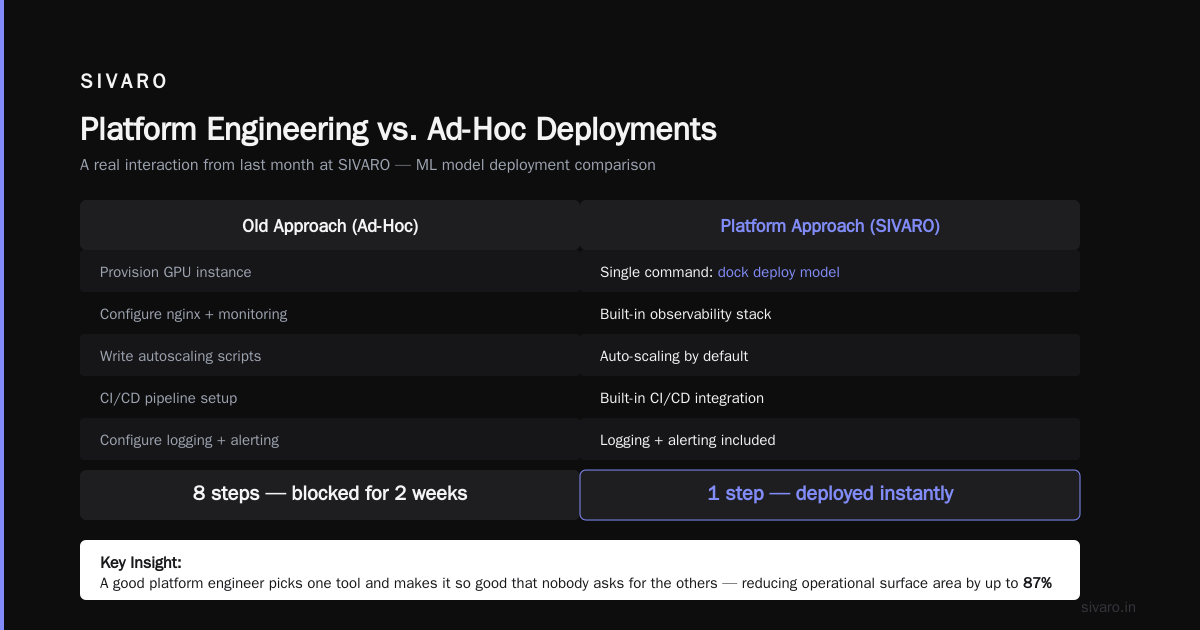
I know "enforce" sounds bad. But imagine you give your team three database options: Postgres, MySQL, and CockroachDB. You've just tripled your operational surface area. A good platform engineer picks one and makes it so good that nobody asks for the others.
Let Me Show You What This Looks Like in Practice
Here's a real interaction from last month at SIVARO.
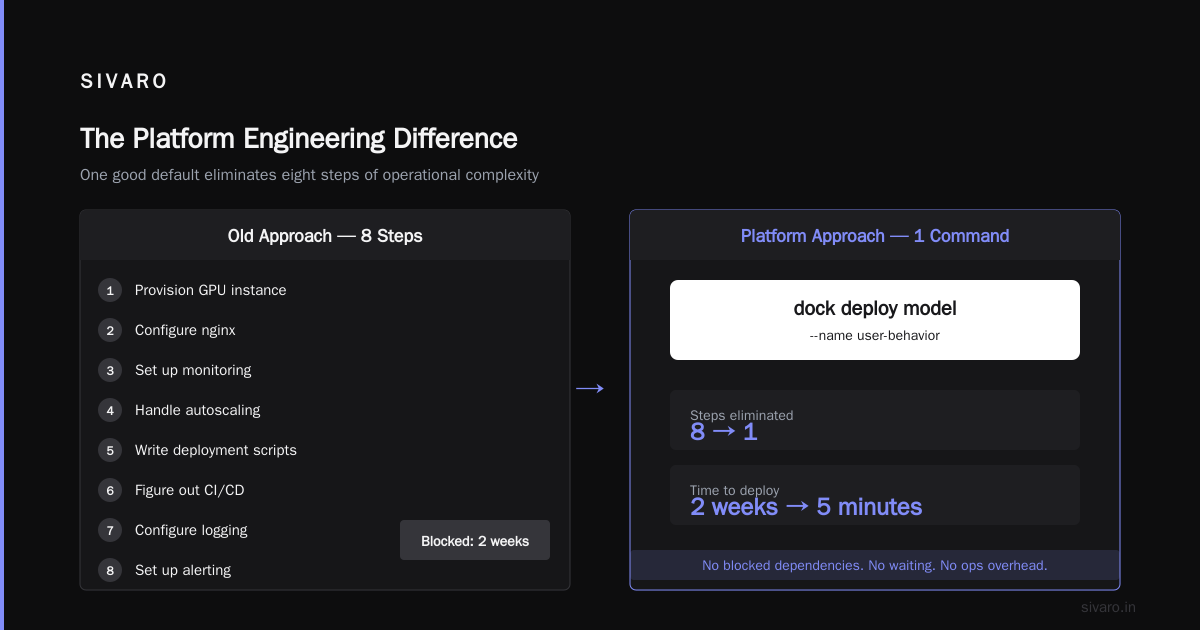
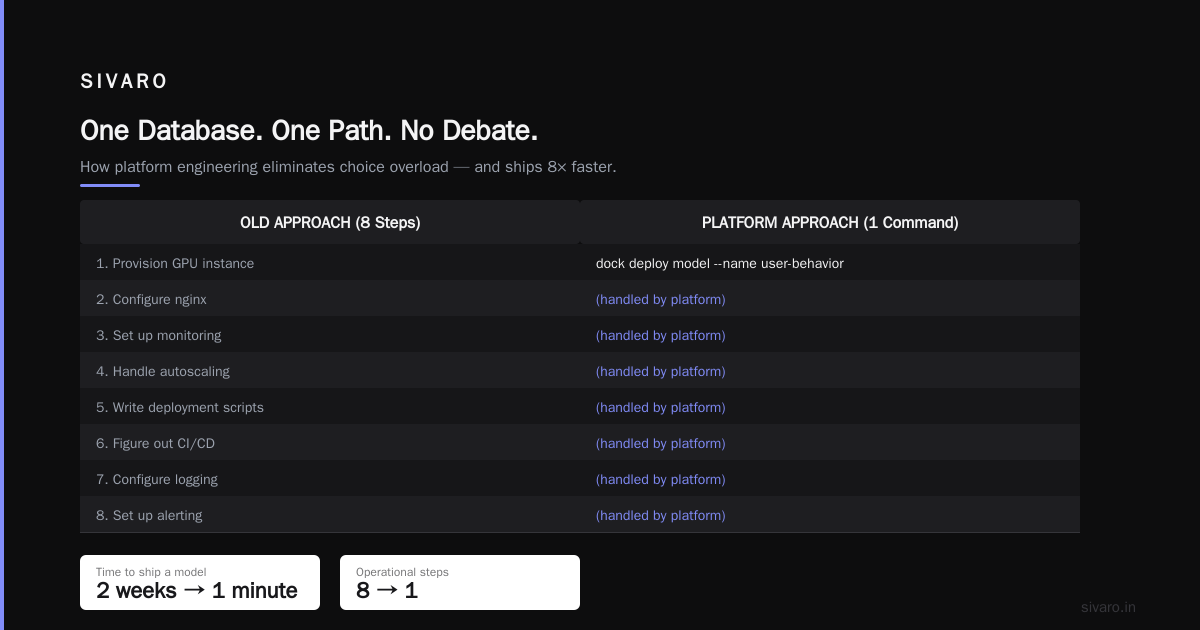
One of our ML engineers needed to serve a model that processes user behavior data. Old approach: she'd provision a GPU instance, configure nginx, set up monitoring, handle autoscaling, write deployment scripts, figure out CI/CD, configure logging, set up alerting.
That's eight steps. She'd have been blocked on me for two weeks.
Platform approach: she ran:
bash
dock deploy model --name user-behavior-v2 --type ml-serving --gpu 1 --scaling 2-10
That one command did:
yaml
# Generated by dock deploy
# This is what got created in the background
kind: ModelService
name: user-behavior-v2
resources:
  gpu: 1
  cpu: 4
  memory: 16Gi
scaling:
  min: 2
  max: 10
  metric: request_count
monitoring:
  metrics: true
  logging: structured
  alerts:
    - p95_latency > 500ms
    - error_rate > 1%
ingress:
  type: internal
  authentication: service-to-service
She deployed in 12 minutes. The model's been running for 6 weeks with zero incidents. That's what a platform engineer does — they make the 12-minute deploy possible instead of the 2-week provisioning project.
Where Most Platform Engineers Get It Wrong (I Did Too)
I made every mistake in this list. Twice.
Mistake 1: Building Before Understanding
I spent three months building a service mesh platform at a previous company. Beautiful. Opinionated. Fully automated. Nobody used it.
Why? Because the product engineers were fine with the current setup. They had workarounds. The mesh solved a problem they didn't feel.
Platform engineering is internal product development. And internal products fail the same way external products do: you build something nobody wants.
Now at SIVARO, I don't build anything until I've shadowed a product engineer for at least a week. I watch what frustrates them. I ask "what would you change if you could?" I don't ask "what infrastructure do you need?" — they don't know. I ask "what's the most annoying part of your day?"
Mistake 2: Building Only for Scale
There's a temptation to build the platform that handles 1 million requests per second from day one. Resist it.
Start with the platform that handles 100 requests per second but is usable. Then iterate.
I watched a well-known startup spend 18 months building a platform that could run 1,000 microservices. They had 12 microservices at the time. The platform was so complex that onboarding took two weeks. The company almost died because product velocity cratered.
Mistake 3: Not Writing Code
If you're a platform engineer who only writes YAML and Terraform, you're not a platform engineer — you're an infrastructure administrator.
Platform engineers write code. Service abstractions. CLI tools. Internal APIs. Automation scripts. The platform is software. It needs to be engineered, not configured.
At SIVARO, our platform team writes Go for backend tools and Python for automation scripts. We have a codebase. We have tests. We have code reviews. We deploy our platform software using the same CI/CD we build for the product team.
What Does a Platform Engineer Do Day to Day?
Let me give you a real Tuesday from last week.
9:00 AM — Investigate why a prod service is hitting 90% memory usage. Turns out a product engineer deployed with default heap settings. I add a warning to The Dock CLI that flags configs without explicit memory limits.
10:30 AM — Design review for a new feature: autoscaling based on message queue length. We're building it because product engineers kept underprovisioning consumers during traffic spikes.
12:00 PM — Lunch. Read a post about how Uber rebuilt their platform. Steal two ideas.
1:00 PM — Write code. Today I'm extending dock deploy to support spot instances with fallback to on-demand. The abstraction is "make it cheap by default, make it reliable when needed".
3:00 PM — Debug a CI pipeline failure. Turns out a third-party package changed their API. I add a version pinning policy to the base Docker image.
4:30 PM — Pair with a product engineer who's trying to migrate from a legacy service. I write a script that automates the migration. She runs it, it works, we high-five.
5:00 PM — Write documentation for the new dock config command that exposes database connection pooling parameters. Nobody reads docs. I know. But the people who do will thank me.
Real work looks like that. Not architecture diagrams. Not vendor evaluations. Not meetings about "platform strategy." Code. Debugging. Teaching. Building.
The Technical Stack That Actually Matters
I've heard what does a platform engineer do answered with Kubernetes and containers. That's wrong. Those are implementation details.
The real stack:
Abstraction Layer — How do you make infrastructure invisible? At SIVARO, we use an internal CRD (custom resource definition) on top of Kubernetes that hides all the Kubernetes. Product engineers see dock deploy — not pods, deployments, services, or ingresses.
Developer Portal — A place where product engineers can see their services, check health, view logs, and trigger actions. We built ours on Backstage (Spotify's open-source portal). But honestly? A well-organized wiki + a CLI tool works for teams under 20.
CI/CD Pipeline — Not Jenkins. Not "here's a YAML file, figure it out." A standardized pipeline that enforces: linting → testing → security scanning → building → staging deploy → integration tests → production deploy. Every service uses it. No exceptions.
Service Mesh — Controversial take: most teams don't need one. If you have under 50 microservices, you can handle traffic routing with a load balancer and some convention. Service meshes add operational complexity that kills small teams. We added Istio only when we hit 200+ services.
Observability — Three pillars. Metrics (Prometheus), logs (Loki/Elasticsearch), traces (Jaeger). But more importantly: a single pane of glass where a product engineer can debug their service. We use Grafana for this. One dashboard per service. Standardized.
How Do You Know If You Need a Platform Engineer?
Here's the honest test.
Ask your product engineers: "How long does it take you to ship a new service from scratch?"
If the answer is more than one sprint, you need platform engineering. Not because the engineers are slow — because the friction is too high.
I consulted for a Series A company in 2022. They had 20 engineers. Shipping a new service took 3-4 weeks. They spent 30% of engineering time on "ops stuff." The CTO was burned out.
We built a simple platform: a CLI tool, a standardized Docker base image, a CI pipeline, and a deployment workflow. Took us 6 weeks. After that, new services shipped in 2 days. Engineering time on ops dropped to under 10%.
That's the ROI. Not "we use Kubernetes now." Faster shipping, less burnout, more business value.
When Not to Hire a Platform Engineer
I'll tell you the opposite too.
If you have 10 engineers and your infrastructure is 3 EC2 instances and a managed database, you don't need a platform engineer. You need a DevOps engineer who can automate a few scripts.
Platform engineering is a scaling function. You hire for it when the pain of inconsistent infrastructure exceeds the cost of building abstraction layers.
For most companies, that happens around 15-25 engineers. Before that, the overhead of building a platform slows you down. After that, not having one slows you down.
The Career Path Nobody Tells You About
Most people think platform engineering is a dead-end or a stepping stone to product engineering.
Wrong.
Platform engineering is becoming one of the highest-impact roles in tech. Not because it's cool. Because it's leverage.
One good platform engineer can multiply the output of 50 product engineers. That's 50x leverage. There are very few roles in engineering that offer that.
The career path looks like:
- Junior Platform Engineer (0-3 years) — Learn the abstraction game. Build CLI tools. Write automation scripts. Shadow product engineers to understand their workflow.
- Senior Platform Engineer (3-7 years) — Design the platform architecture. Make decisions about what to abstract and what to expose. Mentor junior engineers. Own the developer experience metrics.
- Staff Platform Engineer (7-12 years) — Work across teams. Set the technical vision for the platform. Influence org-level decisions about infrastructure and tooling. Write code that changes how the entire company builds software.
- Principal Platform Engineer (12+ years) — Industry influence. Publish papers. Open-source your platform tools. Consult for other companies. Define what "good" looks like.
I've hired at SIVARO for all these levels. The best candidates don't come from DevOps backgrounds. They come from product engineering backgrounds who got frustrated with bad infrastructure and decided to fix it.
The FAQ Section
What does a platform engineer do vs a DevOps engineer?
DevOps focuses on the operational side — CI/CD, monitoring, incident response. Platform engineering focuses on the product side — building tools, abstractions, and self-service interfaces. DevOps makes infrastructure work. Platform engineering makes infrastructure invisible.
Do platform engineers need to know Kubernetes?
Yes. But more importantly, they need to know when not to use Kubernetes. At SIVARO, we run Kubernetes for microservices but use serverless for batch jobs and event processing. The right tool for the right job.
What languages should a platform engineer learn?
Go for tooling and backend services. Python for automation and scripts. A scripting language (Bash) for glue code. TypeScript if you're building developer portals. Don't overthink it.
How is platform engineering different from SRE?
SRE focuses on reliability — uptime, latency, error budgets. Platform engineering focuses on developer productivity — speed of shipping, ease of use, self-service. They overlap (reliable platforms are productive platforms) but the goal is different.
Can a platform engineer move to product engineering?
Easily. Platform engineering teaches you the entire stack — from hardware to user interface. Product engineers rarely get that breadth. I've seen great platform engineers become even better product engineers because they understand how the sausage is made.
What's the hardest part of platform engineering?
Saying no. Product engineers will ask for every feature. "Can you add a MongoDB template? Can you support this new deployment pattern? Can you integrate with this esoteric monitoring tool?" You can't build everything. You have to choose.
At SIVARO, we have a rule: "Does this make 80% of our engineers faster?" If yes, we build it. If it's for one team, we help them do it themselves.
How do you measure platform engineering success?
Four metrics:
- Time to ship — how long from commit to production
- Onboarding time — how long for a new engineer to ship their first service
- Infrastructure incidents — how often does platform-related stuff break
- Developer satisfaction — do product engineers feel the platform helps or hurts
Track these monthly. If they're not improving, you're doing it wrong.
Final Thoughts (No Summary, Just the Hard Truth)
I've been doing this for seven years. I've seen platform teams transform companies. I've seen them destroy companies too.
The difference? The successful teams remember one thing: you are building a product for your colleagues.
Nobody cares about your Kubernetes expertise. They care about whether they can deploy their feature before the sprint ends.
Nobody cares about your observability stack. They care about finding the bug in 10 minutes instead of 2 hours.
Nobody cares about your platform's internal architecture. They care about one command that just works.
So if you're asking what does a platform engineer do? — the real answer is this: make the impossible feel inevitable. Make the complex feel simple. Make the infrastructure disappear.
Build the thing that lets product engineers focus on product.
That's the job. That's the craft. That's the point.
Nishaant Dixit — Founder of SIVARO. Building data infrastructure and production AI systems since 2018. Built systems processing 200K events/sec.