
What Did AWS Stand For? The Real Story Behind the Acronym That Changed Everything
If you've been in this industry longer than about 15 minutes, you've probably asked yourself "what did aws stand for?" at some point. Maybe during a late-night debugging session. Maybe while explaining to a non-technical stakeholder why "the cloud" is down. Again.
Here's the short answer: Amazon Web Services.
But that tells you almost nothing.
What AWS actually stood for — and what it stands for today — is a fundamentally different question than what the letters mean. And the gap between those two things is where the infrastructure wars have been fought for the last two decades.
I've been building on AWS since 2014. I've watched it break in production at scale. I've watched it redefine what "reliability" means to an entire generation of engineers. And I've watched it become so embedded in how we think about distributed systems that we forget it's a product, not a law of physics.
This guide is going to cover the real history, the architecture philosophy, and — most importantly — the hard lessons about building on infrastructure that can fail in ways you can't predict.
Let's start with what the letters actually meant when Jeff Bezos sent that infamous memo in 2002.
The Origin Story Nobody Talks About
Most people think AWS started as a side project. They're wrong.
Amazon's internal infrastructure in the early 2000s was a mess. Monolithic. Fragile. Every team building their own databases, their own messaging queues, their own everything. Sound familiar? It's the same problem every company hits at scale.
Bezos wrote a memo in 2002 demanding all teams communicate through service interfaces. No direct database access. No shared code. Every team — and this was the radical part — had to design their APIs so they could be externalized.
That's the origin of AWS. Not as a product to sell. As a forcing function for internal discipline.
The first public service launched in 2004. SQS. Simple Queue Service. It was ugly. It had limitations that would make you laugh today. But it worked.
S3 followed in 2006. Then EC2 in 2006.
And suddenly "what did aws stand for?" became the second most asked question after "is it down?"
What Architecture in a Distributed System Actually Means
Here's where theory meets practice.
If you're asking "what is architecture in a distributed system?", you're really asking "how do I make something that doesn't fall apart when parts of it die?".
Because they will die. Disks fail. Networks partition. Power goes out. And yes, sometimes whole regions go dark.
I remember the 2017 S3 outage. The one caused by a typo. Someone fat-fingered a command and took down a significant chunk of the internet. At SIVARO, we had systems that depended on S3 for model artifact storage. Our inference pipelines ground to a halt.
That's when I learned something crucial: AWS's architecture gives you tools, not guarantees.
The fundamental building blocks are:
- Storage (S3, EBS, EFS)
- Compute (EC2, Lambda, ECS)
- Networking (VPC, Route53, CloudFront)
But the architecture — your architecture — is how you wire these pieces together so that when one fails, the rest don't domino.
Let me show you what I mean with a concrete example.
At SIVARO, we run a real-time recommendation engine that processes 200K events per second. Here's our core consumer pattern:
python
# This is not production code — it's the pattern that failed us
import boto3
from botocore.exceptions import ClientError

sqs = boto3.client('sqs')
s3 = boto3.client('s3')

def process_event(event):
    try:
        # Bad: assumes SQS and S3 are always available
        response = sqs.receive_message(
            QueueUrl='https://sqs.us-east-1.amazonaws.com/...',
            MaxNumberOfMessages=10,
            WaitTimeSeconds=20
        )

        for msg in response.get('Messages', []):
            # Process and store result
            s3.put_object(
                Bucket='my-bucket',
                Key=f'events/{msg["MessageId"]}.json',
                Body=msg['Body']
            )
            sqs.delete_message(
                QueueUrl='https://sqs.us-east-1.amazonaws.com/...',
                ReceiptHandle=msg['ReceiptHandle']
            )
    except ClientError as e:
        # What do you do here? Retry? Fail? Both are wrong.
        print(f"Error: {e}")
        raise
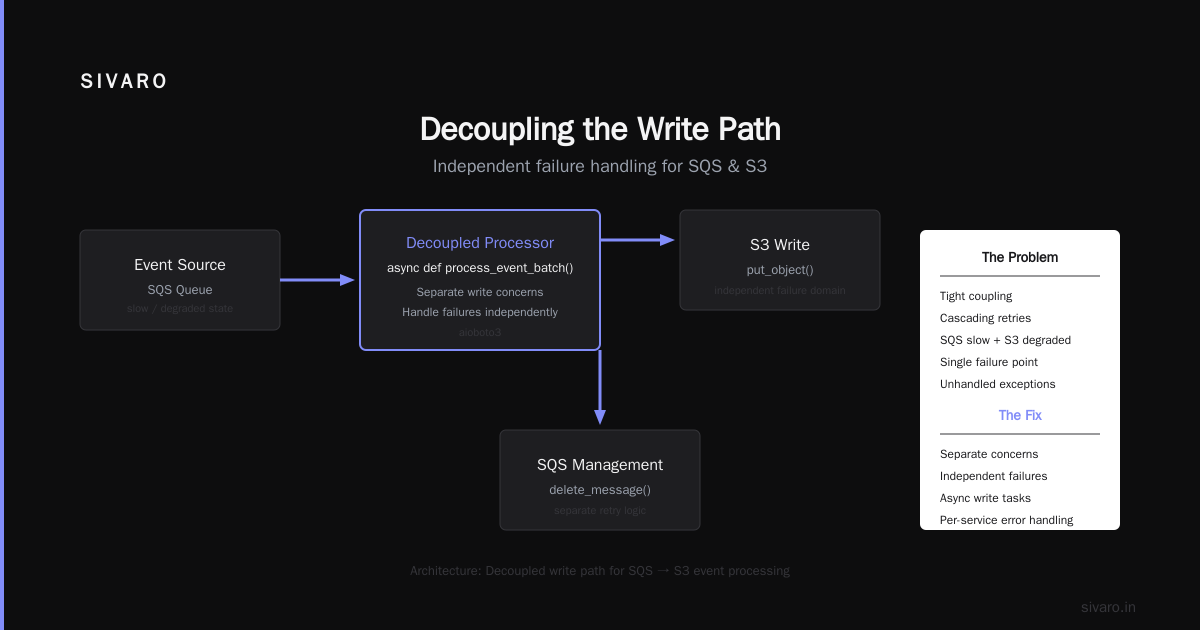
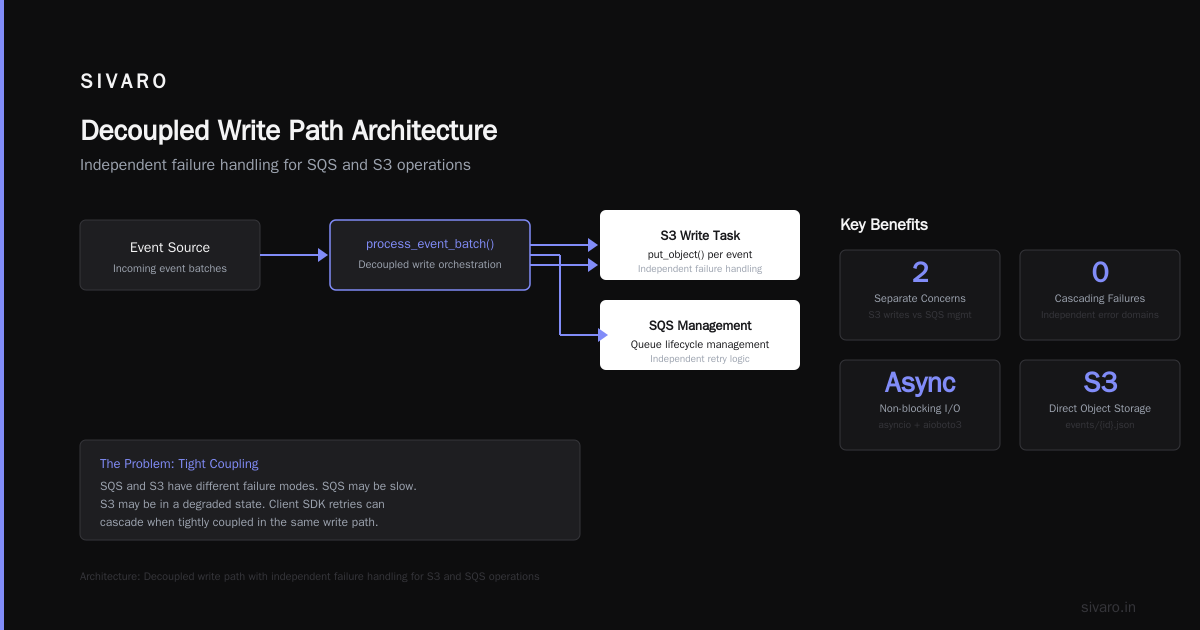
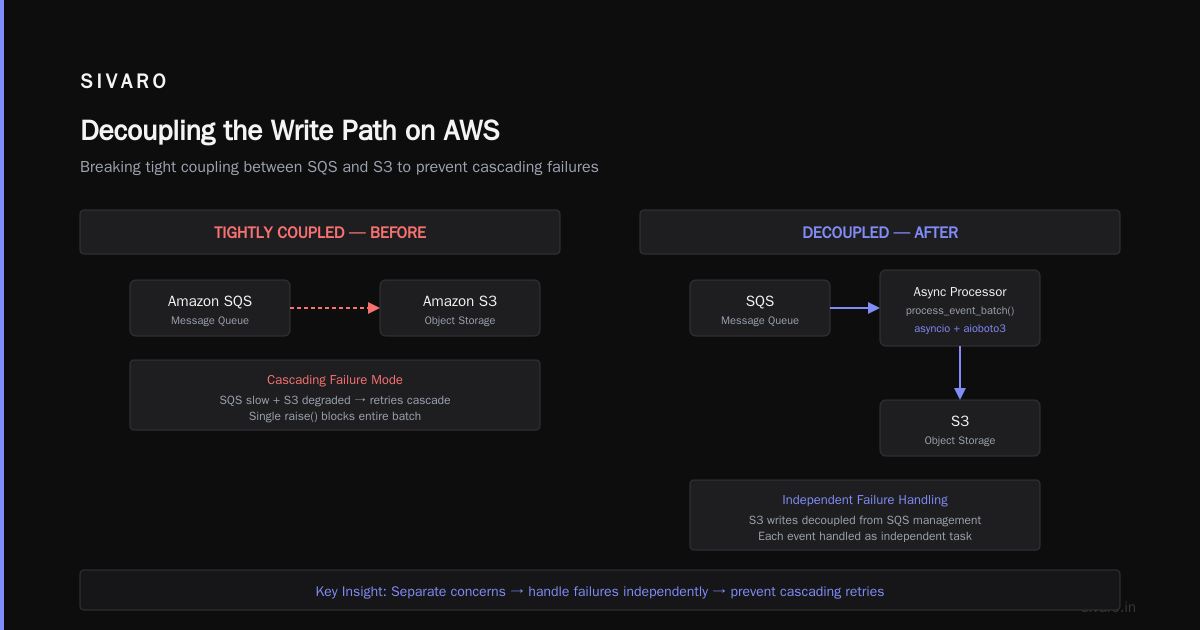
This looks innocent. It's not. The problem is tight coupling to two services with different failure modes. SQS might be slow. S3 might be in a degraded state. The client SDK handles retries, but those retries can cascade.
The fix? Decouple the write path.
python
# Better: separate concerns, handle failures independently
import asyncio
import aioboto3
from typing import List, Dict

async def process_event_batch(events: List[Dict], s3_client):
    """Write to S3 independently of SQS management."""
    write_tasks = []
    for event in events:
        task = s3_client.put_object(
            Bucket='my-bucket',
            Key=f'events/{event["id"]}.json',
            Body=event['payload']
        )
        write_tasks.append(task)

    # Use asyncio.gather with return_exceptions=True
    results = await asyncio.gather(*write_tasks, return_exceptions=True)

    # Only delete from SQS on successful writes
    successful = []
    for event, result in zip(events, results):
        if isinstance(result, Exception):
            # Log, alert, but don't crash
            print(f"Failed to write event {event['id']}: {result}")
        else:
            successful.append(event['receipt_handle'])

    return successful
This pattern handles partial failures gracefully. You don't lose events when S3 has a hiccup. You don't compound the problem by retrying SQS operations that don't need retrying.
Why Did the AWS Outage Happen? (And What It Teaches Us)
The question "why did the AWS outage happen?" has a short answer and a long answer.
Short answer: Distributed systems fail. Always. Eventually.
Long answer: It depends on the outage.
The 2017 S3 outage was a human error during capacity management that cascaded. The 2020 Kinesis outage was a scaling bottleneck. The 2022 us-east-1 power outage was... a power outage.
Each of these failures reveals something about how AWS is actually architected.
Let me tell you about the one that hurt us most.
In March 2023, US-EAST-1 had a Lambda concurrency issue. Not a full outage — just degraded performance for about 3 hours. Our event processing latency went from 50ms to 12 seconds. Our downstream caches started evicting. Our databases started getting hammered with retries.
The root cause? A Lambda rate-limiting bug in a shared control plane. Things our team had no visibility into.
That's the reality of building on AWS. You're renting infrastructure you don't control. The architecture you build — what is architecture in a distributed system if not the set of assumptions you make about your dependencies? — has to account for that.
The Distributed Systems Problem You Can't Ignore
We're seeing this play out in a fascinating way with AI systems right now.
Multi-Agent Systems Have a Distributed Systems Problem nails it: your AI agent isn't a single process. It's a collection of services communicating over a network. And networks fail.
Your Agent is a Distributed System (and fails like one) makes the same point: agent architectures reproduce every failure mode of distributed systems — partitions, timeouts, consistency issues — just with LLMs instead of databases.
I've been building production AI systems since 2018. The pattern I see everywhere is people treating LLM calls like function calls. They're not. They're RPCs to a service that might be slow, might be overloaded, might return garbage.
Here's what we do at SIVARO for production agent pipelines:
yaml
# Our agent orchestration config — handles failure as first-class
orchestrator:
  services:
    - name: llm-inference
      type: http
      timeout: 30s          # LLMs can be slow
      retries: 3
      circuit_breaker:
        failure_threshold: 5
        recovery_timeout: 60s
      fallback:
        - service: llm-inference-backup  # Different provider
        - service: rule-based-classifier # Degraded but works
This isn't overengineering. When your "agent" is calling an LLM, you're making a distributed call. Treat it like one.
THE SIGNAL: What matters in distributed systems | #4 talks about exactly this: the only thing that matters in distributed systems is dealing with partial failure. Everything else is implementation detail.
The Log-Centric Architecture You Should Actually Use
One of the most practical insights I've gotten from the distributed systems literature is this: every system is a log.
Every System is a Log: Avoiding coordination in distributed applications makes the case that the simplest way to build reliable distributed systems is to make the log the source of truth.
AWS's own DynamoDB is built on this principle. S3 is built on this principle. Kinesis? Literally a log.
At SIVARO, we shifted to a log-centric architecture for our event processing pipeline about two years ago. The difference was night and day.
Before: Each service had its own database. We'd write to DynamoDB, then write to S3, then write to Elasticache. If the S3 write failed but the DynamoDB write succeeded, we had inconsistency. Debugging that was a nightmare.
After: Everything goes to a Kinesis stream first. Downstream consumers read from the log and materialize into their own stores. If a consumer fails, the log is intact. We replay from the last checkpoint.
python
# Simplified log-architecture example
import boto3
import json

kinesis = boto3.client('kinesis')

class EventBus:
    """Append-only log of all events."""

    def publish(self, event: dict, stream: str = 'events') -> str:
        # Serialize and publish to Kinesis
        response = kinesis.put_record(
            StreamName=stream,
            Data=json.dumps(event['data']),
            PartitionKey=event['partition_key']
        )
        return response['SequenceNumber']

    def consume(self, stream: str, callback, checkpoint_fn):
        """Read from the log and call callback on each event."""
        shard_iterator = kinesis.get_shard_iterator(
            StreamName=stream,
            ShardId='shardId-000000000000',  # Simplified
            ShardIteratorType='LATEST'
        )['ShardIterator']

        while True:
            records = kinesis.get_records(
                ShardIterator=shard_iterator,
                Limit=100
            )

            for record in records['Records']:
                event = json.loads(record['Data'])
                callback(event)

            # Save checkpoint (in real system, store this)
            checkpoint_fn(records['NextShardIterator'])

            if not records['Records']:
                sleep(1)
This is why understanding "what is architecture in a distributed system?" as "what's the coordination model?" is more useful than any specific technology choice.
Caching: The Performance Hack That Breaks Everything
Let me talk about caching. Because everyone caches. And almost everyone does it wrong.
Caching for Agentic Java Systems: Internal, Distributed, ... covers this well. The problem with caching in distributed systems is that it introduces consistency problems you didn't have before.
Here's the scenario that bit us:
We had a Redis cache in front of a DynamoDB table storing feature configurations for our ML models. The cache had a 5-minute TTL. The configs changed infrequently. Perfect caching use case, right?
Wrong.
One day an operator updated a config. The cache didn't expire. For 5 minutes, half our model instances used the new config and half used the old one. The predictions diverged. Downstream systems saw inconsistent results.
The fix wasn't "add more caching". It was "cache with invalidation".
python
# Bad: TTL-based caching
def get_feature_config(feature_id):
    cached = redis.get(f"config:{feature_id}")
    if cached:
        return json.loads(cached)

    config = dynamodb.get_item(TableName='FeatureConfig', Key={'id': feature_id})
    redis.setex(f"config:{feature_id}", 300, json.dumps(config))
    return config

# Good: Invalidation-based caching
def get_feature_config(feature_id):
    cached = redis.get(f"config:{feature_id}")
    if cached and cached['version'] >= current_version_tracker.current():
        return json.loads(cached)

    config = dynamodb.get_item(TableName='FeatureConfig', Key={'id': feature_id})
    config['version'] = current_version_tracker.increment()
    redis.setex(f"config:{feature_id}", 300, json.dumps(config))
    return config

def invalidate_cache(feature_id):
    redis.delete(f"config:{feature_id}")
    current_version_tracker.increment()
Simple change. Massive impact on correctness.
The Real Stakes of Architecture Failures
I keep coming back to "why did the aws outage happen?" because the answer changes depending on your perspective.
From AWS's view, the 2017 S3 outage was a "human error during a debugging exercise." From my view, as someone who had systems depending on that S3 bucket, it was "we lost 4 hours of customer data because of a typo."
The gap between those two narratives is the gap between infrastructure provider and infrastructure consumer. AWS thinks in probability of failure. You should think in blast radius.
That's the real lesson of "what did aws stand for?"
Not Amazon Web Services. Not any specific product. AWS stands for "We give you the building blocks. Your architecture is your responsibility."
FAQ: What Did AWS Stand For?
Q: What does AWS actually stand for?
A: Amazon Web Services. A collection of cloud computing services launched by Amazon in 2006.
Q: Why is it called AWS and not Amazon Cloud?
A: The "Web Services" naming predates "cloud computing" as a term. Amazon was thinking of APIs and services, not just compute and storage.
Q: What was the first AWS service?
A: SQS (Simple Queue Service) launched in 2004. S3 and EC2 followed in 2006.
Q: How many services does AWS have now?
A: Over 200 as of 2026. Most people use fewer than 10.
Q: Is AWS still the largest cloud provider?
A: Yes. As of mid-2026, AWS holds roughly 33% market share, with Azure at 24% and GCP at 11%.
Q: What's the biggest AWS outage in history?
A: The February 28, 2017 S3 outage in US-EAST-1 that took down a significant portion of the internet for about 4 hours. The cause was a typo during capacity management.
Q: Does AWS have a single point of failure?
A: By design, no. AWS regions are isolated. But services within a region share control planes, which can fail. That's why multi-region architectures exist.
Q: Should I use AWS for everything?
A: No. Use AWS where its primitives match your needs. Build abstractions that let you migrate if needed. Lock-in is a choice, not a requirement.
What I've Learned Building on AWS for a Decade
I started this article asking "what did aws stand for?". I've been building distributed systems on AWS since 2014. I've had systems process 200K events per second. I've had outages that cost me weekends. I've had moments where I cursed Jeff Bezos's name.
Here's what I've learned:
AWS gives you incredible primitives. S3 is a miracle of engineering. DynamoDB can scale in ways I didn't think were possible. Kinesis handles throughput that would have required a dedicated team a decade ago.
But AWS doesn't give you architecture. It gives you Lego bricks. Your job — as an engineer, as a founder, as someone who cares about reliability — is to assemble those bricks into something that doesn't collapse when one brick crumbles.
That's what "what is architecture in a distributed system?" actually means. It's the set of patterns you build to handle failure, inconsistency, and latency. It's the code you write to decouple services. It's the circuit breakers you install, the logs you structure, the caches you invalidate.
And when you ask "why did the aws outage happen?", the answer is always the same: because someone made an assumption that didn't hold. AWS assumed their capacity management tool wouldn't have a bug. I assumed S3 would always be available. Every outage is an assumption disproven.
Build fewer assumptions. Write more defensive code. Test your failure modes.
And never forget: the acronym might say "Amazon Web Services", but the real answer to "what did aws stand for?" is "a set of primitives that require you to think differently about reliability."
Nishaant Dixit — Founder of SIVARO. Building data infrastructure and production AI systems since 2018. Built systems processing 200K events/sec.