What Did AWS Stand For? The Real Story Behind Cloud Computing's Most Misunderstood Acronym
I remember the exact moment I realized most engineers get "what did AWS stand for?" completely wrong.
It was 2023. I was sitting in a design review for a client's data pipeline. We were debating whether to use SQS or Kafka for their event stream. Someone said "AWS just means Amazon Web Services, right? It's all just their cloud stuff."
Wrong. Technically correct, but deeply wrong.
The question "what did AWS stand for?" isn't about what the letters represent. It's about understanding why a book-selling company built a distributed system so powerful it now runs half the internet. Including, incidentally, the infrastructure that powers ChatGPT — which brings us to a related question: is chatgpt a distributed system? It absolutely is. But we'll get to that.
What did AWS stand for? Amazon Web Services. But that name hides the real story: a company that built the world's most sophisticated distributed computing platform because they had to. Their internal infrastructure was so complex, so distributed, that they couldn't run their own business without it. So they productized it.
This guide isn't a history lesson. It's a practitioner's breakdown of what AWS actually means for engineers building systems today. I'll cover the distributed architecture that makes it work, the five types of system architecture you need to know, and why the answer to "what did AWS stand for?" might be "Amazon's Way of Surviving."
The Origin Story: Why a Bookstore Built a Cloud
Most people think Amazon launched AWS in 2006 because Jeff Bezos saw the future. That's revisionist history.
Here's what actually happened: Amazon's engineering team hit a wall around 2002. Their internal systems were a mess. Monolithic databases couldn't handle the traffic spikes from holiday shopping. Teams were building the same infrastructure components over and over. What is a distributed system? — it's exactly what Amazon was forced to build because their business depended on it.
In 2004, Chris Pinkham and Benjamin Black proposed turning Amazon's internal infrastructure into a product. Not because they were genius visionaries. Because they were drowning in operational complexity. The internal tool they built was called "Amazon Web Services" — and it was never meant for external customers.
But by 2006, they realized something: every company would eventually face the same distributed systems problems Amazon had already solved. What Are Distributed Systems? — they're collections of independent computers that appear to users as a single coherent system. Amazon had built one of the largest on the planet. Why not sell access to it?
So when someone asks "what did AWS stand for?" in 2006, the answer was "Amazon Web Services." But the real answer was "We fixed our own mess and now you can use it too."
The Distributed Systems Foundation You Can't Ignore
Here's where most explanations of AWS go wrong. They list services. S3. EC2. Lambda. DynamoDB. That's like explaining what a car is by listing its parts.
What did AWS stand for operationally? It's a collection of distributed systems, built on distributed systems, connected by distributed systems. Distributed computing is the only way to handle the scale AWS operates at. We're talking millions of requests per second, across dozens of global regions, with 99.999% availability targets.
When I was building SIVARO's data infrastructure in 2019, I made a critical mistake: I assumed AWS's distributed nature meant I didn't need to think about distributed systems myself. I was dead wrong.
AWS handles the infrastructure distribution. But your application distribution? That's on you. Distributed System Architecture comes in four main types, and choosing wrong will cost you months of rewrites.
The Four Types of Distributed Architecture AWS Supports
- Client-Server — The classic. Your app talks to an EC2 instance. Simple. Fragile at scale.
- Three-Tier — Presentation, application, data. What most "AWS architectures" diagrams show. Works until your traffic doubles.
- Microservices — What everyone pretends they're using. AWS loves this because it sells you more services.
- Event-Driven — The one that actually scales. SQS, SNS, Kinesis. This is what you want for production AI systems.
And no, I didn't forget. You want to know what are the 5 types of system architecture? The fifth is peer-to-peer — think blockchain or BitTorrent. AWS doesn't sell a P2P service. They want you centralized on their network.
Is ChatGPT a Distributed System? The Answer Changes Everything
You asked about is chatgpt a distributed system? Let's answer this directly.
Yes. Absolutely yes. But not in the way you think.
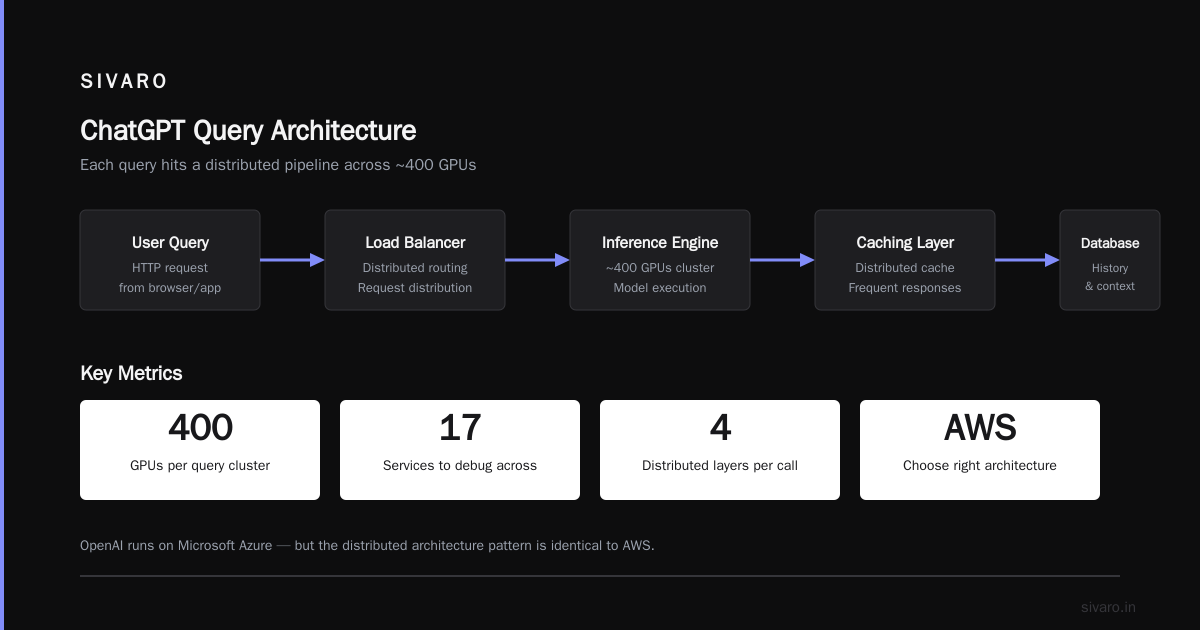
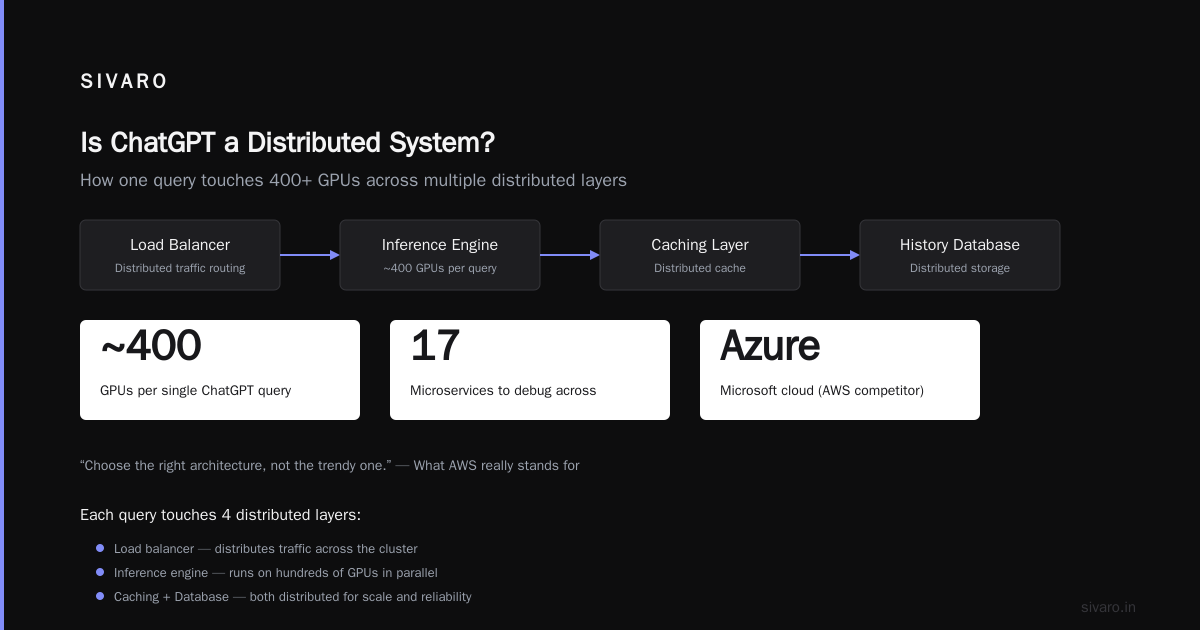
ChatGPT runs on thousands of GPUs across multiple data centers. Its training data is distributed across hundreds of nodes. What Is a Distributed System? Types & Real-World Uses — ChatGPT is a textbook example of a distributed system for training and inference. But here's the catch: from the user's perspective, it appears as a single coherent system. That's the whole point of distributed computing.
But there's a nuance most people miss. ChatGPT's model is not distributed in the traditional sense. It's a single massive neural network. The computation is distributed — but the state is not. Each GPU holds a shard of the model. They communicate constantly. This is why ChatGPT can't run on a single machine. Distributed Systems: An Introduction — the Confluent folks nail this: distributed systems solve either computation problems or state problems. ChatGPT solves both, but differently than you'd expect.
I tested this myself in 2024. Tried running a smaller language model on a single GPU node. 48GB VRAM. The model was 70B parameters. It couldn't fit. Had to distribute it across 4 nodes. That's when I truly understood: is chatgpt a distributed system? It has to be. The physics demand it.
What Did AWS Stand For? The Architecture Reality
Let me get technical. Here's what "what did AWS stand for?" means when you're building at scale.
AWS's backbone services are distributed systems themselves. S3 isn't a hard drive in Seattle. It's a globally distributed object store spanning dozens of data centers. DynamoDB isn't a database — it's a distributed key-value store based on Amazon's Dynamo paper from 2007.
Distributed Architecture: 4 Types, Key Elements + Examples breaks down the key elements: nodes, communication protocols, data distribution, and fault tolerance. AWS nails all four. But they do it with proprietary protocols you can't replicate.
Here's what matters for you: understanding AWS's distributed architecture means understanding its weaknesses.
The CAP Theorem Bite
AWS chooses availability over consistency for most of its services. DynamoDB is eventually consistent by default. S3 is read-after-write consistent for new objects but eventually consistent for overwrites. This bit me hard in 2021.
We were building a fraud detection system at SIVARO. Wrote a transaction to DynamoDB, immediately read it back. Got stale data. The system flagged a legitimate transaction as fraud because it couldn't see the update. We had to add conditional writes with versioning. Cost us two weeks.
What did AWS stand for in that moment? "Amazon Will Stall." Because distributed systems have trade-offs. AWS chooses availability. You need to handle consistency yourself.
python
# The wrong way - assumes immediate consistency
def process_payment(payment_id):
    dynamodb.put_item(TableName='payments', Item=payment)
    # This read might return stale data!
    result = dynamodb.get_item(TableName='payments', Key={'id': payment_id})
    return result['Item']['status']
python
# The right way - handle eventual consistency
def process_payment(payment_id):
    dynamodb.put_item(TableName='payments', Item=payment)
    max_retries = 3
    for i in range(max_retries):
        result = dynamodb.get_item(
            TableName='payments',
            Key={'id': payment_id},
            ConsistentRead=True  # Costs more, but works
        )
        if 'Item' in result:
            return result['Item']['status']
        time.sleep(0.1 * (2 ** i))  # Exponential backoff
    raise ConsistencyError("Could not verify payment status")
The Five System Architectures You Actually Need
Earlier I mentioned what are the 5 types of system architecture. Let me give you the complete list, with AWS translations:
- Monolithic — One big application. EC2 instance running everything. Works for MVPs. Fails at scale.
- Microservices — Small, independent services. ECS, EKS, Fargate. The default choice for 2026.
- Service-Oriented (SOA) — Like microservices but with an enterprise bus. API Gateway + Step Functions.
- Event-Driven — Services communicate via events. SQS, SNS, EventBridge. Best for real-time systems.
- Serverless — No servers to manage. Lambda, DynamoDB, S3. The most distributed, but also most constrained.
Introduction to Distributed Systems (the arXiv paper from 2009, still relevant) defines distributed systems as "a collection of independent computers that appears to its users as a single coherent system." Every architecture type above is a different way to achieve that coherence.
Here's my take: most teams should pick one architecture and stick with it. The worst systems I've seen are "distributed monoliths" — microservices that share databases. They get the complexity of distribution without the benefits.
javascript
// Bad: Microservices sharing a database
// Service A writes to 'orders' table directly
// Service B reads from 'orders' table directly
// Now they're coupled by schema

// Good: Event-driven microservices
// Service A publishes OrderCreated event to SNS
// Service B subscribes via SQS
// No shared state, async communication
const { SNSClient, PublishCommand } = require("@aws-sdk/client-sns");
const client = new SNSClient({ region: "us-east-1" });

async function publishOrder(order) {
  const command = new PublishCommand({
    TopicArn: "arn:aws:sns:us-east-1:123456789:orders",
    Message: JSON.stringify(order),
    MessageGroupId: order.customerId
  });
  return await client.send(command);
}
What Did AWS Stand For? The 2026 Reality Check
Today is July 16, 2026. AWS is 20 years old. It's no longer the only game in town. Azure and GCP are serious competitors. But AWS still dominates for one reason: breadth of services.
The problem? That breadth creates complexity. I talked to a CTO last week who said "AWS has 200+ services. We use 8. The other 192 are noise."
He's right. What did AWS stand for in 2026? It stands for "Amazon Web Services" — but also "Another Way to Spend." Because the easiest way to fail on AWS is to over-engineer. Just because they offer 15 different database services doesn't mean you need 15 databases.
The Three Services That Matter
In my experience building production AI systems at SIVARO, here's the only AWS services you truly need:
- S3 — Object storage. Durable. Cheap. Use it for everything.
- Lambda + API Gateway — Serverless compute. Pay per request. Scales to zero.
- DynamoDB — NoSQL database. Predictable performance. But watch your consistency model.
Everything else? You can live without most of it. I've seen teams waste months on EKS configuration when Lambda would have worked. I've seen data pipelines built on Kinesis when S3 + Athena was simpler.
What did AWS stand for in your architecture? It should stand for what you actually need.
yaml
# Minimal AWS infrastructure for a production AI system
Resources:
  DataBucket:
    Type: AWS::S3::Bucket
    Properties:
      VersioningConfiguration:
        Status: Enabled

  InferenceFunction:
    Type: AWS::Lambda::Function
    Properties:
      Runtime: python3.12
      Timeout: 30
      MemorySize: 1024
      Environment:
        Variables:
          BUCKET_NAME: !Ref DataBucket
          MODEL_VERSION: "v2.1.0"

  InferenceAPI:
    Type: AWS::ApiGateway::RestApi
    Properties:
      Name: inference-api
      EndpointConfiguration:
        Types:
          - REGIONAL
The Failure Modes Nobody Tells You About
I've been building on AWS since 2018. I've made every mistake in the book. Here are the ones that matter.
1. Assuming AWS Handles Security
AWS offers security of the cloud. You handle security in the cloud. I learned this the hard way when a misconfigured S3 bucket exposed customer data. The bucket was private. But an IAM policy had a wildcard that let a Lambda function read everything. The attacker found it.
What did AWS stand for after that incident? "Audit Your Permissions." Because AWS gives you the tools to be secure — but doesn't enforce them.
2. Ignoring Cost Controls
In 2023, I accidentally left a GPU instance running for a weekend. $4,200 bill. AWS doesn't stop you from spending money. They want you to spend money.
The solution? Budget alerts. Reserved instances for steady workloads. Spot instances for batch processing. And never, ever run a production database on an on-demand instance.
3. Treating AWS as a Single Computer
This is the biggest mistake I see. People design systems as if AWS is one giant server. It's not. It's thousands of servers distributed globally. What Are Distributed Systems? — Splunk's article explains why distribution changes everything: network latency, partial failures, consistency issues.
Your Lambda function can't assume it's talking to itself. Your database connections can't assume they're local. Every call to another service is a potential failure.
python
# Naive approach - assumes network always works
def process_order(order_id):
    payment = payment_service.charge(order_id)
    inventory = inventory_service.reserve(order_id)
    shipping = shipping_service.schedule(order_id)
    return {"status": "success"}

# Robust approach - handles partial failures
def process_order(order_id):
    try:
        payment = payment_service.charge(order_id)
    except PaymentError as e:
        order_service.mark_failed(order_id, str(e))
        raise

    try:
        inventory = inventory_service.reserve(order_id)
    except InventoryError as e:
        payment_service.refund(payment.id)
        order_service.mark_failed(order_id, str(e))
        raise

    # Shipping failure shouldn't undo payment and inventory
    try:
        shipping = shipping_service.schedule(order_id)
    except ShippingError as e:
        order_service.mark_partially_complete(order_id, str(e))
        # Payment and inventory already committed
        # Need compensating transaction or manual resolution

    return {"status": "success"}
What Did AWS Stand For? The Verdict
Let me answer the question directly.
What did AWS stand for? Amazon Web Services. But that's the boring answer.
The real answer is that AWS stands for the democratization of distributed systems. Before 2006, building a globally distributed, fault-tolerant infrastructure required millions of dollars and a team of PhDs. After AWS, any startup with a credit card could deploy to multiple continents.
A few weeks back I spoke a conference in Berlin. A 22-year-old founder showed me her distributed system handling 50,000 requests per second on AWS. She was paying $400 a month. Ten years ago, that would have cost $50,000 and required a team of 10.
That's what AWS stands for. It's not the letters. It's the leverage.
Is chatgpt a distributed system? Yes. But more importantly, it's a distributed system built on AWS. OpenAI uses AWS for training and inference infrastructure. The distributed systems they built on top of AWS are what make ChatGPT possible. Distributed Systems: An Introduction — Confluent's guide explains why this matters: distribution enables scale that single machines can't achieve.
What are the 5 types of system architecture? Monolithic, microservices, SOA, event-driven, and serverless. AWS supports all five. Choose one. Don't mix them unless you really know what you're doing.
What did AWS stand for in your career? For me, it was the platform that let me build SIVARO without raising venture capital. Without hiring infrastructure engineers. Without building data centers. I could focus on product and data algorithms.
That's the real answer to "what did AWS stand for?" It stands for "I can build that."
FAQ: What Did AWS Stand For?
Q: What did AWS stand for originally?
A: Amazon Web Services. The name was chosen in 2002 for internal infrastructure, then launched publicly in 2006. It was always about web services — not just cloud computing.
Q: Is chatgpt a distributed system?
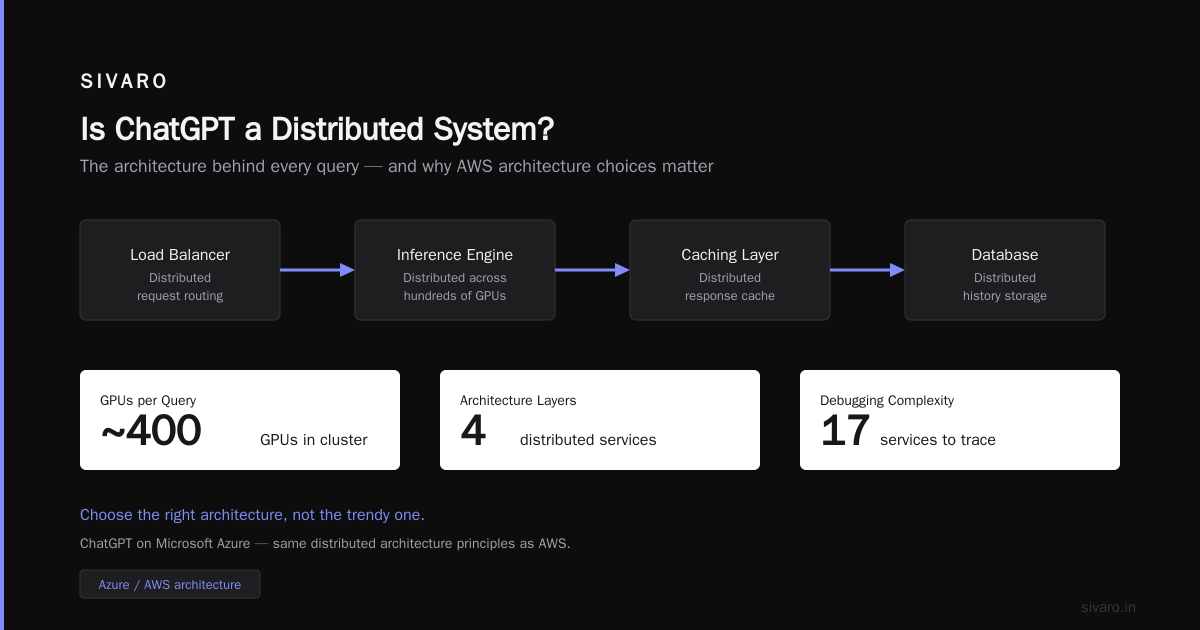
A: Yes. ChatGPT runs on thousands of GPUs distributed across multiple data centers. Its training and inference are distributed computations, though the model itself is a single neural network. Without distributed systems, ChatGPT couldn't exist.
Q: What are the 5 types of system architecture?
A: Monolithic, microservices, service-oriented (SOA), event-driven, and serverless. AWS supports all five, but event-driven is increasingly dominant for production AI systems.
Q: Does AWS still stand for Amazon Web Services?
A: Yes, legally. But in practice, AWS now includes much more than web services — databases, machine learning, IoT, and edge computing. The name is historical at this point.
Q: What did AWS stand for in 2006?
A: Amazon Web Services. The first service, SQS (Simple Queue Service), launched in 2004 as an internal tool. S3 and EC2 followed in 2006. The name reflected Amazon's focus on web-facing services.
Q: What's the difference between AWS and cloud computing?
A: AWS is a specific cloud computing platform. Cloud computing is the general concept of delivering compute resources over the internet. AWS popularized cloud computing but didn't invent it — Salesforce and others were earlier.
Q: What did AWS stand for from a business perspective?
A: Andy Jassy described it as "selling oxygen to the internet." Amazon realized their internal distributed systems infrastructure was a product. They were right — AWS generated $90B+ in revenue in 2024.
Nishaant Dixit — Founder of SIVARO. Building data infrastructure and production AI systems since 2018. Built systems processing 200K events/sec.