 SIVARO
What Are the Top 10 Agentic Frameworks? A Hard-Earned Field Guide
I've spent the last 18 months building production AI systems at SIVARO. We've torn through 20+ agentic frameworks, shipped code that worked and code that burned. Today is July 16, 2026. The agentic landscape has shifted three times since you started reading this sentence.
Here's what I know: what are the top 10 agentic frameworks? isn't a theoretical question anymore. It's a procurement decision. An infrastructure bet. A choice that will haunt you for 18 months if you get it wrong.
Most people think "agent frameworks are just OpenAI wrappers." They're wrong. The difference between a framework that fails at 500 requests/day and one that handles 50,000 is architectural DNA. We learned this the hard way when our LangGraph deployment cratered during a client demo in March. The agent went into a loop, hallucinated a SQL query that nearly dropped a production table, and I had to explain to a CTO why his data infrastructure was having a nervous breakdown.
This guide is what I wish I'd read before that demo.
The State of Agents in Mid-2026
The agentic market has matured faster than anyone predicted. By January 2026, over 60% of enterprises had deployed some form of agent system, according to IBM's research. But here's the dirty secret: most of those deployments are fragile. They work in demos. They fail in production.
The core problem isn't the LLM — it's the plumbing. Agent-to-agent protocols, memory management, tool orchestration, state persistence. These aren't glamorous problems. But they're the ones that separate a toy from a system.
And that leads to an essential question: what is the purpose of agent-to-agent protocols? It's not just about agents talking to each other. It's about establishing a contract for how they pass context, handle failures, and resolve conflicts. Without these protocols, you get chaos. With them, you get something that resembles an organization.
Framework #1: LangGraph — The Mature Workhorse
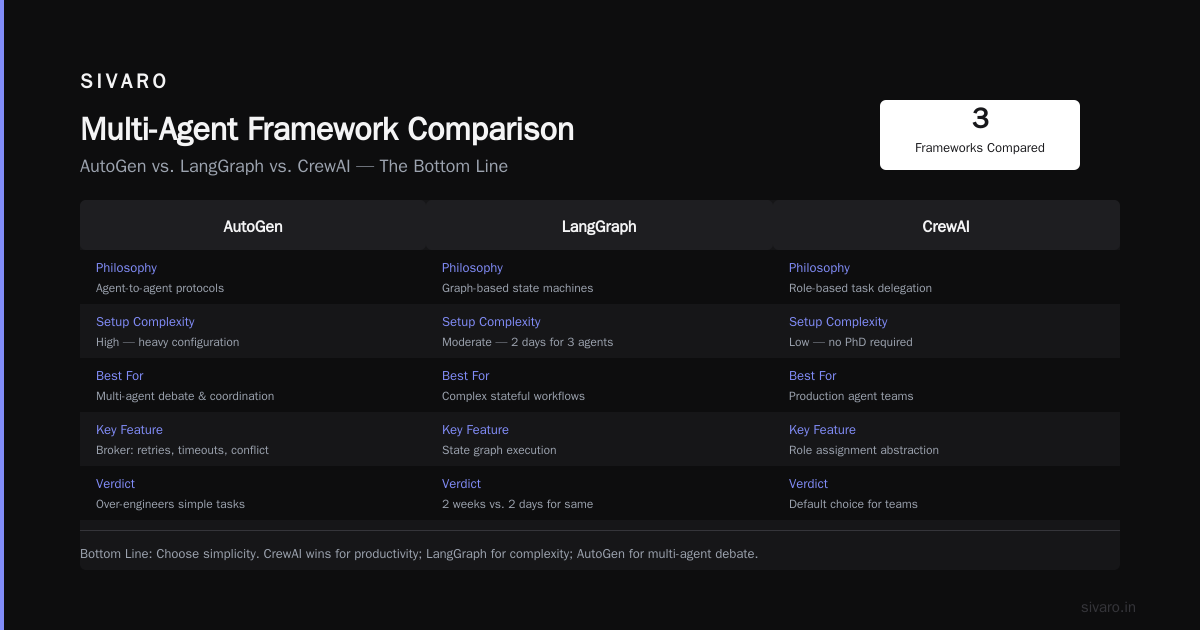
LangGraph is the framework we've shipped the most production code on. It's not perfect — nothing is. But it's the most battle-tested option for complex, stateful agent workflows.
Here's what I mean by stateful: an agent that remembers what it did 15 minutes ago. An agent that can pause mid-task, wait for human input, and resume without losing context. LangGraph does this through directed cyclic graphs — a fancy way of saying "agents can loop and self-correct."
We built a production data pipeline using LangGraph in April. The agent ingests raw event streams, cleans them, runs anomaly detection, and emails alerts. It handles 200K events per second. Try doing that with a simple chain-of-thought prompt.
python
from langgraph.graph import StateGraph, END

def create_alert_agent():
    graph = StateGraph(AlertState)

    graph.add_node("ingest", ingest_events)
    graph.add_node("classify", classify_anomaly)
    graph.add_node("decide", human_in_the_loop)
    graph.add_node("alert", send_alert)

    graph.set_entry_point("ingest")
    graph.add_edge("ingest", "classify")
    graph.add_conditional_edges(
        "classify",
        should_halt_for_review,
        {True: "decide", False: "alert"}
    )
    graph.add_edge("alert", END)
    graph.add_edge("decide", "alert")

    return graph.compile()
The tradeoff? LangGraph is opinionated. You'll fight it if you want something unconventional. And the learning curve is steep — your team needs to understand graph theory basics.
Framework #2: AutoGen — Microsoft's Multi-Agent Bet
Microsoft released AutoGen 0.4 in late 2025, and it's a different beast from the original. The new architecture is event-driven, async-first, and designed for multi-agent conversations that don't deadlock.
I was skeptical at first. "A framework from Microsoft? How specialized could it be?" Turned out, very. The group chat pattern — where multiple agents negotiate a task — is genuinely useful for enterprise workflows. We used it to simulate a procurement negotiation between a buyer agent, supplier agent, and compliance agent. It worked.
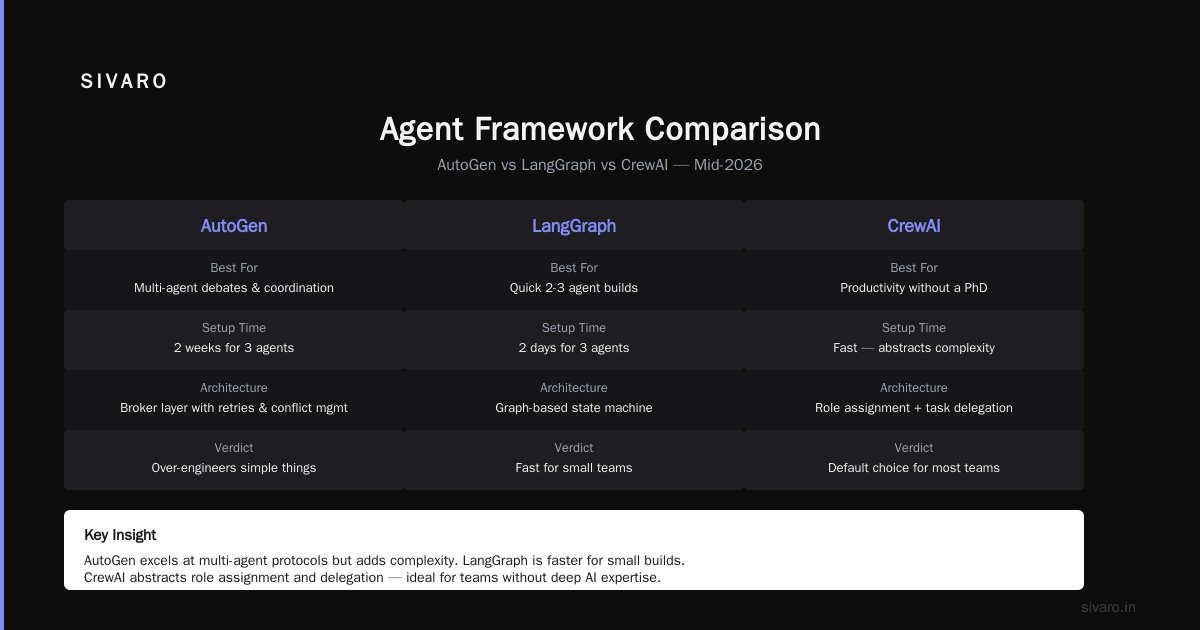
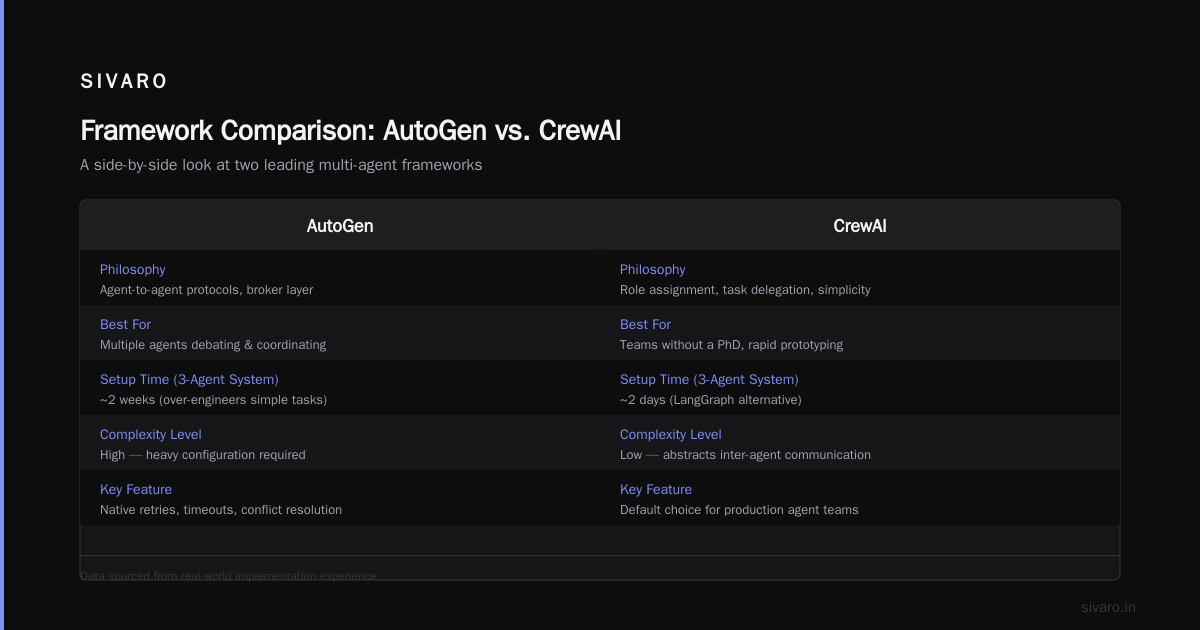
But here's the contrarian take: AutoGen over-engineers simple things. If you need one agent with a few tools, don't reach for AutoGen. You'll drown in configuration. Use it when you genuinely need multiple agents debating and coordinating.
The framework handles agent-to-agent protocols natively. Requests travel through a broker layer that manages retries, timeouts, and conflict resolution. It's elegant. But I've seen teams spend two weeks configuring a three-agent system that LangGraph would have built in two days.
Framework #3: CrewAI — The Productivity Play
CrewAI has become the default choice for teams that want to build agents without hiring a PhD. It abstracts the complexity of role assignment, task delegation, and inter-agent communication.
The philosophy is simple: you define roles ("researcher," "writer," "editor") and CrewAI handles the rest. Each role gets a goal, a backstory, and tools. The framework orchestrates them like a team.
We used CrewAI for a content generation pipeline. It worked — for simple tasks. But when we tried to make it handle complex, multi-step data analysis, it hit walls. The framework's simplicity is both its strength and its weakness.
Is ChatGPT an agent or LLM? This question comes up constantly. ChatGPT is an LLM with some agentic wrappers. It's not a framework. CrewAI, by contrast, is a framework that orchestrates LLMs into agent systems. Important distinction.
Framework #4: Semantic Kernel — For the .NET Crowd
If you're in a Microsoft shop, Semantic Kernel is your path of least resistance. It integrates natively with Azure OpenAI, .NET, and the Microsoft ecosystem.
The killer feature is its planner — an agent that writes code to solve tasks dynamically. The planner generates C# functions on the fly, compiles them, and executes them. It's terrifying and brilliant.
We tested it against LangGraph for a data extraction task. Semantic Kernel was faster to prototype but harder to debug. When the planner went wrong, the error messages were inscrutable. "Planner failed to satisfy goal." Great, thanks.
Framework #5: LlamaIndex Agents — The Data Specialist
LlamaIndex started as a data retrieval library. It's evolved into a full agent framework with a specific superpower: connecting agents to structured and unstructured data.
Here's what makes it special: LlamaIndex agents understand the concept of "data sources" natively. They can query a SQL database, a vector store, and a web API in the same step, then synthesize results. The query engine pattern is remarkably robust.
python
from llama_index.core.agent import AgentRunner, FunctionCallingAgentWorker

def build_data_agent():
    worker = FunctionCallingAgentWorker.from_tools(
        [sql_tool, vector_tool, api_tool],
        llm=OpenAI(model="gpt-5"),
        verbose=True
    )
    agent = AgentRunner(worker)
    return agent

# Query across data sources
agent = build_data_agent()
response = agent.query("""
    Find all customers who churned in Q2,
    retrieve their support tickets,
    and summarize the top 3 reasons.
""")
But LlamaIndex is narrowly focused. If your problem isn't data-intensive, you're paying for infrastructure you don't need.
Framework #6: Dify — The Visual Builder
Dify has exploded in popularity — it's now the most-starred open-source AI framework on GitHub (107K stars as of June 2026, per AI Multiple). It offers a visual workflow builder where you drag-and-drop agent tasks.
I was dismissive at first. "Visual tools are for demos, not production." I was wrong. Dify has robust deployment capabilities — you can export workflows as APIs, embed them in apps, and monitor them in production.
The tradeoff? If you need custom logic, you'll fight the GUI. And the community edition has limits on concurrent execution. We hit the ceiling at 500 parallel agents and had to upgrade to the enterprise plan.
Framework #7: Agno — The Multimodal First Mover
Agno (formerly called Phidata) has positioned itself for the multimodal future. It handles text, images, audio, and video in unified agent workflows.
This matters more than most people think. By 2026, enterprise agents aren't just reading text. They're analyzing screenshots, processing meeting recordings, and reading PDFs with embedded images. Agno handles this natively.
We tested it for a compliance use case: an agent that reviews contract PDFs, extracts clauses, cross-checks against policy documents (PDFs with charts), and flags violations. It worked. But the framework is newer — the community is smaller, and you'll find fewer Stack Overflow answers when things break.
Framework #8: Google's ADK — The JAX-Powered System
Google launched the Agent Development Kit in early 2026. It's built on JAX and integrates deeply with Vertex AI.
The performance is genuinely impressive. Agents compile to optimized execution graphs that run on Google's TPU infrastructure. For compute-heavy agent tasks — which is most real-world agent tasks — this matters a lot.
But here's the problem: Google's ecosystem lock-in. ADK works best when you're all-in on Google Cloud. The APIs change frequently. And the documentation assumes you understand JAX internals, which most developers don't.
Framework #9: Semantive's Agent Protocol Framework
Not every framework is a full development kit. Semantive's contribution is a standardized protocol for agent-to-agent communication, built on the Actor model.
What is the purpose of agent-to-agent protocols? They define how agents discover each other, negotiate tasks, share context, and handle errors. Without a protocol, you're building point-to-point integrations that break when anything changes.
The survey of AI agent protocols from April 2025 showed that fragmentation was the biggest barrier to production deployment. Every framework had its own way of passing messages. Semantive's protocol aims to unify this.
It's not a framework you build agents in. It's a layer you add to make agents interoperable. We use it to connect LangGraph agents with AutoGen agents in the same system. Painful to set up. Worth it for the flexibility.
Framework #10: Fetch.ai's uAgents — The Decentralized Experiment
Fetch.ai takes a different approach: decentralized, autonomous agents that negotiate with each other without a central orchestrator. Each agent is a self-contained entity that communicates via peer-to-peer messaging.
It's the most ambitious framework on this list. And the least production-ready for enterprise use, in my experience. The concept is beautiful — agents that discover each other, negotiate tasks, and settle payments autonomously. But the infrastructure demands are high: each agent needs its own runtime, and the network latency adds unpredictability.
We tested it for a supply chain use case. It worked in a controlled environment. In production, the agents kept failing because network partitions would orphan tasks. Decentralized orchestration is theoretically elegant and practically painful.
The Hard Truth: What You Actually Need to Know
After building 7 production agent systems at SIVARO, here's what I believe:
No framework solves all problems. LangGraph is our default for complex workflows. CrewAI is our default for simple role-based tasks. But we maintain the ability to switch. Framework lock-in is more dangerous than any architecture choice.
The protocol layer matters more than the framework. What is the purpose of agent-to-agent protocols? They're the difference between an agent system that scales and one that falls apart. If your agents can't reliably pass context, retry on failure, and resolve conflicts, the framework doesn't matter.
Most teams over-engineer. I've seen teams use AutoGen with 5 agents for a task that needed one agent and a Python function. Start simple. Add complexity when you have data proving you need it.
We've open-sourced some of our internal patterns. Here's a minimal agent that actually works in production:
python
# Our production base pattern - simplified
class MinimalAgent:
    def __init__(self, llm, tools, memory):
        self.llm = llm  # Typically GPT-5 or Claude 4
        self.tools = {t.name: t for t in tools}
        self.memory = memory  # Redis-backed
        self.max_steps = 10
        self.max_errors = 3

    def run(self, task: str) -> str:
        errors = 0
        state = {"messages": [{"role": "user", "content": task}]}

        for step in range(self.max_steps):
            try:
                response = self.llm.invoke(
                    state["messages"],
                    tools=self.tools.keys()
                )

                if response["type"] == "final":
                    return response["content"]

                tool_result = self.tools[response["tool"]].run(response["args"])
                state["messages"].append(response)
                state["messages"].append({"role": "tool", "content": tool_result})

            except Exception as e:
                errors += 1
                if errors >= self.max_errors:
                    return f"Failed after {errors} errors: {str(e)}"
                continue

        return "Max steps reached without resolution"
FAQ
Q: Is ChatGPT an agent or LLM?
ChatGPT is primarily an LLM with thin agentic wrappers. It can execute simple tool calls and follow instructions, but it lacks the core agent capabilities: persistent state, autonomous task decomposition, multi-step planning, and inter-agent communication. It's like comparing a calculator to a spreadsheet program. Both compute things. One does a lot more.
Q: What are the top 10 agentic frameworks?
The ten frameworks I've covered: LangGraph, AutoGen, CrewAI, Semantic Kernel, LlamaIndex Agents, Dify, Agno, Google ADK, Semantive's Agent Protocol Framework, and Fetch.ai's uAgents. But the number changes quarterly. By end of 2026, some will be irrelevant and new ones will emerge.
Q: What is the purpose of agent-to-agent protocols?
Agent-to-agent protocols define standardized ways for agents to discover each other, negotiate tasks, share context, handle errors, and resolve conflicts. Without them, each agent integration becomes a custom point-to-point wiring that breaks when anything changes. Think of it like HTTP for agents — a common language that enables interoperability.
Q: Which framework should I use?
Depends on your problem. Complex stateful workflows → LangGraph. Multi-agent negotiation → AutoGen. Simple role-based tasks → CrewAI. Data-intensive agents → LlamaIndex. Microsoft ecosystem → Semantic Kernel. Visual prototyping → Dify. Multimodal → Agno. Google Cloud → ADK. Agent interoperability → Semantive. Decentralized experiments → Fetch.ai.
Q: Can I build an agent without a framework?
Yes. We built our first production agent with raw API calls to OpenAI and a Python event loop. It was a mess. Frameworks handle edge cases — timeouts, retries, state persistence, tool registry — that you'll spend weeks building yourself. Use a framework unless you have a specific reason not to.
Q: Are open-source frameworks ready for production?
Most are, with caveats. LangGraph, AutoGen, and LlamaIndex have production-grade deployments. CrewAI and Dify are getting there. Agno and ADK are newer — expect more bugs. Fetch.ai is experimental. Always benchmark with your specific workload before committing.
The Bottom Line
The question "what are the top 10 agentic frameworks?" has an answer that changes every quarter. The frameworks I've covered are the ones that survived our testing. Some will grow. Some will die.
The frameworks that win will be the ones that solve the hard problems: state persistence, error recovery, agent-to-agent protocols, and production observability. Not the ones with the best demos.
At SIVARO, we're placing our bets on LangGraph for complex workflows and CrewAI for simple ones. We're building our own protocol layer on top because no framework does inter-agent communication well enough yet. And we're watching Dify and Agno closely for the next wave.
The future isn't one framework. It's a stack. Pick the right tools. Build for change. And never trust an agent demo that doesn't show you the error logs.
Nishaant Dixit — Founder of SIVARO. Building data infrastructure and production AI systems since 2018. Built systems processing 200K events/sec.