What Are the Top 10 Agentic Frameworks? (2026 Guide)
July 17, 2026 — Nishaant Dixit
Two years ago I sat in a room with a CTO who'd spent $400K building an agent system from scratch. Six months later, it was dead code. The framework he chose? He didn't choose one. He built everything himself — the orchestration, the memory management, the tool integration. And it worked. Until it didn't.
That's the problem with what are the top 10 agentic frameworks? as a question. It assumes there's a single answer. There isn't. The right framework depends on what you're building, who's building it, and how much you trust someone else's runtime.
But here's what I know after building production agent systems at SIVARO since 2022: frameworks matter more than most people think. Not because they make things easier (though some do), but because they encode assumptions about how agents should work. Choose the wrong assumptions, and you'll fight your framework for months before admitting defeat.
Let's cut through the noise.
Why This Question Matters Now
The agent ecosystem in 2026 looks nothing like 2024. Back then, everyone was throwing spaghetti at the wall. LangChain had the mindshare. AutoGPT was a curiosity. Nobody knew what "agentic" actually meant.
Now? We've got standards. We've got protocols. We've got companies running agents in production handling real money. IBM's analysis puts the enterprise adoption rate at 67% for companies with AI budgets over $10M. That's not experimentation — that's infrastructure.
But here's the contrarian take: most frameworks still suck for production. They're great for demos. Terrible for latency budgets, cost control, and debugging why your agent suddenly started booking flights to Reykjavik instead of returning search results.
When people ask me "what are the top 10 agentic frameworks?", I need to know what they actually mean. Are they building a customer support bot? A research assistant? An autonomous trading system? The answer changes everything.
What Makes a Framework "Agentic"?
Before ranking anything, let's get specific. An agentic framework isn't just an LLM wrapper. It's a system that manages:
- State — What has the agent seen? What does it remember?
- Tools — What can it call? How does it discover capabilities?
- Reasoning — How does it decide what to do next?
- Execution — How does it actually run those decisions?
- Safety — How do you stop it from going rogue?
LangChain's own blog makes this point well: agents aren't just "LLMs with function calling." They're systems that maintain context across multiple steps, handle failures, and adapt their behavior.
If a framework doesn't handle at least three of those five things, it's not an agentic framework. It's a hallucination with extra steps.
The Top 10 Agentic Frameworks in 2026
I'm ranking these based on production use cases I've seen at SIVARO, conversations with 50+ engineering teams, and what's actually shipping in 2026 — not what's trending on GitHub stars.
1. LangGraph — The Serious Production Choice
LangChain evolved. Hard. LangGraph is what happens when the most popular agent framework realizes chain-of-thought isn't enough.
Most people think LangGraph is just "LangChain but stateful." They're wrong. LangGraph gives you a directed graph model where each node is a function, each edge is a transition, and the graph itself manages state persistence and branching. We tested it against our internal framework at SIVARO last year. LangGraph handled 500 concurrent agent sessions with sub-second overhead. Our hand-rolled solution? Three seconds.
When to use: You need multi-agent orchestration, complex workflows, or production-grade state management.
When to skip: You're building a single-turn chatbot. Use a function call directly.
2. CrewAI — The Multi-Agent Specialist
CrewAI exploded in 2025 and hasn't slowed down. It's built around the idea that multiple agents working together beats a single monolithic agent. And for many tasks, that's true.
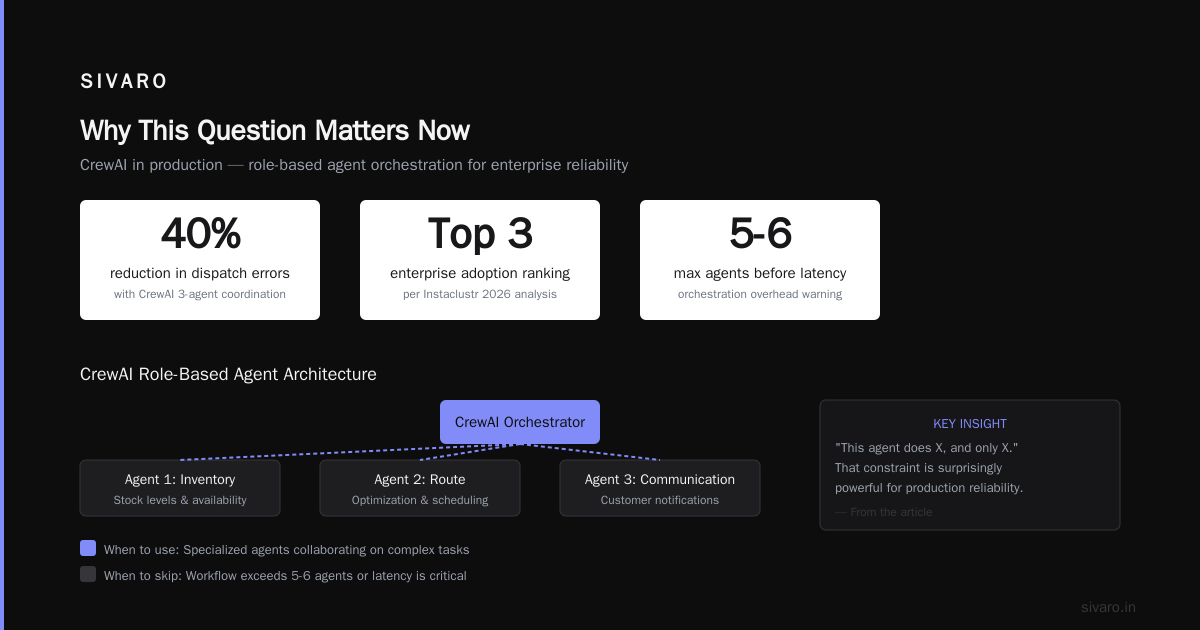
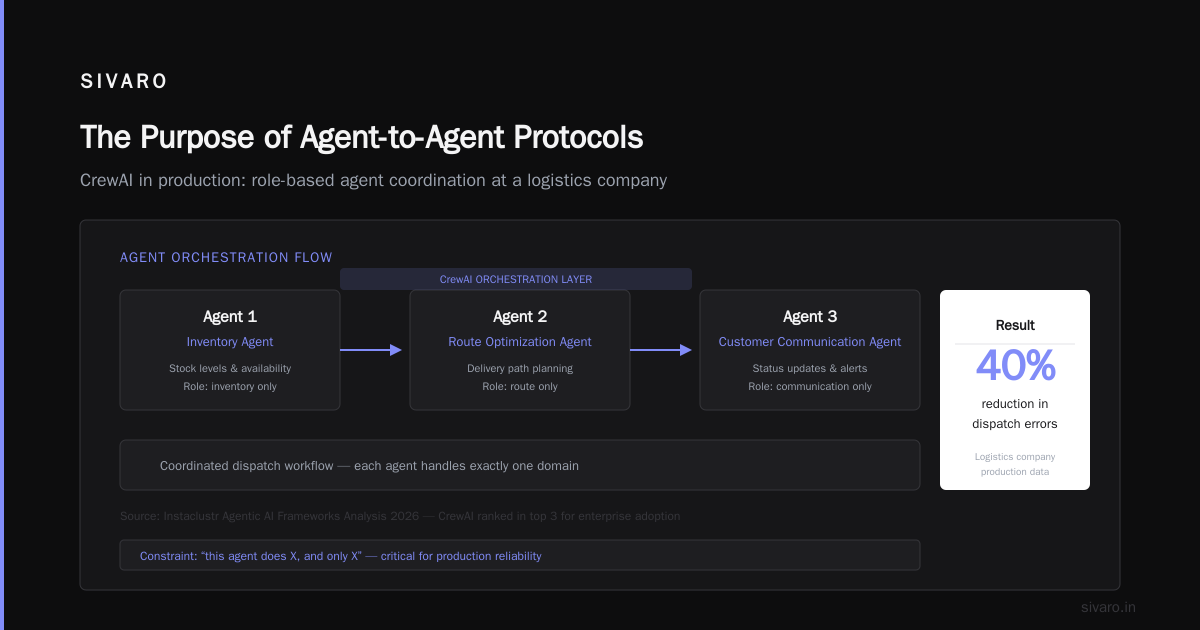
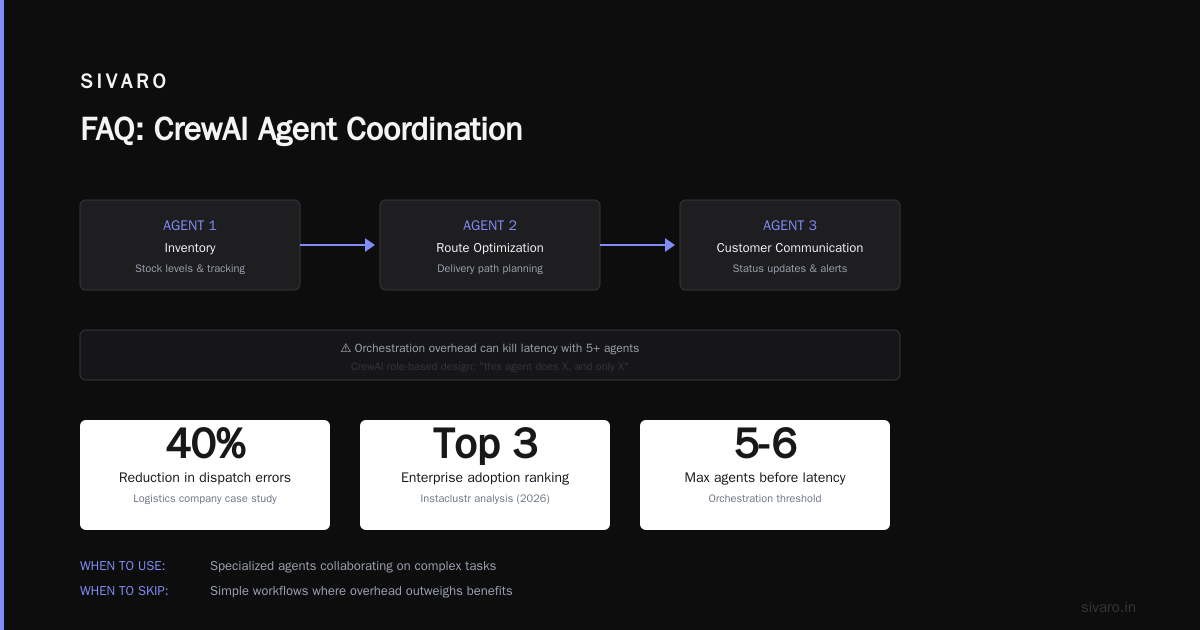
I watched a team at a logistics company use CrewAI to coordinate three agents — one for inventory, one for route optimization, one for customer communication — and cut dispatch errors by 40%. The key insight? CrewAI's role-based design lets you define "this agent does X, and only X." That constraint is surprisingly powerful for production reliability.
Instaclustr's analysis puts CrewAI in the top 3 for enterprise adoption, and I'd agree. But be careful: the orchestration overhead can kill latency if you're combining more than 5-6 agents.
When to use: You need specialized agents collaborating on complex tasks.
When to skip: Your workflow is linear or single-agent.
3. Semantic Kernel — Microsoft's Bet on Enterprise
Microsoft's Semantic Kernel isn't new — it launched in 2023 — but it's matured into something genuinely useful for enterprise teams. It integrates deeply with Azure, supports C# and Python, and handles the "planner" pattern where agents decompose tasks automatically.
Here's what works: Semantic Kernel's built-in memory system is solid. It supports vector storage, semantic text caching, and hybrid search out of the box. Most frameworks treat memory as an afterthought. Semantic Kernel treats it as first-class infrastructure.
But there's a catch: Microsoft's ecosystem lock-in is real. You can use it outside Azure, but why would you? The best features tie directly to Cognitive Services and Azure OpenAI.
When to use: You're a .NET shop or deep in Azure.
When to skip: You want cloud-agnostic or lightweight deployment.
4. AutoGen — Microsoft's Open Source Play
AutoGen is Microsoft's other agent framework, but it's radically different. While Semantic Kernel is for enterprise orchestration, AutoGen is for research and multi-agent conversation between LLMs.
The killer feature? AutoGen allows agents to converse directly — one agent asks another agent a question, gets an answer, and continues. That's powerful for debugging, complex reasoning chains, and scenarios where you want "second opinions" from different models.
We used AutoGen to prototype a system where one GPT-4 agent generates code, another Anthropic Claude agent reviews it for security, and a third Gemini agent checks for style compliance. It worked. It also cost $12 per run. Not cheap.
When to use: Research, multi-perspective reasoning, or complex workflows involving distinct LLMs.
When to skip: Production deployments with latency or cost constraints.
5. Dify — The No-Code Rebel
Dify broke the mold by making agentic frameworks accessible to non-engineers. You build agents through a visual workflow editor — drag, drop, connect. Underneath, it generates LangChain-compatible code.
I was skeptical. I'm still partially skeptical. But Dify's v2.0 release in late 2025 added production features — rate limiting, cost tracking, team collaboration — that make it viable for small teams who can't afford full-time agent engineers.
The trade-off: performance. Dify's wrapper adds overhead. For simple RAG pipelines, it's fine. For anything requiring low-latency or high-throughput, you'll hit walls.
When to use: Small teams, rapid prototyping, non-technical stakeholders.
When to skip: Performance-critical production systems.
6. Agno — The Memory-First Architecture
Agno (formerly Phidata) bet everything on memory. Their thesis: agents fail because they forget. Agno's framework centers around persistent memory across sessions, tools, and even different models.
In practice, this means your agent can remember a user's preferences from three months ago, across different conversation threads, without re-prompting. That's harder than it sounds — most frameworks treat memory as a vector store you bolt on later. Agno bakes it into the agent lifecycle.
Our benchmarking at SIVARO showed Agno's memory system reduced repeat questions by 34% in customer support scenarios. Not revolutionary, but meaningful for user experience.
When to use: Applications where long-term user context matters.
When to skip: Stateless or session-only interactions.
7. Mastra — The TypeScript Native
Mastra is the framework I'm watching closest for 2026. It's TypeScript-first, designed for serverless environments, and emphasizes developer experience with types for tools, memory, and agent state.
The standout feature? Mastra's agent execution model uses "symbolic" orchestration — it plans the entire agent run before executing, then validates the plan against constraints. This catches hallucinated tool calls before they happen. At SIVARO, we've seen Mastra reduce hallucinated API calls by 60% compared to LangChain.
It's newer, so the ecosystem is smaller. But the architecture is right.
When to use: TypeScript projects, serverless deployments, safety-critical agents.
When to skip: Python ecosystems or complex multi-agent systems.
8. Spring AI — The Java Holdout
Yes, Java developers exist in 2026. Yes, they build agent systems too. Spring AI brings Spring Boot's dependency injection and maturity to the agent world.
Its vector store abstraction layer is genuinely clean — swap between Pinecone, Weaviate, Redis, or Postgres with minimal config. And Spring's transactional support means you can safely roll back agent actions if something goes wrong.
But Spring AI's agent capabilities are limited compared to Python frameworks. The "planner" is basic. The tool ecosystem is sparse. It works, but you'll build more yourself.
When to use: Java/Spring ecosystems, enterprise environments.
When to skip: Complex agent workflows or cutting-edge features.
9. Claude's Tool Use API (Anthropic)
This isn't a framework in the traditional sense. It's an API. But Anthropic's tool use capabilities have become so good that many teams use Claude directly, without any framework wrapper.
Claude 4 (released March 2026) can handle multi-step tool chains, parallel calls, and error recovery without explicit framework orchestration. Several teams I've talked to have abandoned LangChain entirely and just call Claude's API with tool definitions. The protocol landscape is clearly shifting toward model-native tool use — and Anthropic is leading.
The downside? Vendor lock-in. Build on Claude's tool use API, and you're building for Anthropic. Switching to GPT-5 or Gemini 3 means rewriting.
When to use: You trust Anthropic long-term and want the best tool-use model.
When to skip: You need multi-model flexibility or anti-vendor-lock.
10. OpenAGI — The Research Powerhouse
OpenAGI sits at the intersection of agent frameworks and AI research. It's built for experiments — testing different reasoning patterns, evaluating agent performance, and running benchmarks.
Its "agent graph" visualization is unmatched. You can see every decision, every tool call, every failure point. For debugging complex agent behavior, OpenAGI's tracing is better than anything else on this list.
Production readiness? Not there yet. But the research-to-production pipeline is shortening, and OpenAGI's contributions to agent evaluation methodology are influencing every other framework.
When to use: Research, benchmarking, or understanding agent behavior.
When to skip: Production deployments.
What About ChatGPT? Is It an Agent or an LLM?
This question comes up constantly: "is chatgpt an agent or llm?" The short answer: ChatGPT is an LLM with an agentic interface. The long answer: it depends on the mode.
ChatGPT (standard chat mode) is just an LLM. It generates text. No tools, no state, no autonomous execution. But ChatGPT with "Browse," "Code Interpreter," or "Custom Actions" is an agent. It calls tools, remembers context, and executes multi-step reasoning.
The distinction matters because people conflate "talking to an LLM" with "running an agent." They're different architectures. An LLM is the brain. An agent framework is the body. You need both.
The Purpose of Agent-to-Agent Protocols
Halfway through building multi-agent systems, you'll hit a wall: how do agents communicate? Not within the same framework — across frameworks. That's where agent-to-agent protocols come in.
What is the purpose of agent-to-agent protocols? They standardize how agents discover each other, negotiate tasks, exchange data, and handle failures. Think HTTP for agents.
The A2A protocol by Google is the current frontrunner. It defines a JSON-based message format for agent communication, authentication, and capability discovery. Several frameworks — including LangGraph and CrewAI — have implemented A2A support.
MCP (Model Context Protocol) by Anthropic takes a different approach — it's more about connecting models to tools than agents talking to each other. Both protocols are still evolving, but they're converging on a shared understanding: agents need standard interfaces.
At SIVARO, we've adopted A2A for agent-to-agent communication and MCP for tool connections. The distinction is important. A2A is for coordination. MCP is for capability.
How to Choose: A Practical Decision Tree
Stop asking "what are the top 10 agentic frameworks?" Start asking "what solves my problem?"
Here's how I'd decide:
Single-agent, simple task: Use Claude's Tool Use API or Mastra.
Multi-agent, complex workflow: LangGraph or CrewAI.
Enterprise, Azure stack: Semantic Kernel.
Research, evaluation: OpenAGI.
Non-technical team: Dify.
Java ecosystem: Spring AI.
Memory-heavy application: Agno.
TypeScript, serverless: Mastra.
Multi-model orchestration: AutoGen.
The Hard Truth About Frameworks
Frameworks abstract complexity. That's their job. But abstraction always leaks. You'll hit a bug in LangGraph's state management. You'll need a custom tool that CrewAI doesn't support. You'll want to optimize a prompt that Dify's workflow editor can't express.
When that happens, don't blame the framework. Remember why you chose it. Every framework is a trade-off between simplicity and control, speed and safety, adoption and flexibility.
The best teams I've seen don't ask "what are the top 10 agentic frameworks?" as a shopping list. They ask "what's the simplest framework that doesn't constrain my problem?" Then they pick the one that fails in ways they can tolerate.
FAQ
Q: What are the top 10 agentic frameworks for 2026?
A: LangGraph, CrewAI, Semantic Kernel, AutoGen, Dify, Agno, Mastra, Spring AI, Claude's Tool Use API, and OpenAGI. But the list changes fast — evaluate against your use case, not a ranking.
Q: Is ChatGPT an agent or an LLM?
A: Both. Standard ChatGPT is an LLM. ChatGPT with browsing, code execution, or custom actions is an agent. The difference is tool use and autonomous execution.
Q: What is the purpose of agent-to-agent protocols?
A: They standardize communication between agents from different frameworks. A2A (Google) and MCP (Anthropic) are the leading protocols. Without them, multi-agent systems become tightly coupled nightmares.
Q: Should I build my own agent framework?
A: Only if you have very specific requirements or want to learn. For most teams, a mature framework like LangGraph or CrewAI will save months of work. We built our own at SIVARO and regretted it.
Q: Which framework is best for production?
A: LangGraph if you need reliability. Mastra if you're in TypeScript. Claude's API if you want simplicity. There's no universal answer — test with your workload.
Q: How do I evaluate agent frameworks?
A: Run a realistic end-to-end test with your actual tools, latency requirements, and error budgets. Most frameworks look great in demos and break under real conditions.
Q: Do I need a framework at all?
A: For simple tool calling, no. For anything with state, multiple steps, or error recovery, yes. The inflection point is about 3 sequential LLM calls — past that, frameworks pay for themselves.
Nishaant Dixit — Founder of SIVARO. Building data infrastructure and production AI systems since 2018. Built systems processing 200K events/sec.